Launching a two-sided marketplace is one of the hardest software ideas to get off the ground, and most founders who try it cannot write the code themselves. You need a development partner who has shipped marketplaces before, understands payments and trust between strangers, and can deliver something lean enough to test before you spend your whole budget.
This guide is built for non-technical founders and solo entrepreneurs. It covers what a marketplace build actually costs in 2026, how early marketplaces earn revenue, and which seven companies are worth shortlisting. Each firm was checked against real client reviews and marketplace work, so you can compare them on the things that matter to a first launch.
What Does a Marketplace Development Company Do for a Non-Technical Founder?
A marketplace development company builds the platform that connects two groups of users, your buyers and your sellers, and handles the money and trust between them. For a founder without an engineering background, the firm becomes your entire technical team until you hire in-house.
What the team builds
The vendor owns the technical side of the platform end to end. A typical build covers:
- Vendor and buyer onboarding flows
- Listings, categories, and search
- Payments, escrow, and payout handling
- Admin dashboards and moderation tools
What stays in your hands
You keep the parts no agency can do for you. That means the business strategy, recruiting the first sellers, setting pricing, and driving early growth. The right partner advises on these, but the decisions stay yours.
How We Selected These Marketplace Development Companies
Every company here earned its spot the same way: through public review data and a record of shipped marketplaces, not marketing claims. The goal was a shortlist you can trust without spending weeks on vetting.
Where the shortlist came from
The search started on Clutch, GoodFirms, and DesignRush, the three directories where marketplace clients leave verified reviews. From dozens of candidates, the pool narrowed to firms with live two-sided platforms in their portfolios.
A specialist marketplace app development company should show real escrow, vendor onboarding, and search work in its case studies, so portfolios without that depth were set aside.
What earned a place on the list
Four practical filters decided the final seven. A firm had to clear all of them, not just rank well on one directory:
- Shipped marketplaces, not just generic mobile or web apps
- Startup-friendly pricing, with rates a first-time founder can fund
- Verified client reviews on at least one major directory
- A clear post-launch support and maintenance offer
Best Marketplace Development Companies for Startups and Entrepreneurs (2026)
These seven firms all have a real record of building marketplaces for founders, and they span a wide range of budgets. The profiles below give the data you need to compare them, followed by who each one fits best.
The table below sets the seven firms side by side by location and core focus, so you can scan the options before reading the profiles.
Company | Offices | Services | Industry expertise |
|---|---|---|---|
Codica | Mykolaiv, Ukraine | Marketplace development, MVP, web apps, UI/UX | eCommerce, automotive, travel, recruitment, insurance |
Cleveroad | Claymont, Delaware (US) | Marketplace development, custom software, mobile, MVP | FinTech, healthcare, logistics, retail, education |
Sloboda Studio | Tallinn, Estonia | Marketplace development, SaaS, Ruby on Rails, MVP | Real estate, recruitment/HR, rental and booking |
Syndicode | Lisbon, Portugal | Marketplace development, SaaS, enterprise software, RoR | eCommerce, real estate, logistics, healthcare |
Roobykon Software | Tallinn, Estonia | Marketplace development, Sharetribe, RoR, MVP | Service marketplaces, rentals, P2P |
Ardas | Dnipro, Ukraine; Irvine, CA (US) | SaaS and marketplace dev, subscription billing, custom software | SaaS, FinTech, martech, logistics |
Greenice | Kyiv, Ukraine | Marketplace development, custom web, eCommerce | eCommerce, healthcare, education |
Methodology: review counts and ratings reflect verified Clutch profiles at the time of writing; confirm current figures before you reach out.
Codica
Codica focuses almost entirely on marketplaces and MVPs, and the team built the domain marketplace Dan.com that GoDaddy later acquired for $71 million. It fits early founders who want a launch-ready platform on a lean budget.
Founded: 2015. Rate: $25–$49/hr. Reviews: 17 on Clutch (5.0).
Cleveroad
Cleveroad brings 15+ years of custom software work across regulated sectors such as FinTech, healthcare, and logistics, backed by ISO 9001 and ISO/IEC 27001 certification. It suits startups that expect to scale a marketplace into a regulated or multi-sided platform and want one partner from discovery through launch.
Founded: 2011. Rate: $50–$99/hr. Reviews: 75+ on Clutch (4.9).
Sloboda Studio
Sloboda Studio has delivered more than 40 marketplaces on Ruby on Rails since 2010, with a strong lean toward rental and booking models. Founders who value predictable timelines and steady post-launch support tend to fit well here.
Founded: 2010. Rate: $25–$49/hr. Reviews: 52 on Clutch (4.9).
Syndicode
Syndicode builds lean MVPs designed to grow into full platforms without a rebuild, working mostly in Ruby on Rails from its Lisbon base. It is a strong match for founders who want a clear path from a first version to a scaled product.
Founded: 2014. Rate: $50–$99/hr. Reviews: 21 on Clutch (4.8).
Roobykon Software
Roobykon Software is a marketplace specialist that builds Airbnb and Upwork-style platforms, including Sharetribe-based work, and holds a Clutch Global award. Budget-conscious founders who want a focused team rather than a generalist agency get good value here.
Founded: 2011. Rate: $25–$49/hr. Reviews: 12 on Clutch (4.9).
Ardas
Ardas has 20+ years of experience and deep strength in subscription billing and high-load SaaS systems. It fits founders planning a subscription-based marketplace that needs reliable recurring payments from day one.
Founded: 2005. Rate: $50–$99/hr. Reviews: 21 on Clutch (4.9).
Greenice
Greenice has shipped 200+ custom web and marketplace builds at flexible budgets, with heavy eCommerce experience. It works for founders who want competitively priced custom development without enterprise rates.
Founded: 2007. Rate: $25–$49/hr. Reviews: 11 on Clutch (4.6).
How Much Does It Cost to Hire a Marketplace Development Company?
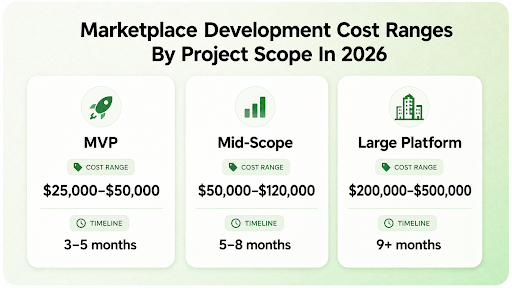
Expect roughly $25,000 to $50,000 for a Minimum Viable Product (MVP), $50,000 to $120,000 for a feature-rich build, and $200,000 to $500,000 for a large multi-category platform. Where you land depends on scope, integrations, and how custom the design is.
The table below breaks cost into three scope-based bands and shows what each budget typically buys.
Project scope | Cost range | What the budget buys | Timeline |
|---|---|---|---|
MVP | $25,000–$50,000 | Listings, registration, payments, search, basic admin | 3–5 months |
Mid-scope | $50,000–$120,000 | Adds analytics, real-time tracking, advanced filters, integrations | 5–8 months |
Large platform | $200,000–$500,000 | Multi-category, high traffic, fully custom design and logic | 9+ months |
Methodology: ranges compiled from 2026 marketplace build-cost guides published by Codica, Cleveroad, and Appscrip.
MVP build for validating an idea
An MVP at $25,000 to $50,000 covers the core flows a marketplace needs to function and nothing more. This is the right spend for testing whether real buyers and sellers will show up before you commit to a full platform.
Mid-scope and large platforms
Once you add analytics dashboards, real-time tracking, and third-party integrations, budgets move into the $50,000 to $120,000 range. Large multi-category platforms built for high traffic and heavy customization can reach $200,000 to $500,000.
Ongoing cost after launch
Plan for 15% to 20% of the build cost every year for maintenance, scaling, and new features. This is the line most first-time founders forget, and skipping it stalls the product right when early traction needs support.
The chart below shows how the three budget bands compare and what separates them.
Conclusion
Building a marketplace is less about finding the cheapest developer and more about matching a proven team to your stage and budget. Start with an MVP to validate demand, decide how you will earn revenue before a line of code is written, then shortlist two or three firms from the table that fit your industry and price range.
Every company here has shipped real marketplaces, so any of them is a credible starting point for a first conversation.
FAQ
How much does it cost to build a marketplace for a startup in 2026?
A Minimum Viable Product (MVP) runs $25,000 to $50,000. A feature-rich build lands between $50,000 and $120,000, while large multi-category platforms reach $200,000 to $500,000.
How long does it take to launch a marketplace MVP?
Most MVP marketplaces take three to five months with a small five-person team of a project manager, a designer, engineers, and a QA specialist.
Should I use a no-code builder or hire a development company?
It depends on how custom your idea is.
- No-code tools like Sharetribe or Bubble fit standard models and cost roughly $30,000 to $80,000
- A development company is worth it when you need unique flows, heavy scale, or custom integrations
What's the best way for a new marketplace to make money?
Start with a transaction commission of 10% to 25%. Sellers commit nothing upfront, and your income scales with volume, which makes it the safest first model before you test subscriptions or paid placements.
How do I vet a marketplace development company before hiring?
Run three quick checks:
- Look for live marketplaces, not just apps, in their portfolio
- Read verified client reviews on Clutch or GoodFirms
- Confirm the post-launch support and maintenance terms in writing

- The Niche E-Commerce Playbook: How Specialist Brands Build an Audience Online - September 25, 2026
- Kindle Publishing Income Review: Is Sophie Howard Legit? - September 23, 2026
- 7 Figure Accelerator Review: Is Philip Johansen Legit? - September 21, 2026