Every business sits on more data than it uses. The question is whether you can turn those data into decisions you trust. Data analytics services exist to bridge the gap taking the scattered, messy information your company already collects and making it useful, reliable and pointed at the choices that actually matter.
This guide explains what those services include, how the pieces connect and how to think about the journey if you're leading it without a technical background.
What Data Analytics Services Actually Cover
The phrase is broad and that breadth causes confusion. It's not one thing – it's a chain of connected disciplines, each building on the one before it. A complete offering spans the whole chain:
Data strategy and assessment. Before anything gets built, a good partner audits what data you have, where it lives and how reliable it is. This step decides whether everything after it works and it's the one impatient projects skip.
Data integration. Connecting your separate systems like CRM, billing, support, operations, so data flows into one place instead of living in silos that don't agree with each other.
Data quality and management. Cleaning, deduplicating and standardizing so the numbers downstream are trustworthy. Clean inputs are the entire game – and they're rarer than most leaders assume. Harvard Business Review found that only 3% of companies' data meets basic quality standards, which is exactly why this unglamorous layer makes or breaks everything above it.
Storage and architecture. Choosing where unified data lives and structuring it to scale, using platforms like Snowflake, BigQuery or Databricks.
Reporting and business intelligence. The visible layer, including dashboards and reports, people use daily to see what's happening.
Predictive analytics and AI. Forecasting and modeling for the decisions where knowing what's likely next is worth the investment.
Governance and security. Controlling who sees what and staying compliant, woven through everything rather than added at the end.
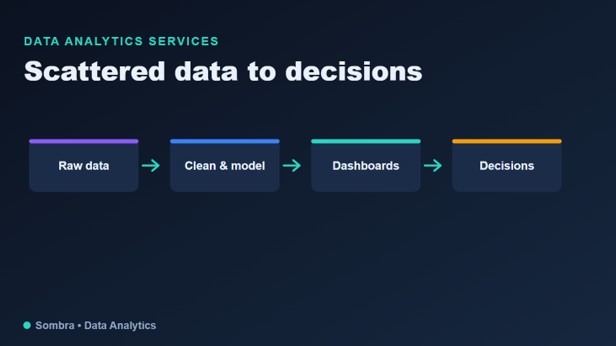
The order matters. Each layer depends on the ones beneath it. Reporting on messy, disconnected data produces numbers nobody believes. Forecasting on a weak foundation produces confident nonsense. This is why working with an end-to-end data analytics services partner, who owns the whole chain, tends to produce results that actually hold up.
The Most Common Mistake: Starting at the Top
Here's the pattern that sinks more analytics projects than any other. A leader wants dashboards or wants AI and the project jumps straight to the visible, exciting layer. The demo looks great. Then reality arrives: the data feeding it is messy, the systems don't agree and the impressive dashboard shows numbers people quietly distrust.
This is the dominant failure mode. Gartner predicts that through 2026, organizations will abandon 60% of AI projects unsupported by AI-ready data, almost always because the foundation underneath was never solid.
The fix is unglamorous but reliable. Build from the bottom up. Get data integrated and clean first. Establish trustworthy reporting. Then extend into prediction and AI where the payoff justifies it. The boring foundation work isn't a detour on the way to insights – it's what makes the insights real.
A good partner will push you toward this order even when the advanced work is what you came for, because they know the alternative is an expensive project that doesn't stick.
When to Invest in Data Analytics Services
Not every company needs outside analytics services. A few signs that you've reached the point where they pay off:
Reports take days and still spark arguments. When pulling a routine number requires manual stitching and two teams still disagree on the result, your data can't keep up with your decisions.
You're making big calls on gut feel. Not because intuition is wrong, but because the data to inform those calls exists and you can't get at it.
Growth is multiplying your systems. New tools, regions or an acquisition turn a manageable data situation into a tangle.
Compliance is getting real. When regulators or enterprise customers start asking how you handle data, ad-hoc processes stop being acceptable.
If several of these resonate, the cost of staying as you are has probably overtaken the cost of fixing it.
Build Internally or Partner?
You have three broad options and most companies land on a mix. A full in-house data team gives you control but is slow and costly to hire and the workload is uneven – heavy during the build, lighter once things run. Off-the-shelf tools handle narrow problems but rarely cover the whole chain. Partnering gives you experienced people who've built this before, with the flexibility to hand operations to your team later.
The smart move for many mid-sized companies is partnering for the build, where experience prevents expensive mistakes, then deciding case by case what to bring in-house. The right engagement model – project-based, managed delivery, staff augmentation or consulting – depends on your team's capacity and how much you want to own over time. A partner worth hiring offers more than one model rather than forcing you into theirs.
What Good Analytics Services Feel Like
When this is done right, you stop thinking about it. A few markers of success:
The numbers are simply correct. No double-checking, no shadow spreadsheets. People trust the reports and act on them.
Decisions get faster. Questions that used to take days get answered in minutes.
Debates shrink. Teams stop arguing about whose figures are right and start discussing what to do.
The foundation holds as you grow. New data sources connect without crisis, because the architecture was built to scale.
That quiet reliability is the real deliverable. Dashboards and models are visible, but the value is in trustworthy data that your business runs on without friction.
The Technologies Behind Modern Analytics (and why they shouldn't lead)
You'll hear a lot of platform names in this space – Snowflake, BigQuery and Databricks for storage; dbt for transformation; Airflow and Dagster for orchestration; Power BI and Tableau for reporting; Fivetran and Talend for moving data between systems. The list is genuinely useful and a capable partner will know these tools well.
But the tools are not the point and a provider who leads with them is working backward. The right question is never "should we use Snowflake or BigQuery?" It's "what decisions are we trying to make faster and what does the data behind them need to look like?" The technology follows from that answer. Two businesses with similar-looking data can land on very different stacks because their decisions, scale and team skills differ.
This matters when you're evaluating partners. The ones worth hiring ask about your business before they mention a platform. The ones to be cautious of arrive with a preferred toolset and try to fit your problem to it. Good analytics is business-first, not tool-first – the platform is an implementation detail, not the strategy.
How Analytics Maturity Actually Progresses
It helps to picture the journey as stages, because knowing where you are tells you what to work on next:
Stage one – descriptive. You can reliably answer "what happened?" Clean, integrated data feeds trustworthy reports. Most companies underestimate how much value lives here; simply having numbers everyone trusts eliminates a surprising amount of wasted debate.
Stage two – diagnostic. You can answer "why did it happen?" Analysts can dig into the drivers behind a trend because the data is connected enough to explore freely.
Stage three – predictive. You can answer "what's likely to happen next?" Forecasting and modeling layer on top of a solid foundation for the specific decisions that justify them.
Stage four – prescriptive. The system recommends what to do, not just what's coming – optimizing pricing, routing or inventory within your constraints.
The mistake is trying to skip stages. Predictive and prescriptive work fail without the descriptive foundation beneath them, no matter how advanced the algorithms. A sensible roadmap walks up these stages in order, investing in each only once the one below it is solid and trusted. Rushing ahead is the single most reliable way to end up with impressive technology that nobody trusts enough to use.
Measuring the Return on Data Analytics Services
The hardest question leaders ask about this work is also the fairest: how do I know it's paying off? Analytics doesn't produce a single tidy number the way a sales campaign does, but its value is real and measurable if you know where to look.
Watch a few categories of return:
Time recovered. Count the hours your team spends each cycle manually pulling, stitching and reconciling data. When integrated reporting replaces that, those hours go back into actual work. It's the easiest gain to quantify and usually larger than people expect.
Faster, better decisions. Harder to put a figure on, but more valuable. When a question that took three days now takes three minutes, decisions stop waiting on data. Track how decision cycles shorten and how often choices get made on evidence rather than guesswork.
Mistakes avoided. Clean, trustworthy data prevents the expensive errors that come from acting on a wrong number – overordering inventory, misjudging a customer segment, missing a compliance requirement. These don't show up as wins, but they're real savings.
Decisions you couldn't make before. The biggest return often comes from questions you simply couldn't answer previously. Predicting demand, spotting churn early, identifying your most valuable customers – capabilities that didn't exist before the foundation was built.
A practical approach is to pick one or two high-value decisions, measure how they're made today and compare after the analytics work lands. That focused before-and-after is far more convincing than a vague promise of "better insights," and it gives you a real basis for deciding where to invest next. The return compounds, too – each layer of foundation makes the next capability cheaper to add, so the value tends to accelerate rather than plateau.
Where to Start
If you're early in this, don't begin by shopping for tools. Begin with an honest assessment of where you are: what data you have, how reliable it is and which decisions better data would most improve. That assessment points to the right first project – usually integrating and cleaning your core data, then building reporting on top of it.
Analytics maturity is a journey, not a purchase. The companies that get value are the ones that build deliberately, foundation first and resist the pull toward the flashy layer before the unglamorous one is solid. Do that and data analytics stops being a buzzword and becomes what it should be: the quiet engine behind better decisions across your business.
One last reassurance for leaders feeling behind: you don't have to do it all at once and you don't have to do it perfectly. The point isn't to reach some final state of analytics maturity. It's to make your next set of decisions a little more grounded in evidence than your last.
Start with the one decision that matters most, build the foundation that decision needs and let the value you prove there fund the next step. Handled that way, data analytics is less an intimidating overhaul than a series of practical improvements, each paying for the one after it.

- The Niche E-Commerce Playbook: How Specialist Brands Build an Audience Online - September 25, 2026
- Kindle Publishing Income Review: Is Sophie Howard Legit? - September 23, 2026
- 7 Figure Accelerator Review: Is Philip Johansen Legit? - September 21, 2026