Your product is selling. Orders are coming in faster than expected. The ads are working, customers are talking about you, and then someone asks a painful question: can we actually make enough of this in time?
That is where growth can get messy. If you're selling a physical product, scaling is not always so simple. You need enough parts, factory time, packaging, storage, and shipping to keep up.
Your BOM (Bill of Materials) needs to be on track. You have to know exactly what parts you need to make your product, and which suppliers have them. If you're having trouble with this step, consider finding quality BOM management services.
Find the Bottleneck Before It Finds You
When sales are low, you can get away with a surprising amount of chaos. You know your main supplier, you know roughly how many units you need, and if something goes wrong, you can fix it yourself.
Then sales jump.
One supplier isn't working at the moment. The other one stopped making that part months ago. Your orders are late, and customers are frustrated. Your reputation is taking a hit.
This is why it's important to map the full production process before you need to scale it. Write down every part, supplier, lead time, minimum order quantity, and production step. Look for single points of failure.
If only one supplier can provide a key component, you have a bottleneck just waiting to happen.
Have a Backup Supplier for Critical Parts
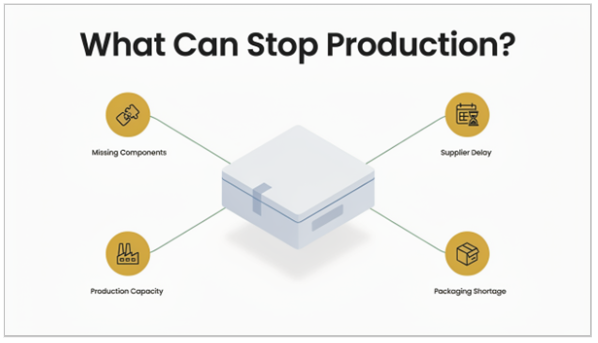
You do not need two suppliers for every box or screw. You do need a backup for anything that can stop production.
Start with your most important components, and find backup suppliers you can work with. The point is knowing who you can call when your main supplier cannot keep up.
The risk is real. A June 2025 Dallas Fed survey found that 32% of manufacturing respondents were experiencing supply-chain disruptions or delays.
Do Not Scale Every SKU at Once
One mistake a lot of businesses make is pushing their whole catalog at the same time.
Find the products that have steady demand and healthy margins. Make those your core products. Keep slower products on a smaller production schedule until they prove they deserve more capacity.
Every new color, size, or packaging option creates more parts to track. Ten variations can quietly turn into dozens of component combinations.
You do not have to kill variety. Just make sure each variation earns its place.
Create a Stock Buffer Before the Sales Spike
Waiting for a post to go viral before placing a larger factory order is a great way to miss sales.
Use your sales history to estimate how long it takes to reorder and receive your best sellers. Then set a minimum stock level that gives you room to react.
A simple starting point is:
Average weekly sales × replenishment time + safety stock = reorder point
For example, if you sell 300 units a week and replenishment takes five weeks, you need about 1,500 units just to cover normal demand during that period. Safety stock sits on top of that.
Make Your Factory Part of the Sales Plan
Your manufacturer should not hear about a major promotion after you launch it.
Share forecasts early. Tell them when you expect a seasonal spike, campaign, or retailer order. Ask what their real weekly output is at normal capacity.
You also want clear answers to four questions:
- How many units can you make per week?
- What is the current lead time?
- Which components are hardest to source?
- What happens if demand suddenly doubles?
Review production in batches, too. If the factory has to stop and change equipment between every small run, you lose a lot of time. Grouping similar orders can reduce changeovers and make production easier to schedule.
Do Not Forget About Packaging and Fulfillment
Brands often focus on the product and forget about what happens after manufacturing.
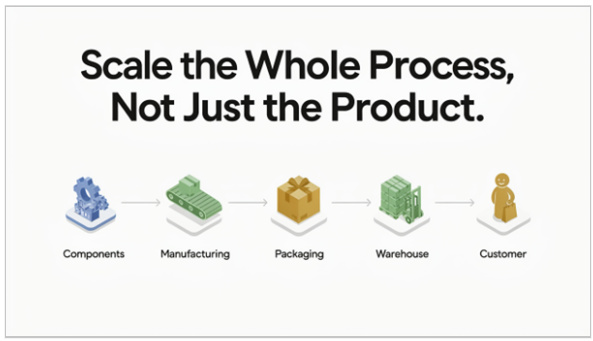
You can have thousands of finished units in a warehouse and still fall behind because boxes, inserts, labels, or packing labor are short.
Treat packaging as part of production. Forecast cartons and printed materials just like you forecast product components. Keep backup vendors for items with long lead times, and standardize box sizes where possible.
Plan for the Next Jump
The best time to fix a bottleneck is before it becomes one.
If you sell 5,000 units a month today, ask what breaks at 10,000. Then ask what breaks at 20,000.
Maybe your factory needs another shift. Maybe your warehouse cannot hold the extra stock.
Find those weak spots early, then fix them one by one.
Scale Without the Panic
A physical product brand gets easier to grow when you stop treating manufacturing as something that happens in the background.
Your product, components, factory, packaging, inventory, and fulfillment all affect the customer experience. A great ad can create demand in a day. A factory may need weeks to catch up.
That gap is where bottlenecks happen.
Keep your product range under control. Know your lead times. Build backup suppliers for critical parts, and keep a sensible stock buffer.
Talk to your factory before demand spikes. Track a few numbers every week.
You do not need to predict every problem. You need to make sure one small problem cannot bring the whole business to a stop.
Think of all the trouble you went through when you were just starting your business, and make sure you give it what it deserves.

- Dropship Breakthru Review: Price, Guarantees, Fine Print - October 11, 2026
- Best Outdoor Equipment Fulfillment Companies for DTC Brands - October 8, 2026
- Why Your Site Needs an Automated Price Calculator - October 7, 2026