Shipping speed wins or loses customers. For ecommerce brands selling to U.S. buyers, where your inventory sits determines how fast packages arrive, and a West Coast warehouse cuts two to four days off delivery times to a third of the country.
These are the top West Coast fulfillment companies for ecommerce brands worth evaluating in 2026.
Why West Coast Location Matters for Ecommerce Brands
Geography is an underrated variable in 3PL selection. Brands stocking inventory on the West Coast reach California, Oregon, Washington, Nevada, and Arizona with next-day or two-day ground shipping without paying air rates. That matters when those states collectively represent roughly 20% of the U.S. population.
And it's not just domestic reach. West Coast ports handle the bulk of imports from Asia, so brands sourcing overseas can receive goods directly into a nearby fulfillment center rather than trucking inventory cross-country before it ships back out. The West Coast fulfillment center for DTC brands model has become a standard first step for any DTC company with a Pacific Rim supply chain or a heavy California customer base.
1. Ops Engine
- Best for: DTC, subscription box, and kitting-heavy ecommerce brands
- Locations: Valencia, CA (Los Angeles area); East Coast expansion in Pennsylvania coming soon
- Standout: Four-part scan verification with 99.99% accuracy on receiving and outbound
- Standout: Led by CEO Arsen Janikyan, formerly VP of Operations at Buck Mason
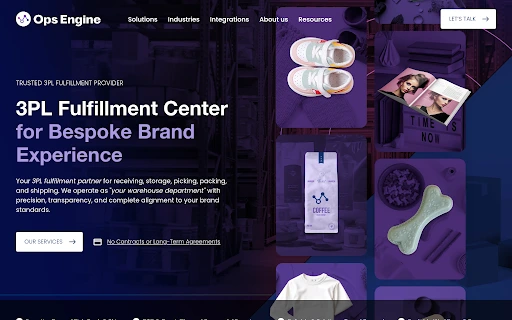
Ops Engine positions itself as "your warehouse department" rather than a transactional vendor, offering dedicated account management, billing with no miscellaneous or "general" fees, and deep hands-on experience in services like kitting and assembly. Their Valencia facility handles apparel, beauty, baby, supplements, toys, and several other categories, making it a practical choice for brands carrying varied SKU mixes.
DTC brands that need more than basic pick-and-pack will find the West Coast fulfillment center for DTC brands built around custom kitting, subscription box assembly, and category-specific storage protocols that growing product lines actually require.
2. Ship Monk
- Best for: Ecommerce brands shipping 500 or more orders monthly across DTC, B2B, and retail channels
- Locations: 12 facilities across the U.S., Canada, Mexico, and Europe
- Standout: Unified portal covering order, inventory, and warehouse management
- Standout: Clients include Saranghae (K-beauty skincare), BEARD KING, BetterBack, and Speks
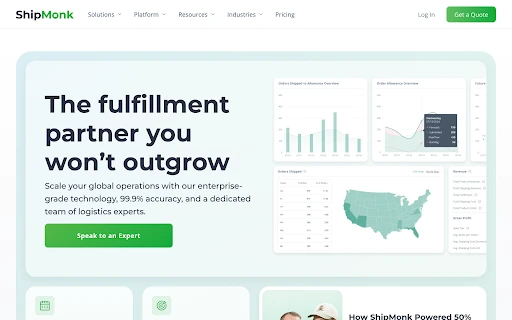
ShipMonk was founded in 2014, is headquartered in Fort Lauderdale, and employs over 2,000 team members, calling itself America's fastest-growing 3PL for DTC and retail brands. Its platform spans sales channel management, kitting, barcoding, Amazon FBA prep, and flash sale support.
For brands that need one integrated system running across multiple geographies, ShipMonk's network breadth is a genuine advantage; but brands shipping fewer than 500 monthly orders may hit a volume threshold that locks them out.
3. Ship Fusion
- Best for: Mid-market ecommerce brands needing real-time inventory visibility and accurate order fulfillment
- Locations: Chicago, York PA, Las Vegas, and Toronto (1M+ sq ft across four facilities)
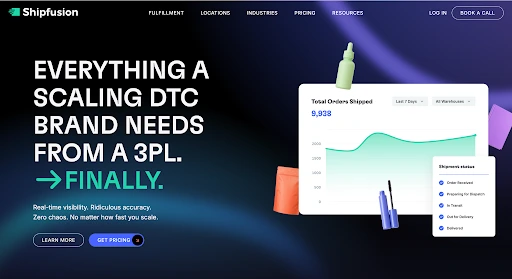
- Standout: Proprietary fulfillment software with real-time analytics and strong capabilities
- Standout: Spiral Bible grew order volume 211% while maintaining 99.9% order accuracy through Shipfusion
Founded in 2013 or 2014 (sources differ), Shipfusion handles order processing, inventory management, returns, retail and B2B fulfillment, and freight. Their U.S. facilities carry SQF certification and their Toronto warehouse is Health Canada approved.
With a team of roughly 130 employees across two continents, Shipfusion's footprint is smaller than some competitors on this list, but their proprietary software gives mid-size brands a level of customization that larger, more generic 3PLs often can't match.
4. Rakuten Super Logistics
- Best for: Ecommerce brands prioritizing coast-to-coast two-day delivery at scale
- Locations: Nationwide network of fulfillment centers (headquartered in Las Vegas)
- Standout: Two-day delivery network reaching 98% of the U.S. within one to two days
- Standout: Acquired in August 2022 by Devin Johnson; now operates under the ShipNetwork brand name
Originally launched in 2001 as Webgistix, Rakuten Super Logistics built its name around three proprietary tools - SmartFill, SmartStock, and SmartShip Optimizer - which calculate optimal shipment routing across its nationwide network.
The platform connects directly with Shopify, Amazon, Magento, Walmart Marketplace, and eBay. No public pricing exists, so brands have to reach out to sales for a quote. The company also earned an IT Award recognizing its carbon-neutral logistics approach.
5. Red Stag Fulfillment
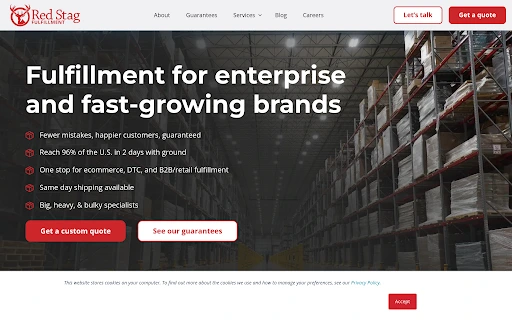
- Best for: Brands shipping heavy, bulky, or high-value items that need guaranteed accuracy
- Locations: Sweetwater, TN and Salt Lake City, UT (1.2 million sq ft combined)
- Standout: Zero-shrinkage and order-accuracy guarantees, Red Stag pays clients if they miss them
- Standout: Named one of Fit Small Business's Best 3PLs for Small Businesses six years running
Founded in 2013 and still 100% founder-owned, Red Stag handles DTC parcels, DTC pallets, retail pallets (including Walmart and Target), and a full suite of Amazon offerings including FBA prep, Seller Fulfilled Prime, and FBM. Their two warehouse locations let brands reach 96% of the U.S. in two days with ground shipping.
But the Tennessee-and-Utah setup means West Coast delivery times are longer than a California-based facility would produce for Pacific time zone customers. Red Stag is the right call for heavy-goods brands that need guarantee-backed precision over geographic proximity.
What to Look for in a West Coast Fulfillment Partner
Not every 3PL with a California or Nevada address is a strong fit for every brand. A few factors separate a functional relationship from a frustrating one.
Volume minimums are the first filter. Some providers require 500 or more monthly orders to open an account. Brands below that threshold need a 3PL willing to work at lower volumes, or should plan to hit that floor before committing.
Software and integrations matter more than most brands realize at the outset. Real-time inventory visibility, automatic order sync, and clean analytics cut the manual reconciliation work that quietly eats hours each week. Ask prospective partners which platforms they connect to natively and how long setup typically takes.
Added services like kitting, subscription box assembly, and retail prep are easy to underestimate. A brand launching a bundled SKU or a subscription product after signing a fulfillment agreement may find its 3PL isn't set up to handle that work, or charges significantly more for it. Confirm these capabilities upfront.
Guarantee structures are a good proxy for operational confidence. Providers that back accuracy and on-time shipping with a financial commitment tend to invest more in systems and training to avoid paying out. It's also worth asking how errors are communicated and resolved, since process transparency predicts partnership quality better than any marketing claim does.
Pricing transparency is what separates trustworthy providers from frustrating ones. Miscellaneous or "general" fees buried in invoices are a recurring complaint across 3PL reviews. Ask for a sample invoice from an existing client if you can; any provider that's confident in its billing won't hesitate to share one.
Bottom Line
Each of the top West Coast fulfillment companies serves a distinct brand profile. The right choice comes down to order volume, product type, service requirements, and how much weight a brand puts on software integration versus hands-on account management.
- DTC brands needing kitting, subscription box assembly, and transparent billing should look at providers with dedicated account management and hands-on category experience.
- Higher-volume operations that need wide geographic reach and a unified tech platform across multiple channels will find the multi-facility, multi-country networks a better match.
- Mid-market brands that prioritize proprietary software and order accuracy should focus on providers built around those capabilities.
- Brands where two-day nationwide delivery reach is the top priority should evaluate providers whose networks are structured around that goal.
- Heavy or bulky goods brands where guarantee-backed precision matters more than West Coast proximity have a clear set of providers built for that use case.
Match those priorities to a provider's actual strengths, not its marketing page, and the shortlist gets short fast.

- Top West Coast Fulfillment Companies for Ecommerce Brands in 2026 - October 19, 2026
- Digital Entrepreneurs Are Discovering That Physical Operational Infrastructure Accelerates Digital Scale - October 18, 2026
- Fast-growing E-commerce Sellers Are Overhauling Fulfillment Hubs To Keep Up With Orders - October 16, 2026