Punta Gorda entrepreneurs endured Hurricane Ian, supply-chain shocks, and unpredictable tourism swings. Now storefronts are reopening, visitor numbers are rising, and fresh capital is flowing back into Charlotte County.
In this rebound, the businesses that market deftly will seize the moment; the ones that wait will watch from the sidelines.
Yet many owners share the same war stories: agencies that drain budgets, recite buzzwords, and disappear when results stall. One Reddit veteran even says 80–90 percent of firms are “money-drain machines aimed at unaware business owners.”
So how do you separate real partners from hollow hype? We examined every shop with a Punta Gorda footprint, scored them on transparent criteria, interviewed clients, and surfaced the seven that consistently move the revenue needle.
If you’re ready to turn the region’s recovery into growth, keep reading, weigh the options, and book a few discovery calls—the right partner is only a ZIP code away.
Our Evaluation Methodology

We knew separating talkers from true performers required more than skimming Google stars. So we built a scoring model that shows how each agency stacks up on the factors that matter most to a Southwest Florida business.
First, we examined ten local shops. We read every case study, cross-checked review sites, and spoke with past clients whenever possible. Then we weighted seven criteria that directly influence real-world results.
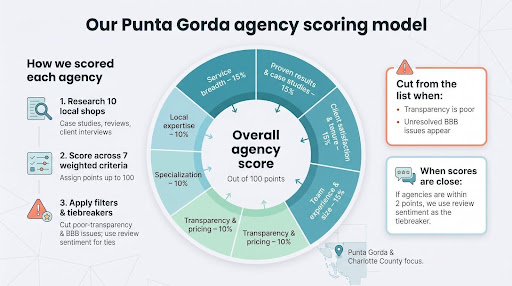
- Service breadth (15 percent): Can the agency run end-to-end campaigns or just one tactic?
- Proven results & case studies (15 percent): Do they publish hard numbers that tie marketing to revenue?
- Client satisfaction & tenure (15 percent): How high are their public ratings, and how long do clients stay?
- Local expertise (10 percent): Are they rooted in Charlotte County and involved in the community?
- Specialization (10 percent): Any niche strengths that match Punta Gorda’s tourism, healthcare, or marine sectors?
- Transparency & pricing (10 percent): Clear scope, clear fees, no cliff-edge contracts.
- Team experience & size (15 percent): Seasoned leadership plus enough hands to execute without bottlenecks.
Each shop earned a score out of 100. If two landed within two points, we used review sentiment as the tiebreaker. Agencies with poor transparency or unresolved BBB issues were cut entirely.
Why share the math? Because glossy “top ten” articles often hide the yardstick. By laying ours on the table, you can sanity-check our picks against your own priorities and weight the factors that matter most to you.
A quick-scan table follows, showing how every contender measured up.
At a Glance Agency Scorecard
Review the table below. It condenses two weeks of research into a one-minute scan. Study the service column first. If an agency does not list the channel you rely on, such as OTT ads or local SEO, cross it off now and continue with a shorter shortlist.
Next, note each Google rating and review count. High stars matter, but volume proves the score is not a fluke. Finally, follow the overall score to spot the true standouts.
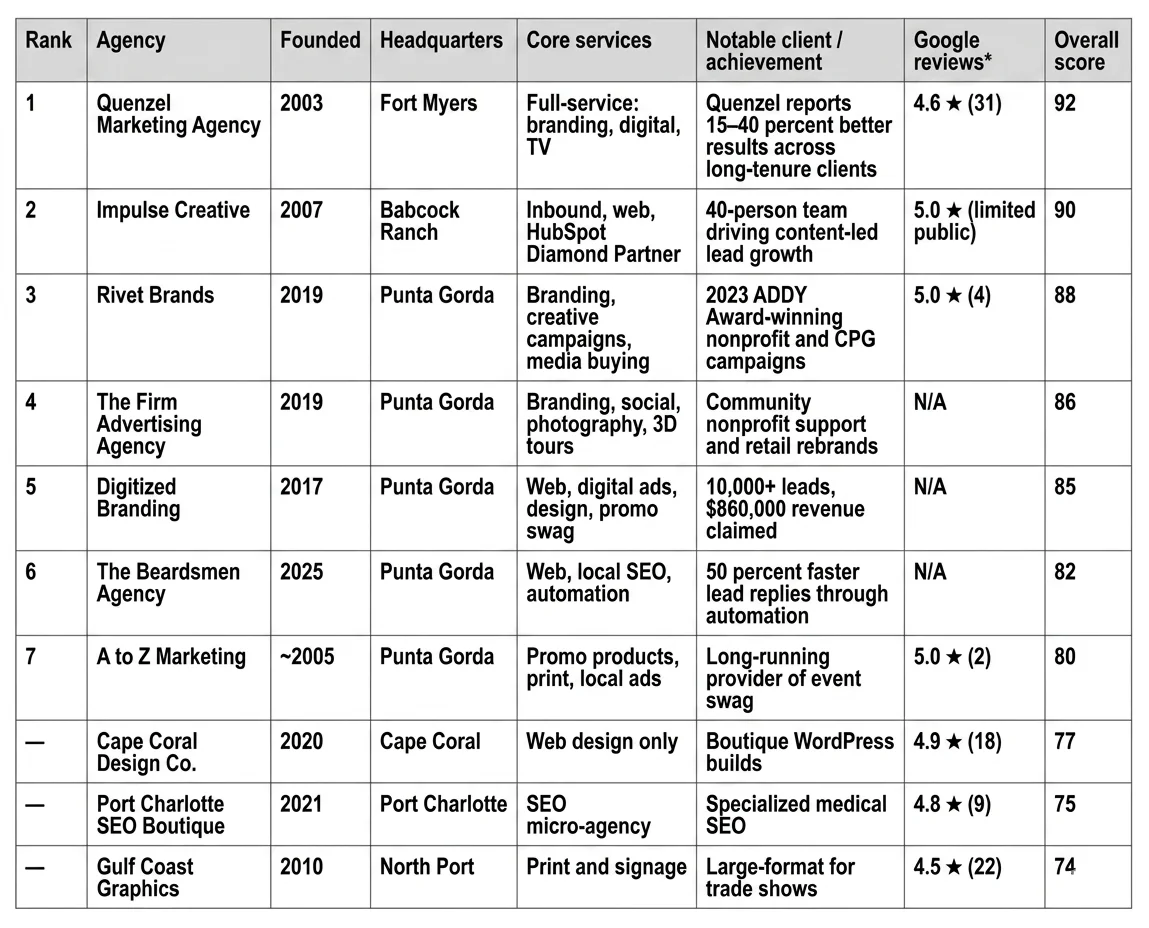
*Google ratings captured May 2026. “N/A” indicates too few public reviews to calculate a reliable average.
Keep this grid nearby as we detail each of the top seven. The narrative strengths will link directly to the numbers you see here.
1. Quenzel Marketing Agency – best for integrated marketing & ROI
Quenzel Marketing Agency is not another ad vendor.
It was founded and is still guided by Earl Quenzel, the strategist behind a three-prong methodology that reviews campaign metrics twice a month and has proven to lift client results by 15 to 40 percent without increasing spend.
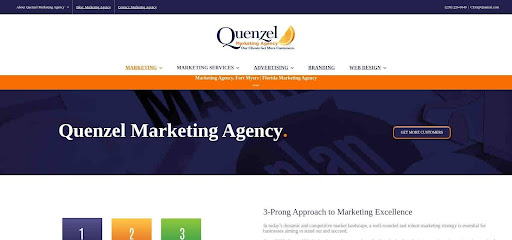
Quenzel Marketing Agency Fort Myers website homepage
Step into the Fort Myers office and you will meet a ten-person crew who plan creative, book media, write copy, optimise SEO, and analyse performance under one roof. That soup-to-nuts model means you brief once and the campaign springs to life across TV spots, Google Ads, email nurtures, and even resort-lobby brochures without the hand-offs that slow bigger shops.
Results support the promise. For a recent Southwest Florida ophthalmology client, Quenzel retooled channel mix and message sequencing, driving double-digit surgery growth while trimming ad spend. Hospitality clients report similar lifts in direct bookings after integrated pushes that blend video, search, and email follow-ups.
Clients stay. Quenzel lists an average tenure of eight years, compared with roughly two years at industry peers, and its 4.6-star Google rating from more than thirty reviews shows the honeymoon rarely fades.
Pricing sits in the middle of the market. Most engagements start near $50,000 per year, structured as monthly retainers with mid-month and end-month KPI reviews. That cadence keeps everyone focused and lets you refine creative while a campaign is still live.
Strengths include senior leadership in every meeting, one team for every channel, and dashboards that tie spend to sales rather than vanity metrics. The only caution is budget. If you have $500 a month, this model will not fit, yet for companies ready to invest and ask for proof, Quenzel feels like an in-house CMO.
Bottom line: For a partner who blends strategy, creative, and accountability in the same conversation, place Quenzel at the top of your call list.
2. Impulse Creative – best for inbound marketing & web strategy
If Quenzel is your full-funnel quarterback, Impulse Creative is the data-driven point guard who keeps leads moving until they score.
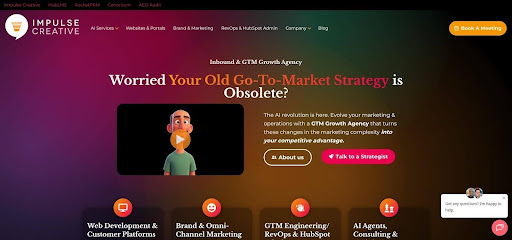
Impulse Creative HubSpot Diamond inbound agency homepage screenshot
Founded in 2007 and now based in Babcock Ranch, the agency grew alongside HubSpot and holds the platform’s Diamond badge. That status signals hundreds of certifications and a team that can connect marketing automation, sales enablement, and service hubs into one growth engine.
During a typical engagement the steps are clear. A discovery sprint maps your buyer journey. Writers and SEO strategists build a content lattice of blogs, videos, and guides that match the questions customers type in Google. Designers revamp your site so each page nudges visitors toward a form, demo, or booking. Technologists then stitch everything to HubSpot so every click, open, and purchase loops back into smarter nurturing.
The payoff shows up in rising traffic and in sales reps who finally trust their CRM because the data makes sense. One SaaS client reported a 75 percent jump in qualified demos after Impulse rebuilt its funnel, while another credited a refreshed knowledge base for cutting support tickets in half.
A 40-person crew keeps the culture human. Weekly “Ship It” meetings celebrate tiny wins, and clients join virtually, so you always know who is steering which experiment.
Impulse is not for bare-bones budgets. Retainers start in the low five figures per month, and website builds rise when custom integrations add scope. Yet if growth stalls because marketing and sales live in separate universes, this team welds them together and hands you the metrics to prove the change worked.
3. Rivet Brands – best for branding & creative campaigns
Some agencies sell impressions; Rivet Brands sells emotion. The boutique studio, reborn from Payton Brands in 2022, views every project through one lens: will this forge a bond strong enough to move people to act?
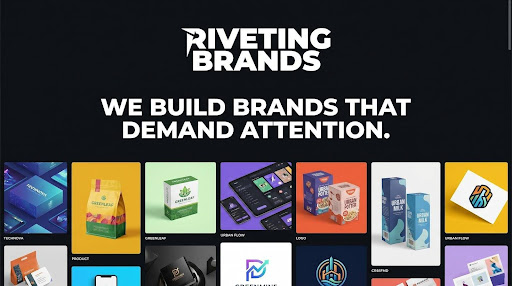
Rivet Brands creative campaigns agency homepage screenshot
That philosophy shows in their work. When a regional cancer foundation needed to lift event sign-ups, Rivet dropped tired “fight for a cure” language and gamified the push under a “Leveling Up” theme. Social posts, out-of-home banners, and a pop-up arcade booth turned fundraising into a local happening, and registrations surged.
Creative is only part of the story. Founder Wendy Payton pairs idea-driven energy with media planners who know how to stretch a Southwest Florida budget. One sauce start-up credits Rivet’s packaging overhaul and targeted grocery co-op ads for a retail placement that doubled first-month sales.
Clients praise the hands-on treatment. With a core team of fewer than ten, the same art director who sketches your logo also reviews your press proofs. That intimacy drives a 5.0 rating on BirdEye, though the review pool remains small.
Capacity is Rivet’s only brake. Complex e-commerce builds or national SEO sprints may need outside specialists, and timelines can extend if several large campaigns land at once. Yet for brands that depend on story-first marketing and senior-level attention, Rivet delivers heavyweight creative without extra bureaucracy.
If your next growth spurt hinges on a message that makes people feel before it makes them click, Rivet belongs on your shortlist.
4. The Firm Advertising Agency – best for personalised advertising solutions
Downtown Punta Gorda is rich in character, and The Firm taps that feeling. Founded in 2019 by Elizabeth Lombardo, the boutique agency positions itself as an extension of your in-house team: quick texts, candid feedback, and the kind of local insight you swap over coffee at Dean’s South of the Border.
Most engagements begin with a listening session rather than a slide deck. Strategists walk your storefront, scroll your socials, and speak with customers. From there, they craft a “right-now roadmap,” a phased plan that fits your budget and bandwidth. Need a logo refresh before season? It tops the list. Ready for social ads next quarter? That lands in phase two.
Execution spans print to pixels. Graphic designers produce menus, billboards, and vehicle wraps while the digital crew schedules Meta ads and reels. A useful add-on is in-house photography and 3D virtual tours, ideal for real-estate and hospitality clients who prefer one vendor.
Community ties run deep. The Firm donates creative hours to Habitat for Humanity events and designs promo kits for the Visual Arts Center’s annual Wine & Jazz Festival. Those relationships give the team pull with local media and printers, translating into brisk turnarounds and friendly pricing.
The core team counts fewer than five, so large-scale e-commerce builds or national TV buys will stretch capacity. And because the shop handles several small campaigns at once, rushed timelines can mean waiting in a queue.
For owners who want face-to-face collaboration, transparent pacing, and creative that feels distinctly Punta Gorda, The Firm provides a neighbourhood marketing department just one call away.
5. Digitized Branding: best for small businesses on a budget
Peyton and Rylee Petersen did not launch Digitized Branding to chase Fortune 500 retainers. They built it to solve the problems they saw classmates and side-hustle friends facing: “I need a website, a logo, and some ads—yesterday—and I can’t pay agency rates.” That scrappy mindset still drives the five-year-old studio.
Engagements stay simple. You book a discovery call, share goals, and within days you receive a fixed-price menu: a three-page WordPress site, a month of Google Ads management, a logo plus print collateral. Each line item lists a clear dollar figure, so you know exactly where the money goes.
Performance is measured, not guessed. The Petersens tag every click with UTMs and track leads in Google Sheets dashboards that owners open and use. Across clients, they report more than 10,000 leads and about $860,000 in attributable revenue—figures most two-person shops never touch.
Versatility is the bonus. Need T-shirts for an event? They design and fulfill. Want a short promo video? Peyton picks up the DSLR. That one-stop convenience saves owners countless vendor messages and keeps branding consistent from screen to storefront.
Capacity has limits. Large e-commerce builds or high-spend paid media will stretch a duo thin. And because their clients are mostly local, you will not find glossy Clutch awards or dozens of public reviews—yet.
For start-ups, cafés, and solopreneurs who need professional creative without a five-figure invoice, Digitized Branding delivers honest work that fits a small-business budget.
6. The Beardsmen Agency – best for SEO and marketing automation
The Beardsmen Agency feels like a tech start-up that happens to sell marketing. Founded in 2025, the team leans hard into code, workflows, and analytics dashboards, the plumbing that turns clicks into booked jobs without constant human babysitting.
Engagement usually begins with a free audit. They crawl your site, map keyword gaps, and sketch your lead flow on a single whiteboard. Within a week you receive a punch list: page-speed fixes, schema markup, and an automated email drip that follows every form submission with a quote reminder and review request.
Execution moves quickly because the core stack is standard. Sites run on lightweight WordPress themes tuned for Core Web Vitals. Local SEO packages include citation clean-ups, Google Business profile optimisations, and a review widget that nudges happy customers to leave five stars. Paid search is optional; when activated, ads pipe leads into a CRM, triggering the nurture cadence.
Early numbers look strong. A North Port contractor’s site climbed from page three to page one for “hurricane shutter installation” within eight weeks, and automated follow-ups cut response time from two days to five minutes, doubling close rates.
Scope is the trade-off. The Beardsmen crew is three people plus freelancers, so projects like national TV buys or deep brand workshops require outside help. Design flourishes stay minimal; visuals serve conversion, not awards.
Pricing favours small operators. A basic local SEO and automation package starts around $1,500 a month with no long-term lock-in, letting cautious owners test results before scaling spend.
If your service business relies on quick replies and strong map visibility, The Beardsmen Agency wires the system so leads never slip through the cracks.
7. A to Z Marketing: best for promotional marketing & print needs
Digital earns headlines, yet in Charlotte County a well-placed flyer or branded pen still brings people through the door. A to Z Marketing has spent more than 15 years refining those tactile touches and adding enough digital to keep campaigns measurable.
Walk into the showroom and you will see walls of samples: shirts, tumblers, yard signs, and trade-show banners. Owner Linda Smith knows every vendor by name, so turnaround times that slow national printers feel routine here. One boat-show committee approved designs on Monday and held glossy programs by Thursday, giving sponsors an extra weekend of exposure.
Strategy starts with the calendar. The team maps community events, tourist surges, and snowbird return dates, then layers print drops and radio spots where they will reach the highest concentration. For businesses that live on seasonality, such as marinas, boutiques, or home-service pros, this timing alone can double response rates.
Costs stay predictable. Because A to Z buys promo inventory in bulk, clients receive price breaks that solo orders rarely match. Need only 50 shirts for staff? They piggyback on a larger run to keep the unit cost low.
Digital services exist but stay supplemental: simple WordPress sites, boosted Facebook posts, and basic Google Ads. If you want deep analytics or A/B-tested landing pages, pair A to Z with a specialist. When the goal is putting branded swag in customers’ hands or flooding a ZIP code with direct mail, few locals move faster.
A to Z does not script a Super Bowl spot, but the team ensures every banner, postcard, and giveaway arrives on time, looking sharp and reinforcing your brand long after a click has faded.
Buyer FAQs: Choosing the Right Marketing Partner
How much should a small business budget for a marketing agency?
Most Punta Gorda companies spend $500 to $5,000 per month on outside marketing help. Where you land in that range depends on scope, not bravado.
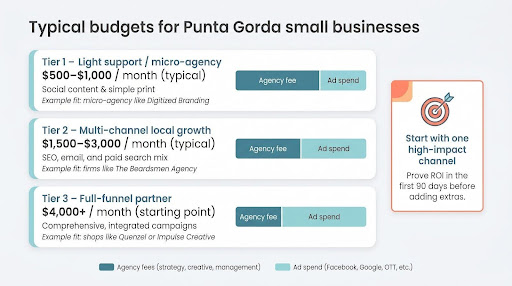
If you only need social posts and an occasional flyer, a micro-agency like Digitized Branding can keep you visible for a few hundred dollars each month. Step up to multi-channel campaigns such as SEO, email, and paid search, and plan on $1,500 to $3,000 with firms like The Beardsmen Agency. Comprehensive, full-funnel programs from shops such as Quenzel or Impulse start near $4,000 and rise with media spend.
Separate agency fee from ad spend. A $2,500 retainer often covers strategy, creative, and reporting, but the Facebook or Google clicks come from a separate wallet. Always ask for an “all-in” projection so the first invoice does not surprise you.
One smart move: pick a single high-impact channel for the first 90 days. Prove ROI there before adding extras. That focus keeps budgets tight and lets both you and the agency measure wins without noise.
Should you choose a local agency or hire from outside the region?
For most Punta Gorda businesses, geography still matters. A nearby agency knows seasonal traffic swings, understands the difference between snowbirds and summer locals, and likely bumped into your customers at Fishermen’s Village last weekend. That native insight shapes messaging and media buys in ways an out-of-state firm cannot match.
Local partners also remove friction. Need to reshoot a menu item because the garnish changed? A downtown creative can pop over before lunch. Quarterly strategy sessions happen face-to-face, not over glitchy video calls. Those conveniences speed projects and cut misunderstandings.
Specialised needs can trump ZIP code. If you run a SaaS startup selling nationwide, a niche Product-Led Growth agency in Austin might bring playbooks no one here offers. In that case, try a hybrid: keep a local shop for community touchpoints such as events, print, and chamber ads, and bolt on a remote specialist for one domain-specific channel.
Whatever route you take, insist on three things: clear KPIs, regular reporting, and a contract that lets you adjust if fit fades. When those boxes are checked, both local pride and outside expertise can drive growth.
What red flags signal an agency will waste your money?
Two warning signs surface in nearly every horror story we heard.
First, guaranteed results. Any shop promising “Page one in 30 days” or “1,000 percent ROI” is selling fantasy. Real marketers control effort and expertise, not Google’s mood or customer whims. Look for agencies that forecast ranges, explain variables, and set milestones you can audit.
Second, foggy reporting. If a proposal glosses over which metrics you will receive—and how often—expect trouble. Clear partners outline the KPIs before you sign, specify the dashboards you will access, and schedule review calls on your calendar. Transparency today prevents finger-pointing tomorrow.
Minor flags matter too: no physical address, no leadership bios, stale blog posts, and sparse public reviews. One Redditor put it bluntly: “Lots of agencies are money drain machines aimed at unaware business owners.”
Do quick due diligence. Read recent Google reviews, ask for two client references, and request a sample monthly report. Reputable firms respond without flinching; pretenders fade faster than a boosted post’s reach.
How will you know the agency’s work is paying off?
Ask this before you sign, not three months later when invoices have piled up.
Strong agencies define Key Performance Indicators on day one. For lead-driven businesses, that might be cost per qualified lead, recorded phone calls, or booked appointments. For e-commerce, think return on ad spend, average order value, and customer acquisition cost. Each metric needs a baseline, a target, and a time frame.
Reporting cadence is equally important. Quenzel sends mid-month and end-month scorecards so clients can course-correct fast. Smaller shops like The Firm prefer weekly Loom videos that walk you through results in plain English. Format matters less than frequency and clarity.
Finally, insist on attribution. Modern tools can track a Facebook ad click all the way to a sale or surgery booking. If a vendor hesitates to show that breadcrumb trail—or still sends PDFs of impressions and “likes”—keep shopping. Data-driven partners welcome transparency because it proves their value.
How long before you see meaningful results?
Tactics drive timelines.
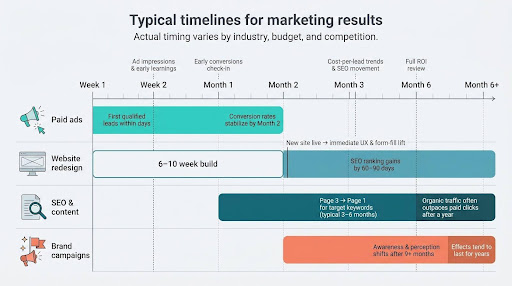
Paid ads move fastest. Launch a well-targeted Google Ads campaign on Monday and qualified leads can appear by Wednesday. Expect the first 30 days to focus on testing headlines, audiences, and bids; conversion rates usually stabilise by the second month.
Website redesigns offer medium-range wins. Once the new site is live—often six to ten weeks from kickoff—clients report instant bumps in time on page and form submissions. Search rankings follow as Google recrawls and credits the improved user experience, typically within 60 to 90 days.
SEO and content marketing take patience. Climbing from page three to page one for competitive keywords like “Punta Gorda fishing charters” or “SWFL cataract surgery” can require three to six months of consistent publishing and link building. Momentum compounds; keep going a full year and organic traffic often outpaces paid clicks.
Brand campaigns sit on the long end of the spectrum. Shifting perception, rolling out new visuals, and saturating multiple channels can run nine months before awareness surveys show real movement, yet those gains tend to stick for years.
Whatever the play, set milestone check-ins: week two for ad impressions, month one for early conversions, month three for cost-per-lead trends, and month six for full ROI review. Clear checkpoints keep everyone aligned and confident that progress is real, not wishful thinking.
Conclusion
Punta Gorda's rebound is rewarding owners who market with intent. The seven agencies above cover every budget and growth stage: Quenzel for integrated ROI campaigns, Impulse Creative for HubSpot-powered inbound, Rivet Brands for emotion-led creative,
The Firm for neighborhood-level personalization, Digitized Branding for budget-conscious starters, The Beardsmen for SEO and automation, and A to Z for print and promo. Match the agency to your channel mix, demand clear KPIs and weekly reporting, and pilot a single tactic before scaling spend. Book two or three discovery calls this week, compare proposals against the scorecard above, and the right partner will become obvious.

- Digital Entrepreneurs Are Discovering That Physical Operational Infrastructure Accelerates Digital Scale - October 18, 2026
- Fast-growing E-commerce Sellers Are Overhauling Fulfillment Hubs To Keep Up With Orders - October 16, 2026
- Ad Network Marketing Myths That Can Lead to Poor Campaign Decisions - October 13, 2026