Books help new online entrepreneurs build stronger business skills when each one addresses a current decision and its ideas are tested on a real project. Start with planning, move to marketing, then study operations. A focused sequence beats collecting titles or reading bestseller lists at random.
Choose Books By The Business Skill You Need First
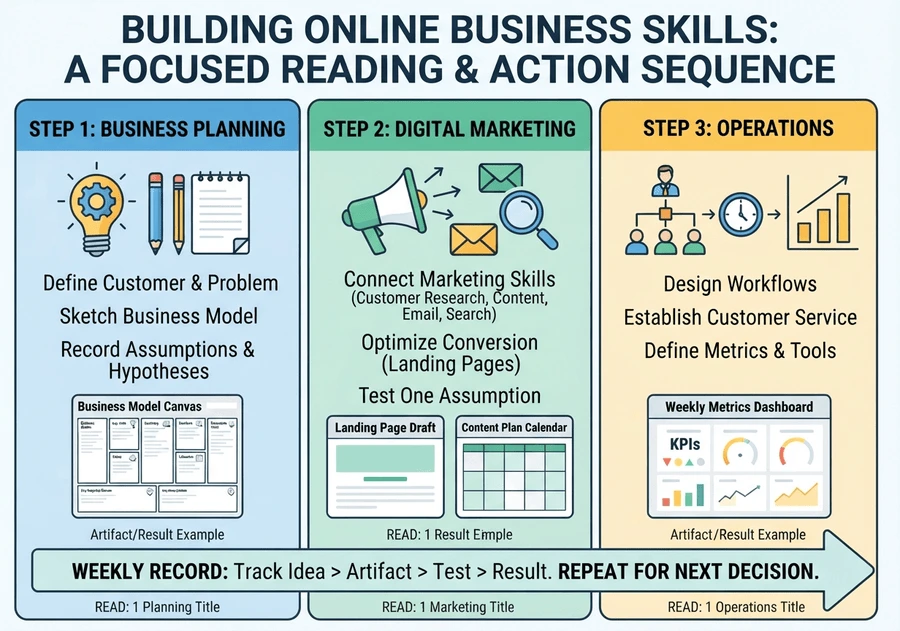
Begin with business planning if you have an idea but cannot explain who will pay for it, what problem it solves, or how it will earn money. A useful planning book should help you define a customer, sharpen positioning, sketch a business model, and record assumptions about costs, pricing, and sales. Those assumptions are hypotheses, not forecasts.
Next, choose a book that treats digital marketing as a set of connected skills. Customer research should inform the message; content marketing, email marketing, and search marketing should give customers ways to find and understand the offer. Conversion matters too: traffic is of little use if a landing page leaves visitors unsure what to do.
Operations books become more relevant once work is underway. Look for practical treatment of workflows, customer service, business metrics, tools, and decisions about when to delegate. A public library or another authorized free lending service can let you assess a title before purchasing. Choose a book tied to a current problem rather than general advice.
To identify credible titles, examine the author’s relevant work, the book’s publication date, its references, and whether its claims are supported with examples or evidence you can assess. Bestseller status is not proof of relevance. A specialized book with a clear method may suit your business better than a famous general title.
Check Digital Book Sources And Editions
Readers may encounter Z-library or another digital library while searching for entrepreneurship titles. A listing or downloadable file does not establish that access is authorized, legal in your jurisdiction, complete, accurate, or safe. Copyright rules vary, and uncertain files can contain missing pages, poor text recognition, or security risks.
The same caution applies to results for Z library. Prefer public libraries’ digital lending, publisher platforms, open-access books, public-domain works, and legitimate previews. An E-library is useful only when its lending terms, publisher relationship, and edition details are clear.
Check the digital file itself. Compare its title, author, ISBN or other edition information, copyright page, and table of contents with the publisher’s authorized version. Scan for missing pages, distorted images, broken formatting, and OCR errors that could alter exercises or instructions.
A newer edition helps only when it updates the parts your business depends on. Principles such as interviewing customers often last longer than advice tied to a particular algorithm.
Turn Each Chapter Into A Small Online-business Experiment
Before opening a book, write down the decision it needs to inform, such as identifying the customer, selecting an offer to test, or finding where prospects leave a sales process. This keeps reading tied to work.
After a useful chapter, produce something practical: a customer profile, positioning statement, landing-page draft, content plan, budget, workflow, or simple measurement dashboard. If a chapter offers a framework, adapt it to your business instead of treating it as a guaranteed formula.
Then test one assumption at a time. Show a draft offer to likely customers, publish a small piece of content, or track inquiries from one channel. Record the expected result, the actual result, the sample or audience reached, and what you will change next.
Keep it small. A well-designed test can provide more relevant evidence than applying an entire framework at once, though its value depends on the quality of the evidence.
Build A Reading Sequence That Matches Your Next Business Decision
Read one planning title first, one marketing title next, and one operations title when you have work to manage. Add specialist books when a specific problem appears. Set aside any book that does not help you make or test a decision after a few chapters.
Use a weekly record: note the idea, the artifact it produced, the test you ran, and the result. Choose the next title by the decision still blocked, not by its position on a generic list.

- Books That Help New Online Entrepreneurs Build Stronger Business Skills - November 18, 2026
- Hands-on Retail Tastings Are Driving Stronger Conversion For Emerging Consumer Brands - November 17, 2026
- Steffen Miro Review: What His Coaching Really Costs - November 13, 2026