Brand recognition alone rarely wins non-branded search results, even for companies with large budgets and decades of domain history. Search almost any high-value commercial term and the first page tends to be filled with comparison sites and niche specialists, with household names usually sitting lower than their marketing teams expect.
Effort is seldom the issue. Most large organizations publish constantly, and they fund paid and organic channels in parallel. What holds them back is structural: A website that serves thousands of products along with dozens of internal teams behaves very differently from a small business site, so tactics that work on one rarely scale to the other.
That’s why enterprise SEO is treated as a separate discipline. It focuses on the systems that decide how thousands of pages are built and maintained, with individual keyword wins coming second.
Why Scale Changes the SEO Problem
A large site hands search engines far more pages to judge, and each one is assessed on its own merits. Legacy templates and duplicate category pages end up competing with the pages that actually drive revenue. Small changes travel far here.
A single template fix can improve hundreds of URLs at once, yet one flawed release can wipe out months of progress just as fast. SEO decisions have to be made at the system level as a result, because a team that reviews pages one at a time won't keep up with a site that adds new URLs every week.
Fix the Technical Foundation First
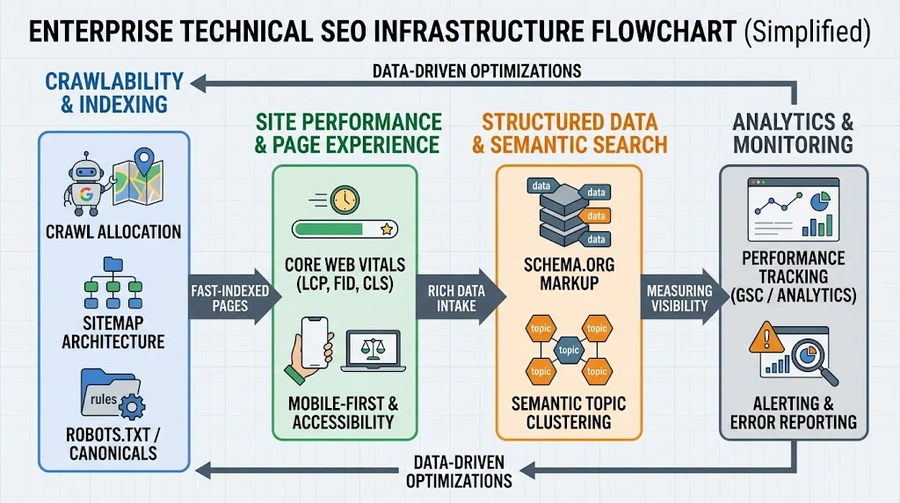
Technical-layer problems limit how far any content or link work can go. Faceted navigation is a common cause on retail and directory sites, since every filter combination can create a new URL. Crawlers may then spend their time on near-identical pages while important ones wait.
Google's documentation on crawl budget says this matters most for sites with 1 million or more unique pages, or for sites where a large share of URLs sit in Search Console as discovered but not yet indexed.
An audit of the URL inventory comes next. Look for parameter-driven pages and orphaned content that no internal link points to, then consolidate or block whatever doesn’t add value. A crawler such as Screaming Frog makes this far faster on a site with 100,000 URLs. Rendering deserves a check too. Many enterprise sites rely on JavaScript frameworks, and if key content or links appear only after scripts run, search engines may not pick them up reliably.
Measure Core Web Vitals by page type. A strong homepage score says little about a slow product template, and that template is shared by every product on the site.
XML sitemaps are often neglected at this scale. They tend to list retired URLs while missing whole sections added after launch. Generate them automatically from the live catalog and split them by page type. Then compare submitted URLs against indexed ones, since a large gap between those two numbers is one of the clearest early signs of a technical problem.
Strengthen Authority Signals Across the Domain
Authority should be a big-company advantage, yet many organizations leave it unused. Google looks for signs of experience and expertise, and large organizations have plenty of both. This is arguably the most underused asset for many enterprise brands, since their engineers and product specialists rarely get bylines on the company website.
Put that expertise in front of readers. Real author bylines with credentials help, as does a review step where subject matter experts check technical content before it goes live. First-party data from internal research is worth publishing too, because original numbers earn citations from journalists far more easily than recycled advice does. Organization and product schema markup support the effort by helping search engines connect your brand to its entities.
For links, digital PR tends to outperform volume outreach at this level. One data-driven study covered by trade publications can earn more relevant links than a year of cold emails. Once those links land, internal linking spreads their value. Point your strongest hub pages toward the commercial pages that need support, and keep those paths shallow.
Build Content Around Search Intent at Scale
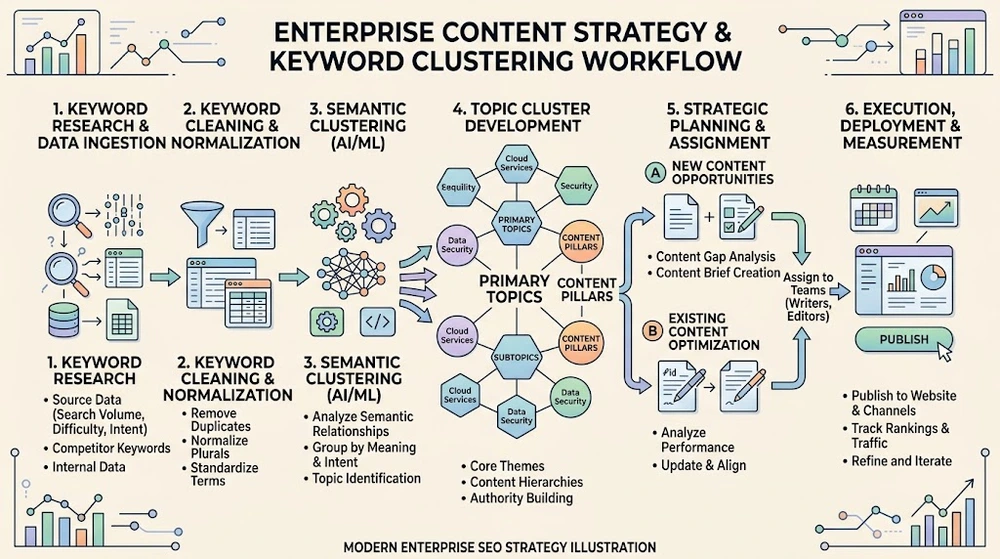
Ownership is usually where enterprise content problems begin. Product teams and the blog team may target the same phrase without realizing, resulting in keyword cannibalization. Relevance gets split across multiple pages from the same company, so none of them rank well.
Keyword research solves this once it’s tied to a page map. Each priority topic should be assigned to one primary URL and one owner. Supporting content can then be grouped into clusters that link back to that primary page, which builds topical authority around the subjects that matter most to the business. Before anyone requests a new page, the map gets checked so teams expand coverage without competing.
Volume means little without intent. A query like "payroll software pricing" signals a buyer comparing options, so the ranking page needs plans and comparisons. Informational queries call for clear, direct explanations. Look at the current first page before writing anything, because it shows which format Google already rewards for that query. In my experience, matching format to intent is the quickest way to move a page stuck on page two.
Outdated pages pile up on large sites. Schedule content reviews by section and decide whether each weak page should be updated or merged into a stronger URL. Pruning can feel counterintuitive for a company used to publishing more. Even so, a smaller set of strong pages often outperforms a large archive of thin ones.
Manage Visibility Across Markets and Locations
International sites face another layer of complexity. Hreflang tags tell search engines which version of a page belongs to which language or region. If those tags are missing or inconsistent, the wrong market version may rank, and users land on pages with an incorrect currency.
Location pages carry similar risks. Hundreds of branch pages built from one template, with only the city name swapped, tend to look like duplicates to search engines. Give each location its own details, such as local services or team information, and keep business data consistent across directories and map listings. Regional teams also need room to adapt copy for their audience. A direct translation often misses the terms people in that market actually search for.
Create SEO Governance Across Teams
Many enterprise SEO setbacks happen because people don’t think about search. A developer removes a set of redirects during a migration. Elsewhere, a content refresh deletes the paragraphs that were driving traffic. Nobody meant any harm, but rankings drop all the same.
Governance prevents most of these losses. SEO checks should be built into the development release process so that template and redirect changes are reviewed before launch. Standards belong in a shared playbook every team can access, with clear ownership over who approves edits to high-value pages. Short training sessions for developers and editors also help, and they often prevent more problems than an audit would.
Measure Visibility the Way Leadership Cares About
Rankings for a handful of head terms tell leadership very little. Non-branded share of voice is a more useful measure because it shows how often your pages appear for important queries compared with named competitors. Branded traffic mostly reflects existing demand, whereas non-branded visibility shows whether the site is winning new customers.
Segment reporting by template and market so problems surface early. If product pages drop while blog traffic grows, the cause is probably technical. The right marketing tools make this easier, especially platforms that pair rank tracking with crawl data. Google Search Console covers the basics for free.
Organic performance should also be tied to revenue. Track assisted conversions along with pipeline from organic sessions, and review the numbers quarterly with product and marketing stakeholders. Once SEO is reported in the same terms as other channels, it tends to get the budget and attention it needs.
Turning Scale Into a Search Advantage
Large companies already have the resources to compete in crowded search results. Structure is usually what holds them back. A clean technical foundation and clear ownership let that scale work in their favor, while visible expertise gives search engines a reason to trust the content.

- How Large Companies Can Improve Their Visibility Across Competitive Search Results - October 20, 2026
- What Business Owners Should Know About Company Audits - October 20, 2026
- Top West Coast Fulfillment Companies for Ecommerce Brands in 2026 - October 19, 2026