Hey, Drew here. Welcome to my Local Marketing Vault review. I've reviewed dozens of "make money online" programs on this site, and this one comes up constantly because James Bonadies runs a lot of ads for it — so I dug through the training breakdown, the Trustpilot pile, the Reddit threads, and every honest reviewer I could find.
Here's my short answer: Local Marketing Vault is a legit, well-built course — but it's overpriced for what most beginners can realistically do with it, and the pricing and refund terms are the real problem, not the training. The model works. It's just expensive, ad-dependent, sales-heavy, and nowhere near passive. If you've got a sales background and a real budget, it can pay off. If you're broke and hoping for laptop-on-a-beach income, this isn't it.
💡Local Marketing Vault Runs on Paid Ads. There's a Lower-Cost Path That Doesn't.
LMV teaches you to build a local ad agency — which means paying for ads, learning to sell to business owners, and eventually hiring a team. That's a real business, but it's not cheap and it's not hands-off.
My 2026 AI Business Blueprint takes the opposite approach: build an online income stream with AI doing the heavy lifting, no ad spend, no cold-calling, no team. It's $47 one-time versus $2,994+ for LMV. Jump to the cheaper alternative or keep reading to see exactly what LMV gives you first.
⭐ My Local Marketing Vault Rating: 3.5/5
I give LMV a 3.5 out of 5. The training is thorough, the founders genuinely practice what they teach, and the community is one of the more active ones out there. What drags the score down is the murky pricing, the brutal 72-hour refund window, the ongoing costs nobody mentions on the sales call, and a business model that's much harder than the ads make it look.
Key takeaways before you scroll:
- Price: Officially $2,994 one-time, but real students report paying $4,500–$5,000+ after the sales call, plus monthly tools.
- Refund: Only 72 hours. That's the biggest red flag for a high-ticket buy.
- Model: Run Facebook/Google ads for local businesses on a monthly retainer. You pay for the ads upfront, not the client.
- Best for: People who can sell and can afford the course plus ad spend. Not beginners on a tight budget.
If you want the cheaper, lower-risk route I actually recommend, I broke it down in how to make money online with AI. And if you're weighing other agency programs, I've also reviewed Agency Vault, which sells a similar dream.
What Is Local Marketing Vault?
Local Marketing Vault is an online course that teaches you to run a lead generation agency for local businesses using paid ads. You learn to find local businesses — plumbers, dentists, roofers, gyms, salons — pitch them your services, then run Facebook and Google ads to send them leads for a monthly fee.
The current "mechanism" they teach is two-page sites: a simple ad-to-landing-page-to-phone-call funnel instead of a full website. You charge a retainer (often $500–$2,000/month), promise a certain volume of leads, and your job is to spend less on ads than the client pays you so you pocket the difference. It launched back in 2015, so it's not some here-today-gone-tomorrow launch. It's been around.
Who Is James Bonadies (and Jason McKim)?
Local Marketing Vault is run by two people, and it helps to know who does what. James Bonadies is the face you see in the ads — a former business teacher and vice principal with an MBA who moved into online marketing. Jason McKim is his partner and runs the back end, including most of the actual ad teaching. He's a former financial consultant who taught himself SEO and paid traffic before going full-time.

James Bonadies

Jason McKim
Both came up through Dan Klein's "Job Killing" program before launching their own thing — which is worth knowing, because a lot of the reviewers trashing LMV came from that same world. The legal entity is Visibility Cloud LLC, doing business as Local Marketing Vault and Two Page Sites.
James claims tens of millions in sales and a famous $74k check from a single client. I'd treat those as his marketing claims, not independently verified numbers — but he does still appear to run client campaigns, which is more than most gurus can say.
How Does Local Marketing Vault Actually Work?
The business model has three pillars, and you have to be good at all three. First, you have to generate leads — get genuinely good at Facebook and Google ads so you can deliver results cheaply. Second, you have to land clients, which means prospecting and selling to local business owners over the phone or in person. Third, you have to keep clients happy by actually delivering leads month after month, or they cancel.
That third part is where people underestimate this. You're not building a passive asset — you're running a service business with demanding clients. If your ads stop performing, you get angry phone calls. This is why I always point people to the reality of professional PPC management before they romanticize the agency life.
Are You Selling Leads or Managing Ads?
You're managing ads, not renting digital real estate. This is an important distinction. LMV's model is an ad-agency model: the client pays a retainer, you run their paid campaigns. James has stated publicly that the client should pay the ad spend, not you.
In practice, though, plenty of students front the initial ad budget, the tools, and their own time while they're still learning — so "the client pays for ads" is true on paper and messier in real life. This is different from the rank-and-rent model, where you own a ranking website instead of renting attention through ads.
What Do You Get Inside Local Marketing Vault?
You get a genuinely deep training library plus done-for-you assets. The core is a main course (called Genesis) followed by roughly nine to ten supporting courses covering marketing, prospecting, sales, Facebook ads, and Google ads — depending on how you count, students describe it as around 21 modules.
On top of the videos, you get 30 to 50+ pre-built ClickFunnels landing pages for different niches so you're not designing funnels from scratch.
The support side is the real selling point. There's a private Facebook group with around 7,000 members and live Q&A calls multiple times a week, often hosted by James or Jason themselves. You also get bonuses like the LMV Accelerator, the $10K Club reward program, a partnership program to pair up with other students, and Goleads for pulling prospect lists.
Most students also end up on Agency Toolbox — a rebranded version of GoHighLevel — to run their CRM and automations.
How Much Does Local Marketing Vault Cost?
The official price is $2,994 for lifetime access, with payment plans available that cost a bit more overall. That's the number most honest reviewers land on, and it's the figure listed across current 2026 reviews. So far, so reasonable for a high-ticket course.
The problem is that the price isn't posted publicly — you only get it on a sales call — and the number people actually pay is all over the place.
Why Do Reviews Say $3,000, $5,000, Even $7,000?
Because the price comes from a sales rep, not a checkout page, so it varies by person and by what upsells get added. I've seen this pattern repeatedly: one student documented paying $5,000 after a call with a rep named Nick.
A Reddit user said he signed up at $4,500 (about $350/month) after being told he'd recoup the cost in 90 days. Others report being quoted up to $7,000 once everything's bundled. When the price changes depending on who's on the phone, that's a transparency problem — full stop. It doesn't make the program a scam, but it means you should walk into that call knowing the real ceiling.
What's the Real All-In Cost?
Plan on a lot more than the course price. The course is just the entry fee. You'll also pay for the Agency Toolbox CRM (around $97–$297/month), the LMV Accelerator upsell (about $997 if you take it), and — most importantly — the ad spend to actually generate leads while you learn.
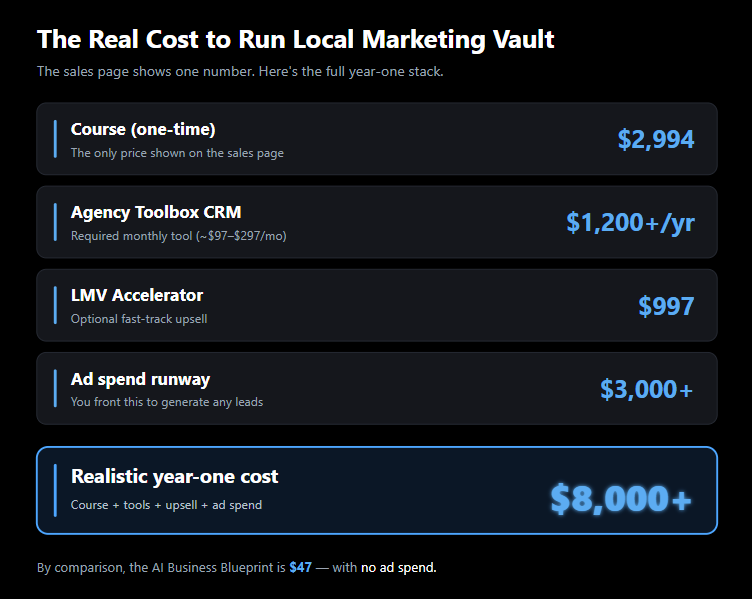
Realistically, you want several thousand dollars of runway on top of the course before this makes sense. If you only have the money for the course itself and nothing for ads or tools, you'll stall out, so make sure you've got real cash behind you before you put $3k on a credit card.
What's the Refund Policy?
You get 72 hours. That's it. The refund window is three days from purchase, tied to their terms of service (the company is based in Wayne, New Jersey). For a course this expensive, three days is not enough time to watch the training, start an agency, run ads, and decide if it's for you.
This short window is, in my opinion, the single biggest mark against the program — and several critics point to it as a sign of shaky confidence in beginner results.
Are Local Marketing Vault's Trustpilot Reviews Legit?
The rating is real, but it's partly engineered, so weight it accordingly. On Trustpilot, LMV sits at roughly 4.8 stars across nearly 1,000 reviews, with about 91% rated 5 stars. The company is also BBB accredited with an A+ rating and has been operating for around seven years. On the surface, that's a strong reputation.
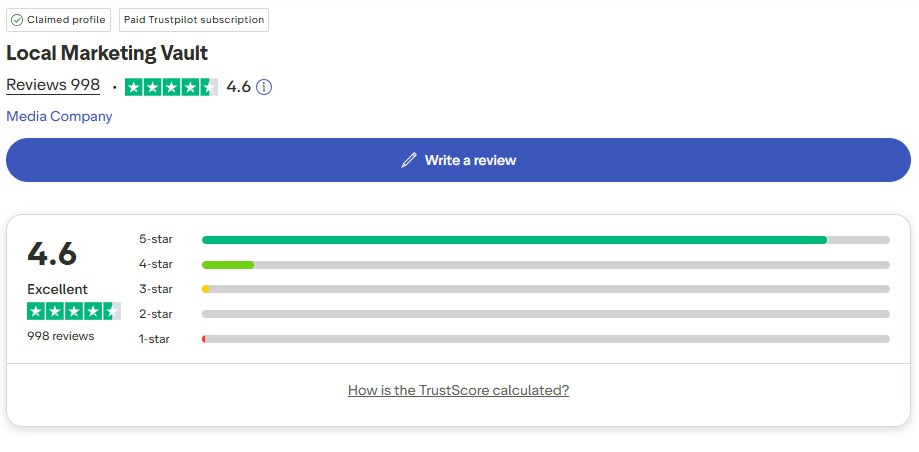
Here's the nuance: independent reviewers have noted that a lot of those positive reviews were solicited — members were asked to post on Trustpilot, and there was even a push to flood a ranking Reddit thread with positive comments after a negative one started hurting sales.
That doesn't mean the reviews are fake, but it does mean the 4.8 is a curated picture. The unfiltered feedback on Reddit and independent sites is noticeably more mixed.
What Happy Students Say
The people who succeed are consistent about why. They praise the step-by-step structure, the heavy support, and the community. One student landed her first client in about four weeks and now runs her agency full-time from an RV.
Another built a semi-passive side income over 18 months with only a couple of hours of upkeep per client each month. The common thread: they treated it like a real business, used the live calls, and didn't quit early.
What Frustrated Students Say
The unhappy reviews share a pattern too. One Reddit user reported calling 1,500–2,000 businesses over a year and signing zero clients — blaming no-shows, owners who didn't believe in ads, and businesses that already had an agency.
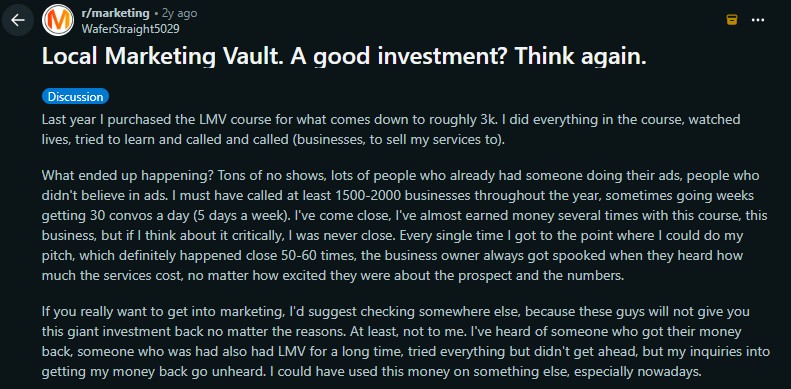
Others complain about the unclear pricing, slow or hard-to-reach support, clients churning after three to six months, and the difficulty of getting a refund. A recurring critique is that coaches sometimes push other affiliate offers instead of staying focused on your campaigns.
What I Like About Local Marketing Vault (The Pros)
The training is legitimately comprehensive and kept current. Across paid ads, prospecting, and sales, it covers the whole arc of building an agency, and they update it as platforms change. The done-for-you funnels save beginners real time, and the live coaching multiple times a week is rare at this price — you're not left alone after you pay.
The founders aren't faceless; they show up on calls and still run client work, which gives the material credibility most courses lack. And the community genuinely helps people stay motivated through a hard slog.
What I Don't Like About Local Marketing Vault (The Cons)
The pricing is opaque and the refund is unforgiving. A course that costs a different amount depending on your sales rep, with only a 72-hour money-back window, puts most of the risk on you.
The all-in cost — course, CRM, upsells, and ad spend — is far higher than the headline number, and that's not made clear upfront. The model itself is demanding: you have to be good at sales, good at ads, and tolerant of clients who cancel. It is the opposite of passive, ad accounts can get suspended through no fault of yours, and copied done-for-you funnels mean lots of students are running near-identical campaigns.
Is Paid-Ads Lead Gen Still Worth It in 2026?
It can work, but the headwinds are real and getting worse. Paid ads deliver leads fast, which is the model's biggest strength — but your margins shrink as ad costs climb, and a big chunk of every retainer goes straight to Facebook and Google rather than your pocket. Many students net only 15–20% of revenue after ad spend. Add the constant risk of account suspensions and clients who churn in three to six months, and you're on a treadmill of always replacing income.
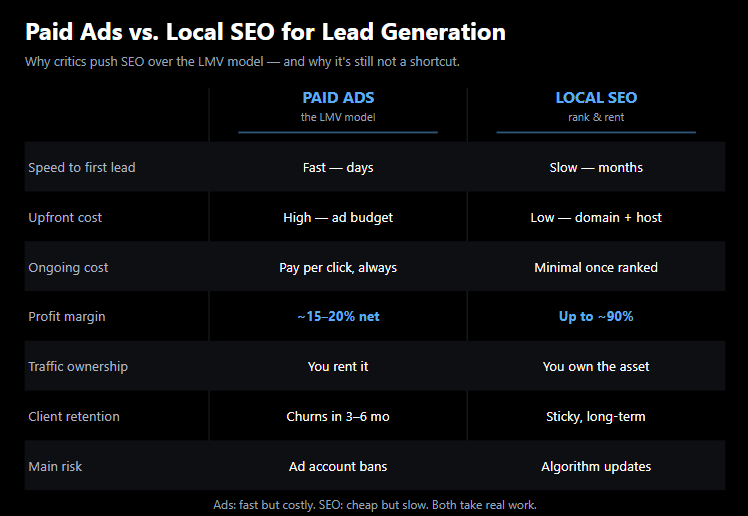
The alternative the critics push is local SEO — ranking a site so leads come in for free instead of renting attention through ads. It's slower but cheaper and stickier. Both models are real businesses with real work; neither is a shortcut.
The Cheaper Path: Build an AI Business Without Paid Ads ($47)
If you read the costs above and felt your stomach drop, this is for you. Local Marketing Vault is a strong program for people who can sell and can afford to feed an ad budget while they learn — but that's a narrow group. Most people asking "is LMV worth it" are beginners who don't have $8k of runway and don't want to cold-call strangers.
That's exactly why I built The 2026 AI Business Blueprint. It's $47 one-time, and it shows you how to build an online income stream using AI to do the grunt work — no paid ads burning your budget, no sales calls, no team to manage. The whole premise is in my free guide, Want to Build a $10K/Month AI Business Without a Team or Paid Ads? — grab that first if you just want to see the model before spending a dime. It's the same outcome LMV promises (recurring online income) without the high-ticket price tag or the ad-spend treadmill.
Who Is Local Marketing Vault For? (And Who Should Skip It)
LMV is for a specific type of person. It's a good fit if you already have sales experience, you can comfortably afford the course plus several thousand dollars in ad spend and tools, and you actually want to build and run a client-service agency. If that's you, the training and support are strong enough to get you there with effort.
Skip it if you're on a tight budget, if you're expecting passive or hands-off income, if the idea of cold outreach makes you queasy, or if you need more than three days to decide whether a $3,000+ purchase was right. None of those are character flaws — they just mean a different business model will serve you better.
Exposed: The Review Game Around Local Marketing Vault
Here's something I wish more people understood when they search for reviews like this one. A huge share of the "LMV review" content online isn't neutral. Many of the harshest critics are affiliates for other programs — usually expensive rank-and-rent or local SEO courses — who trash LMV specifically to redirect you to whatever they're selling.
On the flip side, the glowing reviews often come from LMV affiliates dangling a "bonus" if you buy through their link.
So you've got one camp inflating the negatives and another inflating the positives, both for commission. I'm not an LMV affiliate, and I'm not pretending paid ads are evil so you'll buy something pricier — I genuinely think a leaner, AI-driven approach beats it for most readers. It's the same affiliate-bait pattern I've called out in plenty of high-ticket guru reviews: read past the agenda and look at the actual model.
Is Local Marketing Vault a Scam?
No, Local Marketing Vault is not a scam. It's a real company with a seven-year track record, genuine training, active coaching, founders who still run campaigns, and verifiable students who've built real agencies. Scams don't host weekly live calls for years or maintain a BBB accreditation.
But "not a scam" and "right for you" are two different things. The honest issue isn't legitimacy — it's that the price, the murky sales process, the 72-hour refund, and the difficulty of the model make it a poor bet for the average beginner. Legit, yes. Worth it for most people who land on this page? That's a much harder yes.
Final Verdict: Is Local Marketing Vault Worth It?
For the right person, Local Marketing Vault is worth it — for most people, it isn't. If you can sell, you've got real money to invest beyond the course, and you want to run a local ad agency, the training and community will get you there, and I'd say go for it with your eyes open about the costs.
But if you're a beginner without a sales background or a budget for ad spend, the all-in cost climbs past $5k fast, the refund window is too short to protect you, and the model is far more demanding than the ads suggest. That's why my rating sits at 3.5/5 — solid training, real concerns, and a far cheaper path available for most readers. If that's you, start with my free AI business guide and skip the high-ticket gamble.
You Might Also Find These Useful
If you're still researching, these will save you money before you commit to anything: my breakdown of how to make money online with AI for a lower-cost model, and my best affiliate marketing course roundup if you'd rather start with something cheaper than a $3k agency program.

Frequently Asked Questions
How much does Local Marketing Vault really cost?
The official price is $2,994 one-time, but it's only quoted on a sales call, so what people actually pay ranges from about $4,500 to $7,000 once payment plans and upsells are added. Budget for ad spend and a monthly CRM on top of that.
Is there a refund?
Yes, but only within 72 hours of purchase, per their terms of service. After three days, you can't get your money back — which is a very short window for a high-ticket course.
Is Local Marketing Vault passive income?
No. You're running a service business with paying clients, ongoing ad management, and constant prospecting to replace clients who cancel. It can become semi-passive once you hire a team, but early on it's active, hands-on work.
Who pays for the ads — me or the client?
James teaches that the client pays the ad spend through their retainer. In reality, many students front the initial ad budget and tools while learning, so plan to cover some costs yourself before the model becomes profitable.
How long until my first client?
It varies widely. Some students land a client in their first month; many others take several months, and some never sign one. Your sales ability and how much you actually prospect matter more than the training itself.
Is the Trustpilot rating real?
The roughly 4.8-star rating across nearly 1,000 reviews is real, but a lot of the positive reviews were solicited from members. It's a curated picture, so balance it against the more mixed feedback on Reddit and independent sites.
How is Local Marketing Vault different from rank and rent?
LMV is a paid-ads agency model — you rent attention through Facebook and Google and manage campaigns for clients. Rank and rent (local SEO) means you own a website that ranks organically and send those leads to businesses. SEO is slower and cheaper; ads are faster but pricier.
Is James Bonadies legit?
Yes. James Bonadies and Jason McKim are real, experienced marketers who still run client work and have operated the program for years. Treat their specific earnings claims as marketing, but the people and the training are legitimate.
Can I do this with AI instead?
You can build a recurring online income without the agency grind by using AI to handle the heavy lifting — no ad spend, no cold-calling. That's the entire focus of my 2026 AI Business Blueprint at $47, and you can preview the model in my free guide first.

- Fast-growing E-commerce Sellers Are Overhauling Fulfillment Hubs To Keep Up With Orders - October 16, 2026
- Ad Network Marketing Myths That Can Lead to Poor Campaign Decisions - October 13, 2026
- Dropship Breakthru Review: Price, Guarantees, Fine Print - October 11, 2026