I've been selling things online since 2010, and one shift changed my business more than almost anything else: moving into digital products. No inventory. No shipping. No supplier headaches. You build it once, and every sale after that is close to pure profit.
I run drews-review.com, where I rank for over 500 search terms in Google, with 60+ sitting in the top 3 and nearly 15,000 visitors landing here every month. I also sell my own digital products directly, including one that made $1,023 in its first month with zero ad spend. So everything below comes from actually doing this, not from theory.
Key takeaways: Digital products cost almost nothing to start selling. Validation before you build matters more than the platform you pick. You don't need a big audience or a budget to make your first sale.
What Are Digital Products?
A digital product is anything you create once and deliver electronically, with no physical shipping involved. That covers a lot of ground: ebooks, templates, checklists, mini courses, prompt packs, software, stock assets, and printables all fall under this umbrella.
What ties them together isn't the format. It's the delivery model. Someone buys, and the file or access link lands in their inbox automatically. You're not packing a box or waiting on a supplier. The product exists the moment you finish making it, and it can sell an unlimited number of times without costing you anything extra per sale.
Why Sell Digital Products Instead of Physical Ones?
The margins are the real story here. A physical product has to account for manufacturing, storage, and shipping before you ever see profit. A digital product skips all three. Once it's built, every dollar coming in is close to pure margin, minus whatever percentage your selling platform takes.
I've run dropshipping businesses too, and the contrast is stark. Dropshipping still means dealing with supplier reliability, shipping times, and razor-thin margins after ad spend. Digital products remove the physical layer entirely. You're not at the mercy of a warehouse on the other side of the world.
That doesn't mean digital products are effortless. Building something people actually want takes real work. But the operational overhead that eats a physical products business simply isn't there.
Digital products carry two structural advantages that no physical product model can match, and they're the reason I switched to this model after years of selling physical goods.
How to Validate a Digital Product Before You Build It
Validate demand before you spend a single hour building. This is the step almost everyone skips, and it's the single biggest reason digital products fail to sell.
Look for repeated signals instead of guessing. The same question showing up again and again in forums, comment sections, or social posts is one of the strongest signals available. An audience that's excited about a new tool or trend but visibly confused about how to use it is another, confusion is buyable. A topic growing faster than the content explaining it is a third.
If you can't find any of those signals for your idea, that's information too. It usually means the idea needs to get more specific, or it means the demand isn't really there yet. Building without this step is how people end up with a finished product and zero buyers.
The specific software matters less than the process, but if you want my actual stack, here are the tools I use to build and sell.
I put together a full breakdown of which digital product categories have real demand behind them right now if you want help narrowing this down.
Part of validation is confirming the niche isn't already flooded, here's how to tell if competition is genuinely low.
Where to Sell Digital Products Online
Once you've validated the idea, picking a platform is straightforward. Here's how the main options compare.
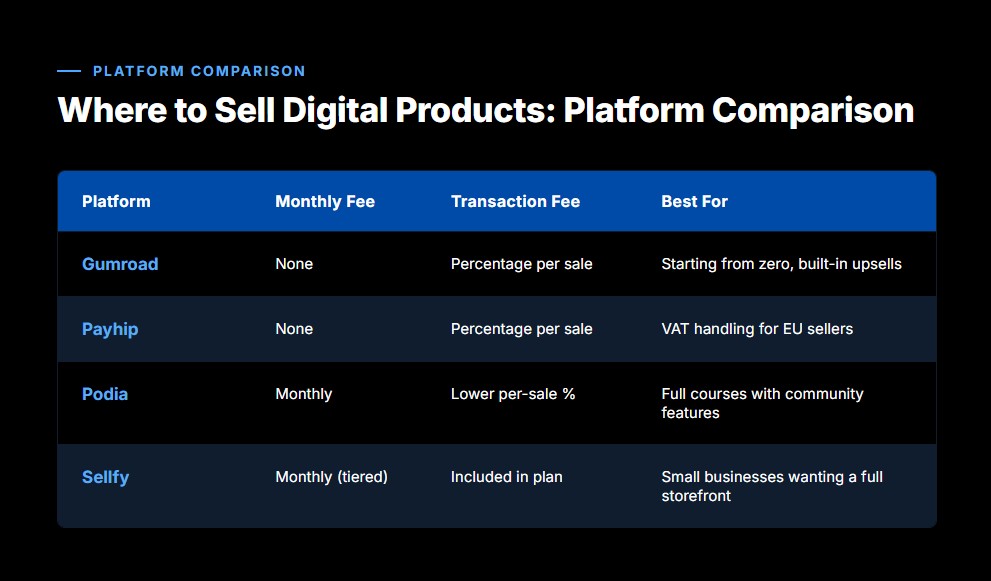
I sell through Gumroad, mainly because there's no monthly fee sitting there whether I sell anything or not, and the built-in upsell system has meaningfully increased what each customer is worth to me. If you're building out a full multi-module course with a community attached, Podia's monthly cost starts to earn its keep. If a chunk of your audience is in the EU, Payhip's built-in VAT handling saves a real headache.
Whichever you pick, prioritize automatic delivery and a checkout that takes under a minute. Anything that adds friction between "I want this" and "I have this" costs you sales.
How to Price a Digital Product
Underpricing hurts you twice. It signals lower quality than what you're actually delivering, and it weakens your business math on every single sale. Overpricing without proof behind it kills conversion before someone even finishes reading your description.
Most first digital products land well in a low, low-friction price range, cheap enough that saying no takes more thought than saying yes, but priced high enough to feel like a real product instead of a throwaway. My own first digital product launched at $17 and made $1,023 in its first month at that price point, without a single ad running.
Price against the specific outcome you're delivering, not against how much time you spent making it. A five-minute checklist that saves someone three hours is worth more than a fifty-page ebook nobody reads past page two.
How to Get Your First Sales Without an Audience
You don't need a following to sell a digital product. What you need is to show up where people are already searching for the exact problem your product solves.
Writing helpful content around that problem, whether that's blogging, answering questions in relevant forums, or posting where your buyers already spend time, works better than trying to cold-convince someone they need something they weren't thinking about. This is slower than running paid ads, but it compounds. A single well-ranked article can keep sending buyers your way for years.
Platforms with their own built-in marketplace traffic (Gumroad's Discover page, for instance) can also send you a small trickle of sales before you've built any outside audience at all. It won't replace real traffic, but it's not nothing on day one.
Legal and Tax Basics for Selling Digital Products
Selling digital products online still means real income, and real income gets taxed. In the US, digital product sales you make as an individual are generally reported as self-employment income, and the IRS has specific guidance on self-employment tax obligations worth reading before your first real sales month.
Sales tax is a separate question, and it varies significantly by state and by whether your platform handles collection for you. Many platforms, including Gumroad, calculate and remit applicable sales tax automatically on your behalf, which removes a major headache. Confirm this with whichever platform you choose rather than assuming, since not all of them handle it the same way.
None of this is legal or tax advice specific to your situation, just the basics worth knowing before you start. A conversation with an accountant familiar with online business income is worth the cost once you're making consistent sales.
👉 I laid out this exact process in more depth, including the pricing and validation framework behind that $1,023 first month, in The Digital Product Playbook.

FAQ
Do I need a website to sell digital products?
No. Platforms like Gumroad let you sell directly from a hosted product page with no website required. A website helps long-term for building organic traffic, but it's not a requirement to make your first sale.
How much does it cost to start selling digital products?
Close to nothing. Platforms like Gumroad and Payhip charge no monthly fee, only a percentage per sale, so your only real cost is the time it takes to build the product itself.
What's the easiest digital product to create first?
A checklist, template, or short guide solving one specific, narrow problem. Narrow products are faster to build, easier to price clearly, and easier for a buyer to understand at a glance than a broad, all-encompassing course.
Can I sell digital products without any marketing experience?
Yes. The validation step matters more than marketing skill. A product built around a real, confirmed demand signal tends to sell itself once it's in front of the right people, even with minimal marketing behind it.
Selling digital products online comes down to fewer moving parts than most people expect: validate the idea, price it honestly against the outcome it delivers, pick a platform that gets out of your way, and show up where the demand already exists.
Where should I start if I have nothing built yet?
I wrote a step-by-step guide for starting from zero that covers the exact order I followed, from no product and no audience to my first $1,023 month.

- Dropship Breakthru Review: Price, Guarantees, Fine Print - October 11, 2026
- Best Outdoor Equipment Fulfillment Companies for DTC Brands - October 8, 2026
- Why Your Site Needs an Automated Price Calculator - October 7, 2026