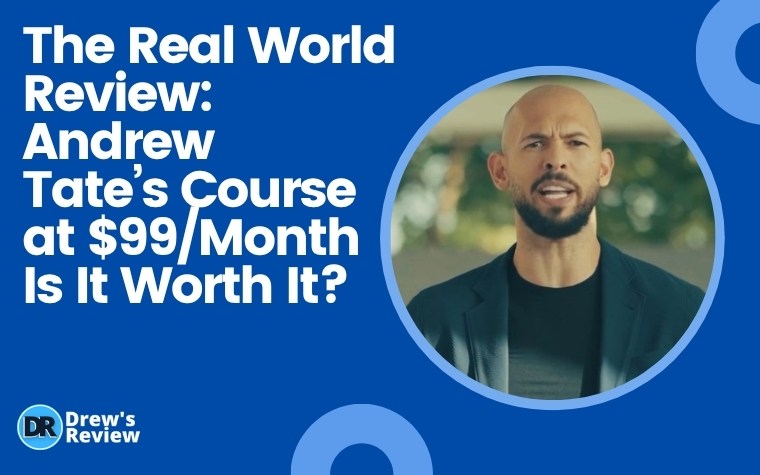
Welcome to my review of The Real World by Andrew Tate.
I'll get straight to the point: I don't recommend it at the current price. Not because it's a scam. It isn't. It's because $99/month is hard to justify for content you can largely find for free, from a platform that doubled its price without doubling its value.
I've been through Hustlers University across multiple versions, I've reviewed dozens of online courses, and I've read through real student experiences from people who paid their $99 and actually used the thing. What follows is the honest picture.
💡 Looking for an Alternative?
The Real World costs $99.99/month ($1,200/year) with no refunds and teaches 6+ business models with no clear path through any of them.
I built The 2026 AI Business Blueprint to fix exactly that: 5 focused models with AI doing the grunt work for $27 one-time. (Price will go up soon - this is a brand new course and is the introductory rate) Jump to this alternative or keep reading to see why TRW falls short for most people.
What Is The Real World?
The Real World is Andrew Tate's subscription-based online education platform. It teaches various ways to make money online through separate learning sections called "campuses", each focused on a specific business model and taught by a dedicated instructor.
It launched in late 2022 as a rebrand of Hustlers University, moving off Discord onto its own custom-built platform and app. Today it runs on independent servers, has over 155,000 members, and costs $99/month.
The core promise hasn't changed: learn practical, income-generating skills from people who are supposedly already using them. The price has.
⭐ My Real World Rating - 3/5
The Real World earns points for improving the platform since the Discord days, having active professors in most campuses, and offering a genuine community for beginners who pick one focus area. It loses marks for doubling the price without doubling the value, no refund policy, teaching too many business models with no clear path through any of them, and marketing that creates unrealistic income expectations.
At $99.99/month it's hard to justify for most people when better-focused alternatives exist at lower price points.
Who Is The Real World For?
The Real World is best suited for complete beginners who have no idea where to start with making money online.
If you've never thought seriously about building an online business, don't know the difference between dropshipping and copywriting, and want a structured place to explore your options - this gives you that. The campuses are organized, the instructors are active, and the community is genuinely engaged.
It's also for people who thrive in community-based learning. A lot of what makes the platform useful is the ability to post your work, ask questions, and get feedback from people actively building businesses, more than the video content itself.
Who Is The Real World NOT For?
It's not for you if you're expecting to make serious money fast.
This is where most people get burned. The marketing around The Real World, not necessarily from Tate himself, but from the affiliate network that promoted it aggressively, created an expectation of rapid income that the course itself doesn't deliver on. One reviewer actually tested the full system from scratch. He did the product research, built the store, ran the ads, and finished his first week with $50 in profit. That's a normal result for someone learning a new skill, not a failure. But it's nowhere near what the marketing implied.
It's not for you if you want advanced training. The content is beginner-level. Multiple reviewers note that what's taught inside the campuses is available for free on YouTube with some searching. One experienced entrepreneur pointed out that the copywriting outreach methods being taught were methods he had already published publicly for free, yet people inside were paying $99/month to access them.
It's also not for you if you're on a tight budget. Beyond the $99/month membership, many of the business models covered require additional capital to actually execute. E-commerce/dropshipping needs at least $1,000 to get started meaningfully. Crypto requires money to invest. AI agency building requires upfront knowledge and tools. The $99 is just the entry fee, not the total cost.
What's Inside The Real World?
The platform has expanded significantly since the Hustlers University days. There are now 12+ campuses covering:
E-commerce and dropshipping, copywriting, crypto investing, crypto trading, crypto DeFi, AI automation agency, business mastery, content creation, freelancing, social media growth, affiliate marketing, and fitness.
Each campus has its own professor, structured modules, and a community chat. You can access all of them with your subscription.
Not all campuses are created equal.
The copywriting campus is the most consistently well-reviewed. It's detailed, structured, and covers everything from writing sales emails to landing freelance clients. If you were going to focus on one campus, this is the one most people point to as genuinely solid.
The e-commerce campus has improved since the early days. The product research section teaches the Meta ad library method: finding products that other people are actively spending money to advertise, which signals they're converting. That's a real and legitimate approach. Store setup, pricing strategy, and ad campaign structure are all covered.
The crypto campuses get mixed reviews. Multiple students describe them as surface-level. The fundamentals are there (chart reading, risk management, position sizing), but the depth isn't enough for anyone who wants to trade seriously. And you need actual money to trade with, which is worth stating plainly.
The Hustlers campus is worth mentioning because it illustrates the range of expectations inside the platform. One reviewer pulled real "wins" from that campus: someone making $40 from cat-sitting for the weekend, someone selling a sweater from Facebook Marketplace for $3.03 profit. Those are real wins for complete beginners taking their first steps. But if you're joining expecting life-changing income, this is a jarring reality check.
The Community
This is one of the more genuinely useful parts of the platform, and it's also one of the most overhyped.
The community is active. Thousands of people post results, ask questions, and give feedback. If you actually use it, posting your work, asking specific questions, engaging with other students, you'll get real responses from real people working on the same things.
The downside is the noise. A large portion of members lurk. Others post motivational content, Tate quotes, and hype rather than substantive help. One experienced reviewer who spent three years inside described half the chats as silent and the other half as people asking questions they'd never apply.
There's also a strong fan club element to the community. Conversations frequently drift toward Tate himself rather than the business skills being taught. That works fine if you're a fan of his. It's a distraction if you're there for the business content specifically.
The Platform
This is where The Real World has genuinely improved.
Earlier versions ran on Discord, which was messy: spammy, poorly moderated, and disorganized. The current platform runs on dedicated custom servers with its own app on iOS and Android. The layout is cleaner, moderation is better, and finding actual course content is easier.
The Android app has received some complaints about glitching mid-video. The iOS version runs more smoothly according to user reports.
It's a real improvement. It's also the most significant change since the price increase, and a better app alone doesn't justify doubling the monthly cost.
Is The Real World a Scam?
No. A scam takes your money and gives you nothing. The Real World gives you something.
The problem is the expectation gap between what the marketing implies and what the product actually delivers. That gap is wide. Going in expecting to make thousands of dollars in the first month leads to feeling scammed. Treating it like an educational investment and committing to one campus for three to six months tends to produce genuine progress instead.
The YouTube review landscape makes this worse. When the affiliate program was active, almost every positive review you could find had an affiliate link attached. Those reviewers weren't reviewing the course. They were selling it. Now that the affiliate program is closed to new enrollment, more honest assessments are surfacing, and they're considerably more mixed.
The Real World Pricing
There are two plans, though only one is currently available.
The Conquer plan is $99/month, or $996/year if you pay annually (saving $192). This is the standard membership and gives you access to all 12 business model campuses, VIP account ranking, up to 7 connected devices, priority support, step-by-step learning, and daily course updates with live broadcasts.
The Vanguard plan is $499/month or $4,970/year, and is currently sold out. It includes everything in Conquer plus experimental feature access. At that price it appears to be a premium coaching or mentorship tier, though details aren't publicly spelled out.
For most people, Conquer is the only realistic option. At $99/month with no refund policy, that's still $1,188 per year if you stay subscribed for twelve months.
You can pay by card, or, worth noting, by crypto on the annual plan.
The no-refund policy is the detail that concerns me most. You pay, you're in, and if you decide it's not for you after a week, that $99 is gone or worse if you pay for the year, that $996 is also gone!

The Hidden Costs Nobody Mentions
The $99/month is just the entry fee. What you actually spend to implement what you learn is a different number entirely.
E-commerce and dropshipping require ad spend to test products. Multiple reviewers cite needing at least $1,000 to $2,000 to get started properly, enough to run Facebook or TikTok ads at a level where you can actually gather data and make decisions. Running ads on a shoestring budget produces shoestring results. The course teaches you what to do, but the money to actually do it comes from your own pocket.
Crypto requires capital to invest or trade. You cannot learn crypto trading without money to trade with. The course covers strategy, but strategy without capital is just theory.
Stock trading requires a minimum of around $4,000 to trade meaningfully according to the course itself.
Shopify, ad tools, product testing, domain names, email software: these all sit on top of the $99 membership fee.
If you're joining The Real World with $99 and nothing else, you'll learn things you can't yet afford to apply. Know that going in.
Beware of Fake The Real World Sites
This is worth a specific warning because it's a real problem.
Multiple phishing sites impersonating The Real World exist online. They look identical to the real platform but are designed to steal your payment details. If you're going to sign up, go directly to jointherealworld.com. Don't click links from social media profiles, YouTube descriptions from unfamiliar channels, or any source you don't completely trust.
The legitimate site processes payments through standard card options. The official terms confirm the recurring charge is $99.99 every 30 days. If a site is offering a different price or a special deal, it's not the real platform.
How to Cancel The Real World - Step by Step
This section exists because the cancellation process has generated more complaints than almost any other aspect of the platform. This walks through exactly how to do it so you don't get charged for a month you don't want.
Log into your account at jointherealworld.com. Go to your membership portal, found in your account settings. Find the subscription management option and select cancel. You must do this before your next billing cycle to avoid being charged for the following month. Screenshot the confirmation screen the moment it appears.
After cancelling, check your email for a confirmation. Then check your bank statement the following month to confirm the charge did not recur. Multiple users report being charged after cancelling. If this happens to you, contact your bank directly about a chargeback rather than waiting for support to respond.
One thing worth knowing: several reviewers describe the cancellation flow as using psychological pressure to keep you subscribed: messaging around quitting, shame-based copy, that kind of thing. It's a marketing tactic. Ignore it, confirm your cancellation, and move on.
Andrew Tate's Legal Situation and What It Means for The Real World
Andrew Tate's criminal case in Romania, involving allegations of human trafficking and organised crime, remains open as of 2026. The case has been ongoing since his arrest in December 2022.
I'm not going to rehash the details here since this is a course review, not a profile of Tate himself. But the legal situation is relevant to anyone considering a $99/month subscription for one specific reason: platform risk.
The Real World has already been deplatformed once, which is why Tate built the entire custom infrastructure to avoid it happening again. But if the legal situation escalates significantly, there is a real question about whether the platform continues operating normally. That's a risk factor worth acknowledging, not a prediction.
If you join and the platform shuts down, there are no refunds. Keep that in mind.
The Real World Pros and Cons
Pros:
- Wide range of business models covered, good for total beginners exploring options
- Active community with real members posting work and getting feedback
- Copywriting campus is genuinely well-structured
- E-commerce product research training is solid and current
- Custom platform is a real improvement over the old Discord setup
- Instructors are active and accessible, not pre-recorded content dumped and abandoned
- Beginner friendly, no prior experience needed for any campus
Cons:
- $99/month with no refund policy is hard to justify
- Most content is available free on YouTube with some effort
- Content depth is introductory, not suitable for anyone past beginner level
- Not all campuses are equal; crypto and some others feel surface-level
- The expectation gap between marketing and reality is significant
- Many business models require additional capital beyond the membership fee
- Community has a fan club element that can distract from actual learning
- Most members lurk and never take action, and while the platform can't fix that, the marketing doesn't acknowledge it either
What Are People Actually Saying About The Real World?
The review landscape for this course is uniquely messy, and worth explaining before you trust any of it.
When the affiliate program was active, thousands of people earned commissions by posting glowing reviews with referral links attached. Most positive YouTube reviews from that era were promotional content dressed up as honest feedback. Now that the affiliate program is closed, more genuine assessments are surfacing, and they're considerably more mixed.
Reddit threads on r/Scams, r/Entrepreneur, and r/AndrewTate are overwhelmingly negative in 2026. The recurring theme: most of what's taught is available free, the community leans more toward Tate fandom than practical business discussion, and the people visibly making money are mostly promoting the platform rather than applying the skills.
Trustpilot reviews from 2025 and 2026 break into two clear camps.
The negative reviews share consistent themes. Content described as mostly motivational speeches rather than technical training. Billing complaints, including charges continuing after cancellation requests, with support slow or unresponsive. The crypto campus gets the harshest criticism, with multiple users reporting significant financial losses following trading signals from the platform. One long-term member who spent years in and out of the program wrote that they never managed to build anything meaningful despite repeated attempts.
The positive reviews also share a pattern. Almost every student who reports genuine results picked one campus, usually copywriting or e-commerce, committed to it for several months, posted their work publicly in the community for feedback, and treated it as a real skill-building exercise rather than a shortcut. The first products usually failed, the second ones did better, and by the third attempt some of them worked. The timeline was months, not weeks.
The honest picture from real student experiences:
The students who feel scammed are usually the ones who went in expecting fast money and found basic content they could have found for free. The ones who got results went in with realistic expectations, focused on one thing, and did the work consistently.
That gap between what the marketing promises and what the experience actually delivers is the single most consistent theme across hundreds of real user reviews. The platform is real, the content exists, and the results depend almost entirely on what you bring to it rather than what it hands you.
A Better Alternative to The Real World
The Real World will cost you $1,200 this year for content that drops you into 6+ different business models with no clear path through any of them. You'll bounce between dropshipping, crypto, copywriting, freelancing, and stocks without ever building real momentum in anything. Then the subscription renews and you're out another hundred bucks.
I built The 2026 AI Business Blueprint to solve exactly this problem.
What's different:
You get 5 focused business models: Affiliate Marketing, Faceless YouTube, AI E-Commerce, AI Freelance, and Digital Products. Pick one, execute it with AI doing the grunt work, move to the next if you want. No subscription trap. No pressure to juggle six models at once.
Each module walks you through the actual work: finding offers, creating content, building stores, landing clients, launching products. AI handles the time-sinks that used to require a copywriter, designer, VA, or weeks of trial and error. Product research that used to take days now takes an afternoon. A round of ad copy that needed three revisions before is down to about ten minutes. Customer service that used to eat into your evenings can largely handle itself.
The price difference is brutal: $27 one-time for all 5 modules plus 3 bonuses versus $1,200/year for The Real World's subscription model. You own the course forever, with no recurring charges, and no refund anxiety since there's actually a guarantee this time.
Here's the breakdown:
- Module 1: AI Affiliate Marketing: Finding offers, creating content, and driving traffic using AI to compress timelines
- Module 2: Faceless YouTube: Building a channel without showing your face, using AI for scripts, voiceovers, and editing
- Module 3: AI E-Commerce: Product research, store building, visuals, and marketing with AI handling the heavy lifting
- Module 4: AI Freelance: Landing clients, delivering services, and scaling with AI as your assistant
- Module 5: Digital Products: Creating and selling info products, templates, and tools with AI production workflows
Plus 3 bonuses:
- Faceless Social Pack (Instagram, TikTok, Twitter growth strategies)
- AI Tools Stack (the exact tools and prompts I use)
- Anti-AI Detector Framework (how to make AI content sound human)
The Real World gives you access to content. What I built gives you a system you can actually execute. Pick one model, go deep, build something real. If it doesn't work for you, there's a 30-day refund window, something TRW doesn't offer at all.
Not ready yet? Get my free AI Business Cheat Sheet to learn more about the program.
My Verdict
The Real World is a legitimate course. It is not a scam. For a complete beginner who has no idea where to start and wants a structured environment to explore online business models, there is real value inside, especially in the copywriting and e-commerce campuses.
But I don't recommend it at $99/month.
My honest take: the content isn't worth double what it cost two years ago. The price went up significantly; the quality didn't follow at the same rate. Most of what's taught is available for free. The business models that require real capital, crypto, e-commerce ads, AI agency building, require money on top of the membership fee. And there are no refunds.
If you're dead set on trying it, pick one campus, copywriting or e-commerce, commit to it for 30 days, post your work in the community, ask questions, and cancel before the second billing cycle hits if it's not clicking. Don't bounce between campuses, and don't get swept up in the community hype. Treat it like a trial run rather than a long-term commitment.
For most people, I think there are better ways to spend $99/month on business education. A specialized course in one skill from an expert practitioner will take you further than a broad platform that covers twelve topics at introductory depth.
Frequently Asked Questions
Is The Real World the same as Hustlers University?
Yes. The Real World is the current version of Hustlers University. HU 4.0 and The Real World share the same login portal, so signing up for either takes you to the same platform.
How much does The Real World cost in 2026?
$99/month. There is no one-time payment option. A yearly plan is available at a discount. Check the current pricing page for exact figures, since rates have been changing.
Is there a refund policy for The Real World?
No. Once you pay, that money is gone. You can cancel future billing at any time, but there are no refunds for payments already made.
Does The Real World have an affiliate program?
The affiliate program is currently closed to new enrollment. It was active during the Hustlers University era but has been shut down and is not available to new members in 2026.
Is The Real World worth it for beginners?
It depends on your expectations. If you treat it as an introduction to online business and commit to one campus for at least 30 days, there is genuine learning value. If you expect to make significant money quickly, you'll be disappointed.
What is the best campus in The Real World?
The copywriting campus is the most consistently well-reviewed for content quality and structure. The e-commerce campus has also improved and covers legitimate, current product research methods.
Is The Real World a scam?
No. The platform is real, the content exists, and the instructors are active. The main criticism is that much of the content is available free elsewhere, the price has doubled without equivalent improvements in depth, and the marketing creates unrealistic income expectations.
Who should NOT join The Real World?
People on a tight budget, expecting quick income, already past beginner level in the business models covered, or uncomfortable with the no-refund policy should skip it.
Are there fake Real World websites?
Yes. Multiple phishing sites impersonating The Real World exist and are designed to steal payment details. Only sign up through jointherealworld.com directly. Do not use links from unfamiliar social media profiles or YouTube descriptions.
How do I cancel The Real World subscription?
Log into your account at jointherealworld.com, go to your membership portal in account settings, and find the subscription management option. Select cancel before your next billing cycle to avoid being charged for the following month. Screenshot the confirmation immediately and check your bank statement the following month to confirm no further charges appear.
What's a better alternative to The Real World?
The 2026 AI Business Blueprint gives you 5 focused business models (Affiliate Marketing, Faceless YouTube, AI E-Commerce, AI Freelance, Digital Products) for $27 one-time versus $1,200/year for The Real World's subscription. Each module uses AI to handle the time-sinks that used to take weeks, things like product research, copywriting, visuals, and customer service. You pick one model and execute it instead of bouncing between six different campuses. It includes a 30-day refund policy, which TRW doesn't offer.
Can I learn business with AI instead of paying for The Real World?
Yes, and you'll save $1,152 in the first year. The 2026 AI Business Blueprint teaches you how to use AI tools to compress timelines across affiliate marketing, YouTube, e-commerce, freelancing, and digital products. What used to take a copywriter, designer, and weeks of trial and error now takes AI and a good prompt. The course shows you which tools work, which prompts get results, and how to execute without the subscription trap.
How is The 2026 AI Business Blueprint different from The Real World?
The Real World is $99.99/month with no refunds and teaches 6+ business models at once with no clear path through any of them. My course is $27 one-time, gives you 5 focused models to pick from, and uses AI to handle grunt work that used to require weeks of manual labor. You own it forever, there's a 30-day refund window, and you can go deep on one model instead of getting overwhelmed by six. TRW runs as a subscription treadmill, while this is a one-time investment with a clear execution path.
Is The Real World worth it in 2026?
At $99.99/month ($1,200/year) with no refunds, The Real World is hard to justify for most people. The platform has improved since the Discord days, but you're still getting 6+ business models with no clear path through any of them. For $27 one-time, The 2026 AI Business Blueprint gives you 5 focused models with AI doing the heavy lifting, a 30-day refund policy, and no subscription trap. Unless you specifically value the TRW community above all else, the AI course is a better investment.

- Top West Coast Fulfillment Companies for Ecommerce Brands in 2026 - October 19, 2026
- Digital Entrepreneurs Are Discovering That Physical Operational Infrastructure Accelerates Digital Scale - October 18, 2026
- Fast-growing E-commerce Sellers Are Overhauling Fulfillment Hubs To Keep Up With Orders - October 16, 2026