Welcome to my Fiction Profits Academy review. Fiction Profits Academy is a legit Amazon publishing program from Karla Marie. It costs far more than the $1,995 price tag, and FPA's own survey shows most students earn little until they've published a lot of books.
The coaching is extensive, and the program now leans heavily on its own AI writing software. Before you buy, you should also know about the refund conditions, a 5% royalty share, and a mandatory arbitration clause, all spelled out in the terms.
📌 The Short Version
Fiction Profits Academy (FPA) teaches you to publish fiction on Amazon Kindle using ghostwriters and its members-only AI software, FictionPub AI. The program costs $1,995, and FPA's own cost estimates put a first year of one book a month at roughly $4,600 to $7,400 total. The refund guarantee requires publishing a 30,000-word ebook within six months. In FPA's July 2025 survey, students with one book averaged $90 a month, and only about 9% of respondents had published 10 or more books.
⭐ Fiction Profits Academy Rating: 3/5
I give Fiction Profits Academy a 3 out of 5. It is a real company with a detailed curriculum and group coaching five days a week. It also has an earnings disclosure, which is more transparent than most programs in this space.
The rating of 3 stays due to all of the elements surrounding the training. The true cost during the first year is several times more than the price of the course. The refund guarantee has a 30,000 word condition that is not listed on the sales page. Additional terms include a 5% royalty share and arbitration. The FAQ mentions income expectations that are well ahead of what the company’s own survey shows.
What Is Fiction Profits Academy?
Fiction Profits Academy is an online program that teaches you to run a fiction publishing business on Amazon Kindle, using ghostwriters and AI instead of writing the books yourself. Karla Marie started it in 2015, and FPA says it has taught more than 15,000 students with a team of about 40 coaches and staff.
The model works like this. You pick a profitable fiction niche like romance, get a book drafted by a ghostwriter or with FPA's AI software, add a cover, publish under a pen name on Kindle Direct Publishing, and repeat. FPA recommends publishing one book a month.
According to FPA's checkout page, the current package includes a new 2026 video course, live group coaching five days a week, and four one-on-one coaching calls, plus four more as a bonus. You also get a private community, one free AI book credit, and a long list of bonuses, including story-creation AI software and a $500 "action-taker" rebate.
FPA sits in a crowded field of Amazon publishing programs, including the Mikkelsen Twins' program I reviewed. Its angle is fiction. FPA says most competitors focus on nonfiction, even though fiction dominates Kindle's bestseller charts.
How Much Does Fiction Profits Academy Cost?
Fiction Profits Academy costs $1,995, but FPA's own cost estimates put a first year of publishing one book a month at roughly $4,600 to $7,400. The checkout page lists a regular price of $3,000 and offers buy-now-pay-later options through services like Klarna, Afterpay, and Sezzle.
The bigger costs come after you join. FPA's own FAQ lays out what it expects you to spend on each book:
| Stage | Book length | Ghostwriting cost per book |
|---|---|---|
| Months 0–6 | 10,000–30,000 words | $100–$300 (about $0.01 per word) |
| Months 6–12 | 30,000–50,000 words | $300–$500 |
| After year one | Longer, higher-quality books | $400–$800 |
FPA also budgets $20 to $50 per cover, plus smaller costs like an email service and a domain.
Here's the first-year math using those numbers:
- Six early books: $600 to $1,800
- Six longer books: $1,800 to $3,000
- Twelve covers: $240 to $600
- The course: $1,995
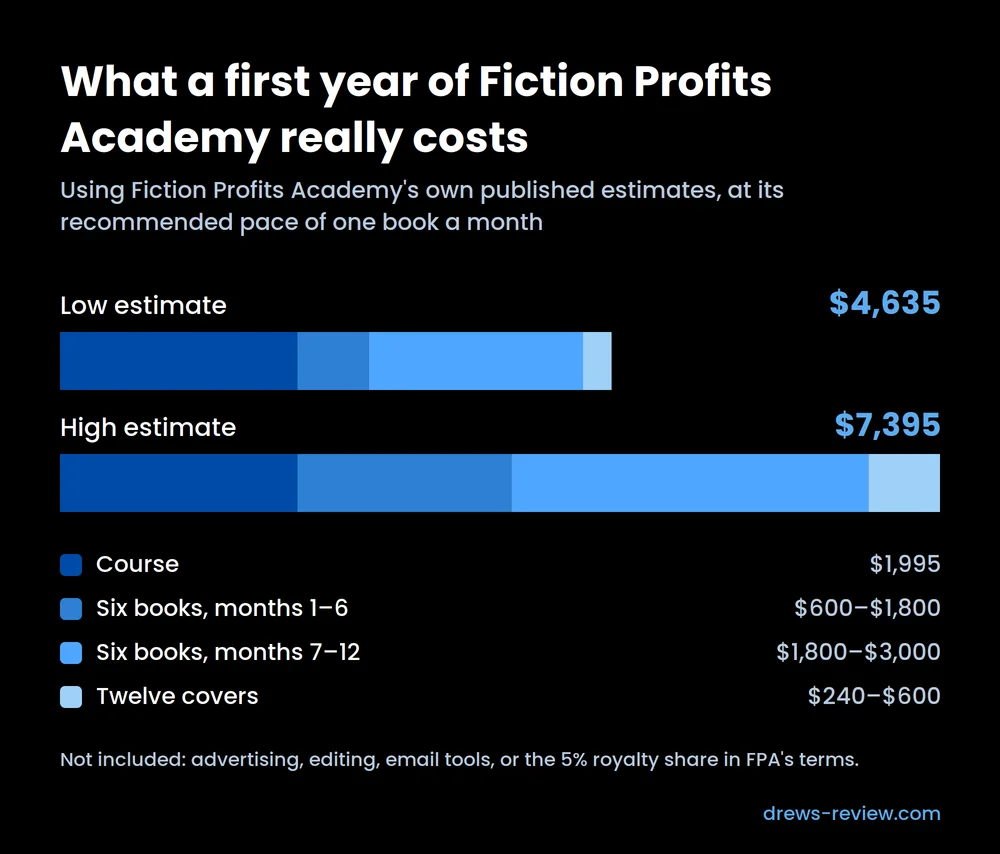
That adds up to roughly $4,600 to $7,400. It doesn't include advertising or editing, which FPA's estimates leave out.
There's also a cost most reviews miss: a royalty share. FPA's terms and conditions say that for 12 months after you enroll, you agree to share 5% of your Kindle royalties with FPA. The same section also mentions 5% of net profits, so ask which one applies before you buy.
To put that spending in perspective, take an ebook priced at $4.99 on Amazon's 70% royalty option. It earns you about $3.49 per sale, before Amazon's small delivery fee. At that rate, covering a $4,600 first year takes about 1,330 sales, and the high end takes more than 2,100. Kindle Unlimited page reads can add to that, but it's still a lot of books to sell.
My advice: don't join without at least $5,000 you can afford to lose. FPA's model assumes you keep paying for a new book every month.
What Does the Money-Back Guarantee Actually Cover?
FPA offers a six-month money-back guarantee, but its terms require you to publish an ebook of at least 30,000 words on Amazon, using the FPA system, within those six months. At FPA's own rates, ghostwriting a 30,000-word book costs about $300, plus a cover, before you can even ask for your money back.
The sales page makes the guarantee sound simpler. It says all you need to do is publish one book in six months, with "no hidden catches, no fine print." The 30,000-word minimum only shows up in the terms. The terms also say you must "fully engage" with the program, without spelling out everything that includes.
A few other details in the terms matter:
- Payments become final after six months.
- No refund if FPA ends your access. That applies if FPA suspends or terminates your account.
- The guarantee only works once. If you take a refund and buy the same program again within two years, it doesn't apply the second time.
- Refund requests go by email to FPA's support team.
The $500 action-taker rebate has its own conditions. You must publish your first ebook within 180 days, at 30,000 words or more, priced at $0.99 or higher. You also need to use a ghostwriter selected through the program, or collect 30 Amazon reviews if you wrote the book yourself.
The terms also require mandatory arbitration and waive your right to join a class action. You can opt out, but only by mailing a letter to FPA within 30 days of your purchase. If you do buy, that letter is worth sending.
FPA has pushed back on refund complaints in public. In a reply on Trustpilot, the company said its refund policy is disclosed before purchase, on the checkout page, and in the terms, and that the guarantee comes with specific conditions.
Who Is Karla Marie?

Karla Marie is the founder of Fiction Profits Academy, a former musician who says she built a six-figure fiction publishing business on Amazon before starting FPA in 2015. FPA's site says she has published more than 60 novels and critiqued thousands of books.
Her co-founder is Roy Lewis, a former student. According to FPA, Roy took Karla's course in 2016, has published more than 200 books, and earned $2.3 million publishing fiction. He's the program's headline success story.
Keep two things in mind. First, these figures come from FPA, and I couldn't find independent verification. Second, the biggest early wins happened years ago, when Kindle publishing was less crowded and AI-written books weren't flooding the store. That doesn't make the stories untrue, but it does make them a weak guide to what a beginner can expect in 2026.
FPA also leans on media badges from outlets like USA Today and Forbes. At least some of that coverage traces back to syndicated press releases, like a May 2025 announcement about FPA reaching 15,000 graduates. A press release is a paid announcement, not independent reporting, so give those badges less weight than a real news story.
What Is FictionPub AI?
FictionPub AI is FPA's own AI software for creating fiction books, and it's only available to FPA students. FPA describes it as a tool that walks you through picking a niche, tropes, characters, story ideas, chapter outlines, and even covers.
This is the biggest change to FPA in recent years. The program started as a ghostwriting system, and FPA now pitches its AI software as the fastest way to publish. Your enrollment includes one free AI book credit, and FPA's software page features a testimonial from someone who says their assistant generated a full manuscript in minutes.
I couldn't confirm what FictionPub AI costs once your included credit runs out, so ask before you buy. And if you plan to use it for your books, read the next section, because Amazon has specific rules for AI-generated content.
Does Fiction Profits Academy's Business Model Still Work in 2026?
FPA's model can still work in 2026, but AI has made fiction publishing more crowded, and quality now matters more than speed. Amazon allows AI-generated books, but it has tightened the rules around them, and cheap, rushed books face a tough market.
What Amazon's AI Rules Mean for FPA Students
Amazon requires you to disclose when a book contains AI-generated text, images, or translations. If AI created the content, you check a disclosure box when you publish, and Amazon still counts it as AI-generated even if you edited it afterward. If you wrote the content yourself and only used AI to edit or polish it, you don't need to disclose anything.
The disclosure is private. Readers don't see it, and it doesn't change your royalty rate. The real risk is misrepresenting your AI use, which KDP policy trackers warn can get books removed or put your whole account at risk.
So if you use FictionPub AI to draft your books, plan on checking that box. And since Amazon has said it doesn't allow AI content that gives customers a poor experience, an AI draft still needs real editing before it goes live.
Amazon also started limiting how many new titles an account can create back in 2023, to slow down mass-produced AI books. That limit won't touch FPA's recommended pace of one book a month, but it shuts down the "flood the store" approach some publishers relied on.
Why Cheap Ghostwriting Is the Weak Link
FPA's starting rate of about $0.01 per word is my biggest concern with the model. At that price, a 30,000-word novel costs about $300. A penny a word is bottom-of-the-market pricing for fiction, so beginners often end up with writers who are new, rushed, or leaning on AI themselves.
FPA's FAQ does say longer, higher-quality books pay off as you grow, and it suggests that students who are earning move up to about $0.02 per word. That's sensible advice. It also means your first six months of books are built on the cheapest possible writing, right when you're trying to earn your first reviews and readers.
Fiction readers are demanding. If a romance reads like it was written in a hurry, readers stop reading, leave bad reviews, and skip your next book. Cheap books aren't a shortcut if nobody finishes them.
What Do Fiction Profits Academy Students Actually Make?
According to FPA's own July 2025 survey, students with only a few books earn a few hundred dollars a month or less on average, and very few have published enough books to earn more. FPA surveyed its students and posted the results on its checkout page, which is more than most programs do.
Here are the average monthly earnings FPA reported, grouped by how many books each student had published:
| Books published | Average monthly earnings | Students |
|---|---|---|
| 1 | $90 | 178 |
| 2–3 | $368 | 188 |
| 4–5 | $185 | 142 |
| 6–9 | $827 | 134 |
| 10–14 | $3,039 | 87 |
| 15–20 | $2,475 | 35 |
| 21+ | $6,064 | 18 |
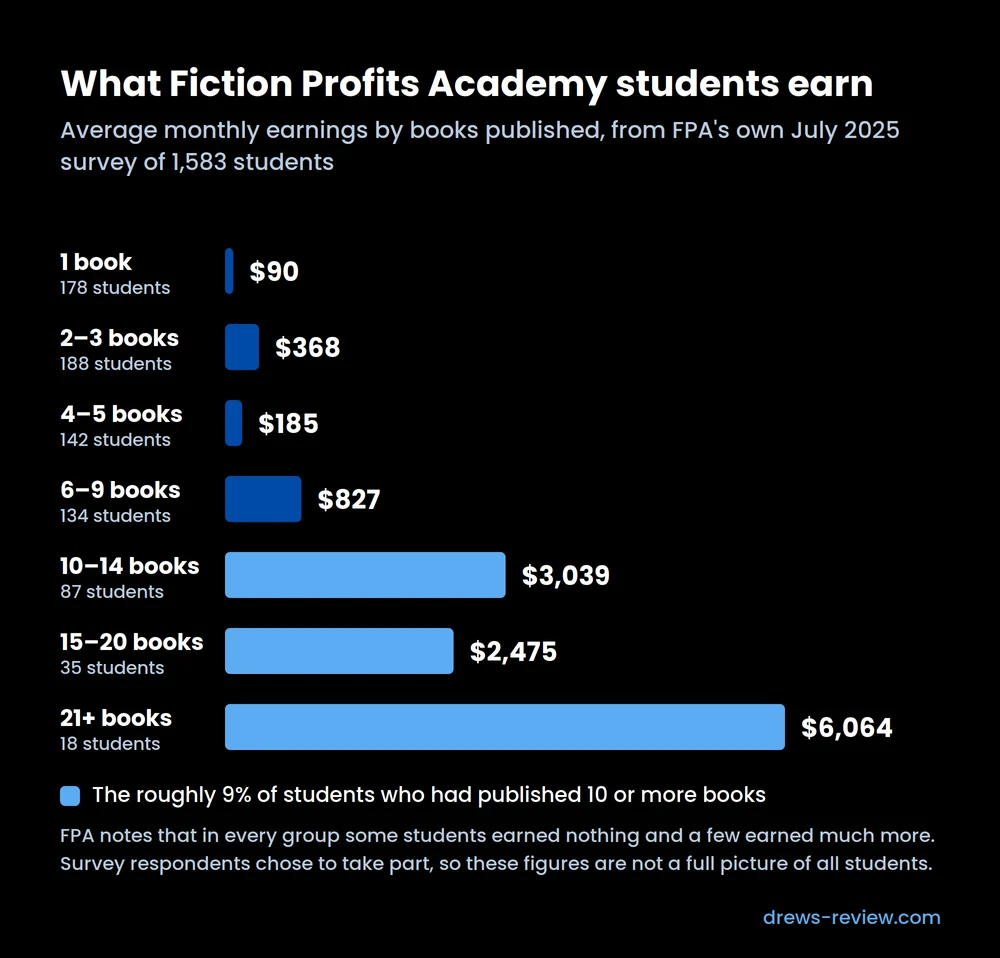
Only 140 of the 1,583 students who responded, about 9%, had published 10 or more books. Those students do report meaningful income on average, which tells me the model can work for people who stick with it. The catch is how few get that far. FPA also notes that some students in every group earned nothing and a few earned much more, so a handful of big earners can pull the averages up.
The numbers don't quite add up, either. FPA says 483 respondents had published at least one book, but the group sizes above total 782. Either way, at least half of the students who answered hadn't published a book yet.
Now compare that with FPA's own FAQ. It says students who follow the program can expect their first dollar within 25 days and usually reach $500 a month within two to three months. It also presents a $10,000-a-month business within a year as a realistic goal. Meanwhile, its survey shows students with two or three books averaging $368 a month. Students with 10 to 14 books, which is roughly a year of publishing at FPA's pace, averaged $3,039.
FPA's terms add one more reality check. They say the testimonials on its website are exceptional results from its most successful users, not what most students should expect.
What Are Students Saying About Fiction Profits Academy?
FPA has more than 3,400 reviews on Trustpilot, mostly praising the coaching, and an A+ rating on its BBB profile alongside some cancellation complaints. Both are worth reading with a bit of context.
Trustpilot
Most of FPA's Trustpilot reviews are glowing, and many name specific coaches who helped with blurbs, covers, and next steps on one-on-one calls. That lines up with FPA's strongest selling point, which is how much coaching you get.
Keep in mind that many of these reviews describe early wins, like feedback on a first book, rather than income. They're a good read on the support, but they don't tell you much about results. FPA does respond publicly to some critical reviews, disputing claims about its refund policy and denying that it posts fake reviews.
Better Business Bureau
On the BBB, Fiction Profits Academy isn't accredited but holds an A+ rating. The profile lists the company's other name as Digital Doers, LLC, and says it has been in business since 2015.
The recent reviews there are mixed. Some praise the program and staff, one mentions FPA's more intensive BootCamp program, and a June 2026 review describes a cancellation request that hadn't gotten a response.
The BootCamp
FPA also runs a BootCamp, a more intensive program that comes up in student reviews. I couldn't find its price published anywhere. If you're offered an upgrade, get the price and refund terms in writing before you agree to anything.
Exposed: What Many Fiction Profits Academy Reviews Won't Tell You
Many reviews of programs like FPA end by steering you toward a different business model the reviewer sells or promotes. One review I read wraps up by suggesting you rank small websites in Google instead. That doesn't make their criticism wrong, but check what a reviewer is selling before you trust their conclusion.
In that spirit, here's mine: I sell a low-cost guide to creating digital products, and I mention it once in the alternatives section below. I'd rather tell you now than bury it.
What I Like About Fiction Profits Academy (The Pros)
The coaching is the standout. Group calls run five days a week, and the package adds one-on-one calls on top. Trustpilot reviewers keep crediting specific coaches for practical, detailed feedback.
FPA publishes an earnings disclosure. Very few programs share survey data on what students earn by number of books published. Even with its flaws, it gives you a much clearer picture than testimonials alone.
The roadmap is clear. FPA spells out book lengths, ghostwriting budgets, cover costs, and a one-book-a-month publishing pace, so you won't be guessing about what to do next.
The AI software is included. You get FictionPub AI and one free AI book credit, which lowers the cost of your first book compared with hiring a ghostwriter.
The model can pay off for people who stick with it. In FPA's own survey, students with 10 to 14 books averaged $3,039 a month. Roy Lewis's results, if accurate, show what's possible for the few who scale.
There's a refund path. It comes with conditions, but a six-month guarantee is more than many programs at this price offer.
What I Don't Like About Fiction Profits Academy (The Cons)
The real cost is easy to underestimate. The $1,995 course is only the entry fee. By FPA's own numbers, a year of publishing runs roughly $4,600 to $7,400, before ads or editing.
The guarantee is harder to use than the sales page suggests. The sales page says there's no fine print, but the terms require a 30,000-word ebook, published with the FPA system, within six months.
You'll share your royalties. FPA's terms take a 5% share for your first 12 months, and they aren't clear on whether that's 5% of royalties or of net profits.
You give up your right to join a class action. Mandatory arbitration applies unless you mail an opt-out letter within 30 days of buying.
Your access isn't guaranteed. The terms describe it as a license FPA can revoke at its discretion, so don't count on having it forever.
The income expectations are too rosy. The FAQ presents $500 a month within two to three months and $10,000 a month within a year as realistic. FPA's own survey says otherwise for most students.
Cheap writing is built into the plan. Starting at about $0.01 per word keeps costs down, but it puts your first books at a quality disadvantage in a crowded market.
Some costs aren't published. I couldn't find prices for the BootCamp or for FictionPub AI after your included credit.
Is Fiction Profits Academy Worth It?
Fiction Profits Academy is worth it only if you have $5,000 or more you can afford to lose, can keep publishing every month for at least a year, and are comfortable managing writers and AI tools. For beginners who need income soon, it's a risky bet.
Who Fiction Profits Academy Might Work For
It fits people with real capital. The model assumes you'll pay for a new book every month, and FPA's survey suggests income only gets meaningful after 10 or more books.
It fits patient, organized people who like coordinating others. You'll be managing ghostwriters or AI drafts, covers, and launches, month after month.
It fits people who want lots of coaching. If you learn best with daily calls and a community to lean on, FPA gives you plenty of both.
It fits fans of the genre. If you read romance or thrillers yourself, you'll spot a weak draft before your readers do, which matters when you're starting with budget writing.
Who Should Skip Fiction Profits Academy
Skip it if you don't have at least $5,000 to spare. Running out of money before you build a catalog is the fastest way to lose.
Skip it if you need income in the next few months. FPA's survey shows students with a few books averaging a few hundred dollars a month or less.
Skip it if you want truly passive income. Publishing a book every month is ongoing work, and Amazon controls the platform your whole business depends on.
Skip it if the fine print bothers you. Between the 30,000-word refund condition, the royalty share, and the arbitration clause, read the terms before you pay.
What Are the Best Fiction Profits Academy Alternatives?
The best alternative for most people is to test Kindle publishing cheaply before paying for any program. Amazon's own KDP help pages and free YouTube tutorials cover the basics. You can publish one short book on a small budget and see whether you actually enjoy the process.
If you want another structured program, compare a few before choosing. For example, Sophie Howard, whose Blue Sky Amazon program I've reviewed, also runs a Kindle publishing course called Kindle Publishing Income. Whatever you look at, check the total costs, the refund terms, and any royalty-sharing clauses the same way.
If what appeals to you is creating something once and selling it many times, digital products you own are another path. Instead of selling on Amazon's terms, you sell guides, templates, or courses on a platform like Gumroad. Gumroad charges 10% plus 50 cents per sale, plus card processing.
You typically keep more of each sale than Amazon's royalties give you, plus you keep your customer list and set your own prices. I've written about the digital products worth selling right now if you want ideas.
And here's that one mention of my own product. My Digital Product Playbook walks you through choosing, validating, creating, and selling a digital product with AI. It's a fraction of the cost of Fiction Profits and includes full instruction how to use AI to help you make income with digital products.
Final Thoughts on Fiction Profits Academy
Fiction Profits Academy is a legitimate program with strong coaching, but the true cost, the fine print, and the slow path to meaningful income make it a fit for a narrow group of people.
I'll give FPA credit where it's due. The coaching gets consistent praise, the roadmap is clear, and posting an earnings disclosure is more honest than most programs manage. An earlier version of this review said FPA hadn't adapted to AI. That's no longer true: FictionPub AI is now central to the program.
What keeps my rating at 3 is everything around the training. A $1,995 price that grows into several thousand dollars, a guarantee with conditions the sales page doesn't mention, a royalty share, and an arbitration clause add up to a lot to weigh.
If you're seriously considering FPA, do three things first. Read the full terms, budget at least $5,000 for your first year, and publish one low-cost book on your own to see whether you enjoy the work.
Drew's Take: FPA can work for patient people with money to invest and a love of fiction. If that's not you, test the waters cheaply first, because FPA's own survey shows most students are still early in the climb.
Frequently Asked Questions
Is Fiction Profits Academy a Scam?
No, Fiction Profits Academy is not a scam. It's a real company with an A+ BBB rating, thousands of Trustpilot reviews, and extensive coaching. The concerns are its true total cost, the conditions on its guarantee, and income expectations that run ahead of its own survey data.
How Much Does Fiction Profits Academy Really Cost?
Fiction Profits Academy costs $1,995, but FPA's own estimates put a first year of publishing at roughly $4,600 to $7,400 total. That covers the course, ghostwriting, and covers, but not ads, editing, or the 5% royalty share in the terms.
Can I Get a Refund from Fiction Profits Academy?
Yes, but only under specific conditions. FPA's terms require you to publish an ebook of at least 30,000 words on Amazon, using the FPA system, within six months of enrolling. After six months, all sales are final.
What Is FictionPub AI?
FictionPub AI is FPA's members-only software for creating fiction books with AI. It helps with niches, tropes, characters, story ideas, chapter outlines, and covers, and your enrollment includes one free AI book credit.
Do You Have to Tell Amazon If Your Book Uses AI?
Yes, if AI generated the text, images, or translations, you must disclose it when you publish on KDP. If you wrote the content and only used AI to edit it, you don't need to disclose it. The disclosure is private and doesn't affect your royalties.
How Much Do Fiction Profits Academy Students Make?
In FPA's July 2025 survey, students with one book averaged $90 a month, and students with 10 to 14 books averaged $3,039. Only about 9% of respondents had published 10 or more books, and some students in every group earned nothing.
Can You Really Make Passive Income with Fiction Profits Academy?
Not really, at least not for a long time. FPA's model is built on publishing a new book every month, and income in its survey rises mainly with the number of books published. Your books can keep earning after launch, but building the catalog is steady, active work.
Is Karla Marie Legit?
Yes, Karla Marie is a real publisher who founded Fiction Profits Academy in 2015. FPA says she published more than 60 novels and earned six figures from fiction before launching the program. I couldn't independently verify those figures.
Does Amazon KDP Still Work in 2026?
Yes, Kindle publishing still works in 2026, but it's more crowded, and quality matters more than speed. Amazon allows AI-generated books with disclosure, limits how quickly accounts can add new titles, and doesn't allow AI content that gives readers a poor experience.

- Digital Entrepreneurs Are Discovering That Physical Operational Infrastructure Accelerates Digital Scale - October 18, 2026
- Fast-growing E-commerce Sellers Are Overhauling Fulfillment Hubs To Keep Up With Orders - October 16, 2026
- Ad Network Marketing Myths That Can Lead to Poor Campaign Decisions - October 13, 2026