Hey, Drew here. Welcome to my AI Agent Bootcamp review of Tina Huang's multi-agent systems course for 2026.
I spent 20+ hours researching this course because people keep asking me if it's worth the $997 price tag. I dug through student testimonials, analyzed the curriculum, watched Tina's YouTube videos, and compared it against what actually works for making money with AI in 2026. I've been running my own AI-powered business since 2023, so I know the difference between impressive tech skills and actual income generation.
Here's my honest take: AI Agent Bootcamp is technically solid, but it teaches you how to build complex systems without showing you how to actually sell them. You'll learn to engineer impressive multi-agent workflows, but you won't learn how to find the businesses willing to pay $10K+ for them or how to close those deals. That's a massive gap.
Look, if you just want to make money with AI and don't want to spend six months chasing enterprise clients, there's a way faster path. My 2026 AI Business Blueprint shows you five AI business models you can start this week without needing to code, pitch enterprise clients, or build custom systems for each sale. $27 one-time vs $997, and you'll be generating income in weeks instead of months. Learn more about the AI approach here.
Jump to the AI alternative or keep reading to see what AI Agent Bootcamp actually teaches.
⭐ AI Agent Bootcamp Rating: 3.5/5
I give AI Agent Bootcamp a 3.5 out of 5. Tina Huang's credentials are 100% legitimate and the technical training is solid based on student reviews. The problem isn't what you learn—it's what happens after you finish the course. You'll know how to build multi-agent systems, but you won't know how to find clients, close enterprise deals, or handle the brutal sales cycles that come with selling $10K custom AI projects. With 800+ students but only one widely documented success story, the math doesn't work for most people.
What You'll Learn in This Review
I'm going to break down everything you need to know about AI Agent Bootcamp. Is it suitable for beginners? What do you actually get for $997? Who's Tina Huang and why does her background matter? What's the real market for these complex AI systems? Why do most students struggle to make money despite learning impressive tech skills?
I'll also show you the total cost breakdown including hidden expenses, and give you better alternatives if you just want to make money with AI without the complexity.
Let's get into it.
What Is AI Agent Bootcamp?
AI Agent Bootcamp is a 28-day intensive course that teaches you how to build multi-agent AI systems—workflows where multiple specialized AI agents work together to automate complex tasks. Founded in 2025 by ex-Meta data scientist Tina Huang under her company Lonely Octopus, the course costs $997 for standard access or $4,997 for VIP with one-on-one coaching.
Here's the basic idea: instead of using one AI to do everything, you create systems where different agents handle different jobs. One agent researches, another summarizes, another makes decisions, and another triggers actions through APIs or databases. It's like having a team of AI workers instead of one overworked assistant.
The course teaches both no-code and coded approaches. You build four projects during the 28 days, starting simple and ending with an advanced multi-agent system. The program includes the AI App Sprint Workshop, Freelance Accelerator Masterclass, and access to a private community.
What makes this different from those "learn ChatGPT in 3 hours" courses: Most AI training shows you how to write better prompts or build simple chatbots. AI Agent Bootcamp goes way deeper into actual system architecture—how to make multiple AI agents coordinate with each other through sequential, hierarchical, parallel, and asynchronous patterns.
The course sells out crazy fast. All four cohorts have filled within 48 hours of opening to the waitlist, which tells you there's genuine demand for this type of training. Whether demand translates to actual income is a different question entirely.
Who Is Tina Huang?

Tina Huang is a former Meta data scientist with legitimate credentials in AI and machine learning. She holds a pharmacology degree from the University of Toronto and a master's in computer science from the University of Pennsylvania. Unlike the random gurus who jumped on the AI bandwagon in 2023, Tina has been working with AI since 2018.
Her background checks out completely. She started in bioinformatics and cancer research before switching to data science. She interned at Goldman Sachs doing machine learning work on massive datasets. She joined Meta in 2020 and worked on Oculus at the Facebook Reality Lab, then moved to Instagram where she built AI models for content moderation algorithms.
Tina left Meta in 2022 to build Lonely Octopus, her AI and data science education company. She also runs a YouTube channel with close to 1 million subscribers and teaches courses on 365 Data Science, where AI Agent Bootcamp holds a 4.9/5 rating.
I really appreciate that Tina's credentials are real. She's not some fake guru who took a weekend ChatGPT course and decided to teach AI. She worked on production AI systems at one of the biggest tech companies in the world.
But here's the thing: Building AI systems at Meta is very different from selling AI systems to small businesses. Working at a company where you already have clients, infrastructure, and a support team is not the same as cold-calling businesses to pitch them on $10K automation projects. This gap is where most students hit a wall, and the course doesn't really prepare you for it.
What Do You Get With AI Agent Bootcamp?
You get 28 days of structured training, four hands-on projects, the AI App Sprint Workshop, Freelance Accelerator Masterclass, private community access, and VIP students get one-on-one coaching calls. The standard tier costs $997 and the VIP tier costs $4,997.
The 28-day multi-agent systems training is the core program. You learn how multi-agent systems work, how to architect them, and how to build them using both no-code tools and actual code. The training is hands-on—you're building real projects, not just watching videos.
You build four different systems during the course, progressing from simple to advanced. By the end, you're supposed to have deployed your first advanced multi-agent system. Whether you'll have anyone to sell it to is a different story.
The AI App Sprint Workshop is a separate component focused on building and launching AI applications quickly. It covers research, user onboarding, and getting something live fast. Attendees get a $100 discount toward the full bootcamp.
The Freelance Accelerator Masterclass covers freelancing basics like landing clients and growing an audience. It includes access to the "AI Tina Huang" tool. From what I've seen in student reviews, this is more generic freelancing advice than specific AI sales training, which is unfortunate because that's the part most people actually need.
You get access to a Circle community where students share progress, ask questions, and hold each other accountable. Student reviews consistently mention the community as one of the strongest parts of the program. Makes sense—struggling together is better than struggling alone.
If you pay $4,997 instead of $997, you get direct coaching calls with Tina and her team. For most people, this is probably overkill unless you're already running an AI business and need specific guidance.
One thing that bothers me: The course has a 7-day refund policy. This is pretty tight considering you're supposed to evaluate a 28-day program in one week. Most legitimate courses give you 30 days. It feels like they're betting most people won't realize the business model doesn't work until after the refund window closes.
How Do Multi-Agent AI Systems Actually Work?
Multi-agent systems split complex tasks across multiple specialized AI agents instead of using one AI to do everything. Each agent has four components: a defined task, an expected output format, a chosen language model, and access to specific tools like APIs, search, calendars, or databases.
Think of it like running a company. You don't hire one person to do sales, marketing, accounting, and product development. You hire specialists and coordinate them. Multi-agent systems work the same way, except your specialists are AI agents instead of people.
Agents can work together in different ways. Sequential workflows pass work down an assembly line—Agent 1 extracts data, Agent 2 summarizes it, Agent 3 creates action items, Agent 4 saves everything to a database. Hierarchical workflows have a manager agent that delegates to specialist sub-agents, then merges their outputs into a decision or report. Parallel workflows have multiple agents working on separate chunks at the same time, which is good for speeding up big analyses. Asynchronous workflows have agents running at different times and reacting to triggers, useful for monitoring tasks. Most real production systems use hybrid approaches—maybe a hierarchical outer structure with sequential inner workflows.
The advantage of multi-agent systems is higher quality output, better reliability, and faster processing for complex tasks. The disadvantage is massive complexity. Each connection point between agents is a potential failure point. APIs time out. Models refuse requests. Data formats don't match. One agent's output doesn't fit the next agent's expected input.
This is why enterprise companies with dedicated engineering teams are the ones actually deploying these systems at scale. They have the resources to handle the inevitable breakage. You, as a solo developer fresh out of a 28-day bootcamp, probably don't.
What Are Tina Huang's Claims About AI Agent Bootcamp?
Tina claims you can become an AI expert in 28 days, that no prior coding knowledge is required, and that you'll be able to automate workflows for yourself and clients after four weeks. Let me break down what's true and what's marketing fluff.
"Become an AI expert in 28 days" is pure marketing language. You can build functional systems in 28 days, but you won't be an expert. Real expertise means you can architect reliable systems, diagnose failures when things break, maintain them over time, and support clients through issues. That takes months or years, not weeks.
"No prior coding knowledge required" is technically true because the course offers no-code tools. But no-code tools have serious limitations. They're more expensive to run, harder to customize, and you'll eventually hit walls where you need actual code. Even if you stick with no-code, you still need technical thinking—understanding logic, troubleshooting API connections, and debugging when workflows break. If you're not comfortable with that kind of problem-solving, you're going to struggle.
"Automate workflows after 4 weeks" is possible, but it's only half the story. You can build automation in 4 weeks. Maintaining it is the real work. AI models get updated and break your prompts. APIs change and break your integrations. Clients change requirements and you need to rebuild logic. The course teaches building, not the ongoing maintenance reality that comes after.
The gap between these claims and reality is where most students get stuck. Building a cool demo project for your portfolio is very different from supporting a production system that a business depends on.
What I Like About AI Agent Bootcamp (The Pros)
Tina Huang's credentials are 100% legitimate. She's ex-Meta with real AI experience, not some guru who discovered ChatGPT last year. That matters because the technical instruction is actually good.
The hands-on project-based learning approach is solid. You're building real systems, not just watching theory videos. By the end, you have portfolio pieces you can show potential clients.
Both no-code and coded tracks are available, which gives you flexibility. If you're technical, you can dive deep. If you're not, you can still build functional systems with no-code tools.
The community support is strong based on student reviews. Having other people going through the same challenges at the same time creates accountability and helps with problem-solving.
The course stays updated with new AI developments. Tina and her team add new content when the tech changes, which is important in a field moving this fast.
The 4.9/5 rating on 365 Data Science shows most students are happy with what they learned. The technical training delivers.
The cohort model creates urgency and commitment. When everyone starts together, you're less likely to quit halfway through.
What I Don't Like About AI Agent Bootcamp (The Cons)
The $997-$4,997 price tag is steep for uncertain income potential. You're making a big investment with no guarantee you'll ever land a client. Most students probably don't.
The 28-day timeline is stressful and unrealistic for reaching "expert" level. You'll be competent, not expert, and clients can tell the difference.
There's minimal training on marketing, sales, or client acquisition. This is the biggest gap. The Freelance Accelerator Masterclass covers generic freelancing advice, but you need specific training on how to generate enterprise leads, qualify prospects, run technical demos, and close $10K+ deals. That's completely absent.
The 7-day refund window is too tight. You need at least 30 days to properly evaluate whether this investment makes sense for you.
Very few documented success cases despite 800+ students. Roque Pagan's $10K sale gets promoted everywhere, but that's basically the only detailed success story with real numbers. Where are the other 799 students? That's a huge red flag.
The course teaches building but not selling. You'll create impressive systems and then have no idea how to find the businesses that will pay for them.
Multi-agent systems require ongoing maintenance that nobody talks about. You're not just building and walking away—you're supporting these systems long-term or risking refund requests.
No-code tools limit customization and increase costs. Most real client projects eventually need custom code.
How Did Roque Pagan Make $10K With AI Agent Bootcamp?
Roque Pagan built an "Expo Assistant Agent" that managed meeting schedules, researched businesses, and generated intelligence reports. He sold it for $10,000 to a client at the AUSA 2025 Expo—a major defense industry event.
His agent provided answers about companies, locations, backgrounds, and points of contact. It was successfully deployed at the expo and then purchased by a client afterward.
This is the success story you'll see promoted everywhere. Here's why it's misleading:
The context matters. Roque sold this at a major expo where defense contractors were actively looking for technology solutions. That's not a typical scenario. You're not going to stumble into $10K deals at your local chamber of commerce meeting.
The client profile matters. Defense contractors and large enterprises have budgets for custom technology and understand long-term ROI. Small businesses do not.
The sample size matters most. With over 800 students enrolled, only a handful of success stories mention real deployments, real revenue, and real clients. Roque's story is one of maybe 3-5 documented cases. That's less than 1% success rate.
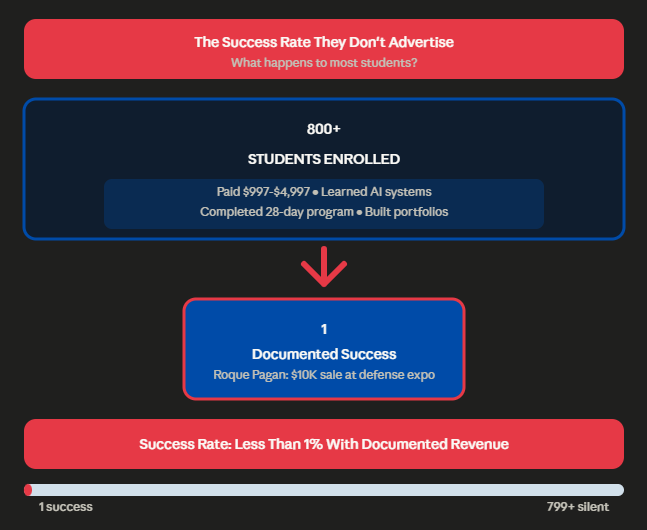
Most students probably build projects, add them to their portfolio, and then struggle to find anyone willing to pay for similar systems. Building a demo is not the same as running a business.
If 800 students each landed one $10K client, we'd be seeing way more testimonials with actual numbers. The silence is telling. When courses work, students can't shut up about it. When they don't, you get one success story promoted over and over.
Who Actually Buys Multi-Agent AI Systems?
Mid-sized to enterprise-level businesses with complex internal workflows actually buy multi-agent AI systems. Small businesses rarely buy them because they don't have the budget, technical infrastructure, or patience for long implementation cycles.
Here's who's actually buying these systems: Companies with 100+ employees that already have operations teams, IT departments, and processes complex enough to justify automation. They're looking to replace 10-20 hours per week of manual work across multiple departments.
They need existing tech infrastructure where AI systems can plug into their CRM, ERP, or data warehouses. If they're still using spreadsheets and email, they're not ready for multi-agent systems.
They have compliance requirements that need extensive security reviews, data governance policies, and legal approval before implementing new technology. This means months-long sales cycles.
They have decision makers who understand AI limitations and won't expect magic. They know these systems need oversight, maintenance, and ongoing tuning. They budget for it.
This limits your buyer pool dramatically. You're not selling $500 services to local restaurants or real estate agents. You're selling $10K-$50K custom implementations to mid-market companies with procurement processes, security teams, and committees that need to sign off.
For a beginner trying to make their first dollar online, this is a brutal path. You need professional sales skills, case studies, technical credibility, and the financial runway to survive 3-6 month sales cycles where most deals fall through.
This is very different from affiliate marketing or AI-powered content businesses where you can start generating income in weeks without pitching anyone.
What Does Research Say About Multi-Agent Systems in 2026?
While the multi-agent AI market is growing at 48.5% annually, only 2% of organizations have successfully deployed agents at full scale, and only 24% have managed to move them from pilot to production. The gap between hype and reality is massive.
Gartner predicts that 40% of enterprise applications will include AI agents by 2026, up from less than 5% in 2025. That sounds promising until you dig into the implementation challenges.
Only 2% of organizations have deployed agents at full scale. Most are stuck in pilot purgatory—building demos that never make it to production because of complexity, cost, or organizational resistance.
88% of organizations have experienced AI-related security incidents, yet only 22% treat AI agents as identity-bearing entities with formal access controls. This creates massive risk that slows down adoption.
Each agent adds 2.3-3.8 seconds of latency before the first tool call returns. Chain five agents together and your "real-time" system is suddenly taking 15+ seconds to respond. This makes many use cases impractical.
The biggest challenge is data engineering, not AI. Research from MIT shows that 80% of the work deploying agentic AI is unglamorous data formatting, stakeholder alignment, governance, and workflow integration. Only 20% is actual prompt engineering or model work.
95% of organizations report zero ROI on their AI agent investments. This isn't a typo. Most companies trying to implement these systems see no measurable return because the systems either don't work reliably or cost more to maintain than they save.
The market opportunity is real, but the execution gap is enormous. This is why experienced developers with enterprise sales experience are the ones actually making money in this space—not beginners who just finished a 28-day bootcamp.
What Are the Real Challenges of Selling AI Agent Systems?
Selling AI agent systems requires long sales cycles, technical demos, security reviews, and ongoing support commitments. Each client needs a custom solution because everyone's data sources, processes, and requirements are different. This makes AI agents mostly one-off projects instead of recurring income.
Every client needs a custom build. Unlike selling a course or SaaS product where you build once and sell many times, each AI system is bespoke. Their CRM is different. Their data is structured differently. Their approval processes are unique. You're rebuilding logic for every deal.
Enterprise deals take 3-6 months minimum. You'll do discovery calls, technical demos, proof-of-concept builds, security reviews, legal negotiations, and procurement processes. Most deals fall through. You need serious pipeline.
You're on the hook for ongoing maintenance. APIs update and break your integrations. AI models change and your prompts stop working. Clients change their processes and you need to update logic. You're not just building systems—you're maintaining them forever or risking refund requests.
When something breaks at 2am, guess who fixes it? You do. Clients expect support, monitoring, and fast response times. This isn't passive income—it's an active service business that never sleeps.
AI Agent Bootcamp teaches you to build systems, not sell them. You need to know how to generate leads, qualify prospects, handle objections, close deals, and negotiate contracts. These are completely separate skills that the course doesn't cover.
Nobody buys a $10K system sight unseen. You'll build free demos to prove value, which means weeks of unpaid work before you know if a deal will close. I've seen people spend 40+ hours on proof-of-concept builds that went nowhere.
The course doesn't prepare you for any of this. You learn the engineering, then get dumped into the market with no sales training, no lead generation system, and no idea how to find the businesses that can afford what you're building.
Can You Really Become an AI Expert in 28 Days?
No. You can build functional systems in 28 days, but real expertise takes months or years. There's a huge difference between following tutorials to assemble a working demo and understanding systems well enough to architect them from scratch, diagnose failures, and support clients.
After 28 days, you'll have basic competence. You'll understand multi-agent architecture, know how to use the tools, and be able to build systems following established patterns. This is valuable but it's entry-level skill, not expertise.
You'll have demo-building ability. You can create impressive projects for your portfolio. These look great in case studies but don't prepare you for production realities like error handling, edge cases, monitoring, or scaling.
You'll know the common workflow patterns—sequential, hierarchical, parallel. You won't yet have the judgment to know which pattern fits which business problem. That comes from experience, not coursework.
What you won't have after 28 days: The experience to troubleshoot cryptic API errors at 2am when a client's system breaks. The architectural judgment to know when multi-agent is overkill and a simple script would work better. The battle scars from watching a $50K deal fall apart because your demo broke during the final presentation. The sales skills to qualify leads and close enterprise deals.
Real expertise comes from doing this work for months, hitting every possible failure mode, and developing intuition for what works. A 28-day course gives you the foundation, not the expertise. Anyone claiming otherwise is overselling.
You can absolutely start building after 28 days. You just shouldn't call yourself an expert or expect clients to treat you like one. The market can tell the difference, and it matters when you're asking for $10K+ per project.
How Much Does AI Agent Bootcamp Actually Cost?
AI Agent Bootcamp costs $997 for standard access or $4,997 for VIP with coaching, but the total investment is much higher when you factor in tools, testing, and time. Here's what you're really signing up for financially:
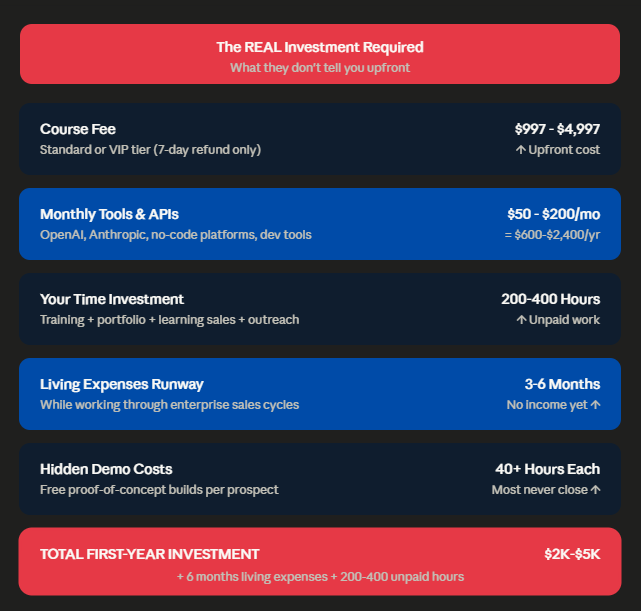
The course fee is $997 for standard or $4,997 for VIP. There's a 7-day refund policy which honestly feels too short for a 28-day program.
You'll need AI API costs for testing and building, which runs $50-200 per month depending on how much you're experimenting. If you go the no-code route, those platforms cost $50-300 per month. Development tools and testing environments add another $20-100 monthly. Domain and hosting for client projects is $20-50 per month.
The time investment is massive. You're looking at 3-4 hours daily minimum during the 28-day bootcamp, which is 84-112 hours. After the course, you'll spend 40-80 hours building portfolio projects. Learning sales and marketing on your own (since the course doesn't teach it) takes another 50-100 hours. Your first real client acquisition effort will eat 20-60 hours of outreach and follow-up.
The hidden costs add up fast. Building free proof-of-concept demos for prospects takes 20-40 hours each. You need 3-6 months of living expenses saved while you work through sales cycles with no income coming in. Tool subscriptions keep charging you while you're still trying to land your first client. Once you have clients, you'll need professional liability insurance.
Total first-year investment: $2,000-$5,000 in direct costs, plus 200-400 hours of your time, plus 3-6 months of living expenses while you build your client base.
For most people, this math doesn't work. You're investing thousands of dollars and hundreds of hours to chase enterprise deals with 3-6 month sales cycles and uncertain close rates.
Compare this to simpler AI business models where you can be generating income in weeks instead of months, with no custom builds and no enterprise sales cycles. Learn more about the AI approach here.
The AI Alternative: Build AI Businesses, Not AI Systems
If you want to make money with AI but don't want to chase enterprise clients for months, there's a way faster path. Instead of building complex multi-agent systems for $10K custom deals, you can use AI to build businesses that generate income without custom work for each client.
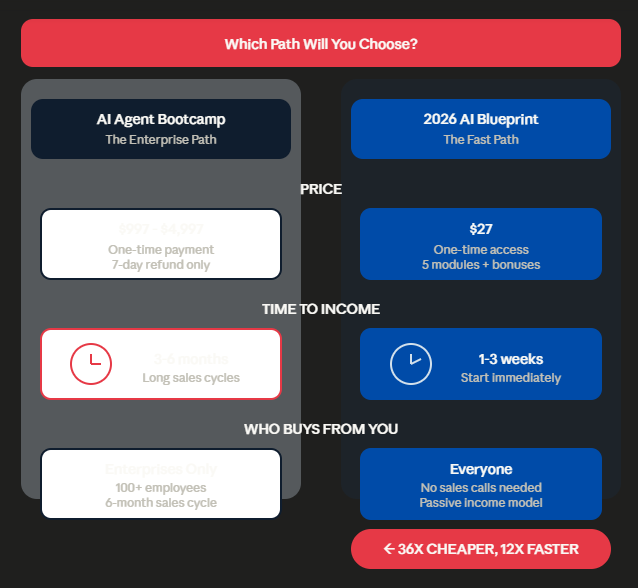
Here's the fundamental difference: AI Agent Bootcamp teaches you to build AI systems as a service. You're selling custom implementations where every client is a new project. You need enterprise buyers, long sales cycles, and ongoing maintenance. It's high-ticket but high-effort.
My approach teaches you to build AI-powered businesses where you use AI to create products, content, or services that scale without custom work. You build once and sell many times. You target smaller buyers who make faster decisions. You generate income in weeks, not months.
The five models I cover in The 2026 AI Business Blueprint work like this:
AI-Assisted Affiliate Marketing uses AI to research products, write reviews, and optimize content. You build niche sites that earn commissions without custom client work.
Faceless YouTube with AI lets AI handle research, scripting, voiceovers, and editing so you can build channels that generate ad revenue and sponsorships without showing your face.
AI-Powered E-Commerce uses AI for product research, design work, ad copy, and customer service to run stores that make money while you sleep.
AI Freelance Services lets you offer high-speed content, design, or consulting services where AI does 80% of the work and you keep the margins instead of competing on hourly rates.
Digital Products with AI helps you create courses, templates, or tools with AI assistance and sell them repeatedly without custom builds.
The key difference: These models generate income without needing $10K enterprise clients or 6-month sales cycles. You're building assets that work 24/7, not trading time for custom projects.
$27 one-time for the full course (5 modules) vs $997 for AI Agent Bootcamp. It includes copy-paste AI prompts for every model and shows you how to start generating income this week instead of six months from now. Learn more about the AI approach here.
Want to build an AI business without the complexity of selling multi-agent systems to enterprises? Grab The 2026 AI Business Blueprint here for $27.
Or if you want to test the waters first, download my free AI Side Hustle Starter Kit and see what's possible before investing anything.
Who Should Buy AI Agent Bootcamp?
AI Agent Bootcamp is worth $997 if you already have technical aptitude, enterprise sales experience, and want to build an AI consulting practice. For everyone else—especially beginners looking to make their first dollar with AI—it's the wrong investment.
Software developers or engineers who already understand system architecture and want to add AI specialization to their skillset should consider it. You have the technical foundation and probably already work with enterprise clients.
Consultants or agency owners who serve mid-market or enterprise clients and want to add AI automation to your service offerings fit the profile. You already know how to close $10K+ deals.
Technical founders building AI products who need to understand multi-agent architecture for their own applications will benefit. You're not selling services—you're building products.
Career pivoters with financial runway who can afford 6-12 months of learning and business development before generating income might make it work. You're treating this as a long-term career investment, not a quick side hustle.
Who Should NOT Buy AI Agent Bootcamp?
Beginners with no tech background expecting to make money quickly should avoid this. The learning curve is too steep and the sales cycles are too long.
People looking for passive income or "make money while you sleep" opportunities will be disappointed. This is active consulting work with ongoing maintenance responsibilities.
Anyone without 6-12 months of living expenses saved shouldn't take this risk. The time to first dollar is too long for most people.
Small business owners who just want to use AI in their existing business don't need this. You don't need to build multi-agent systems—you need practical AI tools.
People who struggle with technical concepts or troubleshooting will have a bad time. Even with no-code tools, you need to think like an engineer.
The honest truth: Tina Huang is credible, the training is solid, but the business model is tough. Teaching someone to build AI systems without teaching them to sell AI systems is like teaching someone to cook without teaching them to run a restaurant.
You'll create impressive portfolio pieces and learn valuable skills. Whether you'll make money is a completely different question—and the 1-in-800 success rate suggests most people won't.
Frequently Asked Questions
Is AI Agent Bootcamp a Scam?
No, AI Agent Bootcamp is not a scam. The training is legitimate and Tina Huang's credentials are real. The issue isn't fraud—it's misaligned expectations. The course teaches technical skills without addressing the business development challenges that prevent most students from generating income.
Can Beginners Succeed With AI Agent Bootcamp?
Beginners can learn the material, but succeeding financially requires additional skills the course doesn't teach. You need sales ability, business development experience, and the financial runway to survive 3-6 month enterprise sales cycles. Most beginners would be better served by simpler AI business models that generate income faster.
Do You Need Coding Knowledge for AI Agent Bootcamp?
The course offers no-code tools, but coding knowledge significantly increases your chances of success. No-code platforms are more expensive, less customizable, and hit technical limits quickly. Real client projects almost always require custom code at some point.
Is There Recurring Income Potential With AI Agents?
Only if you structure retainer agreements for ongoing maintenance and monitoring. Most AI agent deals are one-off projects with occasional update work. Building recurring revenue requires shifting from project-based to subscription-based contracts, which adds sales complexity.
How Long Does It Take to Land Your First Client?
For complete beginners, expect 3-6 months minimum after finishing the course. You need time to build a portfolio, develop your positioning, generate leads, and work through sales cycles. Enterprise deals don't close fast, even with great demos.
Are Multi-Agent Systems Better Than Single-Agent Systems?
For complex workflows, yes. Multi-agent systems can handle tasks that single agents struggle with. But they're also more fragile, more expensive, and harder to maintain. Many use cases that get pitched as needing multi-agent systems would work fine with simpler solutions.
What's Better Than AI Agent Bootcamp for Making Money Online?
If your goal is income generation rather than technical expertise, focus on AI business models where you build once and sell many times instead of custom projects for each client. Check out how much money you can make with affiliate marketing using AI, YouTube channels, e-commerce stores, and digital products that all generate income without enterprise sales cycles. My 2026 AI Business Blueprint covers five models that start generating income in weeks instead of months for just $27.
Does AI Agent Bootcamp Include Marketing Training?
Minimal. The course includes a "Freelance Accelerator Masterclass" that covers basic freelancing concepts, but it's not specific AI sales training. You won't learn how to generate enterprise leads, qualify prospects, run technical demos, or close $10K+ deals.
How Much Can You Actually Earn Selling AI Agents?
If you successfully land enterprise clients, individual projects range from $10K to $50K+. But the success rate is very low. With 800+ students and only a handful of documented success stories, most people aren't earning anything. The potential is high, but so is the failure rate.
Is It Too Late to Get Into AI Agent Development?
No, the market is still early. But competition is increasing rapidly and clients are getting more sophisticated. The early gold rush where any competent developer could land deals is over. You now need strong technical skills, proven case studies, and professional sales ability to compete.
Final Thoughts: Technical Skills Don't Equal Business Skills
I hope this AI Agent Bootcamp review helped you understand what you're actually signing up for.
In summary, AI Agent Bootcamp is a technically solid course from a credible instructor, but it optimizes for engineering competence instead of income generation. You'll learn to build impressive multi-agent systems. You won't learn how to find the businesses that will pay $10K+ for them or how to close those deals.
The 1-in-800 success rate tells the real story. Roque Pagan's $10K sale is impressive, but it's the exception, not the rule. Most students learn the tech, build portfolio pieces, and then struggle to find clients willing to pay enterprise prices for custom automation.
If you're a software developer or consultant who already works with mid-market or enterprise clients, AI Agent Bootcamp could be a smart investment. You have the sales infrastructure and client relationships to actually deploy what you learn.
If you're a beginner trying to make your first dollar with AI, this is the wrong path. The learning curve is too steep, the sales cycles are too long, and the success rate is too low. You're better off with AI business models that generate income in weeks instead of months.
Want to build an AI business without chasing enterprise clients for six months? Check out The 2026 AI Business Blueprint for five proven models you can start this week. $27 one-time, not $997, and you'll be making money way faster.
Or grab the free AI Side Hustle Starter Kit and see what's possible before investing anything.

- Fast-growing E-commerce Sellers Are Overhauling Fulfillment Hubs To Keep Up With Orders - October 16, 2026
- Ad Network Marketing Myths That Can Lead to Poor Campaign Decisions - October 13, 2026
- Dropship Breakthru Review: Price, Guarantees, Fine Print - October 11, 2026