When you set up or start a business the accounting method isn’t always top of the list (unless you’re setting up an accountancy firm). Later down the line, usually when you do your first set of accounts it becomes apparent you need to pick a method of accounting.
While some businesses opt for the cash basis method (recording revenue and expenses only when money changes hands) many choose the accrual method of accounting because it offers a more comprehensive and accurate picture of financial health.
The accrual method is used more by medium to large enterprises especially in the western world, but now smaller businesses are starting to use it more, primarily as they want to meet regulations and requirements. Here we’ll take a look at both methods so you can see which would be more applicable to your business.
What is the Accrual Method of Accounting?
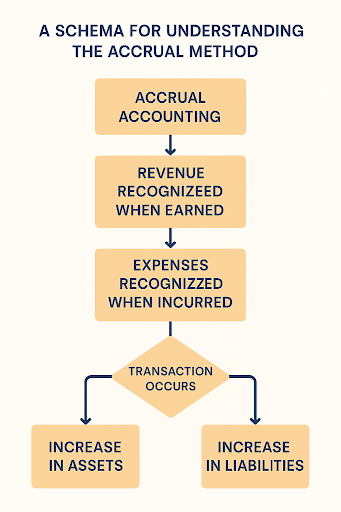
The accrual method of accounting records income and expenses when they are earned or incurred, regardless of when cash actually changes hands (that’s the important part). This means a sale is recorded when the product is delivered or the service is performed, not when payment is actually received by your business irregardless of whether thats bank transfer/cash/cheque etc., Likewise, expenses are logged when the obligation to pay arises, not when the payment is made.
By matching income and expenses to the period in which they occur, the accrual method provides a clearer view of profitability and operational efficiency. This approach aligns with the matching principle in accounting, which requires that expenses be recognized in the same period as the revenues they help generate. There are slight variations on this depending on which country you reside but for the main, countries like the USA, UK, Canada etc., all use the matching principle.
How the Accrual Method Works: A Review
Transactions are captured as soon as they are realizable and measurable with the accrual method. Let’s look at an example, if a marketing agency completes a project in March but doesn’t receive payment until May, the revenue is still recorded in March. The same logic applies to expenses: if you receive an invoice for office supplies in June but pay it in July, the expense is recorded in June. It's pretty simple once you run a few examples through the accounting method.
Accrual accounting often involves the use of:
Accounts Receivable – Tracking money owed to the business by customers.
Accounts Payable – Money the business owes to suppliers or vendors.
Accrued Liabilities – Recording expenses that have been incurred but not yet paid, such as wages earned by contractors or employees before payday.
This approach requires a more complex accounting system which is why many small business won’t go near it. With that said - it does lead to a more sophisticated and accurate financial snapshot.
Why Businesses Choose the Accrual Method
Businesses prefer the accrual method for a differing set of operational, financial, and strategic reasons. Use cases vary by industry and location.
The accrual method gives depth, insight and allows the owner to better project growth and react to any shortcomings of falls.
Here are some of the most common reasons companies adopt the accrual method:
- More Accurate Financial Picture – Revenues and expenses are aligned to the correct periods, avoiding misleading spikes or drops in reported income.
- Better Decision-Making – Managers/owners can see the true performance of the business without cash timing distortions.
- Regulatory Requirements – Public companies and many private businesses are required by law or accounting standards (FSSA etc) to use accrual accounting (the usa, for example).
- Easier Access to Financing – Easier Access to Financing – Banks and investors often require accrual-based statements to assess the health and potential of a business; the better the health the more likely they are to invest or lend, especially when working with the best private lending company in Australia.
- Scalability – As businesses grow and transactions become more complex, the accrual method handles the complexity more effectively.
The accrual method of accountancy becomes an essential tool for planning and forecasting and the earlier its adopted, the better picture a business has.
Key Advantages of the Accrual Method
The accrual method’s main strength lies in its ability to provide realistic and timely financial information. This has several important benefits:
- Accurate Matching of Income and Expenses – Ensures that performance metrics reflect the true results of operations during a specific period.
- Compliance with GAAP – Generally Accepted Accounting Principles require the accrual method for most businesses, especially those seeking outside funding.
- Improved Budgeting – Businesses can forecast more reliably by understanding not only what has been received and spent but also what is expected.
- Better Investor Confidence – Financial statements prepared using the accrual method are considered more credible by lenders, investors, and regulatory agencies.
- Long-Term Planning – The accrual method helps identify patterns and trends in sales, expenses, and profits over time.
For businesses with large contracts, multiple revenue streams, or seasonal fluctuations, these advantages can be game-changing.
Potential Drawbacks to Consider
While the accrual method offers many advantages there are still key challenges to consider. Maintaining accrual-based records can be more complicated and resource-intensive than using the cash basis method. Small businesses with limited resources may find it difficult to keep up with the required level of detail.
Additionally, because revenue and expenses are recognized before cash changes hands, the accrual method can sometimes obscure cash flow problems. A business may appear profitable on paper while struggling to pay bills in reality. This is why many companies also prepare separate cash flow statements to complement accrual-based financial reports.
Accrued Liabilities and Their Role in Accrual Accounting
One of the most important components of the accrual method is accrued liabilities. These are expenses that a business has incurred but not yet paid. Common examples include wages earned by employees that will be paid in the next payroll cycle, interest on loans payable at the end of a quarter, and utilities used but not yet billed.
Accrued liabilities ensure that expenses are matched to the correct period, even if payment has not yet been made. For instance, if a company receives electricity service in December but doesn’t get the bill until January, the expense is still recorded in December’s accounts. This keeps financial statements aligned with actual operational activity, rather than payment timing.
Without accurate tracking of accrued liabilities, businesses risk underreporting expenses in the correct period, which can distort profitability and lead to flawed decision-making.
Comparing the Accrual and Cash Basis Methods
To fully appreciate the accrual method, it’s helpful to contrast it with the cash basis approach:
- Timing of Recognition – Accrual recognizes revenue/expenses when earned/incurred; cash basis waits for payment/receipt.
- Complexity – Accrual requires more detailed tracking and adjusting entries; cash basis is simpler but less precise.
- Financial Insight – Accrual provides a more accurate long-term picture; cash basis reflects short-term liquidity.
- Suitability – Accrual works best for larger, growing businesses; cash basis may be sufficient for very small operations.
The choice often comes down to the size of the business, industry requirements, and the need for accurate long-term planning.
Businesses That Benefit Most from the Accrual Method
Certain types of businesses are particularly well-suited to the accrual method:
- Manufacturers – Need to keep an eye on production costs, inventory, and sales in periods that don’t align with cash flows.
- Service Providers – Often complete work and issue invoices long before receiving payment.
- Retailers with Large Inventories – Must match inventory purchases to the revenue they generate.
- Subscription-Based Companies – Recognize revenue over the life of a subscription rather than when payment is received.
- Construction Firms – Rely on long-term contracts that span multiple reporting periods.
In each case, accrual accounting ensures that the financial statements reflect actual business activity and obligations, not just cash movements.
Why Many Businesses Make the Switch
Some businesses start on a cash basis because it’s easier, then transition to accrual as they grow or seek outside investment. Switching to accrual allows for more precise tracking of obligations and revenue streams, which is critical for scaling operations. Switching can be tricky and you may be better off with accounting advice to manage the change, especially as your business is growing at the same time.
It also helps in meeting the expectations of investors and lenders, who rely on accrual-based financial statements for making funding decisions. Even for privately owned small businesses, accrual accounting can provide the depth of insight needed to plan for expansion, manage debt, and optimize cash flow.
In The End…
The accrual method of accounting is more than just an alternative to cash basis because it’s a tool that offers deeper insights into a business’s performance, obligations, and opportunities.
While it may require more resources and expertise to implement, its benefits in terms of accuracy, compliance, and decision-making often outweigh the drawbacks. That said, with the software on the market at the moment accrual accounting is easier than before.
For businesses aiming to grow, secure financing, or simply gain a more realistic understanding of their financial position, the accrual method provides a solid foundation. Whether you’re a startup planning for expansion or an established company seeking better financial clarity, adopting accrual accounting can be a strategic move toward sustainable success.

- Kindle Publishing Income Review: Is Sophie Howard Legit? - September 23, 2026
- 7 Figure Accelerator Review: Is Philip Johansen Legit? - September 21, 2026
- How to Market Health and Wellness Products Online - September 21, 2026