⚠️ Updated April 2026 — Surfer SEO has added a significant number of new features since I first published this review. Surfy AI, Auto Optimize, Auto Internal Links, the AI Humanizer, Topical Map, and the AI Tracker are all new. Pricing has also changed. I've rewritten this review to reflect where things stand today.
I first heard of Surfer SEO when Matt Diggity told me he liked the tool so much that he invested in the company. Matt does a lot of things right, so I took it seriously and thought I'd see what he invested in.
I ended up getting a subscription for Surfer SEO and put it to the test.
In this Surfer Seo review, I'm going to show you how I use it, it's features and benefits and if I think it's worth it or not. You'll get my honest opinion.
To prove that I'm an actual user and not some guy that just copies other reviews, here's a little bit of billing history since I first started way back in January of 2022.
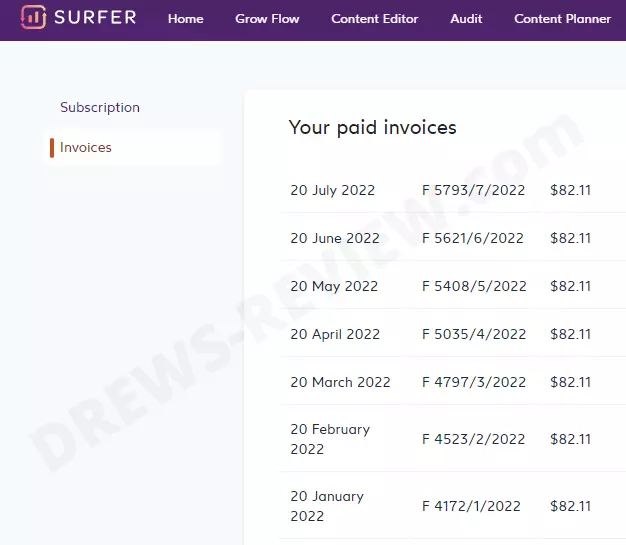
Ok, now you can see I'm a real user of Surfer SEO. The price I got was from a promotion, and pricing has changed a lot since I got it. More on pricing later.
So. What's in it for you?
You're here because you want to know if it's worth the investment and if can really help your rankings, making you more money. Because that's what this is all about, right?
That's why I am going to show you everything such as:
So there's the rundown, now let's get into this review.
My Surfer SEO Rating ⭐ 4.5/5
Surfer SEO is one of the few tools I keep coming back to. It takes the guesswork out of on-page optimization in a way that genuinely moves rankings. The content editor alone is worth the price for anyone publishing SEO-focused content regularly. I'll break everything down below.
What Is Surfer SEO?
Surfer SEO is an on-page SEO and content optimization platform. It launched in 2017 and has grown to over 150,000 customers across 159 countries. The core idea hasn't changed: Surfer analyzes the pages ranking on page one for your target keyword, identifies what they have in common, and tells you exactly what your content needs to compete.
Where Surfer has evolved is in how much of that work it now does for you. When I first started using it, the workflow was mostly manual — you'd read the keyword suggestions and add them yourself. Today, Surfer has Auto Optimize, Surfy AI, Auto Internal Links, an AI Humanizer, a Topical Map, and more. It's become a much more complete content production platform.
How Does Surfer SEO Work?
The core workflow is simple. You enter a target keyword, Surfer analyzes the top-ranking pages for that keyword, and gives you a real-time content score as you write. Add the right keywords, hit the right structure, reach the right word count — and your score climbs.
Think of it like a GPS for your article. Instead of hoping your content is good enough to rank, Surfer gives you a clear road map based on what's already working.
What I really like is that it makes SEO feel like a game. You start at a score of, say, 45 out of 100. You add keywords, fix headings, adjust word count — and you watch it climb to 70, then 80. It's genuinely satisfying, and it keeps you focused on what actually moves the needle.
One piece of advice I'll give upfront: don't obsess over hitting 100. I've seen people spend hours chasing a perfect score. Anything in the green range — roughly 70 to 85 — is solid. If you're already ranking number one for something, don't change a thing. The goal is to rank, not to score perfectly.
Key Features
Content Editor
The content editor is the heart of Surfer SEO and the main reason most people subscribe. It gives you a live scoring system as you write, showing you which keywords to add, how often to use them, what headings to include, what word count to aim for, and how many images to add.
All of this is based on the pages currently ranking on page one for your keyword. Surfer is essentially reverse-engineering what's working and giving you a checklist to match it. You can also select which competitor pages you want to model from, which is useful if you want to exclude big-authority sites like G2 or Capterra that you can't realistically compete with.
You can write the article yourself using Surfer's guidelines, or you can use the built-in AI writer to generate a fully optimized draft with one click. The AI-written output is clean and readable — it doesn't feel like a college essay, and it structures itself naturally. You'll still want to edit it, fact-check it, and inject your own voice, but it's a solid starting point that saves real time.
Surfy AI
Surfy is Surfer's built-in AI assistant inside the content editor. You access it with a slash command or Control+J, and you can ask it to rewrite a section, expand a paragraph, or adjust the tone of a specific part of your article. It's like having an AI co-writer who already knows the SEO context of what you're working on. I find it most useful for fixing sections that feel flat or for rewriting intros that aren't landing.
Auto Optimize
This is one of my favorite new features. Instead of manually going through every keyword suggestion one by one, Auto Optimize does the heavy lifting for you. Click the button and Surfer automatically adjusts headings, adds missing keywords, and restructures where needed.
In testing, going from a score of 69 to 84 took about 30 to 60 seconds. You still review the changes before saving, but it cuts the optimization process down dramatically.
Auto Internal Links
Surfer can now automatically suggest and insert internal links across your content. I'll be honest — I'm particular about my internal links and prefer to handle these manually. But if you have a large site and want a faster workflow, this feature removes a step that used to require a separate tool or a lot of manual effort.
Audit Tool
The audit tool is my second favorite feature. It takes an existing page on your site and gives you a full breakdown of what needs improving — content score, missing keywords, word count, internal links, title and meta description length, and more.
It connects with Google Search Console to show you which pages have the best quick-win potential based on their current position and content score.
The practical use case is simple: find pages sitting at position 8 to 20 in Search Console, run them through the audit, make the suggested improvements, and give them a push up the rankings. This is exactly the kind of content refresh work that moves the needle without having to write anything from scratch.
One important caveat: if you're already ranking number one for a page, leave it alone. The audit tool might still suggest changes, but messing with a top-ranking page is almost never worth the risk.
Topical Map
The Topical Map replaced the old Content Planner and does the same job better. Enter a main topic and Surfer gives you a full cluster of related content ideas that support your main article and build your topical authority. You can filter by keyword difficulty, search volume, and search intent — informational, commercial, or transactional.
This is genuinely useful for building out content strategies. If your main article is "best camping tents," the Topical Map gives you dozens of related supporting articles to write that will link back to it and signal to Google that you're an authority on the topic.
I've found that some suggestions don't make sense for a given niche, so use your judgment — but the tool does most of the heavy lifting on content planning.
Keyword Research
The keyword research tool in Surfer lets you search by similar keywords, same-term variations, or questions. It's a useful addition, but I want to be straightforward with you: it's not as robust as dedicated tools like Ahrefs or Semrush.
You won't get keyword difficulty scores, CPC data, or trend lines. I think of it as a complementary tool rather than a replacement for your main keyword research workflow. It's handy for quick checks and for finding FAQ-style questions to include in your articles.
AI Humanizer
Surfer now includes an AI content detector and humanizer. You paste in AI-generated text, it tells you the probability that it was written by AI, and then humanizes it to read as natural human writing.
In testing it's taken content from 100% AI likelihood down to 0% in a matter of seconds. It's a useful extra feature, especially if you produce a lot of AI-assisted content and want to reduce any risk around detection.
AI Tracker
The AI Tracker is a paid add-on (not included in base plans) that monitors how your brand appears in AI-generated search results from tools like ChatGPT, Google AI, and Perplexity. It shows which of your pages are being cited in AI responses and where you have visibility gaps.
At $95/month extra, it's most relevant for established brands with real authority. If you're a solo blogger or running a niche affiliate site, this is probably not where I'd spend money right now.
Rank Tracker
Surfer has a rank tracker add-on starting at around $8.50/month for tracking keyword positions. It's useful if you want everything centralized in one platform, though most serious SEOs already have a preferred rank tracking tool. Good to know it exists.
Chrome Extension
The free Keyword Surfer Chrome extension is one of the best free tools in the Surfer ecosystem. Install it and every Google search you do shows estimated monthly traffic for each result, word count, and exact keyword usage.
You also get keyword data in a sidebar on the right. It's completely free and gives you data that other tools charge for. There's no reason not to install it.
Surfer SEO Pricing
Surfer currently has three plans. There is no free tier, but all plans come with a 7-day money-back guarantee. You'll need to enter payment details upfront, so make sure you cancel before the 7 days are up if you decide it's not for you.
Annual billing saves approximately 20% across all plans.
Standard Plan — $119/month ($99/month annually)
The Standard plan is the right starting point for solo bloggers and small teams. You get 360 documents to create or optimize, AI visibility tracking across 25 prompts refreshed weekly, Brand Knowledge, 1-click Content Optimization, Team Collaboration, a Plagiarism Checker, and Rank Drop Detection. It integrates with WordPress and Google Docs.
For most bloggers and affiliate marketers, the Standard plan covers everything you need day to day. It's a meaningful jump from the old entry-level pricing, but the document limit is generous enough for consistent publishers.
Pro Plan — $219/month ($182/month annually)
The Pro plan is Surfer's recommended tier for a reason. On top of everything in Standard, you get 5 Brand Workspaces, 1-click Internal Linking, Content Ideas and Coverage Gap analysis, Templates and Custom Voices, a Cannibalization Report, and 50 AI prompts refreshed daily. The daily AI prompt refresh and the internal linking automation are the two features that make this worth the upgrade for serious content operations.
If you're managing content for multiple sites or clients, the Brand Workspaces alone justify the step up.
Peace of Mind Plan — $359/month ($299/month annually)
The Peace of Mind plan is for larger teams and agencies. You get unlimited documents, unlimited Brand Workspaces, 100 AI prompts refreshed daily, Advanced SERP Analysis, Personalized Onboarding, a Dedicated Success Manager, and API access. Contact Surfer's sales team if you need custom arrangements beyond this.
A Note on Credits
Surfer's AI features use credits allocated on a monthly or annual basis depending on your billing cycle. On a monthly plan, unused credits don't roll over. On an annual plan, you get your full year's allocation upfront, giving you more flexibility if your publishing schedule is inconsistent. Worth factoring in when choosing your billing cycle.
Who Should Use Surfer SEO?
Bloggers and affiliate marketers — If SEO traffic is your main acquisition channel, Surfer pays for itself. Getting even one or two additional articles to page one per month more than covers the Standard plan cost. The content editor and audit tool are built exactly for this use case.
Content agencies — The Pro plan's Brand Workspaces, Custom Voices, and Cannibalization Report make it practical for agencies managing client content. The Auto Optimize and 1-click Internal Linking features reduce the manual work on each article.
Niche site builders — The Topical Map is particularly useful here. Planning out a full content cluster around a core topic is much faster with Surfer's data behind it.
Casual bloggers or very low-volume publishers — If you're publishing fewer than four or five SEO-targeted articles per month, the cost is harder to justify. At that volume, you might be better off using the free Chrome extension and the free AI tools Surfer offers without a subscription.
My Tests With Surfer and the Results
Here are some tests I did with the search term - Surfer SEO review
It will show the top ten results and you can click on "load more competitors" if you want to see more. For the purpose of this exercise let's just focus on the top 5.
If you look closely, it looks like the top two have pretty high content scores. Guess where that comes from? Yes - it's a Surfer SEO score.
In other words, the top two are almost definitely using Surfer SEO to improve their content. I mean they should be since they also wrote a review on it!
The outlier is the one in position 3. The score is a bit below optimal, but not terrible.
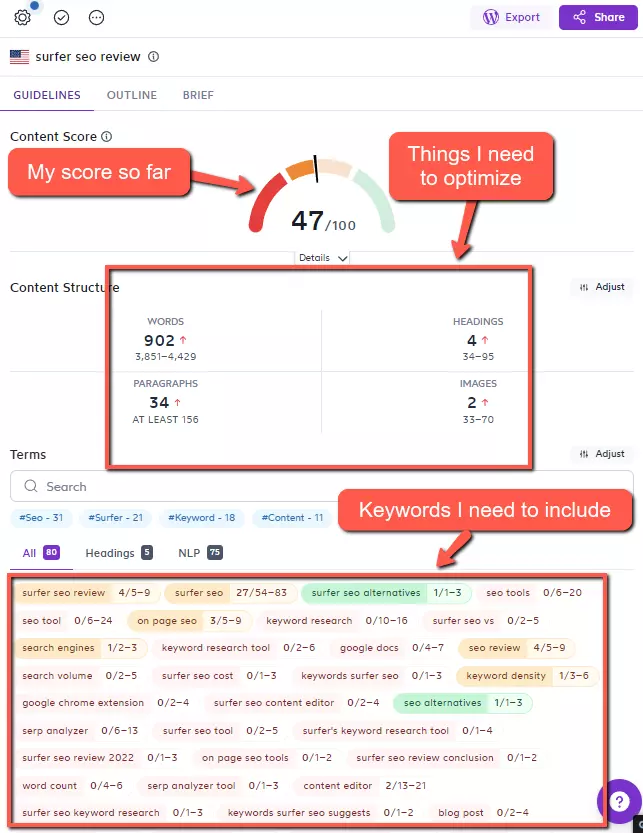
So let's look at where I am so far with this article:
If you start stuffing a keyword in places that just do not make sense, then it's going to work against you. It's important to use the frequency guidelines as a guideline only.
As you can see, I have written 902 words so far and my score is 48/100. The score will increase as I include more of the keywords that Surfer recommends.
You don't need to follow the suggestion the number of times a keyword is used all the time. For example, it says I should use "seo tools" between 6 and 20 times. Even if you used it a couple of times that is fine.
As you can see from the content structure section, I still need to increase my word count, paragraphs, headings, and images.
Write Keyword Rich Headings
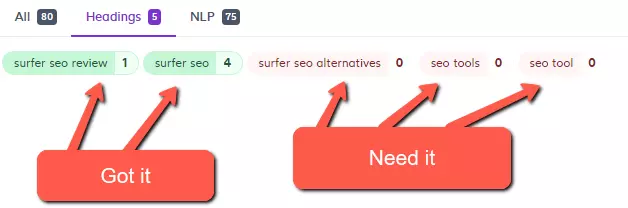
Surfer SEO also tells you what headings you should include in your article. Again, this is based on headings that your competition has. It's not a complete heading, but the keywords you should include in headings in your article.
This can be H2, H3 or H4 headings.
For this particular case study, the headings Surfer SEO wants me to include are:
As you can see, when it turns green that means you have included the suggestion in your content. There are 3 that I need to include in other headings in my article which are surfer SEO alternatives, SEO tools, and SEO tool.
The idea here is that if all the pages ranking on page one for your keyword are including these keywords in their headings, then you should too.
Pros and Cons
Pros:
The content editor is genuinely excellent — it removes the guesswork from on-page SEO in a way no other tool does as cleanly.
The real-time scoring system is addictive in the best way. Auto Optimize is a significant time saver. The Topical Map makes content planning much more systematic. The audit tool is one of the best ways to find quick ranking wins from existing content.
The Chrome extension is free and immediately useful. Surfer integrates with Google Docs and WordPress, which keeps the workflow friction low. The platform is updated frequently — new features arrive regularly.
Cons:
The pricing is the main barrier, especially for beginners. At $119/month for Standard, it's a real commitment for someone just starting out.
The keyword research tool is weaker than dedicated tools like Ahrefs or Semrush — it's a nice-to-have but not a replacement. Credits don't roll over on monthly plans, so if you have an inconsistent publishing schedule you might waste allocation.
Surfer SEO vs The Competition
Surfer SEO vs Ahrefs
Ahrefs is the go-to tool for backlink analysis, competitor research, and keyword data. If you want to know what your competitors' best pages are, where their backlinks come from, or how much traffic they're getting — Ahrefs is unmatched. Surfer doesn't touch any of that.
Where Surfer wins is content creation. Ahrefs tells you what to write about. Surfer tells you exactly how to write it so it ranks. I think of them as complementary tools, not competitors. If you're starting out and can only afford one, Surfer will benefit you more in the early stages when you're producing content. Once you're ranking and need to build links and analyze competitors more deeply, Ahrefs becomes essential.
Surfer SEO vs Semrush
Semrush is a broader SEO platform with keyword research, site audits, competitor analysis, paid advertising data, and social media tools. Its keyword research is far more robust than Surfer's, with difficulty scores, CPC, and trend data that Surfer doesn't provide.
Surfer wins on content optimization. Semrush tells you the SEO landscape. Surfer helps you write content that fits it. If your primary need is creating and optimizing content, Surfer is the better choice. If you need a complete SEO management platform, Semrush covers more ground.
Surfer SEO vs Moz
Moz has solid keyword research and link analysis. Where Moz falls short compared to Surfer is in real-time content guidance. Moz can tell you which keywords to include, but it won't show you your progress as you add them. Surfer's live scoring system is a significant practical advantage. For content creators specifically, Surfer is the stronger tool.
Frequently Asked Questions
Is Surfer SEO worth it in 2026?
Yes, if you're publishing SEO-targeted content regularly. The Standard plan at $119/month pays for itself when it helps even one or two articles climb to page one. For casual bloggers publishing a few articles a month, the cost is harder to justify.
Does Surfer SEO have a free trial?
There is no free trial. Surfer offers a 7-day money-back guarantee instead. You'll need to enter payment information to get started. Cancel within 7 days if you decide it's not for you and you'll get a full refund.
What happened to the Jasper AI integration?
The native Jasper integration no longer exists. Surfer built its own AI writing system (Surfy and the AI article generator) and the integration was discontinued. If you want to use Jasper alongside Surfer, the workflow today is to write in Jasper and then paste your content into Surfer's editor for optimization.
What happened to Grow Flow?
Grow Flow was an earlier feature that has since been replaced by improved tools. The Content Audit feature connected to Search Console now serves the same function — identifying your best quick-win opportunities — in a more useful format.
What is the Surfer SEO Chrome extension?
The Keyword Surfer extension is a free tool that shows estimated monthly traffic, word count, and keyword usage data directly in Google search results. It's completely free and worth installing even if you don't have a paid Surfer subscription.
Does Surfer SEO help with AI search optimization?
Yes. AI visibility tracking is built into all plans. Surfer monitors how your pages appear in AI-generated results from tools like ChatGPT, Google AI, and Perplexity. Higher plans get more AI prompts tracked and daily refreshes rather than weekly.
Can Surfer write content for me?
Yes. The AI article generator can produce a fully optimized article with one click, and Surfy can rewrite or expand specific sections on demand. You'll still want to edit, fact-check, and add your own voice — but Surfer can handle the heavy draft work.
My Final Verdict
I've been using Surfer SEO since January 2022 and it remains one of the tools I'd keep if I had to cut my stack down. The content editor is the best on-page optimization tool I've found, and the audit tool has helped me recover rankings on content I thought was just going to keep declining.
The new features — Auto Optimize, Surfy, Auto Internal Links, the AI Humanizer — have made the platform significantly more useful since I first started using it. What used to take an hour of manual optimization now takes minutes.
The pricing is the honest sticking point. At $119/month for the Standard plan, it's not a casual purchase. But if you're serious about SEO content and you're publishing regularly, it pays for itself. The question to ask yourself is simple: if Surfer helps you get one extra article to page one per month, does that earn you more than $119? For most affiliate marketers and bloggers, the answer is yes.
If you want to try it out, the 7-day money-back guarantee is the place to start. Run a few of your existing articles through the audit tool and see what the content editor suggests. That'll tell you pretty quickly whether it's going to be worth it for your site.

- Dropship Breakthru Review: Price, Guarantees, Fine Print - October 11, 2026
- Best Outdoor Equipment Fulfillment Companies for DTC Brands - October 8, 2026
- Why Your Site Needs an Automated Price Calculator - October 7, 2026