
In this article, I am going to show you the results of a "test" channel I made using YouTube Automation and how much money it made.
YouTube Automation Channels - also known as faceless YouTube channels is where you make videos where you don't need to show your face - that's right, you do not need to go on camera and expose yourself to the world!
My test starts in January 2025. While I won't give away the channel's name, I will tell you that it is in a very competitive niche - Aviation. So, I didn't discover some hidden gem or try to find a niche that gets a lot of searches but with little competition. I went all in with one of the most competitive niches on YouTube.
What Is YouTube Automation (and Why It Works So Well)
In case you don't know, YouTube Automation (also known as faceless videos) is where you create videos using existing content on the web in your own videos without ever having to go on camera.
This is perfect for people that don't want to be seen or heard, but still make good money on YouTube.
In fact, some channels like this are raking in 6 figures a month on YouTube including sales from affiliate programs and the YouTube Partner Program.
The Test Channel I Created in January 2025
I didn't have high expectations going in on this channel, it was more of a test to see how it does based on the training I received (more on that later).
I actually launched this channel way back in 2021 but didn't do anything with it until about the end of 2024.
As I expected, things started off really slow. I had about 10-15 videos up that weren't getting much traffic, maybe just a few hundred views or so.
Then, on one particular video, everything changed.
I still wasn't monetized because I didn't reach 1000 subsribers yet, but this video changed the trajectory of my site. After this video went viral (it pales in comparison to other viral videos but it was viral to me) my channel got a lot of subscribers and people started watching my previous videos too. I noticed that every video I put out after started getting a lot of views - it was like a light switch turned on.
Here is a screenshot of the stats from that one video.
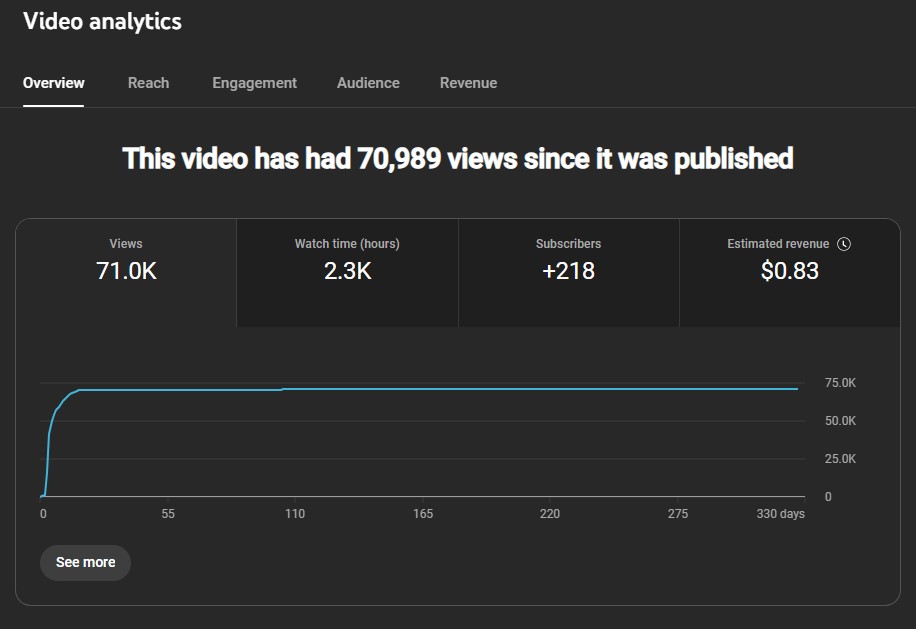
Although this video didn't really earn me money because this all happened before I got monetized, this video was the catalyst that changed everything.
From what I can see, you're going to struggle with getting views in the beginning, and then one video is going to change everything, just like this video did here. The traffic skyrocketed in such a short time as you can see on the left.
After some time, views will die off and you can see that with the straight line. This is typical on YouTube, which is why you need to constantly turn out videos - each video has a "shelf life", so to speak.
So what I learned is that you need to keep trying until you get that viral video - and it will happen, you just need to test with your titles and thumbnails and once you find that formula, stick with it.
The way you find that formula is by watching your data closely after every upload — specifically watch time, audience retention, and click-through rate. If you're not sure which metrics actually matter, I covered all of that in my YouTube Analytics guide.
One Video Made me $2000 to Date
One video in particular got well over 500,000 views and to date has made me almost $2000.
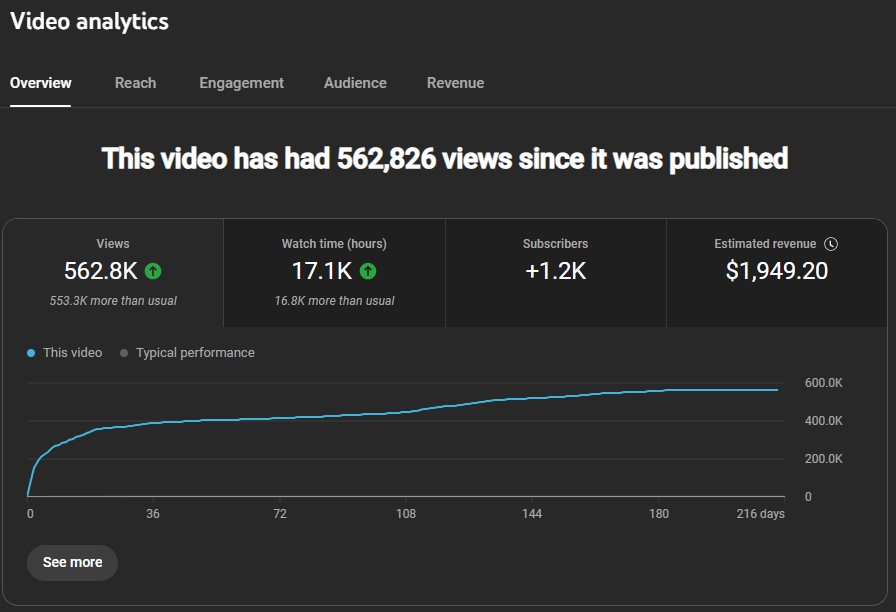
This video is my standout on my channel. I was glad this video was launched after I was monetized (when I reached 1000 subs) so that I would actually get paid for the views by YouTube.
This video in particular kept earning me money for months because traffic was steady. You can see it keeping a steady view climb in the graph above, which is different from the previous screenshot where the traffic died out almost instantly over a short period of time.
Here are some more stats on that video:

What I also learned from this YouTube automation channel is that you're always going to have one or a few videos that will be your top earners. Some will go viral for just a couple of weeks, while others will take off but have a still and steady climb in traffic. And, more views = more money.
My Results so Far
- Revenue - $10,000 and counting
- Subscribers - 6,600 and counting
- Views - Over 2.3 million and going up
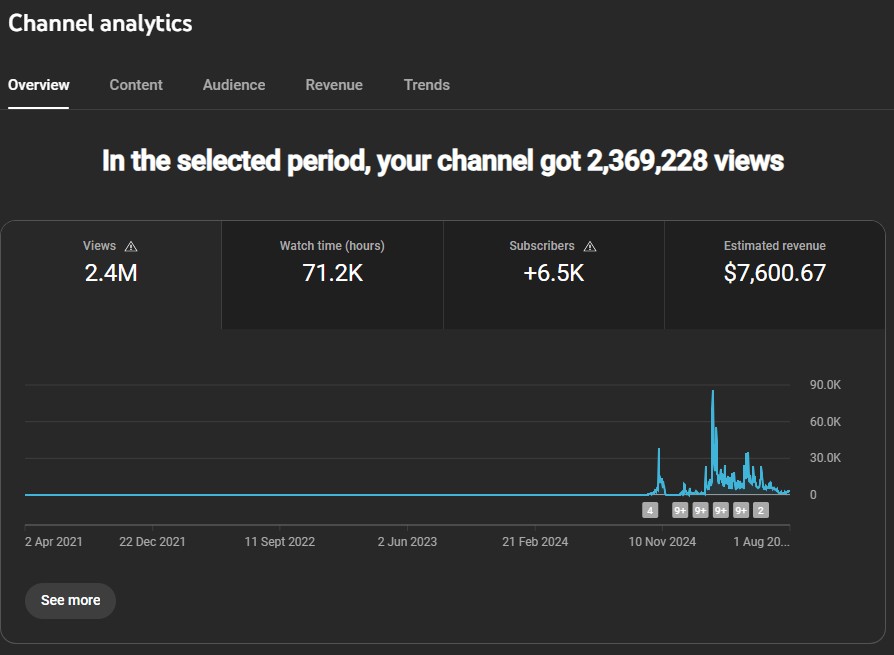
This screenshot was taken a while back and it gives a good indication of the channel's growth.
If you'll notice, there was no activity from April 2021 until the end of November 2024 - that's when I started publishing videos. This is because I just used a dormant channel I created years ago.
You can see by the graph how traffic can skyrocket, those are the videos that went viral as most of those spikes are created with one video only, but it's also a collection of all the videos on my channel.
This is why it is so important to never give up, because once you get your "breakthrough" video, it makes things so much easier.
This is likely due to the YouTube Algorithm that pushes your channel more once they see you have a video that's doing super well.
The Pros and Cons of my YouTube Automation Experience
Pros:
- I didn't need to show my face (or even use my voice)
- It's scalable - once you find a formula that works, stick with it and you'll be rewarded
- Although most videos will die out in traffic over time, some videos keep earning for months to come (this is making money in your sleep kinda income which is the best)
- Zero to Low upfront cost. This channel didn't cost me any money to make. I did all the work myself. I did buy the video editing software years ago, but I was using it for other projects already
- I didn't mention this, but I also set up another income stream by selling merch. I didn't make a lot, just over $150 but then again I didn't focus much on this either.
Cons:
- It took a long time and many videos to get monetized - fortunately one video changed everything for me to get to monetization pretty quick
- Trial and error - it took a while before I was able to realize which videos work and which ones don't
- Channel risk - you need to know the rules of YouTube because if you break them, your channel can be demonitized in an instant
The Time Investment Reality (And Why Most People Quit)
Here's what I didn't mention in the pros and cons: the actual hours required to produce each video manually.
Let me break down my typical workflow in 2024 when I was building this channel:
Video research and concept: 30 to 45 minutes scrolling through competitor channels, checking trending topics, analyzing what's getting views in the aviation niche.
Scriptwriting: 60 to 90 minutes writing the complete video script from scratch. Every video needed a hook, story structure, facts researched and verified, transitions, and a call-to-action.
Title and thumbnail research: 20 to 30 minutes analyzing top-performing videos to see which title formats and thumbnail styles were driving clicks in my niche.
Voiceover recording or sourcing: If I hired voice talent, this added cost and coordination time. If I used text-to-speech tools, I spent 15 to 20 minutes tweaking settings and rendering.
Video editing: This varied wildly depending on complexity, but a typical aviation video with stock footage, transitions, music, and graphics took two to three hours minimum.
Publishing workflow: Writing the description, tags, adding timestamps, uploading, creating the thumbnail in Canva, and scheduling the video took another 20 to 30 minutes.
Total time per video: Four to six hours from concept to publish, and that's assuming I already had all my stock footage sources organized and my editing workflow dialed in.
Now multiply that by 15 videos before I got my breakthrough. That's 60 to 90 hours of work before I saw any meaningful traction. Most people quit somewhere around video 8 because the manual grind feels endless and the results aren't showing yet.
The challenge is that YouTube rewards consistency and volume. The algorithm favors channels that publish regularly. My breakthrough happened because I kept testing different video angles and thumbnail styles until something clicked. But maintaining that testing volume manually is exhausting.
I pushed through because I treated this as a real test with a defined timeline. I committed to 20 videos minimum before evaluating whether the niche worked. Most casual creators don't have that discipline, which is why 95% of YouTube channels never reach monetization.
In 2026, AI changes the economics completely. The strategy I used still works — niche research, compelling thumbnails, strategic titles, audience retention focus — but AI compresses the execution timeline from five hours per video to 90 minutes. Same fundamentals, sustainable volume, no burnout.
If you're starting a faceless YouTube channel in 2026 and you're not using AI to handle scriptwriting, niche research, and metadata optimization, you're competing with one hand tied behind your back. The creators who figure out AI workflows early will publish three times the volume at the same quality level, which means they'll find their breakthrough videos three times faster.
How I Learned YouTube Automation (And What I'd Do Differently in 2026)
I learned the faceless YouTube fundamentals from Matt Par's Tube Mastery and Monetization course back in 2024. The course taught solid principles around niche selection, video structure, thumbnail psychology, and monetization strategies. Unfortunately Matt discontinued the course in late 2024, so it's no longer available.
The training worked. I proved that with $10,000 in revenue and 2.3 million views. But here's the honest truth about the execution timeline: it was brutal.
Every single video required manual scriptwriting (60 to 90 minutes per video), researching competitors to find angles (30 to 45 minutes), writing titles and descriptions optimized for search (20 to 30 minutes), and creating thumbnail concepts (another 30 minutes). Add video editing on top of that, and I was spending four to six hours per video from concept to publish.
When you're testing to find your breakthrough video, that timeline is exhausting. I published 15 videos before anything took off. That's 60 to 90 hours of work before I saw meaningful results. Most people quit somewhere around video 8 or 9 because the manual grind feels endless.
In 2026, AI compresses those timelines significantly.
The faceless YouTube fundamentals I learned in 2024 still work perfectly. Niche selection, storytelling structure, thumbnail psychology, audience retention tactics — none of that changed. What changed is the execution speed.
Module 2 of The 2026 AI Business Blueprint teaches the same faceless YouTube model I used, but with AI handling the time-intensive bottlenecks:
Scriptwriting: 10 to 15 minutes instead of 60 to 90 minutes. AI generates complete scripts from your topic and target keywords. You review, add your voice and specific examples, and publish. Same quality depth, 75% less time.
Niche research: AI analyzes competitor channels instantly and identifies trending topics, upload frequency patterns, and viral video formats in your niche. What used to take 45 minutes of manual scrolling now takes five minutes.
Titles and descriptions: AI generates 10 to 15 title variations optimized for click-through rate and search ranking in 30 seconds. Same with video descriptions and tags. You pick the best option and move on.
Thumbnail concepts: AI generates thumbnail layout ideas, text overlays, and visual concepts based on your niche's top-performing videos. You still create the actual thumbnail in Canva or Photoshop, but the concept phase drops from 30 minutes to two minutes.
Voiceovers: AI voices sound natural enough in 2026 that many successful faceless channels use them exclusively. No need to hire voice talent or record yourself. The audio is ready in minutes.
I'm not saying AI replaces strategy. You still need to understand your audience, choose the right niche, analyze your metrics obsessively, and iterate based on what works. The breakthrough video I mentioned earlier happened because I tested titles and thumbnails until I found the formula that resonated. AI doesn't do that strategic thinking for you.
But AI removes the execution bottleneck that kills most creators before they find their formula. Instead of publishing one video per week because that's all you can physically produce, you can publish three to five videos weekly and find your breakthrough video in half the time.
The math is simple. If it takes 15 videos to find your first viral video, and you're publishing one per week manually, that's 15 weeks before momentum kicks in. With AI compression, you publish three per week and hit that breakthrough in five weeks. Same strategy, three times faster.
If I were starting this channel fresh in 2026, I'd use the exact same niche research and audience analysis I used in 2024. I'd study the same metrics (watch time, click-through rate, audience retention). I'd test thumbnails and titles the same way. The only difference is I'd use AI to cut my per-video production time from five hours to 90 minutes, which means I'd reach profitability in weeks instead of months.
If you want to learn how to start a Faceless YouTube channel but you're also considering other business ideas to become financially free (and quit your job!) then check out how AI can help.
You can also get my free cheat sheet to learn how to start 5 different business models with AI being your assistant. Let AI do the work for you - it's like having a team of skilled professionals at your disposal!
Frequently Asked Questions
Can AI help with YouTube automation content creation?
Yes, AI dramatically reduces the time bottleneck that kills most faceless YouTube creators before they reach monetization. Creating YouTube automation videos manually requires scriptwriting (60-90 minutes per video), niche research (30-45 minutes), title and description optimization (20-30 minutes), thumbnail concepts (30 minutes), and voiceover work.
That is four to six hours per video, and you need to publish 10-20 videos before finding your breakthrough viral video. Module 2 of The 2026 AI Business Blueprint teaches faceless YouTube with AI compressing those timelines — scripts in 10-15 minutes instead of 90, niche research in five minutes instead of 45, instant title variations, AI voiceovers, automated thumbnail concepts.
Same YouTube fundamentals (audience retention, click-through rate, strategic testing), AI just handles the grunt work so you can publish three to five videos weekly instead of one.
How long does it take to make money with YouTube automation?
With manual production, expect three to six months before reaching YouTube monetization requirements (1,000 subscribers and 4,000 watch hours) if you publish consistently. My breakthrough happened around video 15, which took about four months at one video per week.
Most channels have one viral video that changes everything and accelerates subscriber growth significantly. With AI-assisted production in 2026, you can publish three to five videos weekly instead of one, which means you reach your breakthrough video in half the time.
The fundamentals are the same — niche research, compelling thumbnails, strategic titles, audience retention focus — but AI compresses scriptwriting from 90 minutes to 10 minutes, niche research from 45 minutes to five minutes, and metadata optimization to seconds. Same strategy, faster execution, quicker path to monetization.
What is the biggest challenge with YouTube automation?
Content volume and consistency. YouTube rewards channels that publish regularly, and finding your breakthrough video requires testing 10-20 different video angles, thumbnail styles, and title formats. Creating faceless videos manually takes four to six hours per video (scriptwriting, voiceover, editing, thumbnails, metadata), which makes publishing three to five times weekly nearly impossible without burning out.
This is why 95% of YouTube channels quit before reaching monetization — they run out of time and energy before finding what works. AI tools compress video production timelines by handling scriptwriting in 10 minutes instead of 90, generating title variations instantly, automating niche research, and providing AI voiceovers.
You still need to understand your niche, analyze metrics, and test strategically, but AI removes the execution bottleneck so you can maintain volume without exhaustion.

- Automate Channels Review: Prices, Refunds, YouTube Risk - October 23, 2026
- Why Platform Accountability Claims Now Reshape Online Safety Law - October 22, 2026
- Top Google Review Software for Improving Local Business Reputation - October 22, 2026