Hey, Drew here. Welcome to my Seller Circle review for 2026. I've spent years buying and pulling apart online business courses, and I've put nearly every major Amazon FBA course through the same wringer, so I can tell you whether Jake Burden's program is worth your money or just another guru funnel dressed up in nice branding.
Here's the short answer: Seller Circle is a real, working Amazon FBA program — not a scam — but it's a middling one, and I rate it 3.0 out of 5. You get daily done-for-you product leads, decent beginner training, and support that members genuinely seem to like. The problem is structural. Everyone gets the same leads, which means you're racing the rest of the membership to the same products, and the margins get thin fast. There's also a cheaper, lower-risk path I'll point you to if inventory and razor-thin arbitrage margins aren't your idea of fun.
💡 Seller Circle Teaches Arbitrage the Hands-On Way. Here's the Lower-Cost Alternative.
Seller Circle is built around buying physical stock and flipping it on Amazon. That means cash tied up in inventory, leads tied to UK retailers, and Amazon's fees nibbling your margin on every sale. The cheapest tier is £49.99/month, and the wholesale mentorship runs all the way up to £999.99.
My 2026 AI Business Blueprint takes the opposite approach: no inventory, no paid ads, no team. It's $47 one-time, and it shows you how to build an online income with AI doing the heavy lifting, instead of fighting a few thousand other members over the same bargain-bin products.
Jump to the AI alternative, or keep reading to see exactly what Seller Circle gives you first.
Key Takeaways
- What it is: a UK Amazon FBA platform that sends you daily done-for-you arbitrage product leads, plus an optional wholesale training program.
- Price: £49.99/month for the leads platform, up to £999.99 one-time for the wholesale mentorship. No refunds.
- The catch: leads are shared across the whole membership, so the best ones sell out within hours and margins get squeezed.
- Reputation: 3.4/5 on Trustpilot across 288 reviews, and the score has slipped from 4.0 as the community grew.
- My rating: 3.0/5. Legit and beginner-friendly, but middling, and most people are better served by a lower-cost, no-inventory path.
Why I Rate Seller Circle 3.0/5
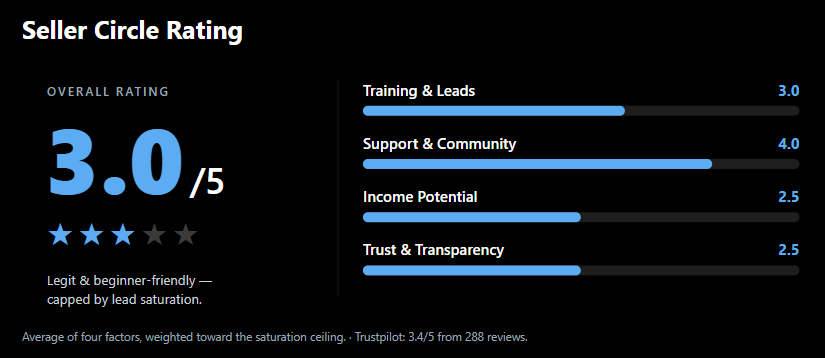
I give Seller Circle a 3.0 out of 5 — it's legit and beginner-friendly, but the business model underneath it is where it loses points. This isn't a course I'd warn you to run from, and it isn't one I'd push you toward either. It sits right in the middle, and the score reflects that honestly.
Breaking it down: the training and the leads are decent, around a 3 out of 5, and the day-to-day support is genuinely good, closer to a 4. Where it drops is income potential for a typical beginner, which I'd put nearer a 2.5. The reason is simple and I'll keep coming back to it: when hundreds or thousands of members all receive the same product leads, the good ones get bought out fast, and what's left is a crowded race to the bottom on price. That single design choice caps what most people will realistically earn, no matter how good the tutorials are.
I set my 3.0 just below the 3.4 it currently holds on Trustpilot on purpose. The public score is dragged up by a wave of glowing reviews from brand-new accounts, and I weight the structural flaw a little more heavily than the average happy first-month member does.
What Is Seller Circle?
Seller Circle is a UK-based Amazon FBA platform created by Jake Burden that hands you done-for-you product leads and teaches you how to resell them on Amazon. It launched in July 2022, now trades as Seller Circle Ltd, and runs its membership through Whop. The whole pitch is built on removing the hardest part of arbitrage for beginners: finding products worth buying.
There are really two products under one roof. The first is the OA/RA platform, which stands for online and retail arbitrage. For a monthly fee you get a steady stream of pre-vetted product leads, each one telling you what to buy, where to buy it, and roughly what profit to expect. The second is a separate, deeper wholesale mentorship aimed at people who want to move beyond flipping retail bargains into buying directly from brands and distributors.
If you're new to the model, it helps to know how FBA differs from other beginner businesses. I broke that down in my Amazon FBA vs dropshipping comparison, but the short version is this: with FBA you buy physical stock, send it to Amazon's warehouses, and Amazon handles the storage, packing, shipping, and customer service when it sells. You're responsible for sourcing profitable products and fronting the cash for inventory. Seller Circle's leads are meant to take the sourcing headache off your plate.
One detail that often gets buried: at the £49.99/month tier, the training is largely text-based guides, not video. The proper video course only comes with the wholesale mentorship. That's worth knowing before you assume the monthly membership is a full video program.
Who Is Jake Burden?

Jake Burden is the young UK entrepreneur who founded Seller Circle, originally from Birmingham and now based in Manchester. He got into e-commerce as a teenager and found his footing in Amazon wholesale rather than dropshipping, which is the more common starting point at that age.
His origin story is the one you'll see repeated everywhere: he invested around $5,000 into his first real product, cake boxes, found the cheapest distributor, studied the demand and pricing on Amazon, and turned that into roughly $79,000 in sales at a 40% margin. He went on to build a brand and, in 2022, the Seller Circle training program. He's reported earning over a million dollars a year through Amazon, and he was only 21 when most of the early reviews of his course were written, which makes him one of the younger faces in this space.
Here's the part I'd want you to know rather than gloss over. The company now refers to "both current owners," which suggests Jake runs Seller Circle alongside a business partner rather than solo. A handful of unhappy reviewers have gone further and claimed Jake isn't really active in Amazon FBA day-to-day anymore and just sells the courses.
Seller Circle disputes that directly, stating that both owners actively sell on Amazon and buy the very same leads shared inside the community. I can't independently verify who does what behind the scenes, so I'll leave it as a fair flag: the founder's hands-on involvement has been questioned, and the company has pushed back on it.
How Does Seller Circle Actually Work?
Seller Circle works by posting daily pre-approved product leads that you buy and resell through Amazon FBA. The promise is that you skip the research entirely. Their team finds products that can be bought cheaply online or in-store and flipped for a profit, and they hand you the details on a plate.
Day to day, a member logs in, browses the latest leads, and sees the buy price, the expected selling price, the source, and the projected return on investment. You purchase the stock, follow their step-by-step guides to prep and send it into Amazon, and once your listing goes live you start making sales.
You repeat the process with each new lead that gets posted. Alongside the leads you get an ungating database to help you unlock restricted brands and categories, 24/7 live chat support, weekly live Q&A sessions, and a community to lean on.
On paper it's a tidy system, and for a complete beginner who has no idea where to even start sourcing, that hand-holding has real value. The catch is what happens when you're not the only one holding that plate.
Does the Seller Circle Model Still Work in 2026?
The model can still work in 2026, but it's a lot harder than the sales page makes it sound, and the leads-for-everyone structure is the reason. Amazon arbitrage isn't dead, but it is crowded, and Seller Circle's own design makes the crowding worse rather than better.
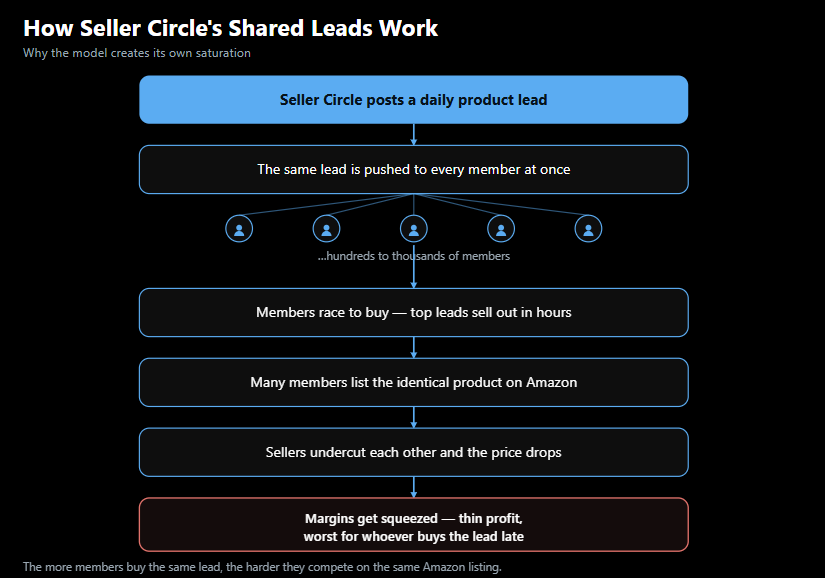
Think it through. When the same profitable lead drops to hundreds or thousands of members at once, the good ones get bought out within a couple of hours. Even members who like Seller Circle openly say this in their reviews. So either you're glued to your phone the moment leads post, or you're left with the slower, lower-margin picks that everyone passed on.
Then those same members all list the identical product on Amazon, which pushes the price down and squeezes the margin for the whole group. You're not just competing with Amazon and outside sellers; you're competing with the people who paid for the same leads you did.
There's also a gap between the marketed returns and the real ones. Seller Circle promotes leads with a 30% to 50% return on investment, and the more experienced reviewers in this space peg realistic net margins closer to 10% to 25% once Amazon's fees, prep costs, and any advertising come out. That distinction matters. A 40% gross figure on a unit is not the same as what actually lands in your bank account. If you're weighing this against lower-overhead models, my affiliate marketing vs Amazon FBA breakdown is worth a read before you commit any inventory cash.
What's Inside Seller Circle?
Seller Circle is split into the OA/RA membership and the separate wholesale mentorship, and they're very different products. Here's what each one actually gives you.
The OA/RA membership at £49.99 a month is the entry point. You get the daily product leads, usually somewhere in the range of three to five hundred a month, covering both online and retail arbitrage. Alongside that you get step-by-step written guides walking you through setting up your Amazon account and sending in inventory, the ungating database, 24/7 live chat support, weekly live Q&A sessions with the team, discounts on software and tools, and access to the member community. This tier is the leads-and-support package, and again, the core training here is written rather than video.
The wholesale mentorship is the bigger, pricier program, and it's where the proper video course lives. It runs roughly 150 individual video lessons across 25 to 30 hours, and it's genuinely comprehensive on the wholesale side. It covers setting up your Amazon account and sending inventory, the wholesale business model itself, moving from sole trader to a limited company, and a fresh sourcing method taught each week.
It goes into negotiating and contacting brands, distributors and wholesalers for better prices, importing goods from abroad safely and cheaply, avoiding private-label and intellectual-property issues, keeping your account healthy, registering for VAT, finding an Amazon-savvy accountant, managing and reordering inventory, automated pricing strategies, and scaling toward six figures.
Jake also walks through his own paid-advertising case study, where he reports spending £4,100 to generate an extra £248,000 in sales over nine months of testing. On top of the videos you get one-to-one support, weekly workshops, and the Discord community.
If you only take the monthly membership, you're really paying for the leads and the support. The deep education is in the wholesale program, which is a separate purchase.
How Much Does Seller Circle Cost?
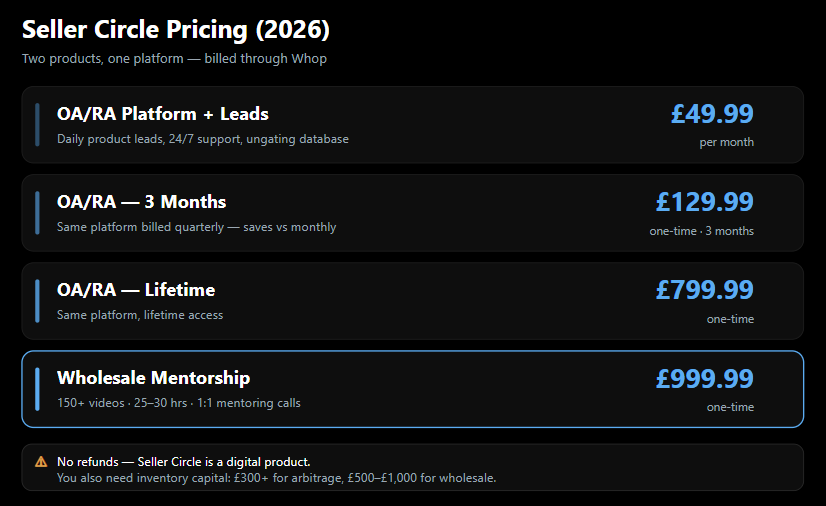
Seller Circle costs £49.99 per month for the leads platform, with a £129.99 three-month option and a £799.99 lifetime tier, while the wholesale mentorship is a one-time £999.99. Billing runs through Whop, and you can cancel the monthly membership at the end of your paid term.
The one thing I'd flag in bold before you buy: there are no refunds. Because it's a digital product, Seller Circle doesn't offer returns, and that's been a consistent sore point in reviews. If you buy the lifetime or wholesale tier and decide it isn't for you, that money is gone. That's a meaningfully worse deal than courses that back themselves with a genuine money-back guarantee.
There's also the question of how much capital you actually need on top of the membership, and here the truth sits between two extremes. Several competing reviews claim you need $5,000 to $10,000 to start FBA, which conveniently makes their own alternative look cheaper. Seller Circle's own FAQ says you can start online or retail arbitrage with as little as £300, and wholesale with £500 to £1,000.
My honest read is that you can absolutely start small with arbitrage, but small budgets earn small numbers, and the saturation problem means you need volume and constant reinvestment to make anything close to a full-time income. So budget realistically, not just for the membership, but for the stock you'll need to keep buying.
What Do Real Seller Circle Users Say?
Seller Circle holds a 3.4 out of 5 on Trustpilot from 288 reviews, and the reaction is sharply split. Roughly 87% of reviews are five stars and about 8% are one star, with almost nothing in between. That polarization tells you more than the average does.
The positive reviews are warm and consistent. Members praise the team by name, call the support responsive and friendly, rate the beginner training as clear and easy to follow, and value the ungating help. Some share real early wins, including reports of 40% to 50% return on investment in their first month on online leads before graduating to wholesale. Those wins look genuine.
The negatives cluster around the same themes I've already raised. The loudest is lead saturation: even some four-star reviewers note the leads sell out within a couple of hours, leaving everyone scrambling. A recurring complaint is that the experience cools off after you pay, with several long-term members describing a once-good community that's become watered down as it scaled.
There are billing gripes too, including one member who says a monthly plan landed on their credit file after being told it wouldn't, and a few who hit broken or empty pages during the move to the Whop platform. A couple of one-star reviews flatly accuse the program of selling a dream it doesn't deliver.
Two more things worth knowing. Trustpilot itself notes that Seller Circle hasn't invited customers through its system, which is why it flags that the reviews may not be representative, and skeptical reviewers have pointed out the number of five-star reviews coming from brand-new accounts.
The company does reply to about 61% of negative reviews, though it usually takes them over a month. And if you were hoping for a neutral Reddit consensus, there basically isn't one. There's almost no real discussion of Seller Circle on Reddit at all.
What I Like About Seller Circle (The Pros)
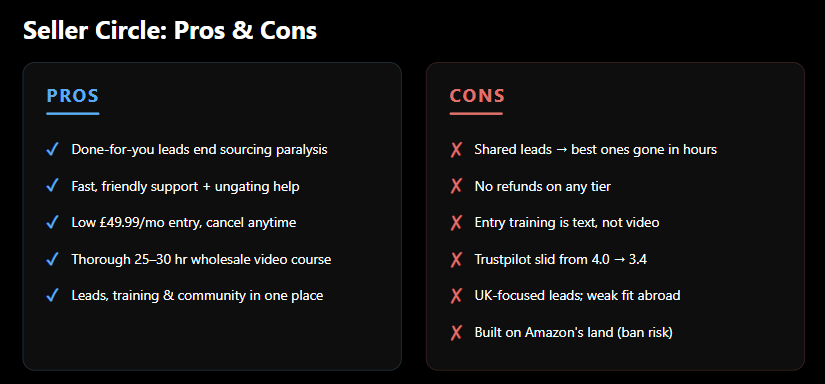
The biggest thing Seller Circle gets right is removing the sourcing paralysis that kills most beginners. Finding profitable products is the single hardest part of arbitrage, and for someone brand new, having vetted leads handed to you with the numbers attached is a real shortcut. It's the difference between staring at a blank screen and actually placing your first order.
The support is another genuine strength. Across dozens of reviews, the recurring praise is for fast, friendly, hands-on help, with team members named personally and credited for walking people through setup. For a beginner who's nervous about Amazon's rules, that reassurance has value, and the ungating database that comes with it solves a problem that stops a lot of new sellers cold.
The entry price is also fair. At £49.99 a month with no long contract, you can test the waters without a huge commitment, and the wholesale program, while pricey, is legitimately thorough for anyone serious about that path. The training, the leads, the community, and the support genuinely do sit in one place, which is convenient for someone who'd otherwise be stitching together free YouTube videos and guesswork.
What I Don't Like About Seller Circle (The Cons)
My biggest issue is the one I keep hammering: shared leads make saturation a feature, not a bug. When the whole membership chases the same products, the best leads vanish in hours and the margins on what's left get crushed. No amount of good tutorials fixes a structural problem baked into how the service works.
The no-refunds policy is the next red flag. Spending up to £999.99 on a digital product you can't return is a real risk, especially when the reputation is this divided. I'd always rather recommend something that stands behind itself with a guarantee.
A few more things bug me. The entry-tier training is text-based rather than video, which is harder for a lot of people to learn from. The Trustpilot trend is heading the wrong way, sliding from 4.0 down to 3.4 as the community grew, and the "it's worse after you pay" theme shows up too often to ignore.
The founder's day-to-day involvement has been questioned. And the model is heavily UK-focused, since the retail leads point at UK stores, so it's a poor fit if you're outside the UK. On top of all that, you're building on Amazon's land, where a policy slip, even an accidental one, can get your account suspended and wipe out the business you spent money building.
Are the Seller Circle Success Stories Real?
Some of the Seller Circle success stories are real, but they're not the whole picture, and I'd take the headline numbers with a healthy pinch of salt. There are members reporting genuine first-month profits and steady growth, and I don't think those are all fabricated.
The problem is survivorship bias and curation. The testimonials on Seller Circle's own site are hand-picked and uniformly glowing, which is exactly what you'd expect any sales page to show. The independent picture on Trustpilot is far more mixed, and the cluster of five-star reviews from new accounts makes it hard to know how representative the rosiest stories are.
Add the saturation problem, and the math gets honest fast: a member who jumped on a great lead early, in a less crowded window, will have a very different result from someone buying the same lead six months later alongside a thousand other people. The wins are real for some. They're just not the default outcome, and the marketing implies they are.
Is Seller Circle a Scam?
No, Seller Circle is not a scam. It's a registered company delivering an actual service: real leads, real training, real support, and real members reporting real results. Scams don't reply to 61% of their negative reviews or run weekly live calls with their members. Whatever its flaws, this is a legitimate, operating business.
But "not a scam" and "a smart place to put your money" are two different things, and I want to be clear about that line. Plenty of legitimate programs are still mediocre investments, and Seller Circle lands closer to the middle than the top for me. It's legit. It's just not the slam-dunk the sales page paints, and the structural saturation issue is a genuine ceiling on what most people will earn.
Exposed: Seller Circle vs the "Local Lead Generation" Pitch
Here's something you should know before you read another Seller Circle review: almost every one you'll find is bait for a completely different business model. Once you notice the pattern, you can't unsee it.
Go and look at the big-name Seller Circle reviews ranking right now. One steers you toward "local lead generation." Another calls the exact same thing "Digital Leasing." The YouTube reviews funnel you to free training opt-ins and affiliate marketing offers.
They'll spend a few hundred words on Seller Circle, lean hard on the saturation and capital problems, and then pivot you into a totally unrelated program, usually one that costs thousands of dollars. These reviewers love to tell you they aren't affiliates of Seller Circle. What they don't shout about is that they are affiliates of the lead-gen course they're sending you to, the one with the four-figure price tag.
I'm not saying lead generation is a bad business. I'm saying don't let a Seller Circle review quietly walk you into a $5,000 purchase you never came looking for. You searched for an honest take on an Amazon FBA program, and you deserve one without a bait-and-switch attached. That's the whole reason I write these the way I do.
Alternatives to Seller Circle
If Seller Circle isn't the right fit, you have better-known options on the wholesale side and a genuinely different path on the lower-cost side. It depends on which problem you're trying to solve.
If wholesale is what appeals to you, The Wholesale Formula is the most established program in that lane, with a longer track record and a reverse-sourcing method that a lot of serious sellers swear by. It's pricier, but it's a more proven name than a young mentorship if wholesale is your goal. There are several other solid FBA programs out there too if you want to compare the field properly.
But if your real frustration is the inventory cash, the thin margins, and being chained to Amazon's rules, then the honest answer is that a physical-product business might be the wrong shape entirely. That's where I'd point you somewhere different.
The AI Approach: Income Without Inventory or Paid Ads ($47)
Seller Circle locks you into buying stock, fighting saturation, and living under Amazon's policies. My 2026 AI Business Blueprint is the opposite of all three. It's $47 one-time, with no inventory to buy, no paid ads to burn through, and no team to manage.
Instead of racing other members to bargain-bin products and praying your margin survives Amazon's fees, the Blueprint shows you how to build an online income using AI to do the grunt work. It's the lower-cost, lower-risk model I'd hand a beginner today, and it doesn't depend on a platform that can suspend your account over an honest mistake. If you want the bigger-picture view first, I walk through the models I actually recommend in my guide on how to make money online with AI.
Compared head to head, the difference is stark. Seller Circle is £49.99 a month forever, plus the cost of every piece of stock you buy, plus Amazon's cut. The Blueprint is forty-seven dollars once. One asks you to keep feeding it cash to keep it running. The other is a one-time investment in skills that don't sit on a shelf depreciating.
Which Should You Choose?
Choose Seller Circle if you're a hands-on UK beginner with spare cash for inventory who genuinely wants to do arbitrage and accepts thin margins as the price of entry. If you're glued to your phone, quick to act on leads, and fine treating this as an active hustle rather than passive income, it can get you off the ground.
Choose the AI path if you want a lower startup cost, no inventory risk, no dependence on Amazon's rules, and the freedom to run things from anywhere rather than chasing UK retail leads. For most people reading this, especially anyone outside the UK or anyone without a few hundred to a few thousand pounds to tie up in stock, that's the model I'd steer toward. You can grab my free guide on building a $10K/month AI business without a team or paid ads if you want to see the shape of it before spending a penny.
Who Is Seller Circle For?
Seller Circle is for hands-on beginners in the UK who have real capital to invest and want the product research done for them. If you've got at least £300 for arbitrage or £500 to £1,000 for wholesale sitting ready, you're patient enough to ride out a slow start, and you like the idea of leads landing in your lap, you're the target customer.
It's not for you if you're hoping for passive income, because arbitrage is constant hands-on work, sourcing, prepping, listing, and repricing. It's not for you if you're tight on capital, since small budgets earn small returns and the saturation problem caps the upside.
It's not for you if you're outside the UK, because the leads lean on UK retailers. And it's definitely not for you if you want a guarantee, given there are no refunds and no business model can promise results. If any of those describe you, your money will go further elsewhere.
Final Thoughts: Is Seller Circle Worth It?
Seller Circle is worth a look for the right person, but for most people it's a middling option, and that's why it lands at 3.0 out of 5. It's a legitimate, active program with helpful support, fair entry pricing, and a thorough wholesale course. I'm not warning you away from a scam, because it isn't one.
The honest issue is the ceiling. Shared leads mean built-in saturation, the margins are thinner than the marketing suggests, there are no refunds on the bigger tiers, and the Trustpilot trend has been sliding. For a hands-on UK seller with capital to spare, it can work.
For everyone else, a lower-cost, no-inventory path is the smarter bet, which is exactly why I built the 2026 AI Business Blueprint at $47 instead of asking you to gamble four figures on stock you can't return. Whichever way you go, go in with your eyes open and your budget realistic.

Frequently Asked Questions
Is Seller Circle legit?
Yes, Seller Circle is legit. It's a registered UK company, Seller Circle Ltd, that delivers actual product leads, training, and support, with a large base of members and a public Trustpilot presence. It isn't a scam. The fair criticisms are about value and the saturation built into its shared-leads model, not legitimacy.
How much does Seller Circle cost?
The leads platform is £49.99 per month, with a £129.99 three-month option and an £799.99 lifetime tier. The separate wholesale mentorship is a one-time £999.99. Billing runs through Whop, and you'll need additional capital on top for inventory, with Seller Circle suggesting at least £300 for arbitrage and £500 to £1,000 for wholesale.
Can you get a refund from Seller Circle?
No. Because Seller Circle is a digital product, it doesn't offer refunds or returns, and this is a consistent complaint in reviews. You can cancel a monthly subscription so it stops renewing, but money already paid, including on the lifetime and wholesale tiers, is not returned.
How much money can you make with Seller Circle?
It depends entirely on your capital, your speed, and how saturated the leads are when you act on them. Seller Circle markets leads with a 30% to 50% return on investment and suggests roughly £150 to £250 a month in profit from a £500 starting budget, or £300 to £500 from £1,000.
In reality, after Amazon's fees and prep costs, net margins tend to land closer to 10% to 25%, and the shared-leads model makes the higher figures harder to hit than they sound.
Is Jake Burden a real Amazon seller?
Jake Burden is a real entrepreneur who built his start in Amazon wholesale, with a widely repeated story of turning a $5,000 cake-box investment into around $79,000 in sales. He founded Seller Circle in 2022. Some reviewers have questioned how active he still is in day-to-day FBA, and the company has disputed that, stating both of its current owners actively sell on Amazon and buy the same leads as members.
Do you need a lot of money to start with Seller Circle?
Not as much as some reviews claim, but more than the membership fee alone. Seller Circle says you can begin arbitrage with around £300 and wholesale with £500 to £1,000. You can start small, but small budgets produce small returns, and the saturation issue means you need steady reinvestment and volume to build anything close to a full-time income.
Can I use AI instead of an Amazon FBA course like Seller Circle?
Yes, and for a lot of people it's the better starting point. Seller Circle ties you to inventory cash, UK retail leads, thin margins, and Amazon's rules. My 2026 AI Business Blueprint is $47 one-time and teaches a model with no inventory, no paid ads, and no team, using AI to handle the heavy lifting. If you'd rather not gamble four figures on stock you can't return, it's the lower-risk path I'd recommend looking at first.

- Digital Entrepreneurs Are Discovering That Physical Operational Infrastructure Accelerates Digital Scale - October 18, 2026
- Fast-growing E-commerce Sellers Are Overhauling Fulfillment Hubs To Keep Up With Orders - October 16, 2026
- Ad Network Marketing Myths That Can Lead to Poor Campaign Decisions - October 13, 2026