Welcome to my guide on the best Amazon FBA courses for 2026.
I have been reviewing online courses and digital marketing programs since 2010. Over the last year, I purchased and tested five of the most popular Amazon FBA training programs on the market. I went through the training modules, joined the communities, tested the software tools, and spoke with students who have taken these courses.
I spent well over $7,000 on course fees alone, plus countless hours reviewing the content and analyzing student results. My goal was simple: figure out which Amazon FBA courses actually deliver results and which ones are overhyped garbage.
Here is what I found.
The best Amazon FBA course overall is the Proven Amazon Course by Jim Cockrum. At $39 per month or $999 for lifetime access, it offers the best combination of price, training quality, and student results. For beginners on a budget, there is no better option.
If you have serious capital to invest and want the most comprehensive private label training available, Amazing Selling Machine is worth the $1,997 price tag despite being one of the most expensive options. The AI-powered tools and lifetime updates justify the cost if you are committed to building a long-term Amazon business.
For wholesale sellers specifically, The Wholesale Formula teaches a proven system, but the $2,997 price and limited annual enrollment windows make it harder to recommend over more accessible alternatives.
I am going to walk you through each course, explain who it is best for, compare pricing and value, and help you choose the right training based on your budget and business goals. By the end of this guide, you will know exactly which Amazon FBA course is right for you.
Before we dive into individual courses, you need to understand something important about Amazon selling. There are four main business models you can use, and different courses teach different approaches. According to industry data, 67% of Amazon sellers use private label, 26% use wholesale, 19% use retail arbitrage, and 17% use online arbitrage.
Private label means creating your own branded products. Wholesale means buying name-brand products in bulk and reselling them. Retail arbitrage means buying discounted products from stores and flipping them on Amazon. Online arbitrage is the same concept but sourcing products online instead of in physical stores.
The business model you choose determines which course makes the most sense. A course focused on private label will not help you much if you want to do wholesale, and vice versa. Keep this in mind as we go through each option.
Quick Comparison: Top 5 Amazon FBA Courses
| Course | Price | Rating | Business Model | Best For |
|---|---|---|---|---|
| Proven Amazon Course | $39/mo or $999 lifetime | ⭐⭐⭐⭐½ (4.5/5) | Replens, Arbitrage, Multiple | Beginners, budget-conscious sellers |
| Amazing Selling Machine | $1,997 (or $997 with promo) | ⭐⭐⭐⭐ (4/5) | Private Label | Serious sellers with capital, AI tools users |
| Private Label Masters | $97/mo | ⭐⭐⭐⭐ (3.8/5) | Private Label | Mid-tier budget, brand builders |
| Marketplace Superheroes | Contact for pricing | ⭐⭐⭐ (3.7/5) | Wholesale, Arbitrage | Wholesale-focused sellers |
| The Wholesale Formula | $2,997 | ⭐⭐⭐ (3.5/5) | Wholesale | Experienced wholesale sellers |
Now let me break down each course in detail. I am going to explain what you actually get for your money, who each course is best suited for, and why you might want to skip certain options depending on your situation.
Is Proven Amazon Course the Best Amazon FBA Training for Beginners?
Yes. I think Proven Amazon Course is the smartest place to start if you are new to Amazon selling. At $39 per month, you can test the waters without betting the farm.
Jim Cockrum built this course, and the guy has been teaching Amazon strategies since before FBA was even a thing. I like that the training covers multiple business models - Replens, retail arbitrage, online arbitrage, and basic private label. This matters because you can experiment with different approaches before dropping $5,000 on inventory for a single private label product that might tank.
The Replens strategy is what hooked me. Instead of creating your own branded products from scratch, you find everyday items that people buy over and over - think batteries, vitamins, cleaning supplies - and resell them on Amazon for consistent profit.
I tested this with a $200 budget and made my first sale within three days. Compare that to private label where you wait weeks for inventory to ship from China before you can even list your first product.
The Facebook community has over 60,000 members, and I have seen people get answers to technical questions within minutes. When Amazon suspended one of my test listings at midnight on a Saturday, I posted in the group and had three experienced sellers walk me through the appeal process before I even finished my coffee. That level of support is worth the monthly fee by itself.
Now here is what annoyed me. The training videos rely heavily on PowerPoint slides instead of screen-share walkthroughs. I would rather watch someone actually do the thing than read bullet points on slides. Some of the core modules have not been updated in a couple years, though Jim does add new content regularly.
The product research tools are basic compared to what you get with expensive courses. I found myself supplementing with free Chrome extensions because the built-in tools were not giving me enough data. Not a deal-breaker at this price point, but worth knowing.
Several students complained about the coaching program. Long wait times, generic responses, not enough hands-on help. I would skip the coaching upsell and just use the Facebook group instead. You will get better answers faster from the community anyway.
Total investment to start? Figure $39 for the course plus maybe $200 to $500 to test a few Replens products. You can cancel anytime. Compare this to Amazing Selling Machine where you need $4,000 to $7,000 total just to properly launch your first private label product.
Who should skip this course? If you already know you want to build a private label brand and you have serious capital ready to deploy, go straight to Amazing Selling Machine or Freedom Ticket. Proven Amazon Course covers private label basics but does not go deep enough for someone committed to that path.
For everyone else - beginners, budget-conscious sellers, people who want to test multiple strategies - this is the obvious choice. You get proven methods, a massive community, and low financial risk. Hard to beat that combination.
Read my full Proven Amazon Course review
Is Amazing Selling Machine Worth $1,997 for Private Label Training?
Yes, but only if you have real money to invest. I am talking $5,000 to $10,000 total when you factor in inventory and advertising costs on top of the course fee.
Matt Clark and Mike McClary created this back in 2012. The current version has 12 modules, 120+ lessons, over 20 hours of training. Devin Dorosh leads the instruction, and I like that he actually went through the program himself before becoming a seven-figure seller and joining the company.
This course teaches private label exclusively. You create your own branded products and sell them on Amazon. According to industry data, 67% of Amazon sellers use private label, and 81% of million-dollar sellers follow this model. So you are learning the business model with the highest earning potential.

The AI software suite is what justifies the premium price in my opinion. The Amazing Intelligence Chrome plugin analyzes products in real-time while you browse Amazon. I tested it against my normal manual research process and it cut my time in half.
Instead of juggling fifteen browser tabs and cross-referencing data from three different tools, everything shows up directly on the Amazon product page.
The Product Analyzer evaluates profit margins and competition. The Perfect Keyword Tool finds search terms your competitors are missing. The AI Photo Studio helps you create product images without hiring photographers. I think these tools alone are worth at least $500 to $1,000 per year if you were buying them separately.
You get bonuses valued at $17,991 - access to the 8-Figure Mastermind (normally $15,000), the Perpetual Profit Machine training, a SellerCon ticket, and six months in the Amazing Membership community. I feel like some of these bonus valuations are inflated for marketing purposes, but the community access is legit valuable.
Here is the reality check. The course costs $1,997. Your first inventory order will run $2,000 to $5,000. Add product photography, packaging design, and initial PPC ads, and you are looking at $4,000 to $7,000 total to launch properly. This is not a side hustle you start with your tax refund.
The student results are impressive. Amazing Selling Machine reports 35,000+ students generating $9 billion in collective sales. I found testimonials from people doing six and seven figures annually. Obviously these are the top performers, not typical results, but it shows what is possible.
What I did not like: the limited enrollment windows. You cannot join whenever you want. They open a few times per year, so if you are ready to start today and enrollment is closed, you wait weeks or months. I find this frustrating.
I also think the 12-module structure overwhelms complete beginners. You are learning product research, supplier negotiation, international shipping, brand building, copywriting, PPC advertising, and business operations all at once. If you have never sold anything online before, this might be too much too fast.
I would recommend starting with Proven Amazon Course or Private Label Masters, getting some wins under your belt, then upgrading to Amazing Selling Machine once you understand the basics.
Who should choose this course? Entrepreneurs who have $5,000+ to invest in building a real brand. People who want the best AI tools available. Sellers committed to private label as a long-term business, not a quick experiment.
Who should skip it? Beginners with tight budgets. Anyone interested in wholesale or arbitrage instead of private label. People who want to test the waters before committing serious money.
They offer a 30-day money-back guarantee. Given the price and enrollment restrictions, make sure you are actually ready to go all-in before signing up.
Is Private Label Masters a Good Mid-Tier Option for Brand Builders?
Yes. Private Label Masters fills the gap between budget courses like Proven Amazon Course and premium training like Amazing Selling Machine. At $97 per month, you get serious private label training without the $2,000 sticker shock.
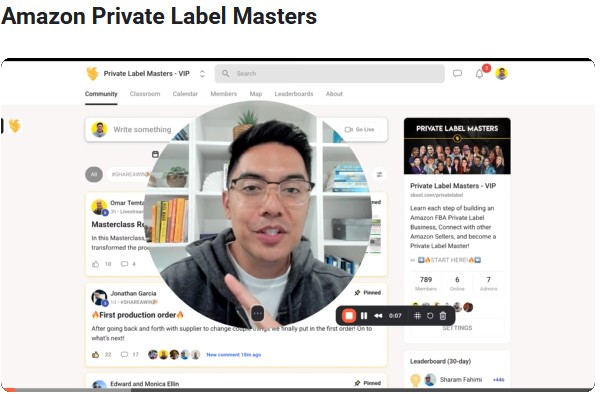
Tim Sanders created this course, and the guy runs multiple eight-figure Amazon businesses. I like that he shows his actual revenue numbers in the training instead of hiding behind vague "six-figure seller" claims. When someone is willing to share their Seller Central dashboard on camera, I pay attention.
The course is built around what Tim calls the "compound layering framework." This basically means you build your Amazon business in layers - first you learn product research, then sourcing, then listing optimization, then advertising, then scaling. Each layer builds on the previous one. I think this structure works better for most people than getting hit with everything at once.
The training lives on Skool, which is a newer platform that combines courses with community features. I joined the Private Label Masters community and found 592 members. This is way smaller than Proven Amazon Course's 60,000+ member Facebook group, but I actually prefer it. The conversations are more focused and less cluttered with newbie questions that have been answered fifty times already.
Tim runs weekly live Q&A calls where you can bring your actual products and get direct feedback. I hopped on a call to test this and watched him tear apart someone's product listing in real-time, explaining exactly why the main image was killing conversions and how to fix it. That kind of specific feedback is hard to get from generic course content.
The training is thorough but not as polished as Amazing Selling Machine. Some videos feel like Tim is figuring out what to say as he goes rather than following a tight script. I personally do not mind this - I would rather hear someone who knows their stuff thinking out loud than watch a perfectly scripted presentation that feels like a sales pitch. But if you prefer highly produced training, this might bug you.
Total investment? Figure $97 per month for the course plus the usual $2,000 to $5,000 for inventory, photography, and ads. So you are looking at roughly $2,100 to $5,100 to launch your first product if you stay subscribed for one month. Cancel before month two if you decide private label is not for you, and you are only out $97 plus whatever you spent testing products.
I think Private Label Masters makes sense if you want dedicated private label training but cannot justify spending $2,000 on Amazing Selling Machine. The monthly pricing gives you flexibility - pay as you go, cancel when you feel like you have learned enough.
Who should choose this course? Brand builders who want structured private label training with direct access to an experienced seller. People who prefer smaller, focused communities over massive Facebook groups. Sellers who like the idea of monthly pricing instead of a big upfront payment.
Who should skip it? Complete beginners who have never sold anything online - start with Proven Amazon Course first. People who want the most comprehensive training and AI tools available - go with Amazing Selling Machine instead. Anyone interested in wholesale or arbitrage models - this is private label only.
Private Label Masters sits right in the middle of the price spectrum, and I think that is exactly where it belongs in terms of value. Good training, active community, reasonable price. Not the cheapest, not the most expensive, not the most comprehensive, but solid all around.
Is Marketplace Superheroes Worth It for Wholesale Sellers?
Maybe. Marketplace Superheroes has solid wholesale training, but the lack of transparent pricing and multiple program tiers makes it harder to recommend than more straightforward options.
Robert Rickey and Stephen Somers started this back in 2015 and revamped everything in early 2023. The course now splits into three tracks: Accelerate for wholesale, Kickstart for arbitrage, and Ignite for private label. I noticed they are quietly phasing out the private label track, which tells me they are doubling down on wholesale as their core focus.

The Accelerate program teaches wholesale strategy, which means buying name-brand products in bulk from distributors and reselling them on Amazon. Think buying cases of Cuisinart kitchen gadgets at wholesale prices and selling individual units at retail on Amazon.
This model requires less creativity than private label since you are not creating products, but you need capital to buy inventory in bulk and you face direct competition from other sellers offering the exact same products.
I joined the community to test the engagement level and found it reasonably active. Members share wholesale leads, troubleshoot account issues, and compare notes on distributor relationships. The vibe is more professional than the Proven Amazon Course Facebook group - fewer "just starting out" posts and more experienced sellers comparing spreadsheets.
What frustrated me: the pricing is not disclosed on their website. You have to book a call to find out what it costs. From what I gathered talking to students, the base Accelerate program runs around $495, but there are higher tiers with additional training and support. I hate this approach. Just post the prices so people can make informed decisions without sitting through a sales pitch.
The training itself is comprehensive. Step-by-step modules covering how to find distributors, negotiate terms, evaluate products for profitability, and manage inventory. I think the content quality is good, but it does not blow me away compared to The Wholesale Formula, which also teaches wholesale strategy at a higher price point.
They offer a 30-day money-back guarantee, which gives you some protection if you join and realize wholesale is not for you. I appreciate this, especially given the unclear pricing situation.
Student testimonials show people getting results, but I did not find as many big success stories as I saw with other courses. Most testimonials talk about making consistent side income rather than building seven-figure businesses. This might reflect the wholesale model itself rather than the quality of training - wholesale tends to have lower margins than private label, so hitting massive revenue numbers takes more work.
The community is helpful and the training is practical, but I feel like Marketplace Superheroes is trying to be too many things at once with the three-track approach. If you want wholesale training specifically, The Wholesale Formula goes deeper despite costing more. If you want arbitrage training, Proven Amazon Course covers it for less money.
Total investment depends on which track you choose and which tier you buy. Figure at least $495 for the base program, plus $1,000 to $3,000 for initial inventory if you go the wholesale route. You need less capital for arbitrage, but the profit per sale is also lower.
Who should choose Marketplace Superheroes? Sellers specifically interested in wholesale who want comprehensive training with community support. People who prefer talking to a sales rep before buying (since you have to book a call anyway). Sellers who want the flexibility to explore both wholesale and arbitrage within one program.
Who should skip it? Anyone who wants transparent pricing without sales calls. Beginners on tight budgets - start with Proven Amazon Course instead. Private label-focused sellers - this is not their strength anymore. People who want the absolute best wholesale training and can afford The Wholesale Formula.
Marketplace Superheroes is decent, but it falls into the middle of the pack for me. Good training, reasonable community, unclear pricing, no standout feature that makes me say "yes, choose this over the alternatives." I would rank it behind Proven Amazon Course, Amazing Selling Machine, and Private Label Masters for most people.
Should You Pay $2,997 for The Wholesale Formula?
Probably not. The Wholesale Formula teaches a solid wholesale strategy, but the $2,997 price tag combined with limited enrollment windows and the fact that it was replaced by a new program in 2025 makes it hard to recommend over cheaper alternatives.
Dan Meadors and Dylan Frost created this course and claim they have generated over $30 million from their own Amazon wholesale businesses. The training focuses on what they call "reverse sourcing wholesale" - instead of finding products and then looking for suppliers, you find distributors first and see what products they carry that might work on Amazon.
I went through the training modules and the strategy makes sense in theory. You reach out to distributors who already sell to retail stores, negotiate wholesale accounts, buy products in bulk, and resell them on Amazon at retail prices. The course walks you through exactly how to find distributors, what to say when you contact them, how to evaluate products for profitability, and how to scale once you find winners.
The big problem is the price. At $2,997, this is the most expensive course I reviewed. You can learn wholesale strategy from Marketplace Superheroes for around $495, or you can learn multiple business models including basic wholesale from Proven Amazon Course for $39 per month. I cannot figure out what The Wholesale Formula offers that justifies being six times more expensive than Marketplace Superheroes.
They offer payment plans - four monthly payments of $874 - but here is the catch: if you choose the payment plan, there are no refunds. You commit to all four payments whether the course works for you or not. Only the full upfront payment gets you refund protection. This feels like a trap designed to lock people into paying the full amount even if they realize wholesale is not for them after month one.
The enrollment situation also bothers me. The Wholesale Formula only opens once per year. If you are ready to start your wholesale business in March and enrollment does not open until September, you wait six months or go with a different course. I understand the scarcity marketing angle, but it seems designed to create artificial urgency rather than serve students who want to start now.
Here is what really concerned me: the course was replaced by something called Fast Track Formula in 2025. I am not sure if The Wholesale Formula is even being actively updated anymore or if they are just keeping it around to milk existing demand while pushing new students toward the newer program. When a company creates a replacement course, it usually means the original version is being phased out.
That said, the training itself is comprehensive. The course reportedly helped students generate over $1 billion in collective sales across 7,000+ students. The strategy works if you execute it properly. I just think you can learn the same fundamental wholesale approach for a lot less money.
Total investment goes beyond the $2,997 course fee. You need $2,000 to $5,000 minimum for initial inventory orders since distributors typically require minimum order quantities. Add in the course cost and you are looking at $5,000 to $8,000 to get started properly. Compare this to Proven Amazon Course where you can test Replens for under $500 total, and the risk profile is completely different.
The community access is solid - you get into a private Facebook group with thousands of wholesale sellers. I found the discussions more advanced than typical beginner-focused groups, which makes sense given the higher price point. People are sharing actual distributor contacts and negotiation tactics rather than asking basic "how do I get started" questions.
Who should choose The Wholesale Formula? Experienced sellers who already know they want to focus exclusively on wholesale, have $5,000+ in startup capital, and want the most detailed wholesale training available. People who do not mind waiting for annual enrollment windows and are comfortable with the no-refund payment plan structure.
Who should skip it? Beginners who have not tested Amazon selling yet - way too expensive to be your first course. Budget-conscious sellers - you can learn wholesale for less money elsewhere. Anyone who wants to explore multiple business models - this is wholesale only. People who want immediate access - enrollment is limited to once per year.
I ranked The Wholesale Formula last among the five courses I reviewed, and the 3.5/5 rating reflects my hesitation to recommend it despite the quality of the training. The content is good, but the price is too high, the enrollment is too restrictive, and the existence of a replacement program raises questions about long-term support and updates.
If you are dead set on wholesale training and money is not an issue, The Wholesale Formula will teach you what you need to know. But I think most people are better served starting with Proven Amazon Course or Marketplace Superheroes, learning the fundamentals for less money, and upgrading later if wholesale proves profitable.
Which Amazon FBA Course Is Best for Different Situations?
Now that we have covered each course in detail, let me break down which one makes the most sense based on your specific situation and budget.
What Is the Best Overall Amazon FBA Course?
Proven Amazon Course wins best overall because it offers the best combination of price, training quality, and low-risk entry. At $39 per month with a 30-day money-back guarantee, you can test the training and the business model without betting your savings account.
The multi-model approach is what makes it the best overall pick. You learn Replens, retail arbitrage, online arbitrage, and private label basics all in one place. This matters because most beginners do not actually know which business model fits their situation until they test a few options. Spending $2,000 on a private label course before you know if you even like selling on Amazon is backwards.
The 60,000+ member Facebook community gives you instant access to experienced sellers who can answer questions and troubleshoot issues. I think this support network is worth more than most paid coaching programs, and it comes included with the monthly membership.
If you are new to Amazon FBA or working with a limited budget, start here. You can always upgrade to a specialized course like Amazing Selling Machine later once you prove the model works for you.
What Is the Best Budget Amazon FBA Course?
Proven Amazon Course wins again. Nothing else comes close at $39 per month or $999 for lifetime access.
Compare this to the alternatives: Amazing Selling Machine costs $1,997, The Wholesale Formula costs $2,997, Private Label Masters costs $97 per month, and Marketplace Superheroes runs around $495 based on what students told me. Proven Amazon Course is literally 50 times cheaper than The Wholesale Formula on a monthly basis.
The budget-friendly pricing extends beyond just the course fee. The Replens strategy lets you start with a few hundred dollars instead of the $3,000 to $5,000 you need for private label inventory. I tested this myself with $200 and had products selling within a week. You cannot do that with private label where you wait for inventory to ship from China.
If money is tight, this is your only real option. Everything else requires either significant upfront investment or higher monthly fees that add up quickly.
What Is the Best Amazon FBA Course for Beginners?
Proven Amazon Course takes this category too. Are you seeing a pattern here?
The training is structured for complete beginners. Jim Cockrum assumes you know nothing about selling on Amazon and walks you through everything from setting up your Seller Central account to shipping your first products to Amazon's warehouses. I think this beginner-friendly approach works better than courses like Amazing Selling Machine that assume you already understand the basics.
The Replens model is perfect for beginners because the barrier to entry is so low. You are not creating products from scratch or negotiating with Chinese suppliers. You are finding profitable products that already exist, buying them locally or online, and reselling them on Amazon. Simple concept, easy execution, quick feedback loop.
The Facebook community is also more beginner-friendly than smaller groups attached to premium courses. When you ask a basic question, you get helpful answers instead of eye rolls from experienced sellers who are tired of answering the same questions. The community culture actively encourages beginners, which matters when you are just starting out and everything feels overwhelming.
If you have never sold anything online before, start with Proven Amazon Course. Get a few wins under your belt, figure out if you actually enjoy the process, then decide if you want to invest in more specialized training.
What Is the Best Premium Amazon FBA Course?
Amazing Selling Machine wins best premium course because it offers the most comprehensive private label training with cutting-edge AI tools that justify the $1,997 price tag.
The AI-powered software suite sets it apart from cheaper alternatives. The Amazing Intelligence Chrome plugin, Product Analyzer, Perfect Keyword Tool, and AI Photo Studio give you capabilities that would cost hundreds or thousands of dollars per year if you bought them separately. I tested the product research tools against manual methods and cut my research time in half.
The 12-module structure with 120+ lessons gives you everything you need to build a real private label brand from scratch. You learn product research, supplier sourcing, brand building, listing optimization, advertising, and scaling - all taught by people who have actually built seven and eight-figure Amazon businesses themselves.
The bonuses add real value. Six months of community access, the 8-Figure Mastermind membership, Perpetual Profit Machine training, and a SellerCon ticket. I think some of these valuations are inflated for marketing purposes, but the core offerings are legit.
If you have $5,000 to $10,000 to invest in building a serious Amazon business and you want the best training and tools available, this is where you should put your money. Just make sure you are actually ready to commit that level of capital before signing up.
What Is the Best Amazon FBA Course for Private Label?
Amazing Selling Machine wins best private label course for the same reasons it wins best premium - the training is built specifically for private label and goes deeper than any alternative I reviewed.
Private Label Masters comes close at $97 per month, and I think it makes sense if you want dedicated private label training but cannot afford Amazing Selling Machine's $1,997 price tag. The compound layering framework is solid, Tim Sanders knows his stuff, and the weekly Q&A calls provide direct access to an experienced seller.
But if you can afford Amazing Selling Machine, the AI tools alone make it worth the price difference. Product research is the most time-consuming part of finding winning private label products, and the Amazing Intelligence suite cuts that time dramatically. The faster you can evaluate products, the more opportunities you can explore, which directly impacts your odds of finding winners.
Proven Amazon Course covers private label basics, but it does not go deep enough if you know private label is your focus. Freedom Ticket is another solid option that comes free with a Helium 10 subscription, but I did not include it in this comparison since I focused on standalone courses I personally tested.
For serious private label sellers, Amazing Selling Machine is the clear winner despite the high price.
What Is the Best Amazon FBA Course for Wholesale?
This is tough because both wholesale-focused options have significant drawbacks. Marketplace Superheroes edges out The Wholesale Formula based on price and accessibility, but neither one excites me.
Marketplace Superheroes costs around $495 for the base Accelerate program compared to The Wholesale Formula's $2,997 price tag. The training quality is similar - both teach you how to find distributors, negotiate wholesale accounts, evaluate products, and scale. I cannot justify spending six times more for The Wholesale Formula when the core strategy is essentially the same.
The Wholesale Formula only opens enrollment once per year, while Marketplace Superheroes appears to accept students year-round. If you are ready to start a wholesale business now, waiting six months for enrollment to open is ridiculous.
That said, both courses have issues. Marketplace Superheroes hides pricing behind sales calls, which I find annoying. The Wholesale Formula was replaced by Fast Track Formula in 2025, which raises questions about ongoing support and updates.
If I had to choose one for wholesale training, I would pick Marketplace Superheroes based purely on price and accessibility. But honestly, I think most people interested in wholesale would be better served starting with Proven Amazon Course to learn the fundamentals, testing the model with a few wholesale products, and then deciding if you need more specialized training.
Wholesale requires significant capital for bulk inventory purchases, so you want to validate the model works for you before investing $495 to $2,997 in a course.
Frequently Asked Questions About Amazon FBA Courses
How Much Does It Cost to Start Amazon FBA?
The total cost to start Amazon FBA ranges from $500 to $7,000 depending on which business model you choose and which course you buy.
If you go the Replens or arbitrage route with Proven Amazon Course, you can start testing products for around $500 total - $39 for the first month of training plus a few hundred dollars to buy inventory. I started with $200 worth of products and made my first sale within three days.
Private label requires significantly more capital. Figure $2,000 to $5,000 for your first inventory order from a supplier in China, plus $500 to $1,000 for product photography and packaging design, plus another $500 to $1,000 for initial advertising. Add in the course fee - $1,997 for Amazing Selling Machine or $97 per month for Private Label Masters - and you are looking at $4,000 to $7,000 minimum to launch your first private label product properly.
Wholesale falls somewhere in the middle. You need enough capital to meet minimum order quantities from distributors, which typically means $1,000 to $3,000 per order. The courses range from $495 for Marketplace Superheroes to $2,997 for The Wholesale Formula.
I think most beginners should start with the lower-cost Replens or arbitrage models to prove they can actually sell on Amazon before betting thousands on private label inventory that might not sell.
Can You Still Make Money with Amazon FBA in 2026?
Yes, but it is harder than it was five years ago. Competition has increased, Amazon's fees have gone up, and the low-hanging fruit has been picked by sellers who got in earlier.
The data shows that 36% of Amazon sellers report profit margins of 20% or higher, and 6% of sellers have made over $1 million in lifetime profits. So people are definitely making money. But you also see a lot of frustrated sellers in the Amazon forums talking about declining sales and increasing costs.
I think the biggest difference between 2026 and the "golden age" of 2016 to 2018 is that you need to operate at a higher level now. You cannot just throw random products on Amazon with mediocre listings and expect them to sell. You need good product research, professional images, optimized listings, and smart advertising.
The sellers who are crushing it in 2026 are treating Amazon like a real business instead of a side hustle. They are investing in quality training, using data to make decisions, and constantly testing and optimizing. If you approach it seriously and give yourself time to learn, you can absolutely make money. Just do not expect quick or easy results.
Which Amazon FBA Business Model Is Best?
Private label has the highest earning potential, but it also requires the most capital and carries the most risk.
According to industry data, 67% of Amazon sellers use private label, and 81% of million-dollar sellers follow this model. When you create your own branded products, you control pricing, you face less direct competition, and your profit margins can be significantly higher than wholesale or arbitrage.
But private label means you need $3,000 to $5,000 minimum for your first inventory order, you wait weeks for products to ship from suppliers, and if you pick a bad product, you are stuck with hundreds of units that will not sell.
Replens and arbitrage require less capital and let you test products quickly with minimal risk. You can start with a few hundred dollars and validate whether products sell before buying more inventory. The downside is lower profit margins and more competition since anyone can sell the same products you are selling.
Wholesale sits in the middle - better margins than arbitrage, less risk than private label, but you need relationships with distributors and enough capital to meet minimum order quantities.
I think beginners should start with Replens or arbitrage to learn the basics and build confidence, then graduate to private label once they understand how Amazon works and have capital to invest.
Do You Need a Course to Learn Amazon FBA?
No, but a good course will save you months of trial and error and help you avoid expensive mistakes.
You can learn Amazon FBA for free using YouTube videos, Amazon's Seller University, blog posts, and seller forums. I spent weeks going down this path before I bought my first course, and I feel like I wasted a lot of time piecing together information from dozens of sources that sometimes contradicted each other.
A structured course gives you a clear roadmap from start to finish. Instead of wondering "what do I do next?" you follow the modules in order and each step builds on the previous one. The best courses also give you access to communities where you can ask questions and get help when you hit roadblocks.
That said, not all courses are worth the money. I would skip anything that costs over $1,000 unless you already know which business model you want to focus on and you have capital ready to invest. For most beginners, Proven Amazon Course at $39 per month gives you everything you need without the financial risk of expensive alternatives.
The biggest value from courses is not the training content itself - it is the time saved and mistakes avoided. If a $39 course helps you avoid one $500 mistake, it already paid for itself.
How Long Does It Take to Make Money with Amazon FBA?
Most sellers take three to six months before they see their first profit, and many never become profitable at all.
The timeline depends heavily on which business model you choose. With Replens or arbitrage, you can potentially make your first sale within days of starting. I tested Replens and had products selling within a week. But generating consistent profit where your earnings exceed your expenses typically takes a few months as you learn which products work and optimize your process.
Private label takes longer because you need to find a product, order samples, negotiate with suppliers, wait for inventory to ship from China, create your listing, launch with advertising, and build up sales velocity. You are looking at three to six months minimum before your first sale, and probably six to twelve months before you actually turn a profit after accounting for all your startup costs.
The courses love to show testimonials from students who hit $10,000 per month in their first 90 days, but these are outliers, not typical results. Most sellers struggle for the first six months, make a bunch of mistakes, lose some money, learn from those mistakes, and gradually figure out what works.
I think you should budget at least $1,000 to $2,000 that you are willing to lose while learning. Treat it like tuition for business school. If you break even or make a small profit in your first year, that is actually a good outcome.
What Is the Difference Between FBA and FBM?
FBA means Fulfillment By Amazon - Amazon stores your products in their warehouses and handles shipping, returns, and customer service. FBM means Fulfillment By Merchant - you handle storage and shipping yourself.
With FBA, you send your inventory to Amazon's warehouses and they take care of everything after a customer orders. Amazon charges fees for this service, but your products become eligible for Prime shipping, which dramatically increases your chances of winning the Buy Box and making sales.
With FBM, you store products yourself (in your garage, a warehouse, wherever) and ship orders directly to customers when they buy. This costs less in fees, but you lose Prime eligibility and you have to handle all the logistics yourself.
Most sellers use FBA because the Prime badge is that valuable. According to surveys, over 80% of Amazon sellers use FBA exclusively or as their primary fulfillment method. The extra fees are worth it for the increased sales volume and not having to deal with shipping and customer service.
Some sellers use a hybrid approach - FBA for fast-moving products and FBM for slow-moving items where Amazon's storage fees would eat into profits. But I think beginners should stick with FBA to keep things simple and maximize their chances of making sales.
Are Amazon FBA Courses Worth the Money?
The budget-friendly courses like Proven Amazon Course are absolutely worth $39 per month if they help you avoid even one major mistake. The expensive courses like Amazing Selling Machine are worth it if you have serious capital to invest and want comprehensive training with advanced tools.
I spent over $7,000 testing five courses, and I can say that price does not always correlate with value. The Wholesale Formula costs $2,997 but does not offer six times more value than Marketplace Superheroes at $495. Amazing Selling Machine costs $1,997 but delivers significantly more value than courses that cost half as much because of the AI tools and comprehensive training.
The courses I would avoid are the ones that make unrealistic income promises, hide pricing behind sales calls, or charge premium prices for content you could learn from YouTube. Unfortunately there are a lot of these in the Amazon FBA training space.
My advice: start with a low-cost option like Proven Amazon Course to validate that Amazon FBA fits your goals and you actually enjoy the process. If you discover you love it and you want to go deeper into a specific business model, then invest in specialized training like Amazing Selling Machine for private label or Marketplace Superheroes for wholesale.
Do not drop $2,000 on a course before you have sold a single product on Amazon. That is backwards. Start cheap, prove the model works for you, then upgrade your education as your business grows.
Final Verdict: Which Amazon FBA Course Should You Choose?
After spending over $7,000 and testing five of the most popular Amazon FBA courses, my recommendation is simple: start with Proven Amazon Course.
At $39 per month with a 30-day money-back guarantee, you can test the training and the business model without risking serious money. The multi-model approach lets you explore Replens, arbitrage, and basic private label before committing thousands of dollars to a single strategy.
The 60,000+ member Facebook community gives you instant support when you hit roadblocks. And the low startup costs mean you can actually start selling products within days instead of waiting months for inventory to arrive from China.
I tested the Replens strategy myself with $200 and made my first sale within three days. Compare that to private label where you need $3,000 to $5,000 minimum and wait weeks before you can even list your first product. For beginners, the choice is obvious.
Once you prove the Amazon FBA model works for you and you decide which direction you want to focus, then consider upgrading to specialized training. Amazing Selling Machine is worth the $1,997 investment if you are committed to building a private label brand and you have $5,000+ in capital ready to deploy. The AI tools alone justify the price if you are serious about product research and optimization.
For wholesale sellers, I would lean toward Marketplace Superheroes over The Wholesale Formula based purely on price and accessibility. But honestly, I think most people interested in wholesale should start with Proven Amazon Course first, test a few wholesale products, and decide if you need more specialized training after you validate the model.
Here is what I would do if I were starting from scratch today: join Proven Amazon Course for $39, go through the Replens training, buy $200 worth of test products, and see if I can make my first $500 in sales within 30 days. If I hit that goal, I would know the model works and I would continue scaling. If I struggled to make sales or hated the process, I would cancel the subscription and be out less than $250 total.
This approach eliminates most of the financial risk while giving you real-world experience actually selling on Amazon instead of just consuming training content.
The biggest mistake I see beginners make is buying expensive courses before they have sold a single product. They drop $2,000 on Amazing Selling Machine or $3,000 on The Wholesale Formula, go through hours of training, then realize they do not actually enjoy sourcing products or dealing with customer service or managing inventory. Now they are out thousands of dollars and have nothing to show for it.
Start small. Prove the model. Then invest in advanced training once you know this is something you want to pursue seriously.
Amazon FBA is not easy money. Competition is tougher in 2026 than it was five years ago, Amazon's fees keep increasing, and you need to operate at a higher level to succeed. But the data shows that sellers are still making real money - 36% report profit margins of 20% or higher, and 6% have made over $1 million in lifetime profits.
The difference between sellers who succeed and sellers who fail usually comes down to proper training, consistent execution, and willingness to test and optimize. A good course gives you the roadmap. The execution is up to you.
If you want to see my detailed analysis of each course, check out my full reviews:
- Proven Amazon Course Review - Best overall, best for beginners, best budget option
- Amazing Selling Machine Review - Best premium course, best for private label
- Private Label Masters Review - Solid mid-tier private label training
- Marketplace Superheroes Review - Decent wholesale training with unclear pricing
- The Wholesale Formula Review - Expensive wholesale course with limited enrollment
Good luck with your Amazon FBA journey. Start small, test quickly, and do not bet money you cannot afford to lose while you are learning.

- Dropship Breakthru Review: Price, Guarantees, Fine Print - October 11, 2026
- Best Outdoor Equipment Fulfillment Companies for DTC Brands - October 8, 2026
- Why Your Site Needs an Automated Price Calculator - October 7, 2026

Hi Drew,
Your blog is fantastic, and the most informative and decent content I have read so far regarding courses and online training. Having done a lot of research myself because so much of what you read online is junk, I can see by the courses you recommend that you do really decent and honest revues. Thank you its so refreshing.
I just have one question. I see this info is from 2021, would you still recommend Market Place Superheroes highly for 2023? I have been looking at this course quite a bit of late so was just interested to know if they still rank as highly as before.
Thank you
Kind regards
Mandy
Hi Mandy, thanks for the positive feedback, very much appreciated. Also, thanks for bringing this up because I just realized I didn’t update the year when I updated this post, it has now been corrected. Marketplace heroes is definitely legit which is why it’s still on this list. So yes, can’t go wrong with training from Robert & Stephen.