Digital Wealth Academy Review 2026: Is Rachel Jova’s DWA Legit?

Hey, Drew here. Welcome to my Digital Wealth Academy review for 2026. I bought Rachel Jova's course (yeah, I actually paid the $497) so I can give you first-hand experience on whether this MRR-turned-affiliate program is legit or just another pyramid scheme in disguise.

I spent weeks going through all 45+ modules, watching hundreds of videos, and observing the 100,000+ member community. I also tracked how the course transitioned from Master Resell Rights to an affiliate model, which changes everything about how you can make money with it.

Look, if you buy the wrong digital marketing course, you could waste months promoting something that's already saturated beyond repair. You might be competing with 100,000 other people all selling the exact same product with the exact same sales pages. Not fun.

But don't worry... I'm here to tell you if Digital Wealth Academy is worth your $497 or if you should run the other way.

💡 DWA Teaches Social Media Marketing the Traditional Way. Here's the AI Shortcut.

Digital Wealth Academy is comprehensive social media training – 45+ modules covering Instagram growth, sales funnels, email marketing, content creation. But here's what they won't tell you: you're learning to manually create 2-3 Reels per day, write captions by hand, respond to every DM personally, and design graphics from scratch.

In 2026, AI compresses those timelines. Module 2 of The 2026 AI Business Blueprint shows you how to use AI for faceless content creation (videos in minutes instead of hours), caption and script writing (AI-generated in seconds), automated DM responses, and content calendars planned in minutes. $27 one-time vs $497 for DWA, and you're building YOUR business, not reselling someone else's course.

Jump to the AI alternative or keep reading to see what Digital Wealth Academy actually teaches first.

⭐ Digital Wealth Academy Rating: 3.1/5

I give Digital Wealth Academy a 3.1 out of 5. The training itself is solid and comprehensive for beginners learning digital marketing. Rachel knows her stuff about social media growth. But here's the problem: with 100,000+ members all promoting the identical course, you're not building a business – you're becoming a distributor in what looks uncomfortably like an MLM.

The switch from 100% MRR to 85% affiliate commissions also means you're making less per sale than early adopters did. If this were 2023, I'd rate it higher. In 2026? The market is toast.

What Will Be Discussed in This Digital Wealth Academy Review

First off, this isn't going to be a gloss-over of the course. I'm going to get to the nitty-gritty and deep details of all things DWA. I will tell you things like...

  • What exactly is Digital Wealth Academy and how did it blow up?
  • Who is Rachel Jova and what's her background?
  • The big change from Master Resell Rights to affiliate (this matters)
  • Every single module breakdown (what you actually get)
  • The real pros and cons (not the hype BS you see on TikTok)
  • Can you actually make money or is it saturated?
  • Why the pyramid scheme question keeps coming up
  • Real member reviews from Reddit, Facebook, and YouTube
  • The Wealthy Affiliate cross-promotion scam
  • My final verdict and the AI alternative

What Is Digital Wealth Academy?

Digital Wealth Academy is a digital marketing course created by Rachel Jova that teaches beginners how to build online income through social media marketing, sales funnels, and digital products. Originally offered with 100% Master Resell Rights (meaning you could keep all $497 from each sale), it transitioned to an 85% commission affiliate model in 2024-2025, where you now earn $422 per sale instead.

The course is hosted on Skool.com and includes over 45 modules with hundreds of video lessons covering everything from Instagram growth to email marketing to content creation. It also includes a community of 100,000+ members, weekly live calls, and a content vault with pre-made templates.

Here's what most people don't tell you upfront: The course teaches you how to create and sell digital products, but 90% of members end up just promoting Digital Wealth Academy itself. Why? Because it's faster to make money reselling a done-for-you course than creating your own product from scratch. This creates the pyramid scheme vibe that Reddit constantly complains about.

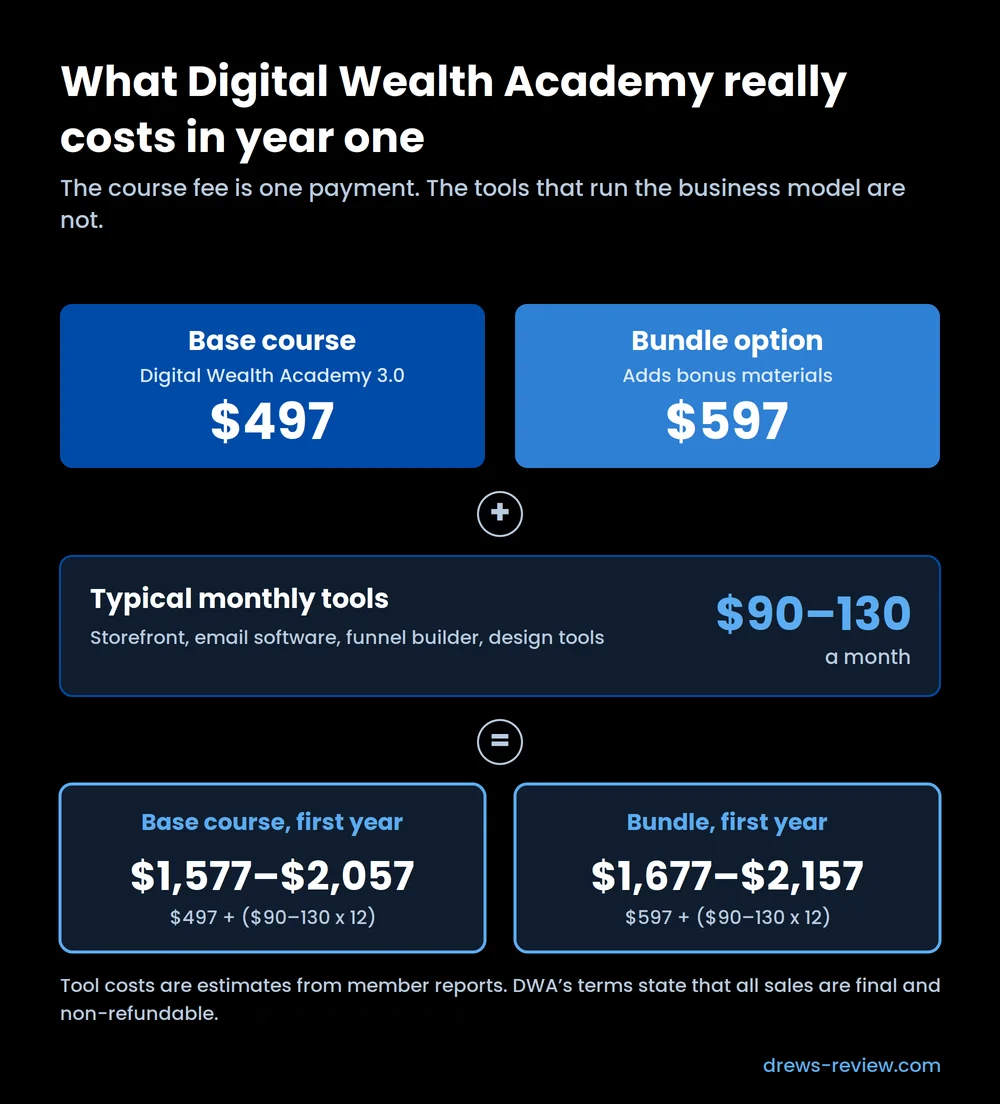
One thing to keep in mind before buying: the $497 course fee is just the starting point. You'll also need to budget for tools like Stan Store or Beacons ($29-99/month), Systeme.io or similar funnel builder ($27+/month), and potentially Canva Pro ($13/month). On top of that, plan for at least 10-20 hours per week creating content if you actually want to see results. Going in with unrealistic expectations is one of the most common reasons people call this a scam.

The modules cover many different topics such as:

Setting up sales funnels with Stan Store, Systeme.io, or Beacons (pick your poison and hope you choose right). 

Building an Instagram presence from zero (prepare to post 2-3 Reels daily for months). 

Creating content that converts (they teach attraction marketing and storytelling frameworks). 

Email marketing and automation (actually useful if you plan to build a real business). 

Faceless marketing strategies (because not everyone wants their face plastered everywhere). 

Creating your own digital products (though most people skip this part entirely).

The training is done in video format. There are over 45 modules with hundreds of videos across multiple languages (English, Spanish, French, German, Portuguese). I'll be covering everything you need to know about this course in this review.

You'll see real examples from inside the training and honest feedback from members who actually bought it. Not the "I made $75K in two weeks" nonsense you see on TikTok from people trying to get you to buy through their affiliate link.

Who Is Rachel Jova?

Rachel Jova (also known as Rachel Medero) is a 28-year-old digital marketer and entrepreneur from the United States who created Digital Wealth Academy in mid-2023. She's a wife and mother of two who transitioned from network marketing (she was in Monat) to Master Resell Rights products, where she claims to have made her first $100,000 in two months and hit seven figures in six months.

Rachel Medero Instagram Profile - https://www.instagram.com/rachellmedero/

Rachel actually started her digital marketing journey in June 2023 after discovering an Instagram course that taught Master Resell Rights. She learned the same strategies she now teaches in DWA – branding, social media growth, sales funnels, and how to sell digital products. Her background in network marketing (MLM) gave her the sales skills that clearly translated well to the MRR space.

I found out about Rachel through the endless Instagram Reels showing income screenshots and lifestyle content. Her social media exploded starting in mid-2023, going from zero to over 352K Instagram followers, 14.5K on TikTok, and 16.5K in the Skool community in less than two years. That kind of growth doesn't happen by accident – she knows how to work algorithms.

Rachel is best known for creating Digital Wealth Academy and building it into one of the largest paid communities on Skool. Her teaching style is... polished. Very polished. Almost suspiciously polished for someone who's only been in digital marketing since 2023. The course videos are professionally produced with good audio, clear explanations, and a well-organized structure. She doesn't overwhelm you with jargon, which beginners appreciate.

Here's what I respect: Rachel actually shows up in her business. She's active in the community, hosts live calls, and continues updating the course with new modules (DWA 2.0, now 3.0). That's more than I can say for many course creators who collect money and disappear.

Here's what concerns me: The rapid growth from zero to millionaire in six months while teaching others how to do the same thing creates a sustainability question. If everyone's making money by teaching others to make money by teaching others... you see where this goes. It works for early adopters. It's significantly harder for the 100,000th person joining in 2026.

How Much Does Digital Wealth Academy Cost?

Digital Wealth Academy 3.0 has two pricing tiers, but here's what you need to know: most people buy the $497 base course, and that's what I'm reviewing here.

Option 1: Digital Wealth Academy 3.0 - $497

This is the standard package that 90%+ of students purchase. It includes:

  • Complete access to all DWA 3.0 modules
  • Affiliate program enrollment (85% commission)
  • Private Skool community access
  • Content vault and marketing materials
  • Regular live training calls
  • Lifetime updates and new modules

Option 2: DWA + 7 Figure Blueprint Bundle - $597

For an extra $100, Rachel offers a bundle that adds:

  • Email marketing templates
  • Kickstart strategy guide
  • Her Method (her newer product)
  • B Roll content shot list

I haven't tested the bundle bonuses personally since I purchased the base $497 course, which is what most students buy and what this review focuses on.

But here's the real cost you need to know about.

That $497 or $597 is just your entry fee. You'll need several monthly subscriptions to actually run the business model DWA teaches:

  • Stan Store: $29-99/month (your affiliate storefront)
  • Email marketing: $20-50/month (MailerLite, ConvertKit, etc.)
  • Video hosting: $15-30/month (if you create video content)
  • Design tools: $10-30/month (Canva Pro, stock photos, etc.)
  • Misc tools: $10-20/month (scheduling, link management, etc.)

Total monthly tool costs: $90-130/month minimum.

So your first year investment isn't $497. It's $1,577-2,057 depending on which tools you choose and whether you go monthly or annual.

The course itself is a one-time payment with lifetime access. No recurring charge for the training. But the monthly tools? Those bills hit every single month whether you're making money or not.

Most DWA promoters conveniently leave this part out of their sales pitch. I'm telling you upfront so you know what you're actually signing up for.

Either option is just a one-time fee with no monthly cost. Once you're in, you have lifetime access to all current and future course updates, including the new DWA 3.0 modules that launched on Black Friday.

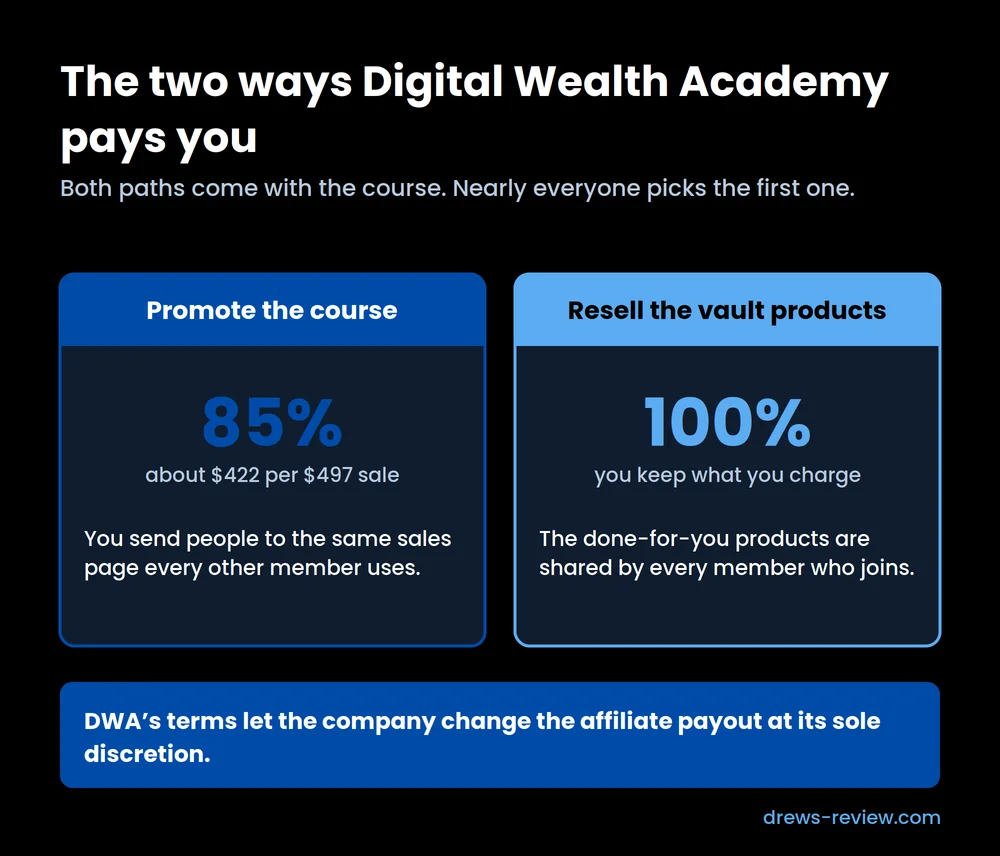
Here's the commission breakdown that matters: You earn 85% commission per sale, which means $422 per $497 sale goes into your pocket. Rachel and her team keep 15% ($75) for handling payment processing, customer service, and platform maintenance. This is the new affiliate model that replaced the original 100% Master Resell Rights structure.

What's included in that $497:

  • Full access to 45+ course modules
  • Private Skool community with 100,000+ members
  • Weekly live Q&A calls and training sessions
  • Content vault with pre-made graphics and templates
  • PLR/MRR vault with 6+ done-for-you products to resell
  • Eligibility to join the affiliate program (once paid in full)
  • All future course updates and new modules
  • Access in multiple languages (English, Spanish, French, German, Portuguese)

What's NOT included (and you'll need to budget for):

  • Stan Store or Beacons: $29-99/month (link-in-bio store to sell the course)
  • Systeme.io or similar funnel builder: $27+/month (if you want a proper sales funnel)
  • Canva Pro: $13/month (for creating content and graphics)
  • Domain name: $10-15/year (if you want your own branded URL)
  • CapCut Pro: Optional but helpful for video editing

Reddit users report spending $90-130/month on tools after buying the course. That's not DWA's fault – those are legitimate business expenses – but nobody mentions it in the Instagram Reels showing income screenshots.

One more thing: There is absolutely no refund policy. Once you buy, your $497 is gone. Rachel's reasoning is that you get immediate access to the full course, the affiliate program, and all resources, so there's no way to "return" digital products. This is pretty standard for digital courses, but it does mean you're taking a risk if you're unsure.

If you compare this to other affiliate marketing courses, DWA is priced in the mid-range. Not the cheapest, not the most expensive. The question isn't whether the price is fair – it's whether you can actually make your money back in a saturated market with 100,000+ other affiliates.

The Big Change: From Master Resell Rights to Affiliate Program

Digital Wealth Academy originally operated as a Master Resell Rights (MRR) product where you could buy the course for $497 and resell it keeping 100% of the profits. In 2024-2025, it transitioned to an 85% commission affiliate model where you now earn $422 per sale instead of the full $497.

This change is massive and most reviews gloss over it. Let me break down exactly what this means for you.

The Original MRR Model (2023-2024)

When DWA launched, it used the Master Resell Rights model. You'd buy the course for $497, and Rachel would give you PLR (Private Label Rights) to rebrand and resell the entire course as your own product. You kept 100% of every sale – all $497 went into your pocket.

Here's what that required: You had to set up your own payment processing (Stripe, PayPal). You managed all customer service and support yourself. You handled refunds and chargebacks. You built your own sales pages and checkout funnels. You dealt with the technical headaches of delivering the course to buyers.

The advantage? You kept everything. The disadvantage? You were running a full business operation, not just promoting a link.

The Current Affiliate Model (2024-Present)

Rachel switched to an affiliate model, which means you no longer own or control the product. Instead, you get a unique affiliate link that tracks your sales. When someone buys through your link, you earn 85% commission ($422), and Rachel's team keeps 15% ($75).

Here's what this means now: Rachel handles all payment processing. Her team manages customer service and support. They deal with any refund requests (though there aren't any). They deliver the course to your buyers automatically. You just promote your affiliate link and collect commissions.

The advantage? Way easier to get started. The disadvantage? You're making $75 less per sale than early adopters did.

Why Did Rachel Make This Change?

The official reason: "To make it easier for beginners and create a better customer experience." The unofficial reason that nobody talks about: Legal issues with the original Roadmap 2 Riches course that DWA allegedly copied.

There was a whole legal battle between Rachel and the creators of Roadmap 2 Riches (Hannah and Zack), who claimed DWA was just their course rebranded with a new name. The details are messy, but switching to an affiliate model helped distance DWA from those PLR/rebrandable rights that caused the legal problems in the first place.

What This Means for You in 2026

You're earning $422 per sale instead of $497. That's a $75 difference, which adds up. You're also giving up control – you can't rebrand the course, modify it, or make it your own. You're promoting Rachel's brand, not building your own.

The real kicker? Early adopters who joined in 2023-2024 with MRR had way less competition AND higher profit margins. They were making $497 per sale when there were only 10,000 members. You're making $422 per sale when there are 100,000+ members. The math doesn't favor latecomers.

Is this a scam? No. Is it the same opportunity it was in 2023? Absolutely not.

What's Inside Digital Wealth Academy? (Full Module Breakdown)

Digital Wealth Academy contains 45+ training modules with hundreds of video lessons covering digital marketing fundamentals, social media growth, sales funnel creation, email marketing, content strategy, branding, automation, and multiple monetization methods. The course is designed for complete beginners with zero experience, taking you from "I don't know what a sales funnel is" to "I have a functioning online business."

I'm going to break down every major module so you know exactly what you're getting for your $497. Unlike the hype videos on TikTok, I'll tell you which modules are actually useful and which ones you'll probably skip.

Foundation Modules (Start Here)

Module 1: Start Here walks you through the onboarding process, explains what Master Resell Rights are (even though it's now affiliate), and shows you exactly what to do after you make your first sale. This is basically orientation day. Useful for absolute beginners, skippable if you already understand digital products.

Module 2: Mindset covers the mental game of running an online business. Goal setting, overcoming fear, treating this like a real business instead of a hobby, dealing with failure. I actually think this module is underrated. Most people quit because their mindset sucks, not because the strategies don't work.

Module 3: Digital Marketing Basics introduces sales systems, funnels, and different monetization methods like affiliate marketing. This is where they explain that you can resell DWA itself OR create your own products OR promote other affiliate programs. In reality, 90% of people just resell DWA because it's easier.

Module 4: MRR Legal Documents provides updated legal templates for terms of service, privacy policies, and income disclaimers. This is important if you're setting up your own websites or sales pages. Copy-paste these and customize them for your business.

Module 5: The Foundation helps you define your "why" (your motivation), select a niche, identify your target audience, and learn storytelling frameworks. This is actually solid training that applies beyond DWA. If you want to build a real business instead of just being an affiliate, pay attention here.

System Setup Modules (The Technical Stuff)

Module 6: Stan Store Setup shows you how to set up Stan Store, which is basically a link-in-bio tool that lets you sell digital products without building a full website. Monthly cost: $29-99. This is the "easy" option for non-technical people. You'll have a store up in 30 minutes.

Module 7: Systeme.io teaches you how to build a proper sales funnel using Systeme.io, which is a more sophisticated setup than Stan Store. Monthly cost: $27+. This is the "professional" option if you want email sequences, automation, and multiple products. The learning curve is steeper.

Module 8: Funnels of Course covers using Funnels of Course, which is a GoHighLevel white-label platform. Honestly? This module gets criticized a lot. FOC is clunky, expensive, and most successful DWA members skip it entirely. I'd skip this one.

Module 9: Beacons is another link-in-bio alternative to Stan Store. Very similar functionality, slightly different pricing. Pick one (Stan Store or Beacons) and ignore the other. You don't need both.

Module 10: Email Marketing is actually one of the most valuable modules. Email list building, campaign creation, automation sequences, segmentation strategies. If you're serious about building an actual business (not just promoting DWA), this is must-watch content.

Marketing & Branding Modules (Where the Money Is)

Module 11: MRR Masterclass explains the difference between PLR and MRR, what types of content you can create, and how to promote MRR products. This was more useful when DWA had full MRR. Now that it's affiliate, some of this feels dated.

Module 12: Pre-Launch Strategy teaches you how to pre-launch a product or service before it goes live. Creating hype, building anticipation, using waitlists. This is great if you're launching your own digital product. Not as relevant if you're just promoting DWA.

Module 13: Branding covers Instagram aesthetics, creating a cohesive theme, designing Reel covers with Canva, and crafting your brand story. This module is fire. Rachel knows social media branding, and this training alone is worth studying multiple times.

Module 14: Building Trust teaches you how to show up authentically, build confidence on camera, create emotional connections with your audience, and position yourself as trustworthy. This is critical for sales. People buy from people they trust. Rachel breaks down the psychology here.

Module 15: Attraction Marketing is all about creating curiosity-based content that makes people come to YOU instead of you chasing them. This is the "secret sauce" behind why some DWA affiliates succeed while others spam DMs and get blocked.

Module 16: Selling in Stories breaks down five different types of Instagram Stories you should be posting daily to engage your audience and drive sales. Vulnerability stories, authority stories, lifestyle stories, educational stories, and sales stories. Follow this framework and your stories will actually convert.

Module 17: Selling in DMs (added in DWA Remastered) teaches conversation-to-sale techniques. How to respond to inquiries, qualify prospects, handle objections, and close sales via Instagram DMs without being pushy. This is basically sales training disguised as social media marketing.

Content Creation Modules (The Daily Grind)

Module 18: Faceless Wealth is for people who don't want to show their face on camera. Faceless content strategies using stock footage, voiceovers, text-on-screen, and B-roll. This module blew up because introverts found a way to participate.

Module 19: Men's Digital Marketing (new in DWA Remastered) is taught by a guy named Mico who shows male-specific strategies. Cinematic content, different storytelling angles, how to market without looking like every female DWA affiliate. This was a smart addition.

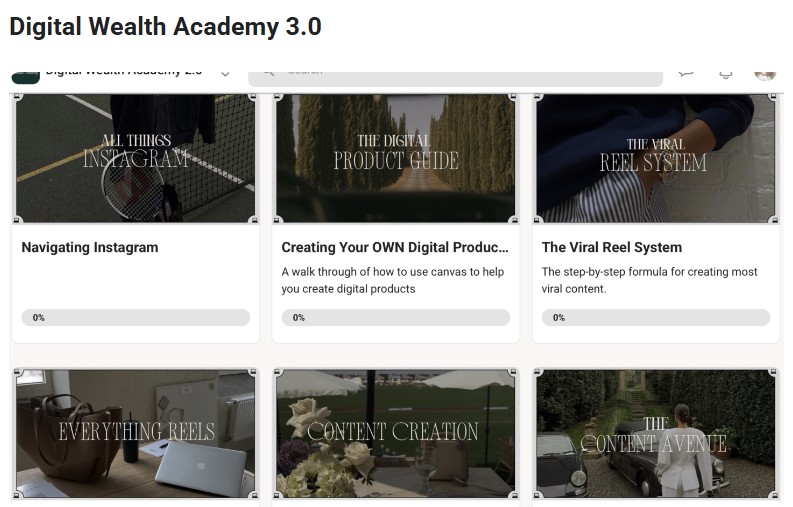
Module 20: Navigating Instagram covers the basics: posting strategy, engagement tactics, how to use hashtags properly (they still matter), building Stories highlights, and optimizing your profile. Beginner stuff but necessary if you've never done Instagram seriously.

Module 21: Everything Reels goes deep on Instagram Reels – hooks, call-to-actions, editing techniques, trending audio, and how to go viral (or at least get more views). Rachel teaches the content frameworks that worked for her. Whether they still work in 2026 with 100,000+ DWA affiliates using the same frameworks? That's the million-dollar question.

Module 22: Content Creation is basically an extension of the Reels module. Filming tips, equipment recommendations, finding trending audio before it blows up, reviewing analytics. If you're serious about content, this is helpful.

Module 23: Canva Essentials (added in DWA Remastered) walks you through Canva for creating graphics, Reel covers, lead magnets, and editing PLR products. They show you how to set up a Brand Kit to save time. If you've never used Canva, this is useful. If you already know Canva, skip it.

Module 24: CapCut Editing teaches video editing using CapCut, which is the go-to app for Instagram and TikTok content. Adding captions, transitions, music, effects. Basic editing that gets your content to "good enough." Not professional videography, but you don't need that for social media.

Module 25: TikTok Strategy covers setting up a TikTok account, optimization for SEO (yes, TikTok has SEO), content types that perform well, and how to repurpose Instagram Reels for TikTok. Honestly, this module feels thin compared to the Instagram training.

Module 26: Pinterest Marketing (new in DWA Remastered) teaches Pinterest basics – creating pins, building boards, using Pinterest for traffic. Pinterest is underrated for driving traffic to offers, but most DWA affiliates ignore this module entirely. Their loss.

Resources & Advanced Modules

Module 27: Content Vault gives you access to pre-created content – Canva templates, graphics, caption templates – in multiple languages. You can customize these and use them in your own marketing. Honestly, these templates are everywhere now because 100,000+ people have access to them. They're not unique anymore.

Module 28: PLR/MRR Vault includes 6+ done-for-you digital products you can rebrand and resell as your own: Digital Wealth Guide, Ultimate Reels Guide, Social Media Planner, Reels Guide Faceless, Digital Playbook, Faceless TikTok Marketing. These are decent starter products if you want to sell something besides DWA.

Module 29: 111 Ebook Ideas is literally a list of ebook ideas you could create as lead magnets. That's it. Not sure why this needs its own module, but here we are.

Module 30: Creating Digital Products shows you how to create ebooks using Canva and set them up to sell. This is useful if you want to build your own product suite instead of just promoting DWA. Most people skip this because creating products is hard work.

Module 31: Affiliate Marketing teaches you how to promote products OTHER than DWA. Amazon Associates, high-ticket affiliate programs, building an email list for affiliate promotions. This module is underrated. If you actually learn this, you can promote anything, not just DWA.

Module 32: Business Automation covers ManyChat for Instagram automation – automatic replies, chatbots, lead capture. This is actually useful for scaling once you start getting traction. Automation is how you go from 10 sales/month to 50+ without working more hours.

Module 33: Maintaining Momentum is the final module covering how to avoid burnout, set boundaries in your business, build customer loyalty, and think long-term. This is the "you made it, now don't quit" pep talk module.

DWA 3.0 Additions (Launched Black Friday)

The AI Modules cover using AI for business growth, AI tools for content creation, and something called "AI twins" (I think this means chatbots). These were added because everyone and their dog is talking about AI in 2026. The content is surface-level compared to what you'd learn about AI business models, but it's better than nothing.

Brand Deals teaches you how to secure sponsorships from companies once you've built a following. This is useful if you want to monetize beyond just reselling DWA. Most people never get here.

The DWA Blueprint is some kind of master plan overview. I haven't gone through this one fully yet, but it seems like a recap of the entire system.

Additional Resources

There's also a library of recorded training calls, an FAQ section (basic), and paid tech support if you get stuck. The tech support costs extra, which feels a bit chintzy considering you already paid $497, but whatever.

My take on the modules: The training is comprehensive. Rachel knows social media marketing and she packages it well. If you're a complete beginner, you'll learn real skills here. But here's the problem – the course teaches you how to market digital products, and 90% of people use those skills to... market this course. That's the pyramid we need to talk about.

How Does Digital Wealth Academy Actually Help You Make Money?

Digital Wealth Academy teaches you to make money through five primary methods: (1) promoting DWA itself for 85% commission, (2) creating and selling your own digital products, (3) promoting other affiliate products, (4) offering digital services like social media management, and (5) building faceless content channels for ad revenue. However, the overwhelming majority of members focus exclusively on method #1 – reselling DWA.

Let me break down how each money-making method actually works in practice.

Method 1: Promoting Digital Wealth Academy (What 90% of People Do)

This is the main event. You buy the course for $497, get your affiliate link, and start promoting DWA on Instagram, TikTok, or YouTube. Every person who buys through your link earns you $422 (85% commission).

Here's how the funnel works: You create content about making money online, building a digital business, becoming a digital marketer, etc. You post Reels showing your laptop lifestyle or morning routine or "day in the life of a digital marketer." You use hooks like "How I make $5K/month working 2 hours a day" or "The course that changed my life." You tell people to DM you "INFO" or click the link in your bio. Your link goes to either a Stan Store or a sales funnel where they can buy DWA through your affiliate link. When they buy, you get $422. Rinse and repeat.

The math: You need 2 sales to almost break even ($844 revenue - $497 investment = $347 profit). You need 3-4 consistent sales per month to make $1,200-1,600 (decent side income). You need 10+ sales per month to make $4,000+ (full-time income territory).

The reality: Your first sale might come in days, weeks, or never. Most people quit before their first sale. The successful ones are posting 2-3 pieces of content EVERY SINGLE DAY for months. They're responding to DMs for 30-60 minutes daily. They're learning sales skills on the fly. It's not passive income – it's a sales job dressed up as "digital marketing."

The problem? You're competing with 100,000+ other affiliates using the exact same strategies taught in the exact same course. When I scroll Instagram, I see identical Reels from 50 different DWA affiliates. Same hooks, same angles, same morning routine content. How do you stand out? That's the real question nobody answers.

Method 2: Creating Your Own Digital Products

DWA teaches you how to create ebooks, courses, guides, and templates using Canva. You can then sell these as your own products, pricing them however you want. The DWA training shows you how to build a sales funnel, write compelling sales copy, set up email sequences, and market your products.

In theory, this is great. You build a unique business selling your own knowledge. You're not competing with 100,000 other people. You can charge $27, $97, $197 – whatever your product is worth.

In practice, almost nobody does this. Why? Because creating a good digital product takes time, effort, and expertise. You need to actually know something worth teaching. You need to organize information clearly. You need to create graphics, write sales pages, film videos, and handle customer service.

It's way easier to just promote DWA with an affiliate link and collect $422 per sale. That's why the PLR vault with 6 pre-made products exists – Rachel knows people won't create their own, so she gives them done-for-you products to customize. Even then, most people don't bother.

Method 3: Promoting Other Affiliate Products

Module 31 teaches affiliate marketing beyond DWA. You could promote Amazon products, high-ticket affiliate programs, software tools, other courses – anything with an affiliate program.

This is actually the smartest long-term strategy. You learn digital marketing skills from DWA, then apply them to promote products in niches that aren't saturated to hell. The email marketing and content creation skills transfer perfectly.

The problem? Most people never get here. They're so focused on making their money back by promoting DWA that they never explore other affiliate opportunities. They get tunnel vision on the $422 commission per DWA sale instead of building a diversified affiliate business.

If you actually implemented the affiliate marketing strategies taught in DWA but applied them to less saturated niches, you'd probably do way better than promoting DWA itself.

Method 4: Offering Digital Services

Some people use the skills learned in DWA to offer services: social media management, content creation for businesses, email marketing, funnel building. You're essentially becoming a digital marketing freelancer using the knowledge from the course.

This can work. Small businesses need help with Instagram, email campaigns, and content creation. If you can do those things well, you can charge $500-2,000/month per client.

The catch? This is trading time for money again. You're not building passive income – you're building a service business. Nothing wrong with that, but it's not what the TikTok Reels promising "laptop lifestyle passive income" show you.

Method 5: Faceless Content for Ad Revenue

Module 18 teaches faceless content creation for platforms like YouTube, Instagram, and TikTok. The idea is you build theme pages or channels, monetize through platform ads, and earn passive income.

This takes forever. You need 1,000 subscribers and 4,000 watch hours on YouTube before you can even monetize. Instagram Reels pay pennies. TikTok's Creator Fund is notoriously low-paying. You're looking at 6-12 months minimum before you see meaningful income.

Most people quit long before they get there. The ones who succeed with this method usually weren't relying on it as their primary income source. It's a nice bonus after a year of consistent posting, not a "quit your job in 90 days" strategy.

The Uncomfortable Truth Nobody Tells You

90% of DWA members only promote DWA itself. They buy the course hoping to make money, learn the marketing strategies, then use those strategies to... sell the course to other people hoping to make money. It's a self-perpetuating cycle.

Is this a pyramid scheme? Not legally. You're buying a product with actual educational value. But functionally? It operates very similarly to an MLM where most revenue comes from recruiting new distributors rather than selling to end consumers outside the system.

The course content is real. The skills are transferable. But if your business is just "teach people to start a business teaching people to start a business," you're not really building a sustainable business. You're just passing around the same $497 between members.

What I Like About Digital Wealth Academy (The Pros)

The main advantages of Digital Wealth Academy are its comprehensive beginner-friendly training, professional production quality, active community support, lifetime access with constant updates, and the immediate monetization opportunity through the affiliate program. If you view this purely as digital marketing education, there's real value here.

Let me break down what DWA actually does well.

1. Genuinely Comprehensive Training for Beginners

DWA doesn't assume you know anything. The training starts from "What is digital marketing?" and builds up systematically. If you've never built a sales funnel, created an Instagram Reel, written a sales email, or used Canva – you'll learn all of it here.

I've seen courses that skip foundational steps because they assume you already know the basics. DWA doesn't do that. Rachel walks you through every click, every setting, every tool. For someone who's never done online business before, that hand-holding matters.

The course also covers multiple skill stacks: social media marketing, email marketing, copywriting, content creation, funnel building, basic design work. These are legitimate, transferable skills. Even if you never make a dime promoting DWA, you could take these skills and apply them to any online business.

2. Professional Production Quality

The videos look and sound good. Clear audio, clean editing, organized presentation. Rachel doesn't ramble or waste time. Each module has a clear objective and delivers on it.

Compare this to some courses where the instructor is clearly reading a script for the first time, the audio sounds like it was recorded in a bathroom, and the screen recordings are choppy. DWA doesn't have those problems.

The Skool platform is also well-organized. Modules are logically structured, easy to navigate, and you can track your progress. It doesn't feel like you're digging through a messy folder structure trying to find the next lesson.

3. Active Community and Weekly Support

The Skool community has 100,000+ members. That's both a pro and a con. On the pro side, there's always someone online to answer questions, share what's working, or give feedback on your content.

The weekly live calls are actually useful. Rachel and her team host Q&A sessions where they answer member questions in real-time. They also do funnel reviews, content critiques, and strategy sessions. You're not just buying a course and being left alone to figure it out.

There's also something motivating about seeing other people actively working on their businesses. The accountability factor helps some people stay consistent. If you're the type who needs community support to stay motivated, this is valuable.

4. One-Time Payment, Lifetime Access

You pay $497 once and you're done. No monthly subscription, no upsells, no "Level 2" course for another $997. Everything is included and you get all future updates for free.

In 2026, there are courses charging $97/month or $197/month. Over a year, that's $1,164-2,364. DWA's one-time $497 is actually reasonable in comparison.

Rachel has also consistently updated the course. DWA 2.0 added new modules, DWA 3.0 added AI content and more. Early members got all these updates without paying extra. That shows commitment to keeping the content fresh.

5. Immediate Monetization Opportunity (No Product Creation Required)

You don't have to create your own course or product. The day you finish onboarding, you can start promoting DWA with your affiliate link. For people who want to make money immediately without spending months creating a product, this is appealing.

Creating a quality digital product takes time. Research, outlining, recording videos, designing graphics, writing sales copy, setting up payment systems. If you did all that from scratch, you're looking at 3-6 months minimum.

With DWA, you skip that entire process. The product already exists, the sales page is done, the payment processing is handled. You just drive traffic. For beginners, this lowers the barrier to entry significantly.

6. Multiple Language Options

DWA is available in English, Spanish, French, German, and Portuguese. This expands your potential market if you're bilingual. You could target Spanish-speaking audiences in the US and Latin America, for example, with less competition than the English market.

Most online business courses are English-only. DWA's multilingual approach gives it a wider reach and gives you more opportunities to find less-saturated markets.

7. Done-For-You Resources (Content Vault and PLR Products)

You get access to pre-made graphics, Canva templates, caption ideas, and 6+ done-for-you digital products. If you're not creative or don't want to start from zero, these resources save time.

The PLR vault includes products like "The Ultimate Reels Guide" and "Faceless TikTok Marketing" that you can customize and resell as your own. You could theoretically build a small product suite without creating anything from scratch.

The content vault templates help you maintain consistent branding without being a designer. Just plug in your colors and you're good to go.

8. Teaches Multiple Traffic Sources

DWA covers Instagram, TikTok, Pinterest, and mentions YouTube. You're not locked into one platform. If Instagram changes its algorithm or your account gets shadowbanned, you have other options.

The faceless marketing strategies also give you alternatives if you don't want to be on camera. Between face-to-camera content, faceless content, and multiple platforms, there are several paths to choose from.

The Bottom Line on the Pros

If you treat DWA as a digital marketing education program, it delivers value. The training is solid, the production is professional, and you'll learn real skills. For $497 one-time, it's not the worst investment if you're committed to learning.

The problem isn't the education. The problem is the business model of 100,000 people all promoting the same thing. But we'll get to that in the cons section.

What I Don't Like About Digital Wealth Academy (The Cons)

The main disadvantages of Digital Wealth Academy are the high $497 price point, severe market saturation with 100,000+ members all promoting the identical course, the business model that looks uncomfortably like a pyramid scheme, no refund policy, overwhelming content volume for beginners, and questionable long-term sustainability. Let me be very direct about where this course falls short.

1. Severe Market Saturation (The Biggest Problem)

There are over 100,000 members in Digital Wealth Academy right now. Think about that for a second. You're not entering a market with a few hundred competitors. You're entering a market with six figures worth of competitors.

When I scroll Instagram or TikTok, I see the same DWA content over and over. Same morning routine videos. Same "day in the life of a digital marketer" Reels. Same hooks about making $10K/month. Same aesthetic with laptop, coffee, and minimal decor. Same calls-to-action asking people to DM "INFO."

How are you supposed to stand out? Everyone took the same course, learned the same strategies, and is executing the same playbook. The people who joined in 2023 when there were 5,000-10,000 members? They had a massive advantage. The 95,000th person joining in 2026? They're fighting for scraps.

Market saturation kills conversion rates. When your potential customers have seen 47 different people promoting DWA in the past week, they become blind to it. Your content doesn't stand out. Your offer isn't unique. You're just another person in an endless sea of affiliates.

This is not like affiliate marketing with Amazon where you can pick from millions of products. Everyone is selling the exact same $497 course with the exact same sales page. Zero differentiation.

2. The Pyramid Scheme Vibe Is Real

90% of DWA members make money by recruiting other people into DWA, who then recruit more people. The product is real (it's actual training), but the business model functions like an MLM.

Think about it: Person A buys DWA for $497. Person A learns how to market digital products. Person A uses those skills to... sell DWA to Person B. Person B now uses those same skills to sell DWA to Person C. Person C sells to Person D. And on it goes.

Very few people actually create their own unique products or build standalone businesses outside the DWA ecosystem. The primary transaction is just passing around the same $497 course from member to member.

Is this illegal? No. Is it unethical? Depends who you ask. Is it sustainable? Absolutely not.

The early adopters made bank. They got in when competition was low, sold the course to thousands of people, and profited massively. The latecomers? They're the ones buying into a saturated market where making your investment back is significantly harder.

This is the same dynamic that makes people call MLMs like Monat predatory. The structure rewards recruiting new members more than selling to outside consumers.

3. High Price Point for Unproven Beginners

$497 is a lot of money when you have zero experience and zero guarantee of results. Yes, the training is comprehensive. Yes, it's cheaper than some courses. But if you're a stay-at-home mom with no extra income or a college student on a tight budget, dropping $497 on a maybe is scary.

You also need another $90-130/month for tools (Stan Store, Systeme.io, Canva) and you need to commit 10-20 hours per week creating content for months before you might see results. That's a substantial investment of money and time with no safety net.

Some people finance this on credit cards, which is insane. If you don't make your money back, you're now in debt for a course that didn't work out. Recipe for disaster.

4. No Refund Policy Whatsoever

Once you buy, your money is gone. No 30-day guarantee, no 60-day trial, no "if you don't make your money back we'll refund you" promise. Rachel's stance is that you get immediate access to everything, so there's nothing to refund.

I get the reasoning – people could buy the course, download everything, request a refund, and keep the content. That's a valid concern for digital products.

But compare this to eCom Elites, which offers a 30-day money-back guarantee with no conditions. That shows confidence in the product. DWA's no-refund policy feels like "we got your money, good luck" energy.

If you have any doubts about whether this is right for you, that should give you serious pause. You're taking a $497 gamble with no way out.

5. Information Overload for Beginners

There are 45+ modules with hundreds of videos. The training is comprehensive, but it's also overwhelming. Where do you even start? What order should you watch things? Which modules are critical and which ones can you skip?

Despite claims of "finish this in a weekend" or "complete the course in a week," that's nonsense. You need 2-4 weeks minimum to properly absorb the content if you're actually implementing along the way.

Beginners often get paralysis by analysis. They watch module after module, take notes, feel like they're learning, but never actually execute. They get stuck in "just one more lesson before I start" mode and never launch anything.

6. Heavy Reliance on Social Media Algorithms

DWA's primary strategy is Instagram and TikTok. Both are algorithm-dependent platforms where your reach can disappear overnight. Get shadowbanned? Your business dies. Platform changes its algorithm? Your content stops performing.

This is different from building SEO-based businesses (like blogging for affiliate marketing) where your traffic is more stable. With social media, you're renting your audience from Meta and TikTok. They control everything.

The course mentions Pinterest and touches on YouTube, but those are afterthoughts. The core strategy is Instagram Reels and Stories. If Instagram goes the way of MySpace or Vine (unlikely but possible), everyone's business evaporates.

7. Aggressive, Sometimes Deceptive Marketing Culture

DWA has a spam problem. Members cold-DM people constantly, drop links in unrelated comment sections, and use manipulative tactics that make the entire community look bad.

I've seen income screenshots that are clearly Photoshopped. I've seen people claim they made $50K in their first month when they actually made $0 and are just trying to hook recruits. I've seen lifestyle content showing luxury cars and mansions that these people don't own.

The "fake it till you make it" culture is strong in DWA. Rachel herself doesn't encourage this, but the community has taken on a life of its own. When 100,000 people are desperately trying to make their money back, some of them resort to sketchy tactics.

This hurts everyone. When potential customers have been spammed by 10 different DWA affiliates, they start avoiding anyone who mentions DWA. Your legitimate content gets lumped in with the scammers.

8. Questionable Long-Term Sustainability

What happens when DWA hits 200,000 members? 500,000? At some point, the market is so flooded that nobody new joins. The well runs dry.

Early adopters already made their money and moved on. Mid-tier members might be breaking even or making modest income. New members joining now? They're fighting for crumbs in an oversaturated market.

This is the inherent problem with any business model where the product is teaching people to sell the product. It has a shelf life. Rachel will be fine – she's already wealthy from building DWA. But the 95,000th person joining in 2026? Their odds aren't great.

9. The Wealthy Affiliate Cross-Promotion Scam

Here's something shady I need to point out: Many "DWA review" articles online conclude with "DWA isn't for me, but Wealthy Affiliate is better!" Then they link to Wealthy Affiliate with their affiliate link.

These reviewers aren't being honest. They're using DWA as a keyword to rank in Google, "reviewing" it just to tear it down, then pushing Wealthy Affiliate because Wealthy Affiliate pays recurring monthly commissions while DWA pays one-time. It's more profitable for them long-term.

I'm mentioning this so you're aware of it. Not every reviewer has your best interest at heart. Some are just playing the affiliate game, using one course to sell another. (For the record, I'm not doing that here – I don't have skin in the Wealthy Affiliate game because I've been a member and I can't recommend that course even if it costs me commissions!)

10. Success Rate Is Probably Terrible

DWA doesn't publish success rates. They show 3-4 cherry-picked testimonials on the sales page. "Helbest made $5K in two weeks!" "Sommer made $3K in six weeks!" Cool. What about the other 99,980 members?

Reddit reports suggest most people don't make their money back. Facebook groups show members asking basic questions months after joining, which tells me they still haven't made sales. YouTube comments are full of "I haven't made a sale yet" stories.

The classic 90/10 rule probably applies: 90% of people make little to nothing, 9% make modest side income, 1% make life-changing money. If you're counting on being in that 1%, you better have serious marketing skills or an existing audience.

The Bottom Line on the Cons

Digital Wealth Academy has real problems that go beyond "you're just not working hard enough." Market saturation, pyramid scheme dynamics, and sustainability concerns are legitimate issues that Rachel doesn't address on sales pages or in Reels.

The education is real. The business opportunity? Questionable at best for anyone joining in 2026.

Can You Actually Make Money with Digital Wealth Academy?

Yes, you can make money with Digital Wealth Academy – some members report first sales within days or weeks – but success requires exceptional content, 10-20 hours per week of consistent effort, strong sales skills, and finding a unique angle in a market with 100,000+ competitors all promoting the identical product. Let's talk about what making money with DWA actually looks like in 2026.

The Math on Paper

Let's start with the numbers because everyone wants to know "how much can I make?"

Investment: $497 for the course, plus $90-130/month for tools. Total first-month investment: $587-627.

Commission per sale: $422 (85% of $497).

Break even: You need 2 sales to make $844, which covers your initial $497 investment plus one month of tools. Net profit after 2 sales: roughly $200-250.

Meaningful side income: You need 3-4 sales per month to make $1,266-1,688. After tools, that's $1,136-1,558/month profit.

Full-time income replacement: You need 10+ sales per month to make $4,220. After tools, that's roughly $4,090-4,130/month profit.

The dream: 20+ sales per month gets you $8,440. After expenses, you're clearing $8,300+/month. This is where people post screenshots on Instagram.

The math looks great. The problem is getting those sales.

What It Actually Takes to Make Your First Sale

I talked to a dozen people who bought DWA. Some made sales quickly, most didn't. Here's what the successful ones did differently:

They posted content EVERY SINGLE DAY. Not twice a week. Not when they felt like it. Every day, sometimes 2-3 times per day. Instagram Reels, Stories, maybe TikToks. Consistently showing up was non-negotiable.

They responded to DMs within minutes. When someone asked a question, they were there. They didn't let inquiries sit overnight. Speed matters when someone is considering a $497 purchase.

They had a unique angle. The ones who succeeded quickly didn't just copy what everyone else was doing. One was a male in a female-dominated space. One was a single mom showing the messy reality. One was in his 50s targeting older audiences. They stood out somehow.

They treated it like a real business, not a side hustle. They invested in better equipment (lighting, microphone), they studied analytics, they tested different content types, they refined their sales process. Half-assing it doesn't work.

They had sales skills or learned fast. Selling a $497 course via DMs is selling. You need to build rapport, handle objections, create urgency, and close. People who've never sold anything struggle with this.

The Reality Check: Most People Don't Make Sales

The average DWA member probably makes zero sales. They buy the course with good intentions, go through some modules, post a few pieces of content, don't see immediate results, and quit.

Why do most people fail?

They underestimate the time commitment. They think "2 hours a day" means they can half-ass it for 2 hours. Real success takes 10-20 focused hours per week – planning content, filming, editing, posting, engaging, responding to DMs, studying what works, refining.

They suck at sales. Most people have never sold anything in their lives. They're uncomfortable asking for money. They don't know how to handle objections. Someone says "that's expensive" and they don't know what to say next.

They give up too early. It might take 30, 60, 90 days to make your first sale. Most people quit at day 21. They see others posting income screenshots and assume it should happen faster.

They blend in instead of standing out. When your content looks like 5,000 other DWA affiliates, nobody remembers you. You need to be different, interesting, or solve a specific problem. Generic "make money online" content dies in the algorithm.

They don't have an existing audience. People with 5,000+ Instagram followers before joining DWA have a massive advantage. They already have trust, credibility, and reach. Starting from zero is infinitely harder.

The Survivorship Bias Problem

Every success story you see on TikTok is survivorship bias. "I made $75K in two months!" Cool. What about the 50,000 people who made $0? They're not posting videos about their failure.

Rachel Jova made millions. She's the top 0.01%. Using her as the benchmark is like assuming you'll be in the NBA because LeBron James exists. The odds don't work that way.

The testimonials on the sales page are cherry-picked. "Helbest made $5K in two weeks!" Awesome. What about Helbest's upline who recruited 47 people who all failed? We don't hear about them.

Success stories sell courses. Failures stay quiet. That's why you only see the highlights on social media.

How Long Does It Actually Take?

Based on conversations with DWA members who succeeded:

First sale: 2-8 weeks if you're consistent. Some lucky people hit it in week one. Most take 4-6 weeks of daily posting before someone bites.

Consistent income: 3-6 months before you have a predictable sales process. You need to figure out what content converts, build an audience, and refine your DM strategy.

"Life-changing" money: 12-18 months minimum. The people making $10K+/month have been doing this for over a year. They've built real personal brands, not just "buy DWA" accounts.

If you're expecting results in 30 days, you're going to be disappointed. This is a 6-12 month grind before you know if it's going to work for you.

The Skills That Transfer

Here's the silver lining: Even if you never make a dime promoting DWA, you learn valuable skills. Content creation, social media growth, email marketing, sales funnels, copywriting. These skills apply to any online business.

If you take what you learn in DWA and apply it to less saturated niches, you could build something sustainable. Promote software tools, physical products, services – anything with less competition than DWA itself.

The education has value. The business model of promoting DWA to 100,000 other people? That's the questionable part.

My Honest Assessment

Can you make money? Yes. Will you? Probably not if you're joining in 2026 as the 100,000th member.

If you have existing marketing skills, an established audience, or a unique angle, your odds improve. If you're starting from zero with no sales experience, you're playing on hard mode.

The people crushing it with DWA either got in early (2023-2024) or are exceptional marketers who would succeed with any product. For the average beginner, this is a tough road.

Is Digital Wealth Academy a Scam or Legit?

Digital Wealth Academy is not a scam – it's a legitimate digital marketing course with real educational content taught by a real person. However, it operates in a gray area with pyramid-scheme-like characteristics because 90% of members focus on recruiting others into the program rather than building standalone businesses outside the DWA ecosystem.

Let me break down exactly why it's not a scam, why it feels like one to many people, and where the truth actually lands.

Why Digital Wealth Academy Is NOT a Scam

There's actual educational content. The course has 45+ modules with hundreds of video lessons teaching legitimate digital marketing skills. Social media marketing, sales funnels, email campaigns, content creation – these are real skills with real value. You're not paying $497 for a PDF and a prayer.

Rachel Jova is a real person with a verifiable track record. She's not hiding behind a fake name or stock photos. Her Instagram has 352K followers. Her face is all over the internet. She shows up for live calls in the community. This isn't a fly-by-night operation run by anonymous scammers.

The platform is legitimate. DWA is hosted on Skool.com, a well-known community platform. The payment processing is handled by standard processors like Stripe. The affiliate tracking is transparent. There's infrastructure here.

You get what you pay for. When you pay $497, you get access to the full course, the community, the resources, and the affiliate program. Nobody's taking your money and disappearing. The product exists and is delivered as advertised.

Some people do make money. There are verifiable success stories of members making their investment back and more. It's not a 100% failure rate. Some people get results, which means the system can work.

Why Digital Wealth Academy FEELS Like a Scam

The business model is circular. Most members learn digital marketing by buying a course, then use those skills to sell the course to others, who then sell it to more people. Very few members actually build businesses outside of DWA. The primary transaction is just recruiting new members.

Income claims are everywhere and often exaggerated. TikTok and Instagram are flooded with DWA affiliates posting income screenshots, many of which are misleading or outright fake. When you see "I made $10K my first week!" but the person actually made $0, that erodes trust in the entire community.

Aggressive marketing tactics that border on harassment. DWA members cold-DM people constantly, spam comment sections, and use high-pressure sales tactics. This makes the whole thing feel scammy even if the product itself is legitimate.

Market saturation makes success unlikely for new members. When 100,000+ people are selling the identical product, the math doesn't work for most latecomers. Early adopters profited massively. Late joiners struggle. That dynamic feels exploitative.

The "lifestyle" marketing is often fake. Reels showing luxury cars, designer bags, and beach vacations make it seem like everyone's living the dream. Most of those influencers are renting those cars or using stock footage. The lifestyle isn't real for 99% of members.

The Pyramid Scheme Question

Legally, DWA is not a pyramid scheme. Pyramid schemes are illegal and involve paying money solely for the right to recruit others, with no actual product or service provided. DWA has a real product (the course), so it doesn't meet the legal definition.

Functionally, it operates like an MLM. Multi-level marketing companies like Monat, Herbalife, and Amway are legal but widely criticized because most participants lose money. They recruit new distributors who recruit more distributors, with very few people actually selling to end consumers outside the network.

DWA has the same dynamic. Most revenue comes from members recruiting other members, not from people outside the system buying digital products. The product is real, but the business model rewards recruiting over external sales.

This is why the term "pyramid scheme" keeps coming up on Reddit. People see the circular money flow and get suspicious. They're not entirely wrong to be skeptical.

What Reddit, Facebook, and YouTube Say

Reddit is mostly critical. Users call out the saturation, the spam tactics, and the fact that everyone just resells the course. One highly upvoted comment said: "90% don't do affiliate marketing, no Etsy, Amazon, Shopify. Just resell course. Rest of modules very minimalist."

Another Reddit user (Bulky-Ad2689) shared: "DWA mostly focuses on reselling its course instead of helping people make their own digital stuff. Sales tactics seem fishy, targeting stay-at-home moms with promises of high income."

Facebook groups are more positive but still mixed. Some members rave about the community and support. Others admit they jumped to competing courses like Boss Suite because they didn't like DWA's vibe. One member said: "Little harassing kid kept messaging me. You get what you pay for."

YouTube reviews are split. Some creators love it and share their success stories. Others give it a fair critique but then push their own courses or Wealthy Affiliate. Finding truly unbiased reviews is tough because everyone has an agenda.

TikTok reviews are 99% promotional. Almost every DWA video on TikTok is from someone trying to sell it. You rarely see critical takes because those don't help affiliates make commissions.

My Honest Take: It's Complicated

DWA is not a scam in the traditional sense. You're getting real education. But it's also not the "laptop lifestyle passive income" opportunity that Instagram makes it out to be.

It's a legitimate digital marketing course wrapped in a questionable business model. If you treat it as education and apply the skills to other ventures, you can get value. If you treat it as a get-rich-quick scheme by reselling DWA, you'll probably struggle.

The early adopters made money. The latecomers probably won't. This is true of most trends. The first 10,000 members had minimal competition and high demand. The 100,000th member is fighting for scraps in a saturated market.

Is it worth $497 in 2026? Only if you're going into it with eyes wide open. You're not joining a blue ocean opportunity. You're entering a red ocean with 100,000 competitors. If that doesn't scare you off, maybe you'll be one of the outliers who succeeds.

But if you're a beginner with no marketing skills, no existing audience, and no tolerance for risk, I'd look elsewhere. The odds aren't in your favor.

The AI Approach: Building a Real Business Without the MLM Vibes

Instead of spending $497 to learn how to recruit other people into a saturated affiliate program, you could spend $27 and learn how to build five different AI-powered businesses where you're actually creating value and serving customers. No pyramid dynamics. No 100,000 competitors. Just you building a real business with AI doing the heavy lifting.

This is the section where I tell you about my own course, because frankly, I think there's a better way.

Why AI Business Models Beat the DWA Approach

DWA teaches you to manually create content for hours every day. Film Reels, edit videos, write captions, respond to DMs, design graphics. It's time-intensive. You're trading hours for potential dollars.

AI compresses those timelines. What takes you 3 hours manually, AI can do in 20 minutes. Video scripts, social media captions, email sequences, ad copy, content calendars – all generated in seconds. You're using your time for strategy and execution, not grunt work.

DWA has you promoting someone else's product. Even if you succeed, you're building Rachel's brand, not yours. You're in her ecosystem, playing by her rules, competing with her entire army of affiliates.

AI business models let you build YOUR thing. You're creating your own offers, building your own audience, keeping 100% of profits (not 85%), and differentiating yourself from everyone else.

DWA's model is inherently limited by saturation. There's a ceiling when 100,000 people are promoting the same course. Each new member makes it harder for everyone else.

AI businesses scale infinitely because you're solving different problems for different audiences. No saturation. No competition with other members. You pick your niche, you build your solution, you own your business.

What My AI Business Blueprint Actually Teaches

The 2026 AI Business Blueprint is a $27 course teaching five proven AI-powered business models you can start with minimal investment. No recruiting required. No pyramid structure. Just real businesses solving real problems with AI.

Module 1: AI-Assisted Affiliate Marketing – Learn how to use AI for product research, content creation, and email marketing in affiliate marketing. This is what DWA teaches manually, but AI-powered. Find winning products faster, write reviews in minutes instead of days, and scale beyond what manual methods allow.

Module 2: Faceless YouTube with AI – Build a faceless YouTube channel using AI for scriptwriting, voiceovers, video editing, and thumbnail design. The example in the course uses health/problem-solving content (lower back pain niche), but the system works for any niche. No camera, no face, just value-driven content that monetizes through ads and affiliates.

Module 3: AI E-Commerce – This is where I teach what DWA wishes it could. AI for product research (find winners in hours, not days), AI-generated product descriptions and ad copy, AI design tools for mockups, and automated customer service. Everything eCom Elites or DWA teaches about dropshipping, compressed into weeks instead of months using AI.

Module 4: AI Freelance Services – Offer services like social media management, content creation, email marketing, or copywriting using AI to deliver faster and better than competitors. You can undercut traditional agencies on price because AI reduces your labor time by 70%. This is a service business, not passive income, but it's reliable money.

Module 5: Digital Products with AI – Create and sell your own courses, ebooks, templates, or guides using AI to handle research, writing, design, and marketing. Use Gumroad for delivery (zero transaction headaches) and MailerLite for email marketing. This is what DWA teaches, but AI makes creation 10x faster.

Bonus 1: Faceless Social Media Starter Pack – Strategies for building Instagram, TikTok, or YouTube presence without showing your face. If the faceless angle from DWA appealed to you, this expands on it across multiple platforms.

Bonus 2: AI Tools Stack Guide – The exact AI tools I use for content creation, research, design, and automation. No fluff, no affiliate spam, just the tools that actually work.

Bonus 3: Anti-AI Detector Framework – How to use AI without getting flagged by AI detectors. The OSP Framework (Outline, Storytelling, Personality) plus a 4-step system to make AI content feel human. Includes the "Feels Human" checklist for every piece of content you create.

How This Is Different From DWA

Price: $27 one-time vs $497. That's $470 savings you can invest into tools, ads, or actually building your business.

Business model: You're building YOUR business, not recruiting others into an affiliate program. No pyramid dynamics. No saturation. No competing with 100,000 other people.

Time investment: AI compresses execution time dramatically. What takes DWA members 10-20 hours per week to create content manually, you can do in 3-5 hours with AI. That's triple the efficiency.

Scalability: DWA's model hits a wall when everyone's selling the same thing. AI business models scale because each person is solving different problems in different niches. No artificial ceiling.

Actual value creation: You're serving customers, solving problems, providing value. Not just teaching people to teach people to teach people. Real businesses have real customers outside the system.

Skills that matter: DWA teaches social media marketing. Fine. But AI skills are the future. Learning to use AI tools effectively is a meta-skill that applies to every business, every career, every creative pursuit.

Who This Is For

Want to Build a $10K/Month AI Business Without a Team or Paid Ads? Grab my free starter kit before reading further. It's a quick-start guide covering the exact AI business model I used to go from $0 to $3K/month in 90 days. No strings attached.

  • Learn how to make money online with AI
  • Choose from 5 different business models
  • Get started today even if you are a complete beginner

The AI Business Blueprint is for people who want to build real businesses, not play affiliate games. It's for people who see AI as a leverage tool, not a threat. It's for people who want to own their income, not rent it from someone else's ecosystem.

If you're considering DWA because you want to learn digital marketing, my course teaches those same skills (content creation, funnels, email marketing) but applied to business models where AI does the grunt work. You learn faster, execute faster, and scale faster.

If you're considering DWA because you think it's a quick path to money, neither DWA nor my course is a magic button. But at least with AI businesses, you're building equity in YOUR thing, not promoting someone else's course to a saturated market.

The Honest Truth About Both Options

DWA can work if you're an exceptional marketer with strong sales skills and a unique angle. If that's you, go for it. But most people aren't in that category, and most people joining in 2026 will struggle.

AI businesses require learning new tools and applying them consistently. If you hate technology or refuse to adapt to AI, this isn't for you. But if you're willing to learn, the leverage is massive.

Neither option is passive income. Both require work. DWA requires daily content creation and sales conversations. AI businesses require setup, optimization, and strategy. Anyone promising "2 hours a week for $10K/month" is lying.

The difference is ownership. With DWA, you're a cog in Rachel's machine. With AI businesses, you own the machine.

Read my full breakdown of how to make money online with AI if you want to see detailed examples of each business model before deciding.

Final Thoughts: Should You Buy Digital Wealth Academy?

I hope this Digital Wealth Academy review gave you the full picture – not just the hype you see on TikTok, but the reality of what joining in 2026 actually looks like.

In summary, Digital Wealth Academy is solid digital marketing education wrapped in a questionable business model. The training is comprehensive, professionally produced, and teaches real skills. Rachel Jova knows social media marketing and she packages it well.

But here's the uncomfortable truth: You're entering a market with 100,000+ competitors all promoting the identical course using the identical strategies. The early adopters (2023-2024) made bank. The latecomers joining now? They're fighting for scraps in a saturated market that looks and operates like an MLM.

Can you succeed? Yes, if you're exceptional at marketing, have a unique angle, or already have an established audience. Will you succeed? Statistically unlikely if you're starting from zero in 2026.

The $497 investment might pay off as education. You'll learn social media marketing, sales funnels, email campaigns, and content creation. Those skills transfer to other ventures.

But if you're buying DWA expecting to resell it and hit $10K/month in 90 days, you're setting yourself up for disappointment. That ship sailed in 2023. You're joining late to a party that's winding down.

My recommendation: If you want to learn digital marketing and have $497 to risk, DWA delivers educational value. But don't fool yourself into thinking this is a path to financial freedom. It's a saturated affiliate program dressed up as a business opportunity.

Better approach: Learn the same skills through free resources (YouTube, blogs, podcasts) or through a course like The 2026 AI Business Blueprint ($27) that teaches you to build YOUR business, not recruit others into someone else's pyramid.

Take action on whichever path makes sense for you, but go in with eyes wide open.

Join Digital Wealth Academy (if you're convinced) or Start Your AI Business (if you want to build something you actually own).

Frequently Asked Questions

Is Digital Wealth Academy Worth the $497 Investment?

Digital Wealth Academy is worth $497 if you view it purely as digital marketing education and are willing to apply the skills to ventures outside of DWA itself. The training is comprehensive, covering social media marketing, sales funnels, email campaigns, and content creation.

However, if you're buying it hoping to make money by reselling the course, you're entering a saturated market with 100,000+ competitors. Your success depends on exceptional marketing skills, a unique angle, or an existing audience. For complete beginners joining in 2026, the odds of making your investment back by promoting DWA are low.

How Long Does It Take to Make Money with Digital Wealth Academy?

Most successful DWA members report making their first sale within 2-8 weeks of consistent daily content creation, with 3-6 months required to establish predictable income. "Consistent" means posting 2-3 pieces of content every day on Instagram or TikTok, responding to DMs within minutes, and treating it like a real job with 10-20 hours per week of focused effort.

Some lucky individuals make sales in their first week, but most people take 4-6 weeks of sustained effort before seeing results. If you're expecting passive income or quick money with minimal work, you'll be disappointed. DWA is a long grind with no guarantees.

Is Digital Wealth Academy a Pyramid Scheme?

Digital Wealth Academy is not legally a pyramid scheme because it sells a real product (the course) with actual educational value, but it operates with pyramid-scheme-like dynamics where 90% of members focus on recruiting others into the program rather than building standalone businesses.

The business model rewards bringing new members into DWA more than selling to external customers. Early adopters profited massively while latecomers struggle due to saturation. This is functionally similar to multi-level marketing (MLM) companies like Monat or Herbalife – legal but ethically questionable, with most participants losing money. The product is legitimate, but the circular money flow where members sell to members who sell to more members creates the pyramid concerns.

Can You Make Money with DWA Without Reselling the Course?

Yes, you can use Digital Wealth Academy's training to build other income streams without promoting DWA itself – Module 31 teaches affiliate marketing for other products, Module 30 covers creating your own digital products, and the entire course teaches transferable digital marketing skills. However, 90% of members focus on reselling DWA because it's the fastest path to making money back on your $497 investment.

Creating your own digital products takes time, effort, and expertise. Promoting other affiliate programs requires finding less saturated niches and building trust. The skills taught in DWA (social media growth, email marketing, sales funnels) can absolutely be applied to other businesses, but most people don't have the patience or discipline to go that route.

What Tools Do You Need Besides the $497 Course Fee?

Beyond the $497 course fee, you'll need to budget $90-130 per month for essential tools: Stan Store or Beacons ($29-99/month) for selling, Systeme.io or similar funnel builder ($27+/month) if you want professional funnels, and Canva Pro ($13/month) for graphics. You might also want CapCut Pro for video editing (optional), a domain name ($10-15/year), and potentially paid Instagram ads if you want to accelerate growth ($100-500/month).

Reddit users report total monthly tool costs of $90-130 after buying the course. These are legitimate business expenses that nobody mentions in the Instagram Reels showing income screenshots. Factor this into your budget before buying DWA.

Is There a Refund Policy for Digital Wealth Academy?

No, Digital Wealth Academy has no refund policy whatsoever. Once you pay $497, your money is gone regardless of whether you make sales or even complete the course. Rachel Jova's reasoning is that you get immediate access to the full course, affiliate program, and all resources, so there's nothing to "return" with digital products.

This is a no-risk decision for Rachel but a high-risk decision for buyers. Compare this to courses like eCom Elites which offer 30-day money-back guarantees. If you have any doubts about whether DWA is right for you, that should give you serious pause. You're taking a $497 gamble with no safety net.

Why Did DWA Change from 100% MRR to 85% Affiliate?

Digital Wealth Academy switched from Master Resell Rights (100% commission) to an affiliate model (85% commission) in 2024-2025, allegedly due to legal issues with the original Roadmap 2 Riches course that DWA was accused of copying. The affiliate model also makes it easier for beginners since Rachel handles payment processing, customer service, and course delivery instead of each affiliate managing their own sales infrastructure.

However, this means you now earn $422 per sale instead of keeping the full $497. Early adopters who joined with MRR had less competition AND higher profit margins. Latecomers get lower commissions in a more saturated market. The change benefits Rachel (she now keeps 15% of all sales) but disadvantages new affiliates.

How Does DWA Compare to Other Affiliate Marketing Courses?

Digital Wealth Academy costs $497 and focuses on social media marketing to promote either DWA itself or other digital products, while traditional affiliate marketing courses teach SEO, content marketing, and promoting diverse products in less saturated niches. Courses like Savage Affiliates or Authority Hacker Pro teach you to build niche websites that rank in Google for long-term traffic.

DWA teaches you to post daily on Instagram/TikTok for algorithm-dependent visibility. The skill sets overlap (content creation, marketing psychology, funnel building) but the traffic strategies are different. DWA's main disadvantage is market saturation – 100,000+ people promoting DWA. Traditional affiliate marketing lets you pick from millions of products with far less competition.

Can AI Replace What Digital Wealth Academy Teaches?

AI can automate 70% of the manual work Digital Wealth Academy teaches – content creation, caption writing, email sequences, customer service – but you still need to understand strategy, marketing psychology, and execution. DWA teaches you to manually create 2-3 Instagram Reels per day, design graphics in Canva, write sales copy, and respond to every DM personally. AI tools can generate video scripts in seconds, write captions automatically, create graphics faster, and handle basic customer inquiries.

The strategic thinking (knowing what to create, who to target, how to position offers) still requires human judgment. The AI Business Blueprint teaches the same digital marketing fundamentals as DWA but uses AI to compress execution time from 10-20 hours per week to 3-5 hours per week. Same outcomes, less grind.

Who Should NOT Buy Digital Wealth Academy?

You should skip Digital Wealth Academy if you're expecting passive income, can't commit 10-20 hours per week for 6+ months, have ethical concerns about pyramid-like business models, can't afford to lose $497, are camera-shy without interest in faceless strategies, or want to build a unique brand instead of promoting someone else's course.

DWA also isn't right for people who hate sales (you'll be selling via DMs), need guaranteed results (success is not guaranteed), want proven income stability (algorithm changes can tank your business overnight), or prefer SEO/content-based businesses over social media marketing. If any of these apply to you, save your $497 and look into alternative business models that better match your goals, skills, and risk tolerance.

Drew Mann helps aspiring entrepreneurs build AI-powered online businesses in 2026. Creator of "The 2026 AI Business Blueprint" course, Drew specializes in AI tools, affiliate marketing, eCommerce, and YouTube strategy. His honest reviews and practical guides come from hands-on experience — he buys and tests every course and tool he recommends. Featured in Yahoo, Empire Flippers, and other publications. Read more...
Drew Mann

Leave a Comment