Welcome to my Wholesale Ted review for 2026.
Give me a few minutes and I’ll tell you exactly what the eComm Clubhouse is, whether it’s worth $67 a month, and whether Sarah Chrisp’s AI Print on Demand approach actually holds up — or whether you should spend your money somewhere else.
I’ve been in ecommerce and online marketing since 2010. I’ve been inside the eComm Clubhouse. And I’ve gone through Sarah’s free ebook that kicks off her sales funnel. So this isn’t a review based on the sales page — it’s based on what’s actually inside.
👉 Quick heads up before we dive in: The eComm Clubhouse teaches AI Print on Demand at $67/month. Sarah's approach is solid - she uses Claude for product listings, ChatGPT for keyword optimization, Perplexity for research, and Midjourney/Leonardo for design generation. But $67/month adds up to $804 in your first year.
Module 3 of my 2026 AI Business Blueprint covers the same AI tools for e-commerce (product research, design automation, listing optimization, SEO, customer service) for $47 one-time. Same AI workflows Sarah teaches, different pricing model. Jump to the comparison if you want to see the breakdown first, or keep reading to see what's inside the eComm Clubhouse.
⭐ My eComm Clubhouse Rating: 3.2 out of 5
The eComm Clubhouse earns points for a credible instructor, a genuinely updated AI Print on Demand curriculum, and a $1 trial that lets you test before committing. Sarah Chrisp is one of the more honest practitioners in the ecommerce education space — she teaches what she actually does.
The course loses marks for a monthly subscription model with no lifetime access option, no private community despite the "Clubhouse" branding, no verified student success stories, and funnel urgency language that doesn't hold up to scrutiny. At $67 a month the value is there if you commit to the model — but there are better-structured options available for less money overall.
What Is Wholesale Ted?
Wholesale Ted is a YouTube channel run by Sarah Chrisp, a New Zealand-based ecommerce entrepreneur. With 1.46 million subscribers and content going back to 2014, it’s one of the biggest ecommerce channels on the platform — and one of the more genuinely useful ones.
The channel covers print on demand, Etsy, Shopify, AI tools for ecommerce, and general online business advice. Sarah’s videos are fast-paced and practical, which is part of why the channel grew so fast.
Worth clarifying upfront: “Ted” was Sarah’s original mentor and business partner. He’s been gone for years. You’ll never see Ted. The channel is entirely Sarah’s operation now, which is fine — she carries it well on her own.
The YouTube channel is the top of a funnel that leads to her paid course, The eComm Clubhouse, hosted at theecommclubhouse.com.
Who is Sarah Chrisp?

Sarah started making money online at 15 — buying used video games from overseas and reselling them to GameStop in New Zealand. From there she moved into ecommerce, discovered print on demand, and built it into a legitimate business.
Her most-cited income claim is scaling a new store from zero to $1,000+ sales days in under six months, which she documented in a YouTube video. Her net worth is estimated at $1 to $2 million by people who track this stuff, which is consistent with running a high-volume Etsy and Shopify operation plus course income.
One thing I respect about Sarah: she doesn’t claim to be a dropshipping millionaire who cracked some secret code. She teaches print on demand because that’s actually what she does. She uses the tools she recommends — including Claude AI for writing product listings, Perplexity for keyword research, and ChatGPT for listing optimization.
That practitioner credibility matters. A lot of course creators in this space are essentially teaching from theory. Sarah isn’t.
What Is the eComm Clubhouse?
The eComm Clubhouse is Sarah’s paid membership program at theecommclubhouse.com. It’s a video-based course teaching you how to build a print on demand business using AI tools, sold primarily through Etsy and Shopify.
The course has gone through significant changes since it launched. The original version leaned heavily on traditional dropshipping and Shopify. The current version — 70 lessons across 6 structured steps — is almost entirely focused on AI Print on Demand. That’s a smart pivot. AI POD is genuinely where the opportunity is right now, and Sarah got there before most of her competitors.
It’s a Shopify Commerce Coach approved program, which is a legitimate credential — not every course gets that nod.
Who Is the eComm Clubhouse For?
I think this course works best for:
Complete beginners who want a structured, no-fluff starting point for building a print on demand store. Sarah’s teaching style is clear and practical. She doesn’t assume you know anything going in, and she doesn’t drown you in theory.
People who are specifically interested in Etsy and AI-driven product creation. If Etsy + Printify + AI design tools is the model you want to learn, this is one of the most current and specific courses available for exactly that.
Creators who already follow Sarah on YouTube and want her deeper, slower-paced tutorials. Her YouTube videos move fast because the algorithm punishes long, educational content. The Clubhouse is where she actually slows down and shows things step by step.
Solo operators who want a low-overhead, semi-passive business. The entire model is built around running stores with minimal daily involvement — Sarah says 30 minutes a day is typical once you’re set up.
Who Is the eComm Clubhouse NOT For?
If you’re expecting a community, this isn’t it. Despite being called a “Clubhouse,” there is no private community inside the membership. No forum, no Facebook group, no Discord. For a program at $67 a month, that’s a meaningful gap. You’re getting training videos and nothing else.
If you want lifetime access, this model doesn’t offer it. The moment you cancel, you lose access to everything you’ve paid for. If life gets in the way and you pause your subscription for six months — which happens to real people all the time — you’ll have to start your payments again from scratch.
If you’re looking for advanced scaling strategies, you’ll likely outgrow the Clubhouse faster than the monthly fee justifies. It’s built for beginners and early-stage store owners. Experienced ecommerce operators won’t find much new ground here.
If you want to learn traditional dropshipping with paid Facebook ads, this isn’t that course anymore. The AI POD pivot is real — the old dropshipping content is still there but it’s no longer the focus.
What’s Inside the eComm Clubhouse? The 6-Step Course Breakdown
The course is structured around 6 steps, with 70 lessons total. Here’s what each step actually covers:
Step 1 — Niche Research
Sarah’s 3-phase niche selection system is one of the strongest parts of the course. The approach is built around manipulating Etsy’s AI-powered algorithm to identify product gaps — places where demand exists but supply hasn’t caught up yet.
The three phases run from broad research (generating 20 niche ideas) through progressive narrowing using data, down to a single winning niche. There’s also a Shopify vs Etsy comparison that helps you decide where to start — and the honest answer is usually Etsy first, Shopify second, which is exactly what Sarah recommends.
This section alone is more strategic than most ecommerce courses that just tell you to “find a passion.”
Step 2 — Using AI and Canva to Create Products
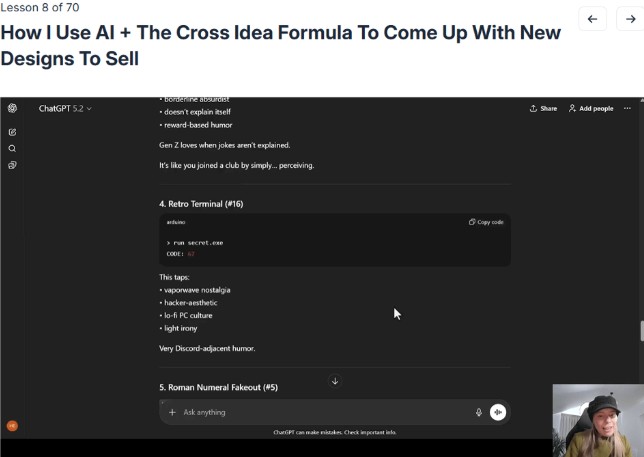
This is the heart of the updated course and where the AI pivot really shows. Sarah covers her “Cross-Idea Formula” for using AI to brainstorm product ideas that fill gaps in the market rather than copying what’s already there.
She also teaches how to use Nano Banana, Midjourney, and Leonardo to generate AI art that actually sells, Canva workflows for turning AI images into print-ready designs, and how to price products for maximum profit — deliberately pricing in the upper-middle bracket even on new stores, which runs counter to what most beginners do but is backed by real consumer psychology research.
Step 3 — Creating a Semi-Passive Print on Demand Store
This step covers the technical setup: creating a free Etsy store, connecting Printify, posting products, optimizing listings for free traffic, and setting up a Shopify POD store as a secondary channel. The semi-passive framing is accurate.
Once Printify is connected to your Etsy store, orders flow through automatically — the print shop handles production and shipping without you touching anything.
Step 4 — Upselling to Big Orders
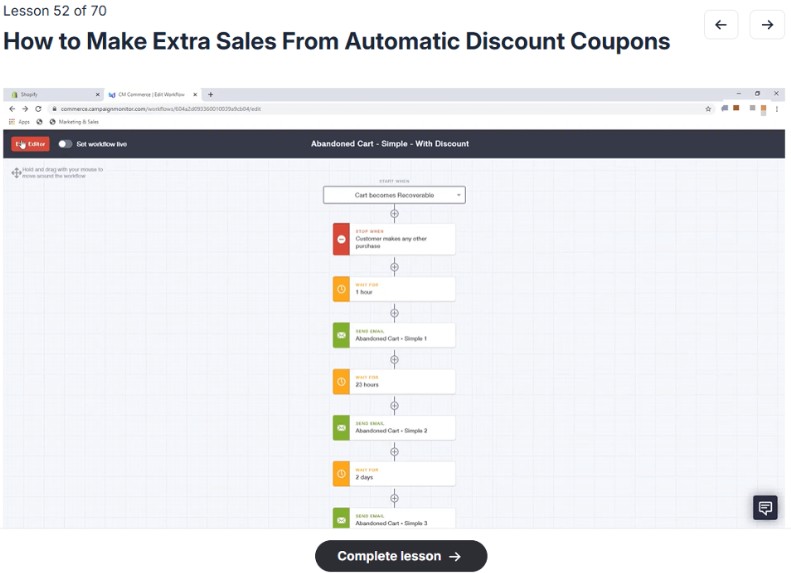
This section covers sales psychology tactics for increasing average order value. Sarah uses three main tools: Voyager for upselling customers into larger orders, the Spin-A-Wheel app to trigger reciprocity, and after-sale coupons to create urgency for repeat purchases.
The design-across-products strategy is particularly practical: take one winning design and apply it to mugs, t-shirts, stickers, and posters simultaneously.
Step 5 — Getting Traffic and Customers
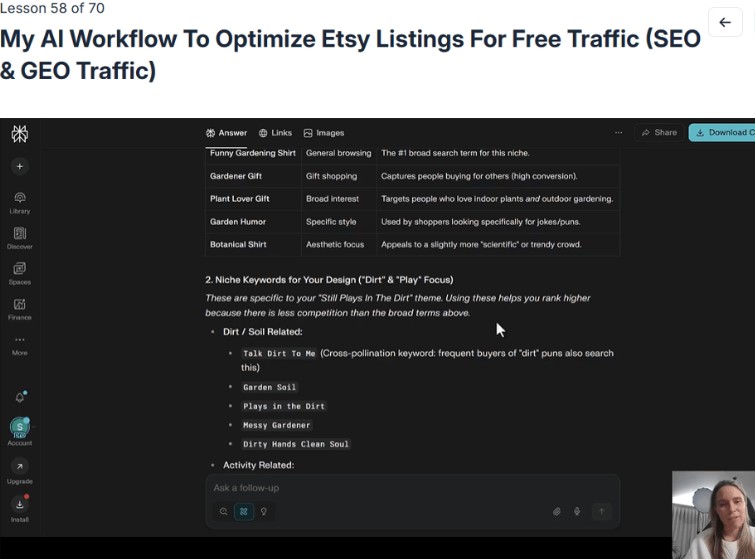
This is where Sarah’s approach stands out from most POD courses. She uses three traffic strategies simultaneously: SEO traffic (optimizing product listings so Etsy’s algorithm serves them to the right customers), GEO traffic (optimizing listings so AI chatbots like ChatGPT and Perplexity recommend her products — genuinely forward-thinking content most course creators aren’t covering yet), and low-budget Etsy ads where she reinvests profits from free traffic to scale what’s already working.
Her AI workflow for traffic is specific: Perplexity to analyze competitor listings for keywords, ChatGPT to write optimized copy around those keywords, then Claude to clean up the copy so it sounds natural rather than keyword-stuffed. That’s a smart three-step process.
Step 6 — Managing and Scaling With AI
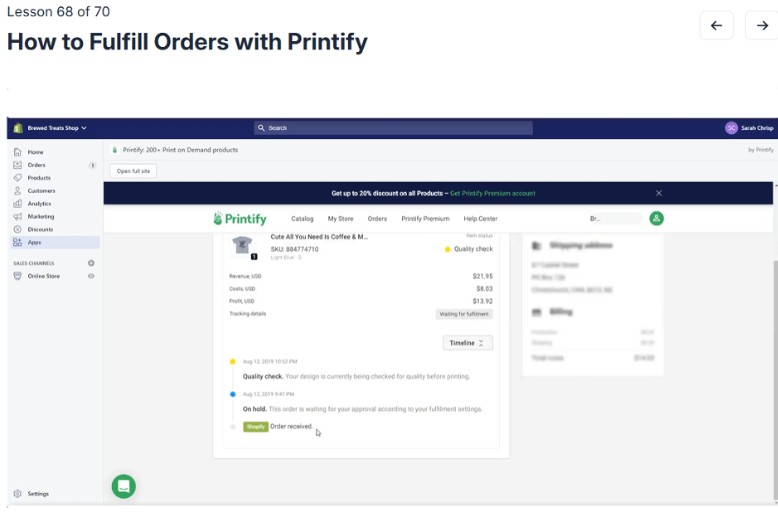
The final step covers daily store management (5 to 20 minutes of email responses per day once running smoothly), order fulfillment through Printify, AI workflows for growing and scaling store sales, and a bonus section on hiring low-cost freelancers. If you follow the model correctly, scaling is mostly about adding new designs — not adding complexity.
The Free Ebook — What Does It Actually Teach?
Before you even see the course, Sarah offers a free ebook called “The 6 Steps That 6-Figure Online Stores Follow To Make $10,000/Month With AI Print On Demand.” You enter your email and it’s delivered immediately.
I went through it. Here’s my honest take: it’s a genuinely useful introduction to the POD model. It explains what print on demand is, walks through all 6 steps at a high level, and gives you enough to understand whether this is a business model worth pursuing.
It’s also, clearly, a sales document. The ebook teaches you just enough to see the opportunity, then points you to the eComm Clubhouse for the deeper how-to. That’s a standard lead magnet structure and there’s nothing wrong with it — but go in knowing what it is.
One detail worth noting: Sarah specifically recommends using Claude AI for writing product listings, citing it as better than ChatGPT for natural-sounding copy. She uses the same tools she recommends and is specific about which ones and why — that adds credibility to everything else she teaches.
The $1 Trial — What’s the Catch?
After you download the ebook, you’re immediately offered a $1 trial: seven days of full access to the eComm Clubhouse before rolling into the $67/month subscription.
I want to be straight with you here. The page says “I will never offer this to you again. This is not false scarcity!” That claim is standard funnel language. The $1 trial is offered to every new subscriber who downloads the ebook. It’s not a one-time, once-in-a-lifetime deal.
That said — the trial itself is a legitimate offer. You get real access to the course for $1. If you use that week to actually go through the content and decide it’s not for you, you can cancel before the 7-day window and pay nothing else. That’s a fair deal. Just set a calendar reminder for day 6 if you’re on the fence.
eComm Clubhouse Pros and Cons
What I Like
- The AI POD pivot is timely and well-executed. Sarah got ahead of this trend and the course reflects real 2026 strategies, not 2019 dropshipping advice repackaged with an AI label.
- 70 lessons is solid content for a $67/month course. You’re not paying for a thin product.
- The traffic strategy is genuinely differentiated. The combination of Etsy SEO, GEO optimization for AI chatbots, and low-budget Etsy ads is more sophisticated than what most beginner ecommerce courses teach.
- Sarah is a credible practitioner. She uses the tools she recommends, runs actual stores, and documents her results publicly on YouTube.
- The $1 trial removes the financial risk of testing the course. One week for $1 is a reasonable ask before committing to $67/month.
- The 7-day refund policy means you have some protection even after your trial ends.
What I Don’t Like
- No community. For a program called the “Clubhouse,” the absence of any member community is genuinely disappointing. No forum, no group, no place to ask questions or share results.
- Monthly subscription with no lifetime access option. If you cancel, you lose everything. Competitors like Ecom Elites offer lifetime access for a one-time fee.
- The $1 trial urgency is exaggerated. Telling people the offer disappears if they click away is a pressure tactic that isn’t true — every new subscriber gets the same offer.
- No verified student success stories. A few testimonials appear on the sales page but nothing with verifiable detail.
- Some older content exists inside the course. At least some training reportedly dates back to 2019. The AI POD sections are clearly newer, but worth knowing.
- 95% dropshipping failure rate industry-wide. The course has pivoted toward POD which carries lower risk, but ecommerce is still a hard business.
How Much Does the eComm Clubhouse Cost?
The eComm Clubhouse costs $67 per month plus applicable local taxes.
There is a $1 trial available for the first 7 days, which then rolls into the standard monthly rate if you don’t cancel.
There is no annual billing option, no lifetime access option, and no one-time payment. You pay $67 every month for as long as you remain a member. To put that in perspective: after six months you’ve paid $402. After a year, $804.
Is There a Refund Policy?
Yes — there’s a 7-day refund policy on membership fees. You can request a refund within 7 days of any payment and get it back, for any reason. That’s a tight window compared to industry standard (most reputable courses offer 30 days). Use your $1 trial week to genuinely evaluate the content — don’t rely on the 7-day refund window as your safety net.
Is the eComm Clubhouse Worth It?
Here’s my honest take after being inside the course and going through the full funnel.
The content is genuinely good. Sarah knows what she’s talking about, the AI POD strategy is current and practical, and the 6-step structure makes the course easy to work through. If you follow it properly, you’ll have a real foundation for building a POD store.
The model is the problem. $67 a month with no community, no lifetime access, and no clear student success documentation is a hard sell when you can get comparable or better training on a one-time payment elsewhere.
I’d rate the eComm Clubhouse a 3.2 out of 5. Great instructor, solid content, genuinely updated for 2026. But the pricing structure and missing community hold it back from being a confident recommendation at this price point.
If you’re determined to try it, use the $1 trial and go hard through the course in that first week. Decide with real information, not marketing.
Alternatives to the eComm Clubhouse
The eComm Clubhouse has genuinely good content. Sarah knows AI Print on Demand, she uses the tools she teaches, and the 6-step structure is clear and practical. The pricing model is what holds it back - $67/month with no lifetime access and no community adds up fast.
Here are your alternatives depending on budget and approach.
The AI Approach: E-Commerce With the Same AI Tools for $47 One-Time {#ai-alternative}
Sarah teaches you to use Claude AI for product listings, ChatGPT for keyword optimization, Perplexity for niche research, and Midjourney/Leonardo for AI-generated designs. Those are the right tools. The problem is you're paying $67/month ($804/year) to learn them.
Module 3 of my 2026 AI Business Blueprint teaches the same AI workflows for e-commerce - $47 one-time, lifetime access.
What Module 3 covers:
AI product research: The exact tools Sarah mentions (Perplexity for competitor analysis, ChatGPT for trend validation) plus AI workflows for finding product gaps faster than manual Etsy scrolling.
AI design automation: Midjourney, Leonardo, and DALL-E workflows for generating print-ready designs. Sarah teaches her "Cross-Idea Formula" - Module 3 shows you how to use AI to generate 50+ design variations in an hour instead of manually brainstorming in Canva.
AI listing optimization: Claude for writing natural-sounding product descriptions (Sarah's specific recommendation), ChatGPT for keyword-rich titles, Perplexity for SEO research. Same three-step workflow Sarah teaches, with the prompts that actually work.
GEO traffic optimization: Sarah's forward-thinking traffic strategy is optimizing for AI chatbots (ChatGPT, Perplexity, Claude) recommending your products. Module 3 covers the same GEO approach - how to structure listings so AI assistants recommend your store when people ask for product suggestions.
Customer service automation: AI chatbots handling common questions 24/7. Sarah says 5-20 minutes of email responses per day once running smoothly - AI removes that entirely.
The fundamentals are identical (find niche, create designs, optimize listings, drive traffic, make sales). Sarah's POD-specific strategies are solid. AI just lets you execute faster and cheaper - and you're not locked into a $67/month subscription with no community.
$47 one-time vs $804 in year one of the eComm Clubhouse. Module 3 covers all five business models (affiliate marketing, faceless YouTube, e-commerce, freelancing, digital products) - e-commerce is one focused module with the AI tools Sarah already recommends.
Not quite ready yet and "just browsing"? Download my Free AI Business Cheat Sheet and see how AI can superpower 5 of these business ideas - including ecom!
The Traditional Manual Route: Ecom Elites ($197-$297)
Ecom Elites is one of the most complete ecommerce courses available, and it does something the eComm Clubhouse doesn't: you pay once and you're done. For $197 (standard) or $297 (super pack), you get 200+ training videos covering ecommerce from A to Z — store setup, product research, Facebook ads, Google ads, email marketing, Instagram, and SEO traffic. Updates are included for free. No monthly fees. No cancellation anxiety.
Read my full Ecom Elites review for the complete breakdown.
The Dropship-to-Wholesale Approach: SaleHoo eCommerce Accelerator ($497)
The SaleHoo eCommerce Accelerator teaches a dropship-to-wholesale model — you use dropshipping to validate products first, then move into wholesale once you know what sells. At $497 (or three payments of $166), you get lifetime access to the course plus actual SaleHoo tools: a dropship tool with one-click Shopify integration, the SaleHoo Directory of 8,000+ vetted suppliers, and Market Research Labs for identifying trending products. The 30-day no-questions-asked refund policy is significantly more generous than the eComm Clubhouse's 7-day window.
Read my full SaleHoo eCommerce Accelerator review for the complete breakdown.
Which should you choose?
Choose the eComm Clubhouse if you specifically want Sarah's step-by-step POD training, don't mind the $67/month subscription model, follow her YouTube channel already, and value her practitioner credibility. The content is good - the pricing structure is the limitation.
Choose the AI approach if you want the same AI tools Sarah teaches (Claude, ChatGPT, Perplexity, Midjourney, Leonardo) for $47 one-time instead of $804/year, want lifetime access with no subscription anxiety, and prefer focused AI workflows over 70 lessons. Sarah's POD strategies are solid - AI just makes execution faster and cheaper without the monthly fee.
Choose Ecom Elites if you want comprehensive e-commerce training (not just POD) with lifetime access for $197-$297 one-time. Franklin's course is broader, proven, and no monthly fees.
Choose SaleHoo if you want the dropship-to-wholesale transition model with supplier tools included, don't mind paying $497 upfront, and value the 30-day refund window.
Frequently Asked Questions
Is Wholesale Ted legit?
Yes. Wholesale Ted is a legitimate YouTube channel and education platform run by Sarah Chrisp. The content is real, the strategies are based on Sarah’s actual stores, and the eComm Clubhouse is a genuine course — not a scam. The main criticisms are about the value proposition of the monthly pricing model, not the legitimacy of the operation.
Who is “Ted” in Wholesale Ted?
Ted was Sarah Chrisp’s original business partner and mentor. He has not been involved with the channel or the eComm Clubhouse for years. Sarah runs the entire operation solo.
How many subscribers does Wholesale Ted have?
As of 2026, the Wholesale Ted YouTube channel has 1.46 million subscribers. Sarah joined the platform on November 3, 2014.
Is the eComm Clubhouse good for beginners?
Yes — it’s specifically designed for beginners. The course assumes no prior ecommerce knowledge and walks you through every step from niche research to store setup to traffic generation. Sarah’s teaching style is clear and practical, and the 70 lessons are structured to build on each other.
Does the eComm Clubhouse teach dropshipping or print on demand?
The current version of the course is primarily focused on AI Print on Demand, with Etsy and Shopify as the main selling platforms. The original course covered traditional dropshipping more heavily, but the current focus has shifted significantly toward POD using AI design tools.
Is there a free trial for the eComm Clubhouse?
There’s a $1 trial that gives you 7 days of full access before rolling into the standard $67/month subscription. This trial is offered to new subscribers who download Sarah’s free ebook. Set a calendar reminder if you’re planning to evaluate and cancel.
Is print on demand still worth it in 2026?
Yes — but the game has changed. The stores that win in 2026 are the ones using AI to create unique, niche-specific designs at speed, optimizing for both traditional search (Etsy SEO) and AI-driven discovery (GEO). Generic designs uploaded at volume no longer cut it. Sarah’s approach reflects this shift, which is one of the stronger aspects of the updated course.
Can you cancel the eComm Clubhouse anytime?
Yes. You can cancel your membership at any time through your account dashboard. Your access will remain active until the end of your current billing period. Be aware that once cancelled, you lose access to all course content — there’s no download option or lifetime access tier.
What is Sarah Chrisp’s net worth?
Estimates put Sarah Chrisp’s net worth at $1 to $2 million, based on her ecommerce store income and course revenue. These are third-party estimates — Sarah hasn’t publicly confirmed her net worth.
Can I use AI instead of subscribing to the eComm Clubhouse?
Yes - Sarah's course teaches you to use Claude AI for product listings, ChatGPT for keywords, Perplexity for research, and Midjourney/Leonardo for designs. Those are the right tools. The question is whether you want to pay $67/month ($804/year) to learn them or $47 one-time.
Module 3 of The 2026 AI Business Blueprint covers the same AI workflows for e-commerce - product research, design automation, listing optimization, GEO traffic (AI chatbot recommendations), and customer service automation. Sarah's POD strategies are solid and practitioner-tested. AI just lets you execute without the monthly subscription cost.
Most people would rather spend $47 once instead of $804 in the first year for access to the same AI tools and workflows.
How is the AI e-commerce approach different from the eComm Clubhouse?
The eComm Clubhouse is $67/month ($804/year) subscription teaching AI Print on Demand with Sarah's 6-step system, 70 lessons, and the specific AI tools she uses (Claude, ChatGPT, Perplexity, Midjourney, Leonardo). No community despite "Clubhouse" branding. Cancel and you lose all access.
The AI approach is $47 one-time with lifetime access covering the same AI tools for e-commerce - design automation, listing optimization, SEO, GEO traffic, customer service. Sarah's POD-specific strategies (Cross-Idea Formula, Etsy algorithm manipulation, semi-passive store setup) are solid. AI just removes the subscription cost and gives you permanent access.
The eComm Clubhouse is POD-specific with Sarah's proven practitioner credibility. AI is e-commerce-general (covers all models including POD) with no monthly fees. Both teach the same AI tools Sarah already recommends.
Does the eComm Clubhouse teach the AI tools I need for POD?
Yes - Sarah specifically recommends Claude AI for product listings, ChatGPT for keyword optimization, Perplexity for niche research, and Midjourney/Leonardo for AI-generated designs. She uses these tools herself and teaches them in the course. The GEO traffic optimization (optimizing for AI chatbots) is genuinely forward-thinking content most POD courses don't cover yet.
The limitation is the $67/month subscription with no lifetime access option and no community. If you want to learn those same AI tools (Claude, ChatGPT, Perplexity, Midjourney, Leonardo) for e-commerce without the monthly fee, Module 3 of the 2026 AI Business Blueprint covers them for $47 one-time. Sarah's POD-specific strategies are solid - just decide whether you want to pay monthly or once.

- Best Outdoor Equipment Fulfillment Companies for DTC Brands - October 8, 2026
- Why Your Site Needs an Automated Price Calculator - October 7, 2026
- Essential Considerations When Choosing a Commercial Building - October 3, 2026

Thank you drew for your honest opinion.. I just sign up for the free trial with Sarah yesterday I will definitely check out Franklin Hatchett
Sounds good Michico. You can email me if you have further questions.
Excellent review. I know It’s been a hot minute, but am fairly new to all of this. Do you think Sarah’s content in her course is something that would REQUIRE multiple months worth of subscriptions to get through? I have more than a fair share of free time and am ready to go. I understand that this isn’t a quick turn around game, but is maintaining the subscription “necessary”?
Hi Dexter, you could potentially go through all the content in the first month and cancel afterwards if it’s not for you. Usually people stay on for the support and any updates that might come out. If you’re new, I do suggest you look at other options like eCom Elites where there is no subscription and you get lifetime updates.
I am specifically wanting to learn about print on demand, would the Franklin Hatchett course help with that or is it more focused on dropshipping? Thanks
Hi Lisa, Franklin’s course focuses on dropshipping only. Some of it would help such as the marketing aspect but there isn’t anything on print on demand specifically.
Thank you very much for this review. I have been curious as to whether Sara Chrisp and wholesale Ted were legit or not. I have also heard of Hatchett as well. They both appear to be legit but paying monthly can get costly. I believe there is enough info out there to give it a shot on your own if your really passionate about what your doing.
Hi Keith, Franklin Hatchett does not charge any monthly fees for his courses, it’s just a one-time fee and updates are included for free. To your second point, if you’re passionate enough you should be getting proper training from a trusted source and not relying on outdated free information. That’s my opinion and really up to the individual.