I've been running affiliate sites since 2010, and the landscape has changed dramatically. What started as a side income stream has evolved into a $18.5 billion global industry that's reshaping how businesses acquire customers online.
This article compiles 147+ data points across 11 categories to give you the complete picture of affiliate marketing in 2026. You'll find real income figures, conversion benchmarks, niche performance data, and insights on how AI is changing the game.
Whether you're considering affiliate marketing as a business model or already running campaigns, these statistics will help you benchmark your performance, identify opportunities, and avoid the common mistakes that cause 91% of beginners to quit before reaching consistent income.
How Big Is the Affiliate Marketing Industry?
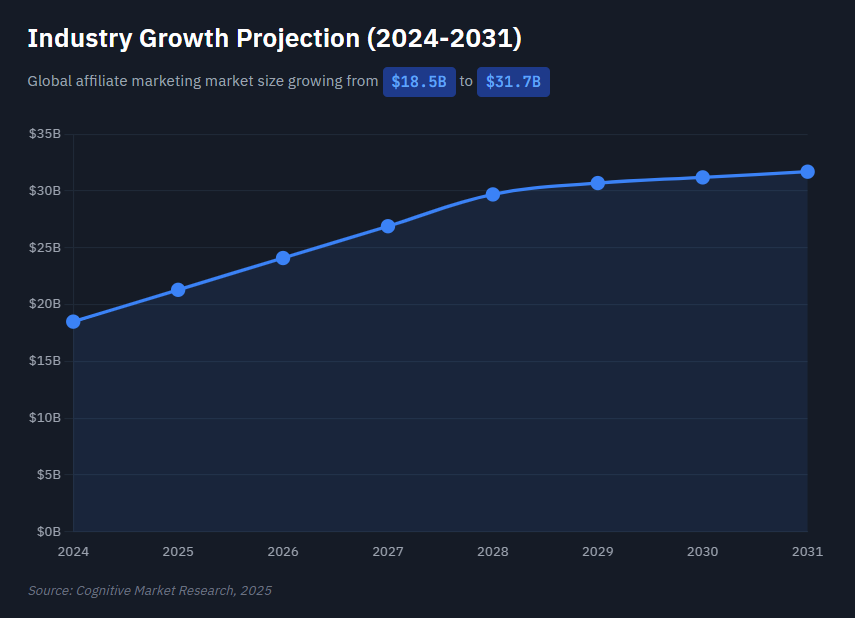
The global affiliate marketing industry reached $18.5 billion in 2024 and is projected to grow to $31.7 billion by 2031, according to Cognitive Market Research. That's a compound annual growth rate of roughly 8% over the next several years.
Regional distribution shows North America commanding about 40% of the global market share, followed by Europe at 30% and Asia-Pacific at 23%. The remaining 7% comes from Latin America, Middle East, and Africa combined.
US affiliate marketing spending specifically is expected to reach $11.2 billion in 2026, up from approximately $9.1 billion in 2023. By 2028, industry projections put US spending near $16 billion.
The growth isn't just happening in mature markets. Asia-Pacific is expanding at over 10% annually, driven by rising internet penetration in India, Indonesia, and Southeast Asian countries. China's social commerce ecosystem adds another layer of complexity and opportunity.
Europe's growth sits around 6.5% annually, with the UK, Germany, and France leading adoption. These markets have strong consumer protection frameworks, which actually helps legitimize affiliate marketing as a trusted acquisition channel.
Global click volume in affiliate marketing has increased by more than 50% since 2020, reflecting both market growth and the shift toward performance-based marketing as paid advertising costs continue rising.
How Much Do Affiliate Marketers Actually Make?
The median affiliate marketer earns around $8,038 per month, but income distribution is heavily skewed. About 35% of affiliates generate at least $20,000 in annual revenue, while 15% report yearly earnings between $80,000 and $1 million.
The reality check most people need is that income varies wildly based on experience, niche, traffic volume, and business model. Affiliates with less than one year of experience average around 56,673 monthly visitors and considerably lower earnings. Those with six to ten years of experience see traffic jump to roughly 108,000 monthly visitors, while the ten-plus year group averages 216,000 monthly visitors.
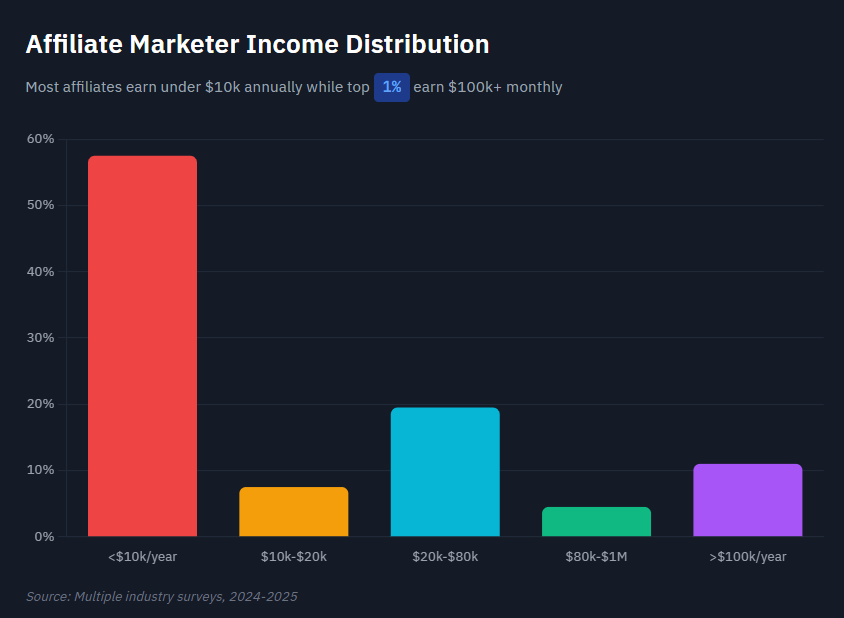
Breaking down the income brackets, roughly 9% of affiliates earn under $1,000 annually. Another 21% make between $1,000 and $10,000. The next tier, from $10,000 to $50,000, captures about 35% of marketers. Then you have 20% earning $50,000 to $80,000, and the top 15% crossing $80,000 with some reaching seven figures.
Geography matters too. Affiliates in North America and Western Europe typically report higher earnings than those in developing markets, largely due to higher product prices and commission rates in those regions.
Full-time affiliates naturally earn more than those treating it as a side hustle. About 47% of affiliates work on their programs full-time, while 53% balance it with other income sources.
The income data also reveals that most successful affiliates diversify across multiple programs. Relying on a single merchant or network creates vulnerability if that relationship ends or commission structures change.
Which Affiliate Networks Perform Best?
Amazon Associates dominates the affiliate network landscape with roughly 46-47% of global market share, which translates to over 215,000 websites using their program. The massive product catalog and trusted brand name make Amazon the default choice for many content creators, despite relatively low commission rates ranging from 1% to 20% depending on category.
According to Rakuten Advertising, 81% of advertisers and 84% of publishers now leverage affiliate programs, with adoption increasing year-over-year. This widespread participation across both sides of the marketplace indicates affiliate marketing has moved from experimental to essential for most businesses.
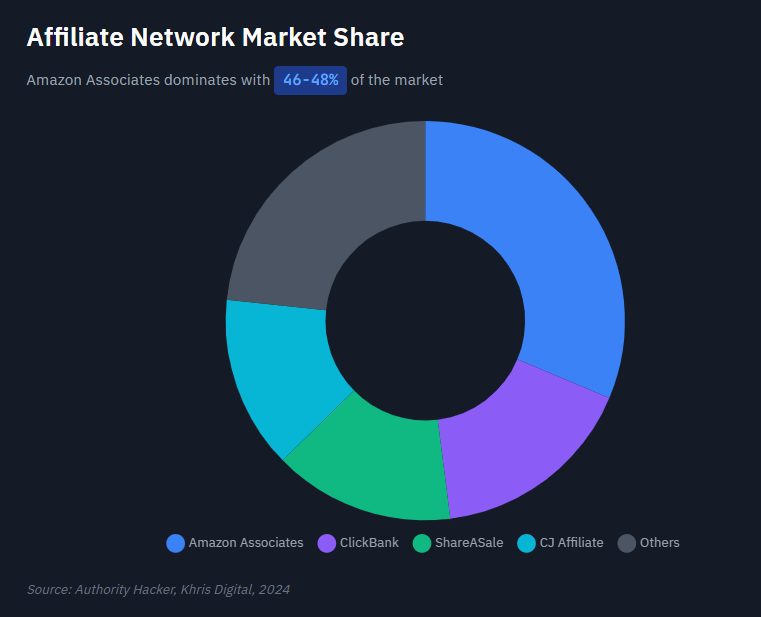
Beyond Amazon, Commission Junction (CJ Affiliate) operates approximately 80,063 affiliate sites, making it the second-largest network. Awin follows with around 59,335 sites, while Rakuten Advertising itself powers roughly 34,116 active affiliates.
ShareASale, Impact, and ClickBank each serve distinct market segments. ShareASale focuses heavily on small to medium-sized merchants. Impact caters to enterprise brands with sophisticated tracking needs. ClickBank specializes in digital products and info products with high commission rates, often 50-75%.
Network choice significantly impacts earnings potential. SaaS and software affiliate programs frequently pay 20-70% recurring commissions, among the highest rates available. Finance and fintech programs commonly offer flat fees of $50-$200 per qualified lead rather than percentage-based commissions.
The average affiliate marketer works with multiple networks simultaneously. This diversification strategy protects against policy changes, merchant departures, or network shutdowns that could otherwise eliminate income streams overnight.
European affiliates often prefer Awin due to its strong presence in UK, German, and French markets. Asia-Pacific has regional networks like Involve Asia and AccessTrade that understand local payment preferences and merchant relationships better than global networks.
What Are the Average Conversion Rates and ROI?
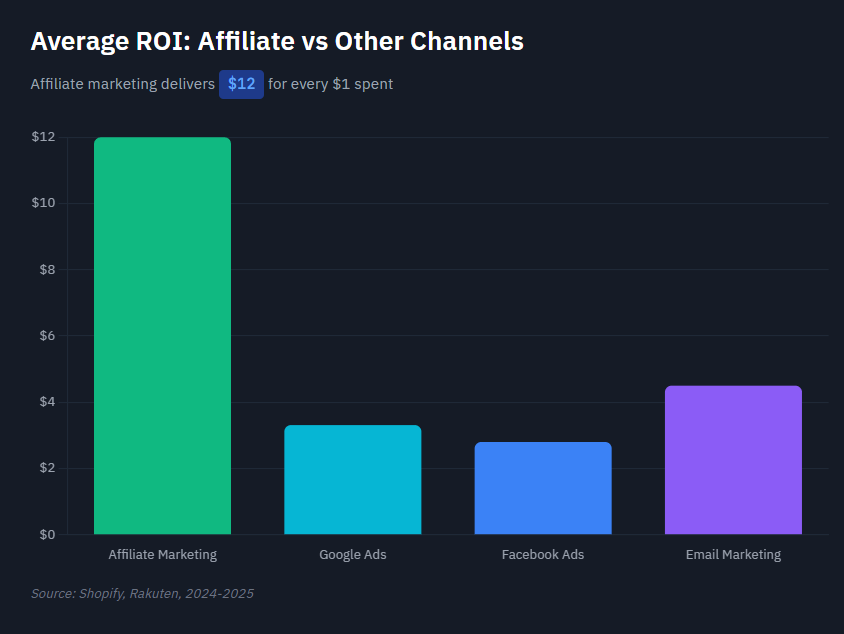
Affiliate marketing delivers an average return of $12 for every $1 spent on advertising, according to Rakuten Advertising's industry benchmarks. This 12:1 return on ad spend dramatically outperforms most other digital marketing channels and explains why over 80% of brands now include affiliate marketing in their acquisition mix.
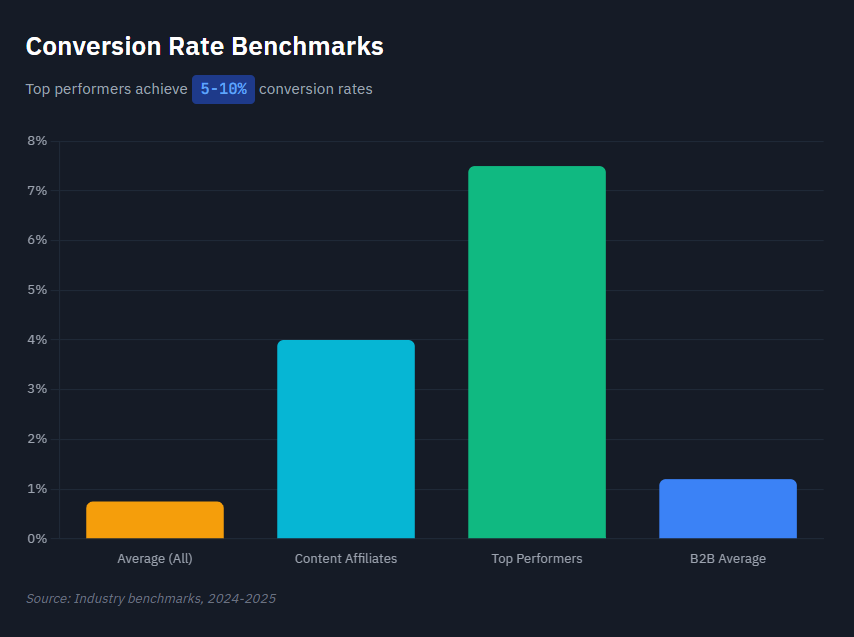
The average affiliate conversion rate across all niches stands at approximately 2.1% in 2025. Content affiliates specifically see conversion rates between 3-5%, while coupon and deal sites often convert at lower rates but generate much higher volume.
B2C affiliate programs average 2.0% conversion rates, while B2B programs sit at 1.2%. The difference reflects longer sales cycles and higher consideration in business purchases.
Click-through rates for affiliate links average 0.7-1.2% across content sites. This might seem low, but context matters. A food blog with 100,000 monthly visitors generating a 1% CTR produces 1,000 clicks to merchant sites, and at a 3% conversion rate with a $30 commission, that's $900 in monthly earnings from organic traffic alone.
Some sources report ROI as high as $15 revenue per $1 spent in affiliate marketing, though I think the $12 figure from Rakuten is more realistic for most marketers. The variance depends heavily on niche, traffic quality, and whether the affiliate owns their audience through email lists.
Average order value plays a crucial role in ROI calculations. A 2024 Awin and Forrester analysis found that affiliate-sourced buyers had 21% higher average order values compared to customers acquired through other channels. These customers also showed higher repeat purchase rates, suggesting superior lifetime value.
Affiliates focusing on high-ticket items naturally see better ROI despite potentially lower conversion rates. Promoting $2,000 software subscriptions requires fewer conversions than promoting $20 products to achieve the same revenue.
The shift toward first-party data and privacy-compliant tracking is impacting attribution. About 59% of brands report difficulty measuring how affiliate campaigns affect other marketing channels, and another 59% struggle with cross-device customer journey measurement. This attribution gap means actual affiliate ROI is likely higher than reported figures suggest.
Where Does Affiliate Traffic Come From?
Organic search remains the dominant traffic source for most affiliate marketers, with content sites heavily investing in SEO to rank for product review keywords, comparison terms, and buying intent queries. The average affiliate site with six to ten years of experience generates approximately 108,000 monthly organic visitors.
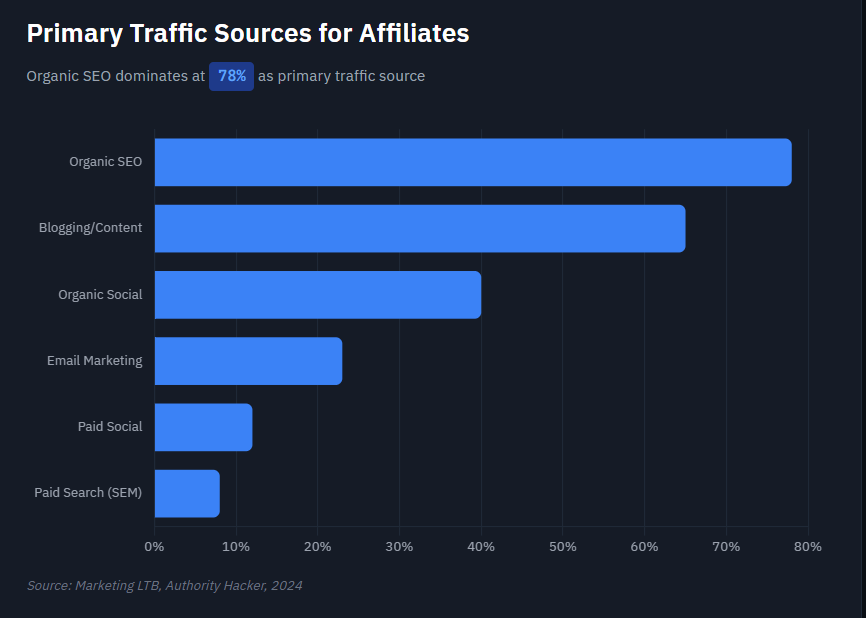
Social media has grown substantially, with over 65% of affiliate marketers actively using social platforms to promote products. Facebook leads with 75.8% of affiliates using it, followed by Instagram at 61.4%, Pinterest at 42.2%, YouTube at 36.9%, Twitter at 31.1%, TikTok at 29.6%, and LinkedIn at 19%.
Instagram and TikTok specifically account for 62% of affiliate revenue generated through social media channels. The short-form video format on both platforms drives engagement rates that longer-form content struggles to match.
Email marketing remains powerful for affiliates who build their own audiences. Roughly 50% of affiliates use email newsletters as a primary promotion channel. Email allows direct communication without algorithm dependency and typically converts better than cold traffic.
Paid advertising accounts for a smaller but significant portion of affiliate traffic. About 40% of advertisers allocate their affiliate ad spend toward in-app campaigns, recognizing that mobile app users show strong purchase intent.
YouTube deserves special mention as 36.9% of affiliates use the platform. Video content allows for detailed product demonstrations and tutorials that build trust before asking for the sale. Many successful YouTube affiliates combine ad revenue with affiliate commissions for diversified income.
The rise of browser extensions and toolbar add-ons represents another traffic source. These tools automatically find and apply coupon codes or trigger cashback offers, capturing last-click attribution even when users found products through other channels.
Influencer-driven traffic is growing rapidly. According to Impact's research, brands combining influencer and affiliate programs reported a 46% increase in affiliate-based sales. Creator-driven affiliate revenues reached approximately $1.3 billion in 2025.
Direct traffic to affiliate sites indicates brand building and repeat visitors. The most successful affiliates cultivate audiences who return directly rather than depending entirely on external traffic sources. Some affiliates even build successful businesses through affiliate marketing without a website by focusing exclusively on social platforms and email lists.
How Is AI Changing Affiliate Marketing?
AI adoption among affiliate marketers hit 79% in 2024, with the majority using AI-driven content creation tools to scale their output. This rapid adoption is reshaping competitive dynamics as content production costs drop and speed increases.
The most significant AI impact comes from search engine changes. According to Averi's AI content marketing study, 48% of search results now display AI Overviews that answer queries directly without sending traffic to websites. This fundamentally challenges the affiliate model that depends on search traffic.

I think this represents the biggest threat affiliate marketers face right now. When Google answers "best running shoes for flat feet" directly in an AI Overview, users have less incentive to click through to affiliate content that makes commissions on those recommendations.
The counterpoint is that AI tools also enable better content. Affiliates use AI for keyword research, outline generation, first drafts, and optimization suggestions. The question is whether AI democratizes affiliate marketing or just raises the baseline quality required to compete.
Beyond content creation, AI powers better affiliate discovery and partner matching. Networks now use machine learning to predict which affiliates will perform best for specific merchants, improving campaign efficiency from the start.
Real-time fraud detection through AI has become essential. With 58.1% of advertising budgets impacted by ad fraud, automated systems can identify suspicious click patterns, bot traffic, and commission fraud faster than manual review.
Predictive analytics helps affiliates optimize conversion probability. AI models analyze user behavior to score leads and predict purchase likelihood, allowing smarter traffic segmentation and personalization.
The global AI in marketing market reached $20.45 billion in 2024 and is growing at 25% annually. Affiliate marketing captures a meaningful share of this spend through AI-powered tracking, attribution modeling, and campaign optimization platforms.
Some affiliates worry about AI detection tools flagging their content. The reality is that AI-generated content isn't inherently problematic if it provides genuine value. Search engines care more about usefulness and expertise than production method.
The shift to AI-powered personalization means the same affiliate content can dynamically adjust based on visitor behavior, location, device, and previous interactions. This level of customization was impossible at scale before machine learning.
Which Niches Make the Most Money?
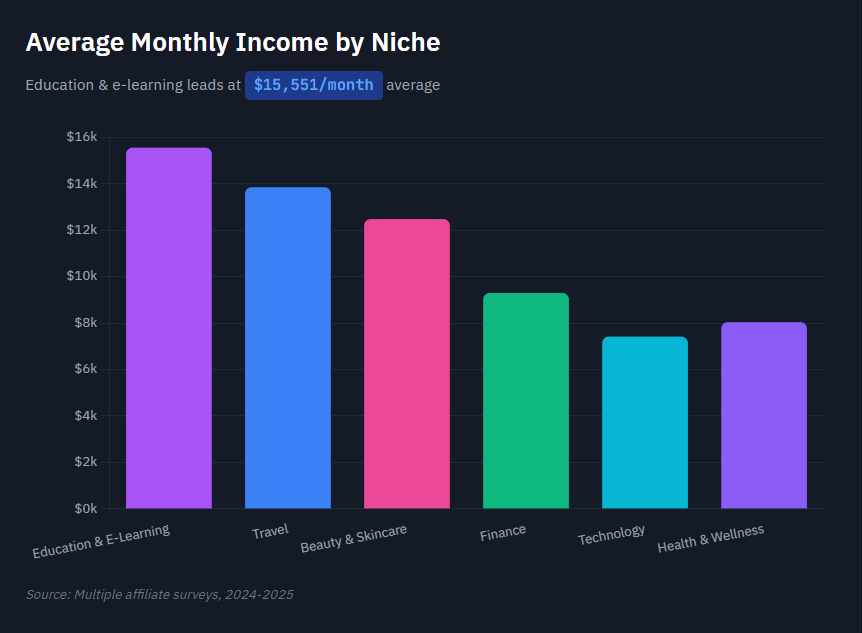
Education and e-learning tops the earnings chart with average monthly income of $15,551 for affiliates in this niche. The combination of high-ticket course prices, recurring subscription models, and strong conversion rates makes educational products particularly profitable.
Travel comes second at $13,847 monthly average earnings. Despite the travel industry's volatility, affiliates in this space benefit from high order values and numerous monetization options including flights, hotels, tours, travel insurance, and booking platforms.
Beauty and skincare affiliates average $12,475 per month. This niche combines reasonable traffic volumes with frequent repeat purchases and strong social media presence. Beauty influencers often transition naturally into affiliate marketing given their existing product recommendation content.
Finance affiliates earn around $9,296 monthly on average. Financial products typically pay flat fees of $50-$200 per lead rather than percentage commissions, and the qualified lead requirements filter out low-intent traffic.
Technology and software affiliates average $7,418 monthly. Tech niches often feature recurring commission structures where affiliates earn ongoing payments for the lifetime of referred customers. SaaS affiliate programs paying 20-70% recurring commissions can build substantial passive income over time.
At the bottom end, arts and crafts affiliates average $1,041 monthly, while pets and animals niches average $920 per month. These lower figures reflect both smaller audience sizes and lower product prices in these categories.
Fashion represents 23% of all affiliate programs, the highest concentration of any category. The massive market size and constant trend cycles create ongoing content opportunities, though competition is correspondingly intense.
Retail and e-commerce collectively generate about 44% of global affiliate revenues, making it the dominant vertical. The breadth of products under this umbrella means almost any content creator can find relevant offers to promote.
Telecom and media account for roughly 25% of affiliate revenues worldwide. Mobile phone plans, streaming services, and entertainment subscriptions provide stable recurring income potential.
The hospitality sector, including hotels, restaurants, and experiences, contributes approximately 16% of global affiliate revenue. Travel restrictions during COVID-19 temporarily disrupted this niche, but recovery has been strong as consumer confidence returns.
Niche selection matters more than most affiliates realize initially. A smaller niche with $200 average commissions requires far fewer conversions than a massive niche with $5 commissions to reach the same income level. For deeper analysis on which niches offer the best opportunities, see my guide to the best affiliate marketing niches.
Who Are Affiliate Marketers? (Demographics & Team Sizes)
The typical affiliate marketer operates solo or with a very small team. Solo entrepreneurs represent the majority, handling content creation, SEO, email marketing, and promotional activities themselves.
Experience distribution shows that affiliates improve their results significantly over time. Those with less than one year average 56,673 monthly visitors and lower earnings. The six-to-ten-year cohort jumps to 108,000 monthly visitors, while veterans with over ten years average 216,000 monthly visitors and substantially higher income.
About 47% of affiliates work on their programs full-time, treating affiliate marketing as their primary business. The remaining 53% balance affiliate income with other work, whether traditional employment, freelancing, or operating other businesses.
Geographic concentration skews toward developed markets with mature e-commerce infrastructure. North America hosts approximately 47% of global affiliate service providers, followed by Asia-Pacific at 24%, Europe at 20%, and Africa at 9%.
Between 2020 and 2022, searches for "affiliate marketing" surged by 264%, indicating growing interest in the business model. This search volume explosion correlates with pandemic-driven interest in remote income and online businesses.
The demographic profile skews younger than traditional marketing roles, with many affiliates starting in their 20s and 30s. The low barriers to entry allow anyone with content creation skills and internet access to begin earning affiliate commissions.
Educational background varies widely. Some affiliates have marketing degrees or technical backgrounds, while others come from completely unrelated fields. Success correlates more with persistence, content quality, and SEO knowledge than formal education.
Team size for successful affiliate operations ranges from solo to small agencies. Mid-six-figure earners often operate alone or with one virtual assistant. Seven-figure affiliate businesses typically employ two to five people handling content, outreach, technical SEO, and administrative tasks.
The shift toward content teams rather than individual bloggers is accelerating. Brands operating affiliate content sites increasingly hire multiple writers, editors, and SEO specialists to scale production beyond what one person can create.
What Are the Biggest Challenges in Affiliate Marketing?
Competition and market saturation rank as the primary challenge, with over 80% of brands now adopting affiliate marketing as a regular revenue channel. In Europe specifically, approximately 82% of brands use affiliate marketing, indicating mature market conditions where differentiation becomes critical.
Privacy regulations create persistent headaches. About 73% of marketers report concern that privacy regulations hinder their analytics efforts. Cookie restrictions, GDPR compliance, and evolving tracking limitations make attribution increasingly difficult.
Ad fraud impacts 58.1% of advertising budgets across the industry. Dishonest affiliates employ bot traffic, click fraud, and other deceptive tactics to generate unearned commissions. Merchants must invest in monitoring and verification systems, which increases operational costs.
Attribution challenges plague 59% of brands who report difficulty measuring how affiliate campaigns affect other marketing channels. Another 59% struggle with cross-device customer journey measurement. These attribution gaps make it harder to justify affiliate spending and optimize campaign performance.
About 38% of affiliates still rely on basic affiliate network measurement methods rather than sophisticated tracking systems. This dependence on network-provided data limits optimization capabilities and makes affiliates vulnerable to tracking changes.
The rise of ad-blockers and privacy-focused browsers reduces tracking capability further. Some affiliates lose credit for legitimate sales when tracking pixels fail to fire or cookies don't persist across the purchase journey.
Algorithm updates from search engines create volatility for affiliates depending on organic traffic. Google's helpful content updates and core algorithm changes can devastate rankings overnight, eliminating months or years of traffic building.
Commission cuts remain an ongoing concern. Amazon has systematically reduced affiliate commission rates across multiple categories over the years, forcing affiliates to either accept lower earnings or find alternative merchants.
Merchant relationship stability varies considerably. Some merchants terminate affiliate programs abruptly, leaving affiliates scrambling to replace lost income. Others change terms without adequate notice, disrupting established promotional strategies.
Content production demands grow constantly. The volume and quality of content required to compete keeps increasing as more affiliates enter the market and AI tools accelerate content creation across the industry.
These challenges contribute to high failure rates in affiliate marketing. Understanding why affiliate marketers fail helps you avoid the common pitfalls that cause most beginners to quit before reaching profitability.
What's the Future of Affiliate Marketing?
Projected growth through 2031 shows the industry reaching $31.7 billion globally, according to Cognitive Market Research. This represents continued expansion despite challenges from AI Overviews and privacy regulations.
The convergence of influencer marketing and affiliate programs is accelerating. Creator-driven affiliate revenues hit $1.3 billion in 2025, and influencers now represent approximately 20% of US e-commerce revenue on major shopping days like Cyber Monday.
Mobile commerce growth creates new opportunities. As smartphone penetration increases globally, particularly in emerging markets, mobile-optimized content and app-based affiliate programs will capture more market share.
First-party data strategies become essential as third-party cookie tracking disappears. Affiliates who build email lists and owned audiences position themselves better than those depending entirely on external traffic and platform-provided tracking.
AI integration will define competitive advantage. Affiliates leveraging AI for content optimization, personalization, fraud detection, and predictive analytics will outperform those using manual processes.
The shift toward performance-based budgets continues accelerating. As customer acquisition costs rise across paid channels, more brands allocate budget to affiliate marketing where they pay only for results.
Subscription and recurring commission models gain prominence. One-time commissions give way to lifetime value arrangements where affiliates earn ongoing revenue from customers they refer.
Regulatory frameworks will continue evolving. Affiliates must adapt to stricter disclosure requirements, privacy laws, and potential platform policy changes that could reshape promotional tactics.
Creator marketplaces and specialized platforms make affiliate marketing more accessible. New tools reduce technical barriers, allowing content creators without technical backgrounds to participate effectively.
Frequently Asked Questions
Is affiliate marketing worth it in 2026?
Yes, affiliate marketing remains worthwhile in 2026 based on the ROI data showing $12 returned for every $1 spent and projected industry growth to $31.7 billion by 2031. The performance-based model creates lower risk compared to traditional advertising since merchants only pay for actual results. That said, competition has intensified significantly with over 80% of brands now running affiliate programs, so success requires genuine expertise, quality content, and strategic niche selection rather than minimal effort.
How much can beginners realistically make?
Beginners typically earn very little in their first year, with most generating under $1,000 annually while building traffic and authority. The data shows affiliates with less than one year experience average around 56,673 monthly visitors, which at typical conversion rates produces modest income. I think realistic expectations for the first 12-18 months are $100-$500 monthly while establishing your content foundation. Significant income usually arrives in years two and three as organic traffic compounds and you understand which promotional strategies work for your specific audience.
What's the best affiliate network for beginners?
Amazon Associates remains the best starting point for beginners despite lower commission rates because the massive product catalog means relevant offers exist for any content niche, and the trusted brand name reduces conversion friction. ShareASale offers a strong alternative with thousands of smaller merchants and generally more favorable commission structures. ClickBank works well if you're promoting digital products and info courses where 50-75% commissions are common. The honest answer is you'll eventually use multiple networks, but starting with Amazon reduces technical complexity while you learn fundamentals.
Do I need a website for affiliate marketing?
No website is strictly required since you can promote affiliate links through social media, YouTube, email lists, or paid advertising, but I feel like a website provides the most stable long-term foundation. Social platforms change algorithms and policies frequently, potentially destroying your business overnight. A website you own gives you control over content, audience relationships, and traffic sources. That said, plenty of affiliates succeed primarily through Instagram, TikTok, or YouTube by building engaged audiences and maintaining consistent promotional activity across those platforms. For specific strategies on building an affiliate business without a site, check out my guide on affiliate marketing without a website.
How long does it take to make money with affiliate marketing?
Most affiliates require six to twelve months before earning meaningful income, with the first three months often producing zero revenue while building content and traffic. The timeline depends heavily on your starting position, content quality, niche competition, promotional strategy, and whether you have an existing audience. SEO-focused affiliates typically wait longer for organic traffic to compound, while those using paid traffic or established social followings can monetize faster. Realistic expectations are $0-$100 monthly for months 1-6, $100-$500 for months 7-12, and potentially $500-$2,000+ in year two as traffic and optimization improve.

- Digital Entrepreneurs Are Discovering That Physical Operational Infrastructure Accelerates Digital Scale - October 18, 2026
- Fast-growing E-commerce Sellers Are Overhauling Fulfillment Hubs To Keep Up With Orders - October 16, 2026
- Ad Network Marketing Myths That Can Lead to Poor Campaign Decisions - October 13, 2026