Hey, Drew here. Welcome to my Business Lending Blueprint review for 2026. I'm going to level with you right up front: I didn't buy this course, but I spent 40+ hours researching it from every angle – watching student testimonials, reading industry critiques from actual loan brokers, analyzing Trustpilot reviews, and comparing it to what business loan brokers actually earn according to ZipRecruiter data.
Look, if you buy the wrong business course, you're not just out $2,197. You could waste six months chasing deals that never close, dealing with credit checks you don't understand, and navigating lending regulations that change every quarter. You might end up as what one industry professional called a "glorified referral partner" instead of actually running a real business.
But don't worry. I'm here to show you exactly what Business Lending Blueprint teaches, what students actually earn versus what Oz Konar claims, and whether this complex loan brokering model makes sense when simpler alternatives exist.
💡 Business Lending Blueprint Teaches Loan Brokering the Hard Way. Here's the AI Shortcut.
Business Lending Blueprint is $2,197 of training on becoming a business loan broker – finding businesses that need funding, qualifying them based on credit scores and revenue, then connecting them with alternative lenders for commission. It's comprehensive but was built for traditional manual brokering where you cold-call prospects, manage complex credit applications, navigate regulatory compliance, and depend entirely on lender approvals.
In 2026, AI changes the game. Module 4 of my 2026 AI Business Blueprint shows you how to build AI-powered service businesses where you're the expert, not the middleman. Instead of chasing loan approvals from lenders you don't control, you offer AI consulting, automation setup, or content services where you own the client relationship and set the terms. $37 limited-time price (regular $47) vs $2,197 for Business Lending Blueprint.
Jump to the AI alternative or keep reading to see what Business Lending Blueprint actually delivers.
What Will Be Discussed in This Business Lending Blueprint Review
First off, this isn't a surface-level overview. I dug into the details so you don't have to. I'll cover things like:
- What Business Lending Blueprint actually teaches across 6 modules
- The real income data for business loan brokers (spoiler: not $15K-$25K/month for beginners)
- Hidden costs Oz doesn't mention upfront
- Student reviews from multiple platforms (the good, bad, and suspicious)
- Industry critiques from actual loan brokers
- Why regulatory compliance is harder than Oz admits
- How this compares to simpler online business models
⭐ Business Lending Blueprint Rating: 2.5/5
I give Business Lending Blueprint a 2.5 out of 5. The business model is legitimate and the community support is solid, but the $2,197 price tag doesn't include the real costs ($5,000-$7,000 total), the income claims are wildly optimistic for beginners, and the course downplays the sales skills and financial knowledge required. It's worth considering only if you have B2B sales experience and a substantial budget. For most people, simpler business models offer better ROI.
What Is Business Lending Blueprint?
Business Lending Blueprint is a $2,197 online training program created by Oz Konar that teaches you how to become a business loan broker by connecting business owners who need funding with alternative lenders, earning commissions when deals close.
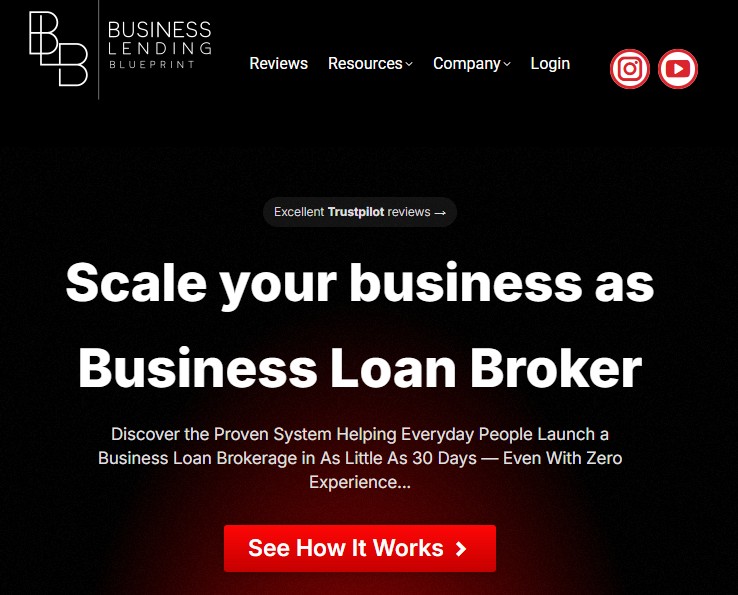
The course launched in February 2018 and includes six video modules, weekly one-on-one coaching calls, access to a network of alternative lenders, and membership in a private Facebook community. Oz claims you can earn $15,000 to $25,000 per month within your first 30-60 days, even with zero experience in finance or lending.
Here's how the business model works: You find businesses that need capital (through marketing, networking, or referrals), qualify them based on their credit score and revenue, submit their applications to lenders in Oz's network, and earn a commission ranging from $1,500 to $25,000+ per funded deal. The catch? You don't control whether loans get approved, you don't set the terms, and you're completely dependent on lender relationships Oz provides access to.
The model is legitimate – business loan brokering is a real industry. But the income claims deserve scrutiny. According to ZipRecruiter data from May 2026, the average business loan broker in the United States earns $54,017 per year, which works out to $4,501 per month. That's a far cry from the $15,000-$25,000 monthly income Oz promises beginners.
I should mention upfront: this business requires skills Oz downplays. You need to understand credit reports, debt-to-income ratios, merchant cash advance factor rates versus traditional interest rates, and state-specific lending regulations. You'll also need strong sales skills because you're essentially cold-calling business owners and convincing them to trust you with their financial future.
If you're looking for something simpler without the regulatory complexity, affiliate marketing offers a lower barrier to entry where you promote existing products instead of brokering financial deals.
How Does Business Lending Blueprint Work?
Business Lending Blueprint works by teaching you a four-step process: find businesses that need funding through marketing or referrals, qualify prospects based on credit score and revenue requirements, submit applications to lenders in Oz's network, then earn commission when deals close and funding is approved.
Let me break down each step so you understand what your day-to-day would actually look like:
Step 1: Find businesses that need funding. This is the hardest part that Oz glosses over. You'll need to generate leads through LinkedIn outreach (the primary method taught), Facebook ads (requires ad budget), networking with accountants and business consultants (takes months to build), or buying leads from lead generation companies (expensive and low-quality). The course teaches these strategies, but executing them consistently is a different story.
Step 2: Qualify prospects. Once you have a business owner interested, you'll collect their business bank statements, personal credit report, tax returns, and revenue documentation. You need to assess whether they qualify for traditional term loans, merchant cash advances, lines of credit, equipment financing, or invoice factoring. This requires understanding credit scores (most lenders want 680+), time in business (many products require 6-12 months minimum), and monthly revenue (typically $10K+ needed).
Step 3: Submit to lenders. You'll use Oz's network of alternative lenders to submit applications. Here's where it gets interesting: based on industry critiques I reviewed, many of these "lenders" are actually other brokers or aggregators, not direct lenders. This means your commission gets split, and you're one more layer removed from the actual funding source.
Step 4: Earn commission. If the deal closes, you get paid. Commissions vary wildly: merchant cash advances might pay $1,500-$3,000, term loans could pay $5,000-$10,000, and large SBA loans might pay $15,000-$25,000. But here's the reality check: most beginners start with small merchant cash advance deals because they're easiest to get approved.
The timeline claim is aggressive. Oz says you can make $15,000-$25,000 within 30-60 days. Industry data suggests it takes most new brokers 3-6 months to close their first deal, and that first deal is usually a small merchant cash advance paying $1,500-$2,000, not $15,000.
One thing Business Lending Blueprint doesn't emphasize enough: you're building a sales-heavy business, not a passive income stream. You're on the phone qualifying leads, chasing down documentation, following up with lenders, and managing client expectations. It's active income that stops the moment you stop working.
If you want to understand how business models compare, check out my guide on affiliate marketing vs ecommerce to see different approaches to making money online.
What Do You Get With Business Lending Blueprint?
You get six video training modules covering mindset through scaling, weekly one-on-one coaching calls with a business coach, access to Oz's network of alternative lenders, pre-written scripts and contracts, a branded website template, and membership in a 2,500+ member Facebook community.
Let me walk through exactly what's included so you know what you're paying $2,197 for:
Module 1: Mindset and Foundation. Oz spends several videos on mindset training, goal-setting, and overcoming limiting beliefs. Here's my take: if you're paying $2,197 for business training, you probably don't need three hours of generic mindset content. You need tactical execution strategies. This module also covers LLC setup basics and business structure, which is helpful but could be condensed.
Module 2: Alternative Lending Products Overview. This module introduces you to merchant cash advances, business lines of credit, term loans, equipment financing, invoice factoring, and startup funding options. The challenge? Based on industry critiques I reviewed, Oz doesn't actually teach you how to process these products yourself. Instead, he brings in other brokers and lenders who explain their products, then tells you to refer clients to them. You're not learning to be a loan broker; you're learning to be a referral source.
Module 3: Client Qualification Process. You learn how to read credit reports, analyze bank statements, and determine which products a business qualifies for. This is valuable information, but according to one industry professional who reviewed the course, Oz doesn't go deep enough into the details. You won't learn how to calculate debt-to-income ratios, understand debt service coverage ratios, or interpret business financial statements in detail.
Module 4: Marketing and Lead Generation. This module covers LinkedIn outreach strategies, Facebook ad basics, and building referral partnerships with accountants and business consultants. The LinkedIn strategy is the core focus: connecting with business owners, starting conversations, and offering free business credit reports as a hook. It works, but it's time-intensive and requires strong copywriting skills.
Module 5: Sales and Closing Strategies. You get scripts for initial calls, objection handling techniques, and follow-up sequences. The scripts are helpful templates, but success depends entirely on your ability to build rapport and handle objections naturally. If you've never done sales calls before, these scripts won't magically make you good at it.
Module 6: Scaling Your Brokerage. This covers hiring virtual assistants, automating follow-ups, and building systems. Honestly, if you're struggling to close your first few deals, scaling content feels premature.
Additional Resources Include: Access to Oz's lender network (merchant cash advance companies, business credit card programs, and equipment financing companies), pre-written email templates and scripts, website branding templates, weekly Q&A calls with Oz, and U.S.-based customer support.
What's NOT Included: A CRM system to manage leads and follow-ups, marketing budget for ads or lead generation, ongoing lead flow (you have to generate your own), phone system for taking calls, and any guarantee of lender approval rates.
The Facebook community is active, but based on my research of similar programs, much of the activity revolves around basic questions about how to use the lenders rather than advanced strategy discussions. It's helpful for beginners but doesn't replace real mentorship.
If you're comparing different ways to build an online business, you might want to check out my best affiliate marketing course roundup to see what other training options exist at different price points.
How Much Does Business Lending Blueprint Cost?
Business Lending Blueprint costs $2,197 as a one-time payment, or you can choose a payment plan of three monthly installments at $845 per month, which totals $2,535 if you go the installment route.
That upfront cost is just the entry fee. Here's what Oz doesn't tell you about the actual cost of running this business:
Lead generation will eat your budget. If you want to run Facebook ads to find business owners who need funding, expect to spend $500-$1,000 per month minimum to test campaigns and get enough data. LinkedIn outreach is free but requires premium LinkedIn Sales Navigator at $99.99 per month if you want to scale beyond basic connection limits. Buying leads from lead generation companies costs $15-$50 per lead, and most leads are garbage that won't convert.
You need a CRM system. Business Lending Blueprint doesn't provide one, but you'll need software to track leads, follow-ups, and deal stages. GoHighLevel or HubSpot will run you $97-$297 per month. You could use free options like a spreadsheet, but good luck managing 50+ prospects that way.
Phone system costs add up. You need a professional phone number with call recording, voicemail, and possibly call tracking. Services like OpenPhone or RingCentral cost $15-$50 per month. Small expense, but it adds up.
LLC formation and business setup. You'll want to set up a proper business entity for liability protection. LLC formation costs $50-$500 depending on your state, plus annual fees. You'll also need business insurance, which runs $300-$1,000 per year for general liability coverage.
Marketing materials and branding. The website template Oz provides is basic. If you want it to look professional, you'll spend $500-$2,000 on design and development. Business cards, email signatures, and other branding materials add another $200-$500.
Potential upsells exist. Based on student reviews I found, Oz offers higher-tier programs like Business Lending Mastermind (for established brokers making $20K+ monthly) and Business Credit Success Blueprint (teaching how to build business credit). These aren't required, but they're presented as the next step when you're not seeing results with the base course.
The 90-day refund policy has conditions. You can request a refund within 90 days, but you have to prove you completed all the modules and implemented the strategies. That's a high bar. Most people who want refunds haven't completed everything because they realized the business model isn't for them after a few weeks.
When you add it all up, expect to invest $3,000-$5,000 in your first 3-6 months to properly run this business. That's on top of the $2,197 course fee. And remember, you're not earning anything until you close your first deal, which could take months.
Compare that to starting affiliate marketing, where your startup costs are a domain ($10), hosting ($5-$20/month), and your time creating content. No CRM needed, no phone system, no lead generation budget required.
Who Is Oz Konar?
Oz (Oguz) Konar is a Turkish immigrant who founded Business Lending Blueprint in 2018 after building Local Marketing Stars, a digital marketing agency that specialized in generating leads for alternative lending companies.

Let me give you the background so you understand where he's coming from:
Oz graduated from Montclair State University in 2009 and started his career as a Territory Manager at Heartland Payment Systems, selling merchant services to small businesses. He bounced between sales jobs for a few years before founding Local Marketing Stars in March 2013. His agency focused on generating leads for merchant cash advance companies and alternative lenders through paid advertising and SEO.
Here's where it gets interesting: Oz wasn't a loan broker himself initially. He was a marketer selling leads to loan brokers and lenders. After seeing how profitable the lending industry was, he decided to teach others how to become brokers while positioning himself as an expert in the space.
His credentials include being featured in Huffington Post and Entrepreneur magazine (though as many entrepreneurs know, you can often pay for these placements through PR services), authoring two books on online marketing for small businesses, and winning two "Two Comma Club" awards from ClickFunnels (meaning he made over $1 million each from two different funnels).
His company is listed on the Inc. 5000, which features the fastest-growing private companies in America. That's legitimate and shows real revenue growth. According to various sources, Oz's net worth is estimated in the millions, though these estimates are often inflated.
On social media, Oz has 35,000 YouTube subscribers, 45,300 Instagram followers, and 3,400 Facebook followers. His YouTube channel features free training videos on business lending, LinkedIn strategies, and alternative financing options. The content is helpful for understanding the industry basics, but it's primarily designed to funnel people into Business Lending Blueprint.
Here's my take: Oz is a skilled marketer first, educator second. He built a successful lead generation business, recognized the demand for business lending training, and created a course to monetize that knowledge. That doesn't make the course bad, but it explains why the marketing and positioning feel more polished than the actual training content.
One thing to note: Oz's background is in merchant cash advances, which is one of the most expensive forms of business financing. Factor rates on MCAs can effectively translate to 40-80% APR when annualized. This creates an ethical tension – you're helping businesses get funding, but you're often putting them in expensive debt that could hurt them long-term.
If you want to learn from someone who teaches multiple income streams instead of just one model, check out my 2026 AI Business Blueprint review, which covers five different AI-powered business models you can start for under $50.
Is Business Lending Blueprint Legit?
Yes, Business Lending Blueprint is legit. It's a real registered business (Massive Action Consulting Co, Inc.) and business loan brokering is a legitimate industry, but the course has mixed reviews and the income claims are overstated for most beginners.
Let me break down the legitimacy question from multiple angles:
The company is real. Business Lending Blueprint is registered under Massive Action Consulting Co, Inc. and is listed on the Inc. 5000, which features verified revenue data from fast-growing companies. That's more than most online course creators can claim.
The business model exists. Business loan brokers are real professionals who make real money. According to the Small Business Administration, alternative lending has grown to over $300 billion annually in the U.S. There's genuine demand for people who can help businesses navigate funding options.
Students do close deals. I found verified testimonials of students who funded deals and earned commissions. JJ van Oss closed a $20,000 startup funding deal within a few months. Luisa funded her first deal shortly after joining. Omar Tinsley claimed $48,000 in his first month (though that's clearly an outlier, not the norm).
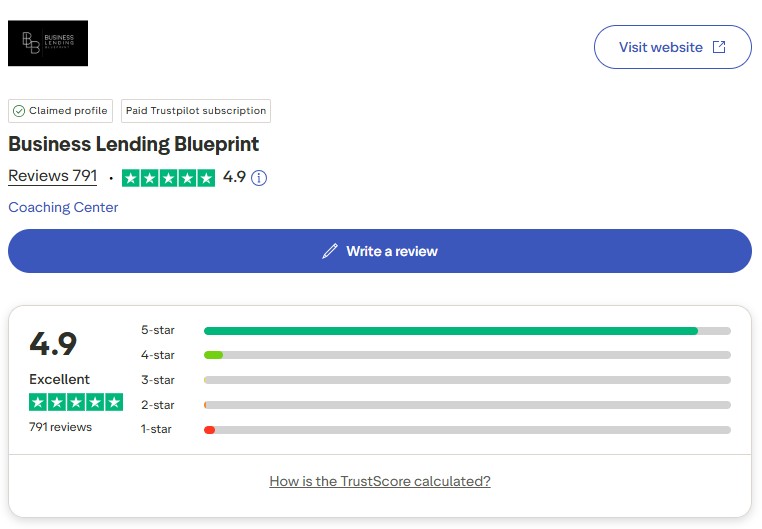
But there are red flags. The Trustpilot rating is 4.9 stars from 778 reviews, which sounds great until you realize many reviews praise customer service staff by name rather than discussing actual earnings results. That pattern suggests incentivized or filtered reviews. Meanwhile, PissedConsumer shows 1.6 stars from 4 reviews with complaints about refund denials, hidden costs, and billing issues.
Industry professionals are skeptical. Brian Mosso from Pentatetic Consulting Group, who has 13+ years in business lending and has funded over $100 million in loans, called Business Lending Blueprint a scam in his detailed video review. His main critiques: Oz teaches you to be a referral partner, not a real broker; the lenders in Oz's network are mostly other brokers, not direct lenders; and the training lacks depth on actually processing applications yourself.
The "no experience needed" claim is misleading. While you don't need a license in most states to be a business loan broker, you absolutely need financial literacy to do this well. Understanding credit reports, reading business bank statements, calculating debt service coverage ratios, and explaining complex loan terms to clients requires knowledge that most beginners don't have.
So is it legit? Yes, in the sense that it's not a pyramid scheme or outright scam. No, in the sense that the marketing promises are much rosier than the reality most students experience.
For comparison, dropshipping is also a legitimate business model, but that doesn't mean everyone who takes a dropshipping course makes money. Same principle applies here.
What Do Students Say About Business Lending Blueprint?
Student reviews are mixed. Trustpilot shows 4.9 stars from 778 reviews, but most positive reviews praise customer service staff rather than income results. Independent review sites show 1.6 stars with complaints about high costs, refund denials, and misleading marketing.
Let me break down what real students are saying across different platforms:
Trustpilot Reviews (4.9/5 stars, 778 reviews): These look great on the surface, but when you actually read them, a pattern emerges. Most reviews mention customer service representatives by name – "Dionna was amazing," "EJ was so helpful," "Simon helped me update my website email." Very few reviews discuss actual earnings or successful deal closures. This suggests Business Lending Blueprint encourages students to leave reviews about their onboarding experience rather than their business results.
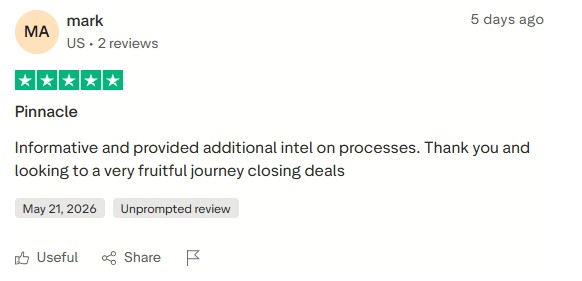
The few results-focused reviews are positive: students mention closing their first deals, earning commissions ranging from $1,200 to $48,000, and appreciating the community support. But these represent the top performers, not the average student experience.
Pissed Consumer (1.6/5 stars, 4 reviews): Here's where you see the frustrated students. One review states: "I basically just threw almost $2k away." Another complains about recurring billing issues and upsells. A third mentions that refund requests were denied despite following the 90-day policy. The complaints center on three themes: the course doesn't deliver on income promises, hidden costs add up quickly, and customer service is unhelpful when you want a refund.
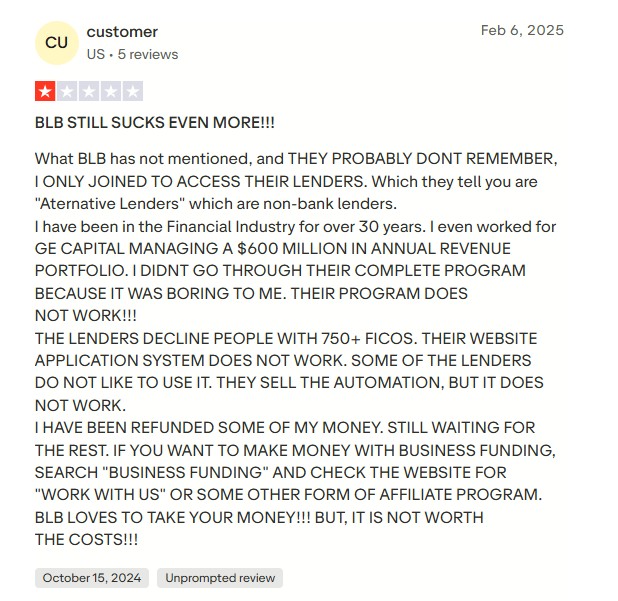
YouTube Reviews: I found eight YouTube reviews ranging from positive to highly critical. The positive ones are mostly from students within the first few months who haven't earned significant money yet but are excited about the training. The negative ones come from either industry professionals who reviewed the content or students who tried the program and gave up.
One particularly harsh critique comes from Brian Mosso (mentioned earlier), who spent $2,197 on the course himself and created an extensive video breakdown. His main complaint: "Oz doesn't teach you to be a real business loan broker. He teaches you to be a glorified referral partner." Brian argues that Oz brings in other brokers to teach about specific products, then tells you to refer clients to those brokers rather than processing applications yourself.
Student Testimonials on Oz's Website: The official Business Lending Blueprint site showcases success stories like a student who closed a $105,000 funding deal and another who made $1,200 on a single deal. These are real, but they're cherry-picked examples. What you don't see are the students who spent months generating leads, never closed a deal, and quietly quit.
Reddit (3 reviews – mostly skeptical): Reddit users are generally critical, calling it "basically a glorified affiliate program for each funding company." One user pointed out that you can access the same lenders Oz provides without paying $2,197 for training – they're publicly available if you know where to look.
Facebook Group Activity: The private Facebook group has 2,500+ members, which sounds impressive until you realize that represents everyone who ever bought the course since 2018. Daily activity is moderate, with most posts being basic questions about how to use specific lenders rather than advanced strategy discussions.
Here's my assessment: The students who succeed with Business Lending Blueprint are those who already have sales experience, financial knowledge, or an existing network of business owners. For complete beginners with no background in finance or sales, the learning curve is steep and the timeline to first commission is much longer than 30-60 days.
Business Lending Blueprint Pros and Cons
Let me give you the straight truth about what works and what doesn't with this course:
The Good Stuff
The business model is real and lucrative for experienced brokers. Business loan brokering is a legitimate profession, and top performers genuinely make six figures. If you have sales experience and financial knowledge, this could work for you. The commissions are substantial when you close deals – $5,000 to $25,000 per funded loan is life-changing money for most people.
The community is active and supportive. The Facebook group has real engagement, and students help each other with lender recommendations, script improvements, and troubleshooting. Having 2,500+ members means you can usually get answers to questions within a few hours.
Weekly coaching calls provide accountability. Unlike many courses that disappear after you buy, Business Lending Blueprint includes weekly one-on-one calls with a business coach. This keeps you accountable and helps you troubleshoot specific challenges. The coaching quality varies by which coach you get, but having structured check-ins is valuable.
Oz provides lender access. You don't have to spend months building relationships with lenders yourself. Oz gives you direct contacts for merchant cash advance companies, business credit card programs, and equipment financing sources. This saves time, though industry professionals argue many of these are broker relationships, not direct lenders.
The training is comprehensive. Six modules covering everything from mindset to scaling is thorough. You're not buying a 2-hour video and getting left to figure out the rest. The course structure makes sense, and the progression from basics to advanced topics is logical.
No monthly fees after the initial purchase. Once you pay $2,197, you have lifetime access. No recurring subscription, no annual renewal fees. In an era where everything is subscription-based, that's refreshing.
Inc. 5000 credibility. Oz's company being listed on the Inc. 5000 is legitimate validation. These aren't self-reported numbers – Inc. verifies revenue data. That proves Business Lending Blueprint generates real revenue.
The Problems
The income claims are wildly optimistic. Oz says you can make $15,000-$25,000 per month within 30-60 days. ZipRecruiter data shows the average business loan broker earns $54,017 annually, which is $4,501 per month. Even top performers (90th percentile) make $90,000 per year, which is $7,500 per month. Oz's claims represent the top 1% of brokers, not the typical beginner experience.
It's expensive with hidden costs. The $2,197 course fee is just the start. Add lead generation ($500-$1,000/month), CRM software ($97-$297/month), phone system ($15-$50/month), LLC formation ($50-$500), business insurance ($300-$1,000/year), and marketing materials ($500-$2,000). You're looking at $3,000-$5,000 investment in the first 3-6 months before earning a dollar.
You're building a sales-heavy business, not passive income. This is active income that requires constant phone calls, lead qualification, document collection, lender follow-ups, and client management. The moment you stop working, income stops. If you're looking for passive income, this isn't it.
The business model depends entirely on lenders. You don't control approval rates, loan terms, commission structures, or funding timelines. If lenders change their requirements or commission payouts, your business suffers. If your best-converting lender stops accepting new brokers, you're scrambling to replace them.
Regulatory complexity is downplayed. Some states require licensing or registration for loan brokers. Federal regulations like the Truth in Lending Act and state-specific usury laws affect what you can and can't do. Oz barely touches on compliance, which could expose you to legal risk.
The refund policy has high barriers. The 90-day money-back guarantee requires you to prove you completed all modules and implemented everything. That's subjective and gives Business Lending Blueprint room to deny refunds. Several reviews mention refund denials.
Industry professionals are critical. Brian Mosso's extensive critique highlighting that Oz teaches referral partnerships rather than actual loan processing is concerning. If an experienced broker with $100M+ in funded deals says the training is insufficient, that's worth considering.
No CRM or lead management system included. For a $2,197 course teaching a business that requires managing dozens of prospects simultaneously, not including a CRM is a major oversight. You'll have to buy and learn separate software.
The "no experience needed" claim is misleading. You need to understand credit reports, financial statements, debt ratios, and lending regulations. You need sales skills to build rapport and handle objections. You need marketing skills to generate leads consistently. Beginners will struggle significantly.
Potential upsells reported. Several reviews mention being encouraged to join higher-tier programs like Business Lending Mastermind or Business Credit Success Blueprint when not seeing results. This suggests the core course might not be enough on its own.
My take? Business Lending Blueprint is a legitimate course teaching a legitimate business model, but it's suited for people with sales experience and financial knowledge, not complete beginners. If you've never done sales calls, don't understand credit reports, and don't have a marketing budget, you'll struggle.
For simpler business models that don't require those skills, check out affiliate marketing without a website or my guide on how to make money with AI.
Business Lending Blueprint vs AI-Powered Service Business
Business Lending Blueprint teaches you to broker loans for commission, requiring sales calls, lender dependencies, and regulatory compliance. An AI-powered service business makes you the expert offering automation, content, or consulting services where you control pricing, delivery, and client relationships with no lender dependencies.
Let me compare these models so you understand the differences:
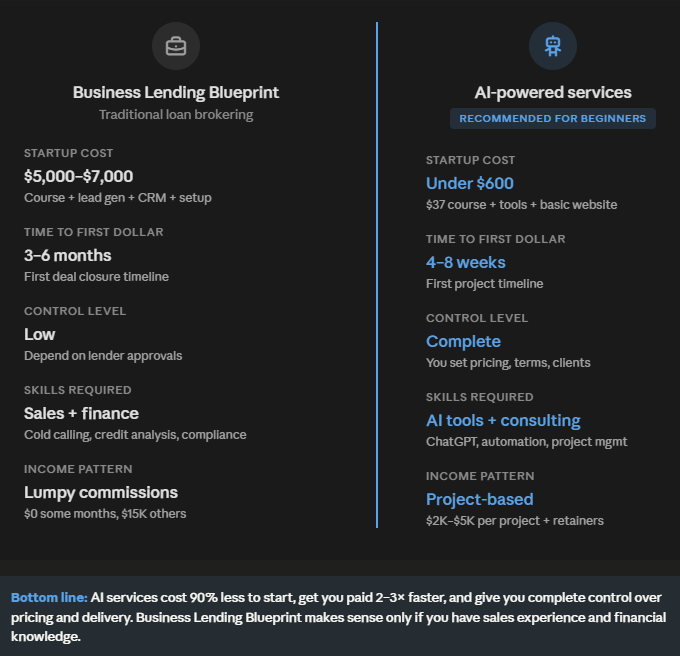
Business Lending Blueprint Model
You find business owners who need funding, qualify them based on credit and revenue, submit applications to lenders in Oz's network, and earn commission when deals close. You're the middleman connecting two parties, earning anywhere from $1,500 to $25,000 per deal. But you don't control whether loans get approved, you can't set terms, and you're dependent on lender relationships.
Your income is lumpy – you might close three deals one month and zero the next. Each deal requires 10-20 hours of work spread over 2-4 weeks: initial qualification call, collecting documentation, submitting to multiple lenders, following up on applications, coordinating closing paperwork, and waiting for commission payout after funding.
You need strong sales skills because business owners are naturally skeptical of loan brokers (many have been burned by predatory lenders). You need financial literacy to understand credit reports and loan products. You need compliance knowledge because lending has strict regulations.
Lead generation is expensive and time-consuming. LinkedIn outreach requires sending 50-100 connection requests daily, starting conversations, and converting cold contacts into interested prospects. Facebook ads for business lending cost $5-$15 per lead, and most leads are tire-kickers. Referral partnerships with accountants take months to build.
AI-Powered Service Business Model
You position yourself as an AI consultant, automation specialist, or content strategist helping businesses implement AI tools. You offer packages like "AI-Powered Customer Service Setup" ($2,000-$5,000), "Content Production Automation" ($1,500-$3,000), or "Sales Process Automation" ($3,000-$7,000). You're the expert delivering a service, not the middleman chasing approvals.
Your income is more predictable because you control pricing and delivery. A $3,000 project takes 10-15 hours of work over 1-2 weeks: discovery call, proposal, implementation, training, and delivery. You decide what services you offer, how much you charge, and which clients you accept.
You need AI tool knowledge (learnable in weeks, not months), basic automation understanding, and consulting skills to diagnose business problems. No regulatory compliance, no credit checks, no lender dependencies.
Lead generation is simpler. You create educational content showing AI implementations, share case studies on LinkedIn, and run targeted ads to business owners who need automation. Your marketing demonstrates expertise rather than chasing skeptical prospects.
Side-by-Side Comparison
Startup Cost: Business Lending Blueprint requires $2,197 course + $3,000-$5,000 in lead gen, CRM, and phone systems. AI service business requires $37-$47 for training, $20/month for AI tools, and $200-$500 for basic website and branding.
Time to First Dollar: Business Lending Blueprint takes 3-6 months for most beginners to close their first deal. AI service business can land first client in 4-8 weeks if you demonstrate expertise through content.
Skills Required: Business Lending Blueprint needs sales, financial literacy, compliance knowledge, and relationship building. AI service business needs AI tool proficiency, consulting skills, and project management.
Control: Business Lending Blueprint gives you zero control over approvals, terms, or commission structure. AI service business gives you complete control over pricing, services offered, and client selection.
Income Pattern: Business Lending Blueprint is lumpy commission-based income (might close $15,000 one month, $0 the next). AI service business is project-based with retainer potential (monthly automation maintenance fees).
Scalability: Business Lending Blueprint scales by hiring junior brokers or building referral networks. AI service business scales by creating automation templates, offering group programs, or productizing services.
Regulatory Risk: Business Lending Blueprint has significant regulatory risk (lending laws, state licensing requirements, compliance rules). AI service business has minimal regulatory risk (standard business consulting rules).
Here's my honest take: Business Lending Blueprint makes sense if you have sales experience, financial knowledge, and a lead generation budget. AI service business makes sense if you want faster results, more control, and lower startup costs.
Module 4 of my 2026 AI Business Blueprint teaches you how to position yourself as an AI expert, package AI services, land clients through content marketing, and deliver automation projects using tools like ChatGPT, Claude, Make.com, and Zapier. It's $37 right now (regular $47) versus $2,197 for Business Lending Blueprint.
Want to explore this further before committing? Grab my free guide: Want to Build a $10K/Month AI Business Without a Team or Paid Ads? It shows you the exact AI service business model, pricing structure, and client acquisition strategy.
Common Business Loan Broker Mistakes to Avoid
The four most common mistakes business loan brokers make are targeting the wrong customers who won't qualify, failing to balance lender and borrower needs, setting unrealistic revenue goals, and stopping growth after initial success.
Let me break down each mistake so you don't waste months going down the wrong path:
Mistake 1: Targeting the Wrong Customers
Most new brokers chase any business owner who says they need money. Bad move. You need to qualify prospects strictly before investing time. The average small business loan application has a 20-25% approval rate, meaning 75-80% of your prospects will get declined if you're not screening properly.
Here's what to screen for: Personal credit score above 680 (most lenders require this minimum), time in business over 6 months (startup funding is much harder to get), monthly revenue above $10,000 (lenders want to see consistent cash flow), debt-to-income ratio below 50% (too much existing debt kills applications), and no recent bankruptcies or tax liens (automatic disqualifiers for most lenders).
The temptation is to take every lead because you're desperate for deals. But spending 10 hours qualifying someone who has a 550 credit score and $3,000 monthly revenue is wasted effort. They won't get approved anywhere, and you've burned time you could've spent finding qualified prospects.
Here's what to do instead: Create a simple qualification checklist based on the requirements above. On your initial call, ask these questions in the first 5 minutes. If prospects don't meet minimum criteria, politely explain they need to improve their credit or revenue before applying, then end the call. Your time is valuable – protect it by only working with qualified leads.
Mistake 2: Failing to Balance Lender and Borrower Needs
You're the middleman between two parties with different goals. Lenders want low-risk deals that make them money. Borrowers want the cheapest rates and best terms. Your job is matching the right product to the right client, not just pushing whatever pays the highest commission.
Here's where ethics come in: Merchant cash advances pay great commissions ($2,000-$4,000 per deal) but charge effective APRs of 40-80% when annualized. They're expensive money that can trap businesses in debt cycles. If a client qualifies for an SBA loan at 8% APR but you push them into an MCA because it pays better, you're prioritizing your commission over their wellbeing.
I've seen this pattern in Business Lending Blueprint's focus: the course emphasizes merchant cash advances because they're easier to get approved and pay faster commissions. But they're not always the best solution for the client.
Here's what to do instead: Learn all lending products thoroughly – term loans, SBA loans, lines of credit, equipment financing, invoice factoring, and merchant cash advances. When qualifying clients, start with the lowest-cost options they might qualify for and work your way up to higher-cost alternatives only if needed. Build a reputation for genuinely helping businesses rather than just chasing commissions. This creates referrals and repeat clients.
Mistake 3: Setting Unrealistic Revenue Goals
Oz Konar claims you can make $15,000-$25,000 monthly within 30-60 days. That's the top 1% of brokers, not the normal path. Most new brokers close their first deal in 3-6 months, and that first deal pays $1,500-$2,000, not $15,000.
When you set unrealistic goals, you get discouraged quickly. You expected to be making $20,000 by month two, but by month three you haven't closed a single deal and you're questioning everything. That's when most people quit.
The other trap is only chasing big deals. You hear about someone closing a $500,000 SBA loan that paid a $25,000 commission, and you think "I'm only going after those deals." Problem is, big deals take longer to close (SBA loans can take 60-90 days from application to funding), require more experienced clients (established businesses with strong financials), and are more competitive (every broker wants those deals).
Here's what to do instead: Set tiered goals. Your first 90 days, aim to close one small deal ($1,500-$3,000 commission). This proves the model works and gives you confidence. Months 4-6, aim for 2-3 deals totaling $5,000-$8,000. Months 7-12, aim for 5-8 deals totaling $15,000-$25,000. Build up gradually rather than expecting home runs immediately. Mix small quick deals (merchant cash advances) with larger slower deals (term loans and SBA loans) so you have consistent cash flow while bigger commissions are in process.
Mistake 4: Stopping Growth After Initial Success
Many brokers hit their first income goal ($5,000/month or $10,000/month) and coast. They stop prospecting, stop building referral relationships, and stop learning new products. Then the deals dry up and they're scrambling.
The loan brokerage business has a long sales cycle. The prospects you contact today might close deals 2-4 months from now. If you stop prospecting when you close a few deals, your pipeline runs dry in 60-90 days. You go from steady income to feast-or-famine cycles.
Another growth limiter is product knowledge. If you only know how to broker merchant cash advances, you're limiting yourself to one product for one type of client. Learning SBA loans, equipment financing, and invoice factoring expands the clients you can serve and the commission opportunities available.
Here's what to do instead: Commit to generating 10-20 new qualified leads every single week, regardless of how many deals you have in process. Build referral partnerships with accountants, business consultants, and commercial real estate agents who naturally interact with business owners who need funding. These relationships compound over time. Set aside 2-3 hours weekly to learn new lending products, watch webinars from lenders, and improve your skills. Join mastermind groups or coaching programs focused on business lending to stay sharp and learn from experienced brokers.
If you want to avoid these mistakes entirely by choosing a simpler business model, check out my guide on why affiliate marketers fail to see common pitfalls in other online businesses, or explore done-for-you affiliate marketing options.
Is It Profitable to Be a Business Loan Broker?
Yes, business loan brokering is profitable with average annual income of $54,017 and top earners making $90,000-$141,000, but Oz Konar's claim of $15,000-$25,000 monthly ($180,000-$300,000 annually) represents the top 1% of brokers, not typical beginner results.
Let me give you the real numbers so you have accurate expectations:
According to ZipRecruiter data from May 2026, the average business loan broker in the United States earns $54,017 per year, which breaks down to $4,501 per month or $25.97 per hour. That's solid middle-class income, but it's nowhere near the $15,000-$25,000 monthly that Business Lending Blueprint markets.
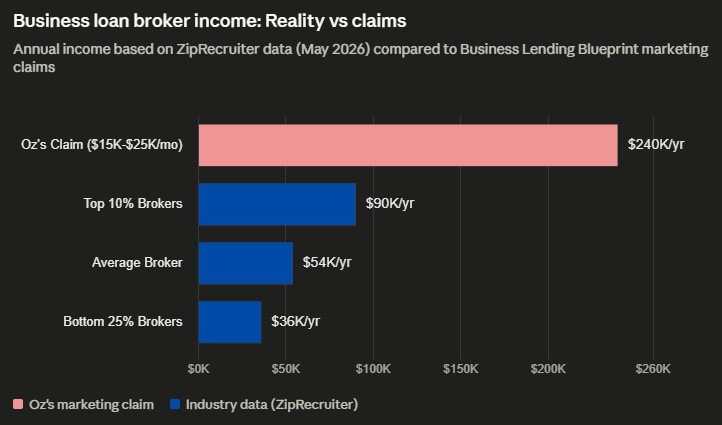
The income range is wide: bottom 25% of brokers earn $36,000 annually ($3,000/month), middle 50% earn $36,000-$62,500 annually ($3,000-$5,208/month), and top 10% earn $90,000+ annually ($7,500+/month). The absolute top performers can hit $141,000 annually, but that's rare.
Here's what determines your income as a broker: Deal volume matters most. If you close one deal per month averaging $3,000 commission, you're at $36,000 annually. Close two deals per month, you're at $72,000. Close four deals per month, you're at $144,000. The math is simple, but closing deals consistently is hard.
Deal size affects income dramatically. Small merchant cash advance deals pay $1,500-$3,000. Medium term loans pay $5,000-$10,000. Large SBA loans pay $15,000-$25,000. If you only close small deals, you need higher volume to hit income goals.
Sales cycle length impacts cash flow. Merchant cash advances close in 7-14 days from application to funding. Term loans take 30-45 days. SBA loans take 60-90 days. If you only pursue big SBA deals, you might go 3-4 months between commission checks.
Your marketing budget directly correlates to lead flow. Spending $500/month on Facebook ads generates roughly 33-100 leads (at $5-$15 per lead). If you convert 2-5% of leads to deals, that's 1-5 deals per month. Spending $1,000/month doubles your lead volume and deal potential.
Economic conditions matter. During recessions, banks tighten lending standards, which pushes more businesses toward alternative lending (good for brokers). But businesses also delay expansion plans and seek smaller funding amounts (lower commissions per deal). During economic booms, more businesses seek funding, but bank approval rates are higher (fewer businesses need alternative lenders).
The time investment is significant. Most brokers work 40-50 hours weekly: 20 hours on lead generation and prospecting, 10 hours on client qualification and application processing, 10 hours on lender follow-ups and deal coordination, and 5-10 hours on admin, education, and business management. This isn't passive income or part-time work – it's a full-time business.
Here's my take on profitability: If you have sales experience, financial knowledge, and at least 6-12 months of runway to build the business, you can realistically hit $50,000-$70,000 in your first year. That's good income. But expecting $180,000-$300,000 as Oz claims is unrealistic for beginners.
Compare this to other online business models: Dropshipping has similar income potential but requires product inventory risk. Affiliate marketing has lower income per transaction but more passive potential. YouTube automation can generate $3,000-$10,000 monthly but takes 6-12 months to build an audience.
Or consider AI-powered services where you can charge $2,000-$5,000 per project with 1-2 week delivery times and no lender dependencies. Module 4 of my 2026 AI Business Blueprint shows you exactly how to position, price, and deliver AI automation services to businesses.
Why I Recommend AI-Powered Services Over Business Lending Blueprint
I recommend building an AI-powered service business over loan brokering because you own the client relationship, control pricing and delivery, avoid regulatory compliance, start with lower costs ($37 vs $2,197), and earn similar income without depending on lender approvals.
Let me explain why this matters:
You're the expert, not the middleman. In loan brokering, you're connecting businesses to lenders. You don't control whether loans get approved, you can't modify terms, and you're at the mercy of lender policies. In AI services, you're the expert solving business problems with automation, content production, or process optimization. You control the service, set your prices, and decide which clients you work with.
The startup costs are dramatically lower. Business Lending Blueprint requires $2,197 for training plus $3,000-$5,000 for lead generation, CRM, phone systems, and business setup. That's $5,000-$7,000 before earning a dollar. AI services require $37 for training (my course, currently on sale from $47), $20/month for AI tool subscriptions (ChatGPT Plus, Claude Pro, or Make.com), and $200-$500 for a basic website. You're in business for under $600.
Your skills transfer across industries. Learn AI automation once, and you can serve restaurants (automated review responses, menu updates), real estate agents (lead nurturing sequences, content creation), e-commerce stores (product descriptions, email campaigns), or consulting firms (proposal automation, research summaries). In loan brokering, your skills only apply to financial services.
The sales cycle is faster. AI service projects typically close in 1-2 weeks from initial contact to signed agreement, with project delivery in 1-2 weeks after that. You can go from first conversation to paid invoice in 3-4 weeks. Loan brokering takes 2-4 weeks just to qualify a prospect, another 2-4 weeks for lender approval, then 1-2 weeks for funding and commission payout. You're looking at 5-10 weeks minimum per deal.
You avoid regulatory complexity. No lending laws, no state licensing requirements, no compliance training needed. AI consulting operates under standard business consulting regulations – get a business license, pay taxes, carry general liability insurance. That's it.
Your income is more predictable. Project-based work with clear deliverables means you know exactly what you're earning and when. Invoice upon project completion, get paid within 7-14 days via PayPal or Stripe. In loan brokering, you're waiting for lenders to approve deals, borrowers to accept terms, funding to complete, and commissions to process. Cash flow is lumpy and unpredictable.
The market demand is exploding. Every business owner is being told they need to "implement AI" but most have no idea where to start. They're overwhelmed by tool options, confused about use cases, and worried about implementation. You position yourself as the guide who simplifies AI adoption. The total addressable market is every business owner who uses email, content, customer service, or repetitive processes – which is essentially every business.
Here's a real-world example: A local restaurant owner needs help responding to Google reviews (takes 2 hours weekly, they're falling behind). You set up an AI automation using ChatGPT API and Zapier that monitors new reviews, generates personalized responses in the owner's voice, and sends them for approval. Charge $1,500 for setup, $200/month for maintenance. Total project time: 8 hours. Recurring income: $200/month with minimal ongoing work.
That same restaurant owner might need a business loan, but you'd spend 10+ hours qualifying them, collecting documentation, submitting to lenders, and waiting for approval – with no guarantee of commission. Even if you close the deal at $2,000 commission, you earned less per hour than the AI project.
You can start immediately with existing skills. If you understand basic business operations and can learn AI tools (which takes days, not months), you're ready to offer services. Start with simple automation projects, build case studies, then expand to more complex implementations. In loan brokering, you need financial literacy, credit report interpretation, compliance knowledge, and sales expertise before closing your first deal.
Module 4 of my 2026 AI Business Blueprint walks you through positioning yourself as an AI expert (even as a beginner), packaging AI services into $1,500-$5,000 projects, creating case studies that attract clients, and delivering automation projects using ChatGPT, Claude, Make.com, and Zapier. It's $37 right now (limited time, regular $47) compared to $2,197 for Business Lending Blueprint.
And if you're still exploring, grab my free guide first: Want to Build a $10K/Month AI Business Without a Team or Paid Ads? It shows the exact service packaging, pricing strategy, and client acquisition method.
Frequently Asked Questions
Does Business Lending Blueprint Have a Refund Policy?
Yes, Business Lending Blueprint offers a 90-day money-back guarantee, but you must prove you completed all modules and implemented the strategies taught, which creates a high barrier for getting refunds approved.
The refund policy sounds generous on the surface – 90 days is longer than most courses offer. But the requirement to prove you completed everything and implemented all strategies gives Business Lending Blueprint subjective criteria to deny refunds. Based on reviews I found, several students reported refund requests being denied because they couldn't prove they "fully implemented" the training.
Here's the practical reality: by the time you complete all six modules, implement the LinkedIn outreach strategy, run Facebook ads, build referral relationships, qualify prospects, and submit applications to lenders, you're 60-90 days in. If it's not working, you're right at the refund deadline with little time to request and fight for a refund.
My advice? If you buy the course and realize within the first 30 days it's not for you, request the refund immediately. Don't wait until day 85 hoping things will turn around.
Do You Need a License to Be a Business Loan Broker?
No license is required in most states to be a business loan broker, but some states like California, Florida, and New York have specific regulations requiring registration or bonding, and you should verify your state's requirements before starting.
This is one area where Oz's "no license needed" claim is technically true but misleading. While most states don't require a specific loan broker license, some states have regulations that apply:
California requires commercial loan brokers to be licensed if they broker loans under $2.5 million. Florida requires registration if you're brokering more than $25,000 in commercial loans. New York has strict lending laws that could require registration depending on loan types. Nevada requires a license for commercial loan brokers in many situations.
Even in states without specific requirements, you need a business license (costs $50-$500 depending on location), and you should carry general liability insurance (costs $300-$1,000 annually) to protect yourself from potential lawsuits.
The bigger regulatory concern is federal compliance. The Truth in Lending Act (TILA) requires disclosure of loan terms. The Gramm-Leach-Bliley Act requires protecting customer financial information. Anti-money laundering (AML) regulations require reporting suspicious activities. Violating these could result in fines or legal action.
My recommendation? Before starting, consult with a business attorney in your state who specializes in financial services to understand your obligations. Spending $500-$1,000 on legal consultation upfront could save you tens of thousands in fines or legal fees later.
How Long Does It Take to Make Money With Business Lending Blueprint?
Most beginners take 3-6 months to close their first deal and earn their first commission, not the 30-60 days Oz Konar claims, and that first deal typically pays $1,500-$2,000, not $15,000-$25,000.
Here's the realistic timeline based on industry data and student reviews I analyzed:
Month 1: Complete training modules, set up business entity, create LinkedIn profile, start connecting with prospects. No income yet.
Month 2: Send 500-1,000 LinkedIn connection requests, run initial Facebook ad campaigns, start qualification calls with interested prospects. Collect documentation from 5-10 prospects. No income yet, spending money on ads and tools.
Month 3: Submit applications to lenders for qualified prospects. Get rejections on 60-80% of applications. Get conditional approvals on 1-3 deals pending additional documentation. Still no income, but deals are in process.
Month 4: Close first deal (typically a merchant cash advance because they're fastest to approve). Earn first commission of $1,500-$2,000. Finally profitable, but you're still negative overall after course costs and business expenses.
Months 5-6: Close 1-2 more deals per month as your pipeline builds. Earning $3,000-$5,000 monthly. Breaking even on total investment around month 6.
Months 7-12: Hit consistent rhythm of 2-3 deals monthly if you've built good lead generation and referral systems. Earning $5,000-$10,000 monthly.
The students who beat this timeline are those with existing networks (they know business owners personally), sales experience (they can close deals faster), or financial backgrounds (they understand credit and lending already).
Compare this to affiliate marketing timelines, where you might start earning small commissions ($100-$500/month) in 2-3 months from content you create, or AI service businesses where you could land your first $2,000 project in 4-8 weeks by demonstrating expertise through content.
What's the Difference Between Merchant Cash Advance and Traditional Loans?
Merchant cash advances are faster to get approved (7-14 days) but significantly more expensive with effective APRs of 40-80%, while traditional term loans take longer to approve (30-90 days) but offer much lower rates of 6-12% APR.
Let me break down the key differences:
Approval criteria: MCAs only require 6 months in business, $10,000+ monthly revenue, and credit scores as low as 500-550. Traditional term loans require 2+ years in business, $50,000+ annual revenue, and credit scores of 680-700+.
Funding speed: MCAs fund in 7-14 days from application to cash in account. Term loans take 30-45 days for bank loans, 60-90 days for SBA loans.
Cost structure: MCAs use factor rates (1.1 to 1.5) instead of APR. A $50,000 MCA with a 1.3 factor rate means you repay $65,000. That $15,000 fee equals 30% of the advance amount. When annualized based on the repayment period (usually 6-12 months), the effective APR is 40-80%. Traditional term loans charge 6-12% APR, much lower total cost.
Repayment structure: MCAs take a percentage of daily credit card sales or make daily/weekly ACH withdrawals from your bank account until the full amount is repaid. Term loans have fixed monthly payments over 1-5 years, making budgeting easier.
Use cases: MCAs make sense for emergency situations (equipment breaks, need inventory for busy season, bridge short-term cash flow gaps) where the business can repay within 6-12 months from increased revenue. Traditional loans make sense for long-term investments (expand location, buy real estate, purchase major equipment) where lower rates matter over multi-year repayment.
As a business loan broker, you'll push MCAs more often because they're easier to get approved (more deals close = more commissions) and they pay faster commissions. But they're not always the best solution for the client. This creates an ethical tension you need to navigate.
Is Business Lending Blueprint Worth It?
Business Lending Blueprint is worth it only if you have sales experience, financial literacy, a $5,000-$7,000 budget (course + operating costs), and 6-12 months to build the business, otherwise simpler business models offer better ROI for beginners.
Here's how to think about it:
You should buy Business Lending Blueprint if: You have 2+ years of sales experience (phone sales, B2B sales, or consultative selling), you understand financial statements and credit reports, you have $5,000-$7,000 to invest without needing income for 6 months, you're comfortable with 10-20 cold calls daily, and you want to build a high-commission business where individual deals pay $5,000-$25,000.
You should skip Business Lending Blueprint if: You've never done sales calls, you don't understand how credit scores work, you need to start earning income within 60-90 days, you don't have a marketing budget for lead generation, you want passive or semi-passive income, or you're looking for something you can do part-time while keeping your job.
The course itself is comprehensive, Oz provides real lender access, and the business model is legitimate. But the income timeline and skill requirements are much more demanding than the marketing suggests.
Better alternatives for most people: If you want to promote financial products without the complexity, look into high-ticket affiliate marketing where you earn commissions promoting courses, software, or coaching programs. If you want to help businesses but avoid lending regulations, consider consulting or coaching models where you're paid for expertise.
Or explore AI-powered services where you help businesses automate processes, create content, or optimize operations. My 2026 AI Business Blueprint shows you five different AI business models including AI consulting, content production, and automation services. It's $37 right now (limited time) compared to $2,197 for Business Lending Blueprint, and you can start earning within 4-8 weeks instead of 3-6 months.
What Are Oz Konar's Other Programs?
Oz Konar offers Business Credit Success Blueprint ($297-$997) teaching business credit building and Business Lending Mastermind (high-ticket program for brokers making $20,000+ monthly who want to scale to seven figures).
Business Credit Success Blueprint is pitched as a companion to Business Lending Blueprint. It teaches business owners and brokers how to build business credit scores to access more funding. The course covers setting up business credit profiles with Dun & Bradstreet, Experian Business, and Equifax Business, getting trade lines with vendors that report to credit bureaus, and building credit scores to access higher funding limits. Pricing varies from $297 to $997 depending on promotions.
Business Lending Mastermind is Oz's premium program for established brokers. To qualify, you need to be making at least $20,000 monthly already. The program focuses on scaling from solo broker to brokerage shop with multiple team members, diversifying into different lending verticals, building broker-to-broker relationships, and accessing exclusive lending partners. Pricing isn't publicly disclosed, but based on similar programs, expect $5,000-$15,000.
Commercial Loan Broker Training is a free 70-minute training webinar that serves as the entry point to Business Lending Blueprint. It covers basic concepts of loan brokering and is essentially a sales pitch for the main course.
Based on student reviews, there's a clear upsell path: Free webinar → Business Lending Blueprint ($2,197) → Business Credit Success Blueprint ($297-$997) → Business Lending Mastermind ($5,000-$15,000+). This is a standard course creator funnel, but it's worth knowing upfront so you're not surprised when higher-tier programs are pitched after you buy the base course.
Can You Make $15,000 Per Month as a Loan Broker?
Yes, experienced business loan brokers can make $15,000 per month, but this represents top performers with 2+ years experience, strong referral networks, and consistent deal flow, not typical beginner results within 30-60 days as Oz claims.
Let's do the math on what it takes to earn $15,000 monthly:
Option 1: Close 5-7 merchant cash advance deals per month at $2,000-$3,000 commission each. This requires qualifying 30-50 prospects monthly (assuming 10-15% close rate), which means generating 200-300 leads monthly (assuming 10-20% qualification rate).
Option 2: Close 2-3 medium-sized term loans per month at $5,000-$7,500 commission each. This requires qualifying 15-25 prospects monthly with stronger credit profiles and longer sales cycles.
Option 3: Close 1 large SBA loan per month at $15,000-$25,000 commission. This requires working with established businesses ($500K+ annual revenue), navigating complex SBA requirements, and managing 60-90 day closing timelines.
Most brokers who consistently earn $15,000+ monthly use a mix: they chase big SBA deals for large commissions while closing small MCA deals for consistent cash flow.
What it takes to hit this level: You need 50+ qualified leads in your pipeline at all times, 3-5 strong referral partnerships sending you pre-qualified prospects monthly, deep expertise in 4-6 different loan products, relationships with 10+ lenders across different product types, and 2+ years of experience understanding which prospects will actually close.
The beginners hitting high numbers quickly (like the testimonial claiming $48,000 in the first month) either had existing business networks, prior sales experience, or got lucky with one large deal that isn't repeatable.
For most beginners, a realistic first-year goal is $30,000-$50,000 total, which averages $2,500-$4,200 monthly. That's still good income for a home-based business, but it's not the $15,000-$25,000 monthly that Business Lending Blueprint markets.
What's Included in the Business Lending Blueprint Facebook Group?
The Business Lending Blueprint Facebook group has 2,500+ members and includes peer support, lender recommendations, deal troubleshooting, and strategy discussions, but activity varies and many posts are basic questions rather than advanced insights.
Based on my research of the group (it's semi-public so you can see some activity without being a member), here's what you'll find:
Common post types: Students asking which lender to use for specific scenarios, troubleshooting declined applications, seeking advice on how to handle difficult prospects, sharing small wins (first deal closed, first commission received), and requesting help interpreting credit reports or bank statements.
The good: The community is genuinely supportive. Members congratulate each other on wins, offer encouragement when deals fall through, and share lender experiences (which ones are fast, which ones are difficult, which ones have good approval rates). Having access to 2,500+ members means someone has probably faced your specific challenge before.
The not-so-good: Much of the discussion is basic, suggesting many members are stuck in beginner stages for extended periods. You'll see the same questions repeated weekly: "How do I find prospects on LinkedIn?" "What credit score is needed for X lender?" "Why did my application get declined?" This suggests either high turnover (people join, struggle, quit) or insufficient training depth in the core course.
The missing element: Not much discussion of advanced strategies like building seven-figure brokerages, hiring and training junior brokers, or negotiating better commission splits with lenders. That content likely exists in the higher-tier Mastermind program, meaning the Facebook group is primarily for beginners.
If you join Business Lending Blueprint, the Facebook group is a nice support system, but don't expect it to replace real mentorship or advanced training. It's a supplement, not the core value.
Are There Hidden Costs With Business Lending Blueprint?
Yes, Business Lending Blueprint has significant hidden costs including lead generation ($500-$1,000/month), CRM software ($97-$297/month), phone system ($15-$50/month), business formation ($50-$500), insurance ($300-$1,000/year), and potential upsells to higher-tier programs.
Let me itemize the real cost of running this business:
Mandatory costs: Business formation (LLC or Corporation) costs $50-$500 depending on your state, plus $50-$300 annual renewal fees. General liability insurance costs $300-$1,000 annually to protect against potential lawsuits. Business bank account costs $10-$30 monthly in fees. Professional phone number with call recording costs $15-$50 monthly through services like OpenPhone or RingCentral.
Highly recommended costs: CRM system costs $97-$297 monthly for tools like GoHighLevel, HubSpot, or Salesforce to manage leads and follow-ups. Website costs $200-$2,000 for professional design beyond the basic template Oz provides. Marketing materials (business cards, email signatures, branded documents) cost $200-$500 upfront.
Lead generation costs: LinkedIn Sales Navigator costs $99.99 monthly for advanced search and outreach features. Facebook ads cost $500-$1,000 monthly minimum for testing campaigns and generating leads. Purchased leads cost $15-$50 per lead if you buy from lead generation companies. These aren't technically required, but without spending money on lead generation, you're limited to unpaid LinkedIn outreach, which is slow.
Potential upsells: Business Credit Success Blueprint costs $297-$997 as an add-on course. Business Lending Mastermind costs $5,000-$15,000+ for established brokers. These are pitched as necessary next steps when you're not seeing results with the base course.
Total realistic investment: $2,197 course + $1,000 business setup + $2,000-$5,000 for 3-6 months of operating costs = $5,200-$8,200 before earning your first commission. That's significantly more than the $2,197 course fee Oz advertises.
Compare this to starting a blog ($200-$500 total to start), affiliate marketing ($0-$300 to start), or my AI business model ($37 course + $20/month tools + $200-$500 for basic website = under $600 total).
Who Is Business Lending Blueprint Best For?
Business Lending Blueprint is best for people with 2+ years of B2B sales experience, financial literacy, a $5,000-$7,000 startup budget, and 6-12 months of runway who want to build a high-commission consulting business helping companies access capital.
Here's who succeeds with this program:
Sales professionals transitioning to entrepreneurship. If you spent years in B2B sales (software sales, insurance sales, merchant services) and you're comfortable making 20-30 calls daily, handling objections, and closing consultative deals, you have the foundation. You're not scared of phone calls, you understand sales cycles, and you can handle rejection.
Financial services professionals looking for side income. Accountants, bookkeepers, financial advisors, and insurance agents already have relationships with business owners and understand financial statements. Adding loan brokering to your services is a natural extension. Your existing clients need funding, and you can earn $5,000-$15,000 annually per client just by referring them to lenders.
Mortgage brokers or former loan officers. You already understand lending, credit reports, and loan documentation. The transition to business lending is learning new products (merchant cash advances, equipment financing, invoice factoring) rather than learning the entire industry from scratch.
Entrepreneurs with established business networks. If you're active in local business groups, chambers of commerce, or industry associations, you have warm leads already. You're not starting from zero – you can reach out to 50-100 business owners you know personally and offer to help with funding.
People with patience and capital. If you have 6-12 months of living expenses saved and you're willing to invest 40-50 hours weekly building this business without immediate income, you can push through the difficult early stages when most people quit.
Who should avoid this: People with no sales experience, those who need income within 60-90 days, anyone uncomfortable making cold calls, people without financial literacy, and those looking for passive income. Also avoid if you don't have $5,000-$7,000 to invest upfront.
For those people, explore affiliate marketing, dropshipping, blogging, or AI-powered services which have lower barriers to entry.
Final Thoughts: Should You Buy Business Lending Blueprint?
I hope this Business Lending Blueprint review helped you understand what you're actually buying.
In summary: Business Lending Blueprint is a legitimate course teaching a real business model, but it's not for complete beginners despite what the marketing claims. The $2,197 course fee is just the start – expect $3,000-$5,000 in additional costs for lead generation, CRM, phone systems, and business setup. The income timeline of 30-60 days to $15,000-$25,000 monthly is unrealistic; most beginners take 3-6 months to close their first deal earning $1,500-$2,000.
The business model is sales-heavy. You're making 20-30 calls daily, qualifying prospects, collecting financial documentation, submitting applications to lenders, and following up on deals. This is active income requiring constant effort, not passive income that generates while you sleep.
You're the middleman, not the expert. You don't control whether loans get approved, you can't modify terms, and you're completely dependent on lender relationships. If lenders change commission structures or stop accepting new brokers, your income is directly affected.
Regulatory complexity is real. Some states require licensing or registration. Federal laws like Truth in Lending Act and Gramm-Leach-Bliley Act create compliance obligations. Oz barely mentions this, which could expose you to legal risk if you're not careful.
There are simpler alternatives. If you want to help businesses but avoid the complexity of loan brokering, consider affiliate marketing where you promote existing products, consulting or coaching where you're paid for expertise, or AI-powered services where you help businesses automate processes.
My recommendation? If you have sales experience, financial knowledge, and $5,000-$7,000 to invest, Business Lending Blueprint could work for you. But for most people reading this, there are faster, simpler, and cheaper ways to build an online business.
Module 4 of my 2026 AI Business Blueprint teaches you how to position yourself as an AI expert, package AI services into $2,000-$5,000 projects, land clients through content marketing, and deliver automation projects using ChatGPT, Claude, Make.com, and Zapier. It's $37 right now (limited time, regular $47) versus $2,197 for Business Lending Blueprint. You can start landing clients within 4-8 weeks instead of 3-6 months, you own the client relationship instead of depending on lenders, and you avoid all regulatory complexity.
Not ready to commit? Grab my free guide first: Want to Build a $10K/Month AI Business Without a Team or Paid Ads? It shows the exact service packaging, pricing strategy, and client acquisition method.
Take action now and build a business you actually control.

- Digital Entrepreneurs Are Discovering That Physical Operational Infrastructure Accelerates Digital Scale - October 18, 2026
- Fast-growing E-commerce Sellers Are Overhauling Fulfillment Hubs To Keep Up With Orders - October 16, 2026
- Ad Network Marketing Myths That Can Lead to Poor Campaign Decisions - October 13, 2026