If you've been looking into Adam Enfroy's courses, you've probably noticed the name has changed. Blog Growth Engine is now AI Income Blueprint — same instructor, same core strategy, updated for where blogging and AI actually are in 2026.
I've spent time going through what the course teaches, what real students are saying, and where it falls short. This review covers all of it, including the things most reviews skip over.
My AI Income Blueprint Rating: 4.0/5
| 🏆 About | Build a $10K/month blog using AI-powered content systems |
| 💲 Price | $747 (Skool) |
| 👍 Pros | Solid methodology, active community, live weekly coaching, Blog Automation Factory included |
| 👎 Cons | Results take 6–12 months minimum, Reddit criticism that core content is available free on YouTube, Adam's own site traffic has declined |
| 🤔 My Take | A legitimate course with a real framework — go in with realistic expectations and it delivers |
What Is AI Income Blueprint?
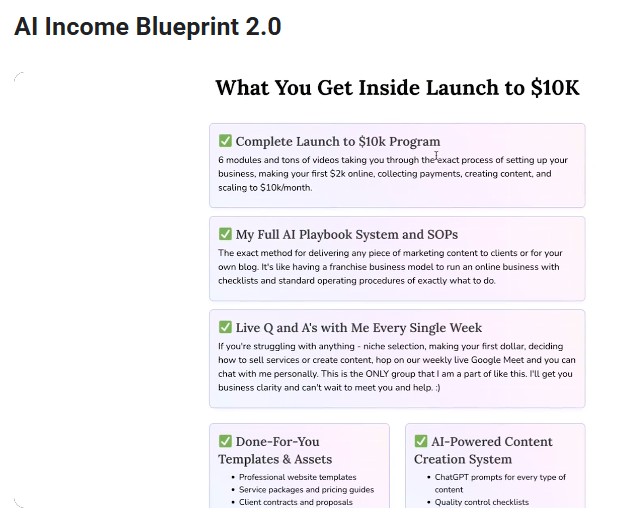
AI Income Blueprint is Adam Enfroy's current flagship course on building a profitable blog and affiliate marketing business using AI-powered content workflows. It's hosted on Skool, costs $747, and includes 8 phases, 37 video lessons, 15 AI frameworks, live weekly coaching calls with Adam, and access to a private community of 4,700+ members.
The core promise is that you can build a $10,000/month online business by combining affiliate marketing with AI tools that handle the mechanical parts of content production — keyword research, content briefs, drafts, formatting, and content updates — while you focus on strategy and monetization.
It's a more evolved version of what Adam has been teaching since 2021, updated to reflect how AI has changed what's actually possible in content production.
Who Is Adam Enfroy?

Adam Enfroy launched AdamEnfroy.com in January 2019 with no audience and no content. Before that, he'd worked in digital marketing — eventually reaching Director of Digital Marketing at BigCommerce, where he managed a $10M+ advertising budget and oversaw a large affiliate program.
He applied what he learned in the startup world to his blog. He treated it like a business from day one — publishing at scale, building backlinks through outreach, and focusing on high-commission affiliate programs rather than Amazon Associates. Within two years he was making over $200,000 a month. Forbes, Business Insider, and Entrepreneur all covered his story.
His YouTube channel now has 241,000+ subscribers and focuses almost entirely on AI-powered blogging and affiliate marketing strategies. He's generated eight figures from blogging and affiliate marketing, and his results are publicly documented.
Is AI Income Blueprint the Same as Blog Growth Engine?
Sort of. AI Income Blueprint is the official rebrand of Blog Growth Engine. The Skool community page describes it plainly as "AI Income Blueprint™ (formerly Blog Growth Engine)."
The core strategy is the same — build a personal brand blog, target buyer-intent keywords, earn through affiliate marketing and digital products. What's changed is the execution layer. Instead of doing everything manually, the course now teaches you to build AI workflows that handle the repetitive work. The legacy BGE 4.5 course is included as a bonus inside AIIB.
If you want the full history of what Blog Growth Engine was before the rebrand, I covered that in my Blog Growth Engine review.
Is It Also Called Launch to 10K?
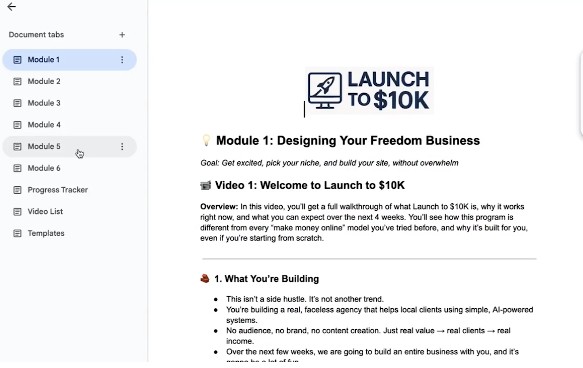
Yes, and it's worth being straight about this. AI Income Blueprint shares the same price, structure, and core promise as another course Adam sells called Launch to 10K. Same $747 price, same refund policy, same $10K/month claim.
The difference appears to be in how each is marketed — AIIB is positioned around AI and blogging while Launch to 10K is positioned more broadly around making money online. But functionally they teach the same model.
I don't think this is necessarily a dealbreaker. A lot of course creators package the same content under different names for different audiences. But it's something you should know going in, and I'd rather flag it than pretend it isn't the case.
Who Is AI Income Blueprint For?
AI Income Blueprint works best for two types of people.
The first is someone who wants to build a real blog-based affiliate marketing business and is willing to treat it like a business — consistent work over months, not a side project you check once a week. If you have that mindset, the course gives you a solid framework and a real community to work alongside.
The second is someone who is already doing affiliate marketing or content marketing and wants to understand how to incorporate AI workflows properly. The automation and agentic workflow sections are genuinely useful for anyone running a content operation, not just beginners. If you're producing content manually and want to 3x your output without 3x-ing your time, the methodology here is practical.
Who Is It Not For?
If you're expecting quick results, this isn't the right course. Building a blog with enough traffic to generate meaningful affiliate income takes 6–12 months minimum, often longer in competitive niches. AI tools speed up content production — they don't speed up how long it takes Google to trust a new site.
It's also not ideal if you want a completely passive business. Running a blog-based affiliate operation requires ongoing work: updating content, building links, monitoring rankings, and staying current with what's ranking. AI reduces the manual load significantly, but it doesn't remove you from the equation.
And if you're purely a beginner looking for the easiest possible path to online income, blogging with AI is not that path. It's a legitimate business model but it's a slow burn. There are faster ways to get your first online dollar — this is a long-game play.
What Does AI Income Blueprint Teach?
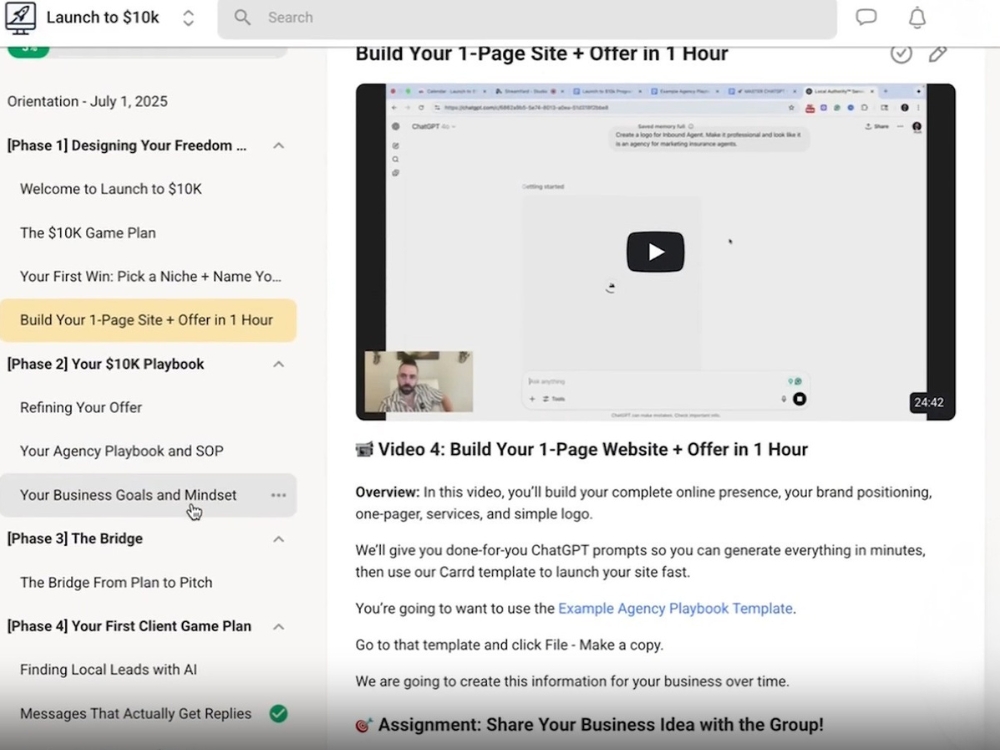
The course is structured into 8 phases covering the full lifecycle of building and growing an AI-powered affiliate blog.
Foundation and Niche Selection. You start with picking a niche based on affiliate program availability, keyword opportunities, and your own knowledge or interests. Adam pushes a personal brand approach rather than anonymous niche sites — your face, your voice, your recommendations. This matters more than ever in 2026 when generic AI content is everywhere.
Website Setup. Step-by-step WordPress setup including hosting, plugins, and site architecture. The recommended host is Hostinger for its price point and built-in AI website builder. This phase is beginner-friendly and moves quickly.
AI Keyword Research and Competitor Analysis. This is where the course gets interesting. Instead of manually working through a keyword tool, you build an AI agent that processes hundreds of keywords and returns a filtered, prioritised list based on search volume, keyword difficulty under 30, and buying intent. Adam focuses specifically on rising and trending keywords rather than established ones — the logic being that newer keywords have less entrenched competition.
The competitor analysis workflow is similarly practical. You feed the top-ranking URLs for your target keywords into an AI agent with instructions to extract word count, content structure, affiliate programs used, and content gaps. Two hours of manual research done in about ten minutes.
Content Production with AI. The course teaches a specific agentic approach to content creation. Rather than copy-pasting from ChatGPT, you build a workflow where a detailed prompt feeds your content brief into an AI agent with instructions covering intro structure, section coverage, product recommendations with reasoning, comparison tables, FAQ sections, and output format. The draft comes back in 3–5 minutes. Your job is then editing for accuracy, adding your own experience and opinions, and fact-checking pricing and product details — because AI will confidently pull last year's prices if you don't.
Internal Linking and SEO Optimisation. The course covers using AI to identify internal linking opportunities automatically — feeding your new post and your existing URL list into an agent that outputs specific anchor text recommendations and placement instructions. SEO optimisation follows a similar workflow: feeding the complete post into an agent that checks keyword placement, meta description, image alt text, and content length against competitors.
Content Update Systems. One of the more practical sections. Adam teaches you to build an AI agent that audits your existing content by analysing traffic trends and publishing dates, then flags posts for updates with a priority ranking — high, medium, or low — with reasoning. This turns a 10-hour manual task into about an hour of review work.
Monetization. Affiliate marketing is the primary focus: how to identify high-commission programs, build content that converts, and stack multiple revenue streams. Adam covers display advertising for when you hit traffic thresholds, sponsorships for when you build authority, and digital products as a way to diversify beyond affiliate commissions. The 100+ affiliate programs he's personally worked with give him a practical frame of reference here that most course instructors don't have.
Scaling with AI and Automation. The final phase covers building Make.com automation workflows that connect your tools — keyword data in Google Sheets, AI content generation via Claude, publishing workflows — so the system runs with minimal manual intervention. The Blog Automation Factory course, included as a bonus, goes deeper on this with plug-and-play Make.com automations you can download and use immediately.
One thing the marketing doesn't emphasize much is that the course includes a services and agency layer on top of the blogging content. There are standard operating procedure templates, a client acquisition playbook, lead sourcing guides, pitch decks, invoice templates, and service page frameworks. This is more relevant if you want to offer content or SEO services to clients as a way to generate faster income while your blog builds. It's not the headline feature but it's there and it adds real value.
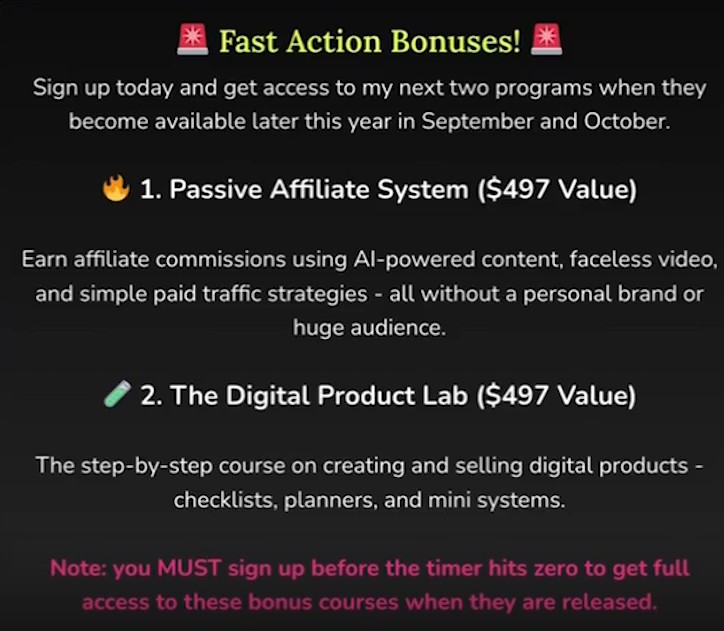
Two bonus courses are also being built out inside the program: the Passive Affiliate System, covering affiliate strategies across content, AI, YouTube, and paid ads, and the Digital Product Lab, a full course on creating and selling digital products like checklists, planners, and mini systems. Both were listed as coming soon at the time of writing, so check current availability when you join.
All Q&A sessions are weekly Google Meet calls with Adam directly, run for around an hour each. They're recorded and stored in the classroom tab, so if you're outside North America or can't make the live time you can catch the full video and transcript afterward. There's also a mobile app for watching lessons on the go. Lifetime access is included at the one-time price — no recurring fees and all future updates are included.
The AI Workflow Approach
The thing that separates AI Income Blueprint from older blogging courses — including earlier versions of BGE — is how it frames the role of AI. Adam is explicit that copy-pasting from ChatGPT is not the model. You're building agents that handle workflows without micromanaging every step.
The practical difference looks like this. Traditionally, producing one quality affiliate post might take a full day — keyword research, competitor analysis, outline, writing, formatting, internal linking, optimisation. With the agentic workflow approach Adam teaches, that same post takes a fraction of the time because each step has a specific AI agent handling the mechanical parts. You're reviewing outputs and making decisions, not doing every step from scratch.
Adam's target output under this model is 20–30 quality posts a month. Over a year that's 240 pieces of content — compared to around 75 at the old rate of one to two posts a week. Three times the content, same time investment.
I think this framing is honest and practical. The course isn't selling AI as magic — it's selling AI as a production multiplier for someone who already understands what good affiliate content looks like.
Student Results
There are real documented results from students who went through Blog Growth Engine before the rebrand, and those same students are referenced in the AI Income Blueprint community.
Jessica La went from zero to $15,000 a month in recurring income, grew her domain rating from 0 to 50, and quit her job within about a year of joining. She later became a coach inside the program.
Eddy Ballesteros built a blog earning $10,000+ a month and is now the head coach inside BGE/AIIB, employed by Adam full-time.
Rob Wagener built a fitness site at fizznessshizzness.com and was generating $5,000+ a month in affiliate income within a few months of applying the course strategies.
Samantha North at bloggedigitalemigre.com reached $10,000+ a month in affiliate commissions after implementing what she learned.
A few honest caveats. Some of the most prominent success stories — Jessica, Eddy, Chris — have since been hired as coaches by Adam. That doesn't invalidate their results, but it's worth knowing when you see them used as testimonials. And as with any course, the people who get these results are the ones who commit fully and work consistently. Not everyone does.
What Are People Saying on Reddit?
The Reddit feedback on AI Income Blueprint is mixed, and I'd rather address it directly than pretend it isn't there.
The most common criticism is that Adam's core content is available for free on his YouTube channel. That's fair — his YouTube is genuinely good and covers the strategy in real depth. If you're disciplined, self-directed, and don't need structure or accountability, you could probably piece together a lot of what the course teaches without paying $747.
What you don't get from YouTube is the Make.com automation library, the private Skool community with 4,700+ active members, live weekly coaching calls with Adam directly, or the structured progression of the course. Whether that's worth $747 depends entirely on how much value you put on those things. For some people it's essential. For others it isn't.
Another Reddit criticism is that Adam is a "clickbait YouTuber" who teaches basic stuff. I think that's partially true and partially unfair. His YouTube content is designed for a broad audience — yes, some of it is entry-level. The course goes deeper, but it's still fundamentally a beginner-to-intermediate program. If you're an experienced affiliate marketer or SEO, you probably won't learn anything groundbreaking here.
What's the Catch?
There are a few things worth knowing before you buy.
Adam's own site traffic has declined. Multiple sources have noted that AdamEnfroy.com has seen a traffic decline since November 2024. That's a legitimate observation and it's worth addressing honestly. Google's algorithm updates have hit a lot of established affiliate sites hard over the past two years — Adam's included. He's been transparent about this on his YouTube channel and has adapted his approach accordingly. The pivot to AI workflows and the AIIB rebrand is partly a response to that shift. Whether his site's own struggles should factor into your decision about the course is something only you can decide.
Potential upsells after purchase. Some reviewers have mentioned additional products being pitched after you join. I can't confirm exactly what's currently being offered, but go in aware that $747 may not be the final ask.
The 14-day refund window is short. Two weeks is enough time to get through some of the material, but not enough to actually test the strategy and see results. You're essentially evaluating the course content itself rather than the outcome.
How Much Does AI Income Blueprint Cost?
The current price through the Skool community page is $747. This is the price listed at skool.com/bge-mastermind-1429 and is the most straightforward way to join.
There is also a free masterclass route through incomeblueprint.ai. You watch an 80–90 minute webinar and are then offered the course — some sources have reported pricing around $997 through this funnel. Worth checking both entry points to see what's currently on offer before purchasing.
Does AI Income Blueprint Have a Refund Policy?
Yes, there's a 14-day money-back guarantee. Contact support within 14 days of purchase to request a refund. Read the full terms and conditions before purchasing so you understand any requirements attached.
Pros and Cons
Pros
Adam Enfroy is genuinely credible — eight figures from blogging, publicly documented results, and he's been doing this long enough to have adapted when Google changed the game.
The Skool community has 4,700+ active members, which means real peer support rather than a ghost town. Weekly live Google Meet calls with Adam himself are included and all sessions are recorded — useful if you're in a different timezone.
The Blog Automation Factory bonus with plug-and-play Make.com automations is practical and immediately usable.
The agency SOPs and client acquisition templates add a services income layer that most blogging courses skip entirely.
Lifetime access at a one-time price with all future updates means you're not paying again as the course evolves.
The course has evolved honestly with where the industry is, rather than selling a 2021 playbook in 2026.
Cons
Results take 6–12 months minimum before meaningful income appears — longer in competitive niches.
Adam's own site has seen traffic decline since late 2024, which raises fair questions about whether his methodology works in the current environment.
Some of the core strategy is available free on his YouTube channel. Potential upsells after purchase have been flagged by other reviewers.
The 14-day refund window is short. And for experienced affiliate marketers, the course may cover ground you already know.
My Verdict
AI Income Blueprint is a legitimate course teaching a real business model. The methodology is sound — using AI as a production multiplier rather than a content spammer, focusing on buyer-intent keywords, building personal brand authority, and diversifying revenue across affiliate commissions, ads, and digital products. That's the right approach in 2026.
I feel like the honest answer to "should you buy this" is the same as it was for Blog Growth Engine: it depends on how seriously you'll take it. The students who have gotten real results from this course are the ones who treated it like a business, showed up consistently, and gave it time. The ones who didn't get results are the ones who expected AI to do the work for them or gave up after three months without traction.
The thing I keep coming back to is that the $10K/month promise in the marketing oversells what most people will experience in the first year. Adam himself says in his own YouTube content that you shouldn't expect to see results right away — but that nuance gets lost in the headline numbers. Go in expecting a 12-month project minimum and you'll be in the right headspace.
At $747 it's a reasonable investment if you're serious about affiliate marketing and want a structured framework, an active community, and live access to someone who has actually built what he's teaching. If you're still figuring out whether affiliate marketing is the right model for you at all, start with my affiliate marketing guide before spending anything on a course.
Alternatives
Looking for alternatives to AI Income Blueprint that are currently open for enrolment? I keep an updated list of the best blogging and affiliate marketing courses available right now. Head over to my best affiliate marketing courses page for current recommendations.
FAQ
Is AI Income Blueprint the same as Blog Growth Engine?
Yes. AI Income Blueprint is the official rebrand of Blog Growth Engine. The Skool community page describes it as "AI Income Blueprint™ (formerly Blog Growth Engine)." The core strategy is the same — the course has been updated with a heavier focus on AI workflows and automation tools.
Is AI Income Blueprint the same as Launch to 10K?
Functionally, yes. Both courses are offered by Adam Enfroy at the same price of $747, with the same structure and refund policy. They appear to be the same course marketed under different names to different audiences.
How much does AI Income Blueprint cost?
The current price is $747 through the Skool community page. Pricing through the free masterclass funnel at incomeblueprint.ai may differ — check both entry points before purchasing.
Does AI Income Blueprint have a refund policy?
Yes, there is a 14-day money-back guarantee. Contact support within 14 days of purchase. Read the terms and conditions before buying to understand any requirements attached.
How long does it take to make money with AI Income Blueprint?
Realistically, 6–12 months before you start seeing meaningful affiliate income. Google takes time to trust a new site regardless of how much content you publish. Students who report fast results typically had some existing SEO knowledge or an established online presence before joining.
Is AI Income Blueprint beginner friendly?
It's structured for beginners but the business model itself requires patience and consistency that not all beginners are prepared for. If you go in expecting to make money in the first few months, you'll likely be disappointed. If you go in prepared to build over 12+ months, it's accessible.
What happened to Blog Growth Engine?
Adam Enfroy rebranded Blog Growth Engine as AI Income Blueprint in 2025. The course is still active under the new name. You can read more in my Blog Growth Engine review.

- How Large Companies Can Improve Their Visibility Across Competitive Search Results - October 20, 2026
- What Business Owners Should Know About Company Audits - October 20, 2026
- Top West Coast Fulfillment Companies for Ecommerce Brands in 2026 - October 19, 2026