Hey, Drew here. I've been in the online business space since 2010, and dropshipping has come up in almost every conversation I've had about starting an ecommerce business since then.
It's one of those models that sounds almost too simple — sell products you never touch, from a store you run from your laptop. No warehouse. No shipping tape. No risk of being stuck with 500 units of a product nobody wants.
The honest version? It works — but it's not as easy as the YouTube gurus make it look. The barrier to entry is low, but the bar for actual success is higher than it's ever been in 2026. I'll explain exactly what dropshipping is, how the model works, what it realistically costs, and how to approach it without wasting months going in blind.
Key Takeaways
- Dropshipping = you run the store, a supplier handles inventory and shipping
- Startup costs are low (a few hundred dollars to test), but ad spend adds up fast
- Profit margins typically run 15–30% — you need volume or high-ticket products to make serious money
- The model still works in 2026, but you need a real strategy, not a copy-paste AliExpress store
- Getting trained properly matters — the wrong course can set you back months
What Is Dropshipping?
Dropshipping is an ecommerce fulfillment model where you sell products through your own online store without ever holding inventory. When a customer places an order, you forward it to a third-party supplier — who then packs and ships the product directly to your customer. You never see the product. You never touch it.
Your job is to run the storefront: find the right products, build the store, drive traffic, and handle customer relationships. The supplier handles everything behind the scenes. You pocket the difference between what you charged the customer and what the supplier charged you.
It's a clean model in theory, and it can absolutely be profitable — but "no inventory" doesn't mean "no work." You're still running a real business. You're just outsourcing the logistics.
How Does Dropshipping Work, Step by Step?
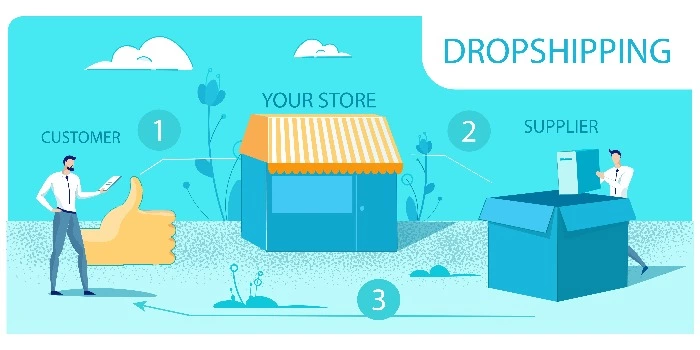
The dropshipping process follows a simple four-step loop once your store is live.
First, you set up an online store on a platform like Shopify or WooCommerce and list products from your chosen suppliers. You set your own retail prices, which are marked up from the wholesale rate the supplier charges you. Second, a customer finds your store — through ads, SEO, social media, or wherever you're driving traffic — and places an order at your retail price. Third, you receive the order and payment, then forward the order details to your supplier, paying them the wholesale price. Fourth, the supplier ships the product directly to your customer under your store name.
The spread between what the customer paid and what you paid the supplier is your gross margin. From that, you subtract your ad spend, platform fees, and any apps you're running — what's left is your profit.
Is Dropshipping Still Worth It in 2026?
Yes — but the playbook from 2018 is dead. The model itself is alive and growing. The global dropshipping market is projected to hit over $476 billion by 2026, and new stores are launching every day. What's changed is the execution.
A few years ago, you could throw up a generic Shopify store, run some Facebook ads pointing at a trending AliExpress product, and actually get results. Today, customers are savvier. Many have ordered from a dropshipping store before, waited three weeks for shipping from China, and gotten burned. That experience raises their guard.
What wins now is brand trust: a store that looks legitimate, products that ship fast (ideally from domestic suppliers), and marketing that doesn't feel like a copy-paste template. I go much deeper on this in my is dropshipping dead post — short answer, it isn't, but you do need to adapt.
What Are the Pros of Dropshipping?
The biggest advantage of dropshipping is that you can start a real ecommerce business with very little upfront cash.
You don't buy inventory speculatively, so you're never stuck with products that don't sell. You can test five different products in the time it would take a traditional retailer to place one wholesale order. That flexibility is genuinely powerful, especially early on when you're still figuring out what your market actually wants.
Location independence is another real perk. I can run a dropshipping store from my home office in Mississauga just as easily as from a coffee shop in Lisbon. You're not tied to a warehouse, a shipping schedule, or a physical location. And because you're not managing inventory, there's no hard ceiling on how many SKUs you can offer — you can add and remove products without any financial risk tied to stock.
For beginners, it's also one of the best ways to learn the mechanics of ecommerce — product research, paid ads, conversion optimization, customer service — without putting your savings on the line.
What Are the Cons of Dropshipping?
The same thing that makes dropshipping accessible — low inventory risk — is also the source of its biggest headaches.
Because you're not handling fulfillment yourself, you have limited control over shipping speed, packaging quality, and stock levels. If your supplier runs out of stock or ships a defective product, that's your customer's problem and your reputation on the line. Dealing with refunds and complaints for products you never touched is frustrating, and it happens more than the success stories suggest.
Margins are another reality check. Gross margins of 15–30% sound workable, but once you factor in Shopify fees, app subscriptions, and paid ad costs, net margins can get thin fast — especially on low-ticket items. This is why understanding your real expenses before you launch matters. A lot of beginners underestimate what it actually costs to run a store and end up selling themselves into near-zero profit.
Competition is also higher than ever. The entry bar is low, which means everyone and their cousin has tried dropshipping. Standing out requires either a genuinely differentiated product angle, better branding, or smarter marketing than what most beginners are willing to put in upfront.
How Do You Find Products to Dropship?
Product research is the single most important skill in dropshipping — find a winner and everything else gets easier; pick the wrong product and no amount of marketing saves you.
The fastest approach in 2026 is using a dedicated product research tool. I've reviewed Sell The Trend which uses AI to surface products gaining traction before they hit peak saturation — it tracks sales velocity across AliExpress, Amazon, and Shopify stores simultaneously, which gives you a real edge over people still manually scrolling AliExpress best-sellers.
Beyond tools, I'd also recommend looking at what's gaining traction organically on TikTok and Instagram Reels. If a product is generating genuine UGC content — people filming themselves using it without being paid — that's a strong signal. You're looking for products that solve a visible problem, have a "wow" factor that translates to video, and aren't already in every second Shopify store.
I go deeper on this in my guide to finding trending products to sell online. There's no shortcut to good product research, but there are smarter systems.
How Do You Find Dropshipping Suppliers?
The quality of your supplier determines your customer experience — and your reputation.
For beginners, the two most common starting points are AliExpress (easy to access, massive product range, slower shipping from China) and US/domestic suppliers through platforms like AutoDS, Spocket, or SaleHoo. Domestic suppliers charge more at wholesale, but they can ship in 3–7 days instead of 2–3 weeks — and in 2026, that shipping speed difference can make or break your store's reviews.
When evaluating any supplier, I'd tell you to look at three things first: their order volume and review count on the platform, their response time when you message them (test this before you commit), and whether they offer sample orders so you can check quality yourself before you start selling. A supplier who takes three days to reply to a pre-sales question will not suddenly get faster once you're sending them orders.
Don't be afraid to work with multiple suppliers across different product categories. Spreading your store across two or three suppliers also protects you if one runs into stock or quality issues.
What Does It Cost to Start Dropshipping?
You can technically launch a dropshipping store for under $100, but if you want a real shot at profitability, budget at least $500–$1,000 to start.
Here's how the money actually breaks down. Shopify runs $39/month for the basic plan. A domain name is around $15/year. You'll likely need a premium theme ($0–$350 one-time) and a handful of apps for product imports, reviews, and email capture — budget $30–$60/month there. Then there's ad spend: if you're running Facebook or TikTok ads to test products, expect to spend $300–$500 minimum before you have enough data to know what's working.
The hidden cost most beginners underestimate is course and education. I've bought a lot of dropshipping courses over the years. Some are a waste of money. A few are genuinely good. Before you spend thousands on a course, check out my best dropshipping courses roundup — I've done the vetting so you don't have to.
What's the Best Platform for Dropshipping?
Shopify is the default answer for good reason — it's purpose-built for ecommerce, has the best app ecosystem, and the learning curve is manageable for beginners.
he connection between Shopify and apps like DSers, AutoDS, or Zendrop makes the supplier-to-store workflow relatively frictionless. You can import products, sync inventory, and auto-fulfill orders without doing it manually. What makes Shopify especially appealing, though, is that its app ecosystem extends well beyond dropshipping.
Merchants can tailor nearly every aspect of their store experience with solutions such as Essential Apps, which offer tools for improving functionality, optimizing the customer journey, and supporting store growth. If you're starting from scratch and don't have WordPress experience, Shopify is where I'd point you.
WooCommerce is a solid alternative if you're already comfortable with WordPress. It's more flexible and cheaper at baseline, but you'll spend more time managing plugins and hosting. For most beginners, that tradeoff isn't worth it.
Amazon dropshipping is a different beast — the rules are stricter, Amazon can pull your listing at any time, and you're operating in their ecosystem, not your own. It can work, but I'd build your own Shopify store first and treat Amazon as an expansion later.
TikTok Shop is also worth paying attention to in 2026. It's still early enough that organic reach is real, and the product discovery behavior there (impulse buys triggered by short video) aligns naturally with the dropshipping model.
Dropshipping vs. Affiliate Marketing: Which Is Better?
They're both legitimate online business models — the right one depends on what you want your day-to-day to look like.
Dropshipping gives you more control: your own brand, your own pricing, your own customer relationship. The ceiling is higher if you find a winning product and scale it. But you're also dealing with customer service, refunds, supplier headaches, and ad spend from day one.
Affiliate marketing is simpler to start — you promote other people's products and earn a commission, with zero inventory or fulfillment involved. The tradeoff is that you don't control the product or the offer, and commissions are capped by whatever the merchant decides to pay.
I've done both for years and still do both. They're not mutually exclusive — a lot of people run affiliate content alongside a dropshipping store. If you want a side-by-side breakdown, I cover it in my dropshipping vs affiliate marketing comparison.
Is There an AI-Powered Alternative to Traditional Dropshipping?
If the startup costs, ad spend, and manual workload of traditional dropshipping give you pause — there are AI-powered business models that work differently.
Module 3 of my 2026 AI Business Blueprint covers an AI-assisted ecommerce approach where you use AI for product research (hours instead of days), product photography (AI-generated mockups instead of hiring a photographer), ad copy (written in minutes, not hours), and customer service automation. It's a leaner way to approach ecommerce without starting from a $1,000 ad budget.
The course is $47 one-time — a lot cheaper than most dropshipping courses and a different angle entirely if you want to build online income without a paid ads-heavy model. If that sounds more like your speed, download my free guide here for a preview of how the model works.
You Might Also Find This Useful
- Best Dropshipping Courses — I've reviewed and ranked the top training available so you can skip the bad ones
- Is Dropshipping Dead? — a detailed look at whether the model holds up in 2026
- How to Make Money Online With AI: 5 Proven Business Models — if you want to see what AI-powered income looks like beyond ecommerce
Frequently Asked Questions
What exactly is dropshipping in simple terms?
Dropshipping is a way to sell products online without buying or storing inventory. You list products in your store, a customer buys one, and a third-party supplier ships it directly to them. You keep the margin between what the customer paid and what the supplier charged you.
Is dropshipping legal?
Yes, dropshipping is completely legal. You're operating a standard retail business — you just outsource fulfillment to a supplier. The key is to make sure you're not selling counterfeit goods, infringing on trademarks, or violating the terms of service of whichever platform you're selling on.
How much can you realistically make with dropshipping?
It varies enormously. Some people make nothing and quit after their first failed product test. Others build stores doing consistent five figures a month. A realistic expectation for a first-time dropshipper is six to twelve months of testing before hitting meaningful profitability — if they stick with it and keep improving.
Do you need a business license to start dropshipping?
In most jurisdictions you're not required to have a business license to start, but you should register your business and collect sales tax properly once revenue starts flowing. Requirements vary by country and state, so check your local rules. In Canada and the US, most dropshippers operate as sole proprietors to start, then incorporate once the business is generating real income.
What's the difference between dropshipping and affiliate marketing?
With dropshipping, you own the customer relationship — you process the sale, handle support, and control the brand. With affiliate marketing, you refer customers to someone else's product and earn a commission. Dropshipping has higher upside but more operational complexity. Affiliate marketing is simpler but you have less control over what you're promoting.
Is dropshipping worth it for beginners in 2026?
Yes, but only if you go in with realistic expectations. It's not passive income and it's not a shortcut. The advantage for beginners is that the financial risk is low — you're testing products and learning ecommerce skills without buying inventory upfront. Treat your first store as an education and your second store as the business.
What's the fastest way to learn dropshipping?
A good course will compress months of trial and error into a structured path. Check out my best dropshipping courses breakdown for the options I actually recommend — I've been through a lot of them.

- Top Google Review Software for Improving Local Business Reputation - October 22, 2026
- How Remote Technology Is Changing the Way Legal Proceedings Are Conducted - October 21, 2026
- The Role of 3PLs in Building a More Efficient Supply Chain - October 21, 2026