Hey, Drew here. Welcome to my Money Press Method review of Preston James' options trading system for 2026. I spent weeks researching this program, reading through the 121-page book, watching hours of YouTube reviews, and digging through hundreds of user complaints on Reddit and BBB to give you the real story.
Look, if you're thinking about dropping money on an options trading course, you need to know what you're actually getting into. Options trading isn't like starting an online business where you control the variables. It's more like trying to predict which way a drunk person will stumble next while blindfolded. One bad market day and your account gets wiped out.
But don't worry... I'm here to tell you if Money Press Method is worth your $7 (plus the $129/month upsell) or if there's a smarter path to consistent income.
💡 Money Press Method Teaches 2021 Options Strategies. Here's the 2026 AI Alternative.
Money Press Method is a 121-page guidebook teaching weekly options trading through diagonal spreads (also called Poor Man's Covered Call but with puts). The book costs $7 for shipping, then upsells you to the $129/month Weekly Options Windfall alerts service. Materials are from 2021, provided on DVDs, with no community or coaching.
The real problem? You're risking your own capital ($10,000 minimum recommended) with no guarantee of returns. Time decay, implied volatility, and assignment risk can erase your account in days. You're also competing against Wall Street algorithms and professional traders.
In 2026, AI creates income without risking trading capital. Module 4 of my 2026 AI Business Blueprint shows you how to use AI for freelance services (copywriting, design, consulting) where clients pay you upfront. $27 one-time vs $7 + $129/month for trading alerts that don't guarantee profits.
Jump to the AI alternative or keep reading to see what Money Press Method actually teaches first.
⭐ Money Press Method Rating: 2.1/5
I give Money Press Method a 2.1 out of 5. While the diagonal spread strategy is technically legitimate, the materials are outdated (2021), the presentation is oversimplified, and there's zero verified performance data.
Most concerning? The company's own Terms of Use states testimonials are "not representative" and income claims are just "estimates." For a system that requires $10,000+ of your own money at risk, that's a massive red flag.
What Will be Discussed in This Money Press Method Review
First off, this isn't going to be a gloss-over of the program. I'm going to get into the real details of Preston James' Money Press Method. I will tell you things like...
Is it suitable for beginners or is it oversimplified? Does the "market-neutral" claim actually hold up? What's the real cost beyond the $7 book? What do actual users say about their results (spoiler: it's mostly negative)? How does this compare to other income models? What are the hidden risks they don't mention upfront?
What Is Money Press Method?
Money Press Method is an options trading guidebook that teaches you how to sell weekly put options while holding longer-dated protective puts. The strategy is essentially a diagonal spread, which is similar to what options traders call a Poor Man's Covered Call—except Preston uses puts instead of calls. Preston markets this as a "market-neutral" income system that supposedly works regardless of market conditions.
The program was published in July 2021 by Preston James, founder of Traders Edge Network. The core promise is simple: collect weekly premium income from selling options, regardless of whether the market goes up, down, or sideways.
Here's what you actually get for your $7 shipping fee: a 121-page physical book, a digital PDF copy, two instructional DVDs (yes, DVDs in 2026), and a guide called "How To Get Started On $10,000 or Less." The book spends the first 20+ pages on Preston's background story, then covers the basic strategy with examples, and ends with a pitch for the high-ticket Weekly Options Windfall program at $129/month.
One thing to keep in mind before buying: the $7 book fee is just the starting point. You'll need at least $10,000 in trading capital to implement the strategy properly, plus brokerage fees, options approval (Level 2 or 3), data subscriptions, and potentially thousands in losses while you learn. Going in thinking this is just $7 is one of the fastest ways to get blindsided by the real costs.
The strategy itself works by selling weekly at-the-money put options to collect premium, while simultaneously holding a longer-dated put option (3-6 months out) at a lower strike price as protection. When the weekly put expires worthless, you keep the premium and sell another one the following week. If the stock drops too far, your protective put limits your losses.
Sounds reasonable on paper. The problem is what they don't tell you upfront about assignment risk, time decay working against your long position, and how volatile markets can crush both sides of your spread simultaneously.
Who Is Preston James?
Preston James is the owner and CEO of Traders Edge Network, which he founded in 2003. He graduated from the University of Utah with a Bachelor of Science in Finance between 1989 and 1993, and credits his football scholarship as the only reason he made it through college. He played linebacker, which is why he calls himself the "stock market linebacker" (cheesy, but whatever).

Preston started exploring trading in 1996 and began trading his own accounts soon after. Over the years, he's built a following of traders interested in his weekly options strategies. He's also known by the nickname "The Pirate" and operates out of Salt Lake City, Utah.
On paper, Preston has decent credentials. He's been in the trading space since 2003, which gives him some legitimacy. His YouTube channel has about 2,240 subscribers, and the Preston James & Traders Edge Network Facebook page has around 9,600 followers. Not massive numbers, but consistent presence.
Here's what concerns me: despite 20+ years in trading and founding a company in 2003, there's zero verified track record of his trading performance. The Weekly Options Windfall program shows every trade going back to 2011 on their dashboard, but none of them include profit/loss data. Just entry dates, tickers, and expiration dates. No yearly summaries, no win rates, no actual proof the system makes money consistently.
That's a red flag the size of Texas. If you had 13 years of profitable trading data, wouldn't you show it?
How Does Money Press Method Work?
Money Press Method works by creating a diagonal spread using put options. You buy a longer-dated put option (the "protection") at a lower strike price, then sell shorter-dated weekly put options at or near the current stock price to collect premium income.
Let me break this down in plain English because options jargon makes most people's eyes glaze over.
Step 1: You pick a stable, large-cap stock (think companies like Apple, Microsoft, etc.)
Step 2: You buy a put option 3-6 months out in time at a strike price below the current stock price. This costs you money upfront. This is your insurance policy.
Step 3: You sell a weekly put option at or near the current stock price. This brings money into your account immediately. This is your weekly income.
Step 4: If the stock stays above your sold put's strike price, that option expires worthless and you keep the premium. Then you sell another weekly put and repeat.
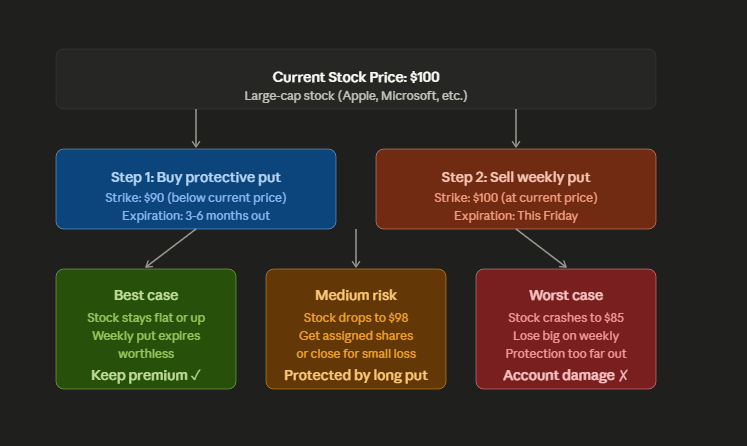
The theory: You keep collecting weekly premiums while your longer-dated protective put limits your downside risk if the stock crashes. Preston calls this "market-neutral" because you're supposedly protected in any market condition.
The reality: Three things can happen, and only one is ideal.
Scenario 1 (Best case): The stock stays flat or goes up. Your weekly put expires worthless, you keep the premium, and you sell another one next week. Rinse and repeat. This is what Preston's marketing focuses on.
Scenario 2 (Manageable loss): The stock drops slightly and your weekly put ends up in the money. You either get assigned shares (which means you're forced to buy 100 shares at the strike price) or you close the trade early for a loss. Your protective put helps offset some damage, but you still likely take a hit.
Scenario 3 (Account killer): The stock drops hard and fast. Your weekly put gets crushed (you lose big), and your protective put doesn't gain enough value to offset the loss because it's further out of the money. You're forced to close everything and reset, usually at a significant loss.
Preston doesn't spend much time on scenarios 2 and 3 in the book. And that's the problem. The weekly premium you collect is tiny compared to the loss you can take when things go wrong. You might collect $200 in premium one week, then lose $2,000 the next week when the market tanks.
I think the strategy can work in stable, low-volatility markets. But we haven't had a stable market in years, and 2026 has been a rollercoaster. The "market-neutral" claim falls apart when real volatility hits.
What's Included in Money Press Method?
The Money Press Method bundle includes a physical 121-page book, instant digital download of the PDF, two DVD training videos (archaic format for 2026), and a bonus guide titled "How To Get Started On $10,000 or Less."
The book itself is split into three sections. The first 20+ pages are Preston's background story and trading philosophy. The middle section covers the Money Press strategy with examples and diagrams showing how to structure the trades. The final section is a pitch for the Weekly Options Windfall (W.O.W.) Insider Service, which costs $129/month or $997/year.
The two DVDs are "quick-start training videos" that walk through the strategy visually. I haven't watched them personally because who has a DVD player in 2026? But based on user reviews, they basically repeat what's in the book with some screen-sharing of how to enter the trades in a brokerage platform.
The "How To Get Started On $10,000 or Less" guide is positioned as a $79 value but comes free with the book. It's essentially a chapter explaining how to start with smaller positions if you don't have the recommended capital. Spoiler: starting with less than $10,000 means you can't properly diversify, which increases your risk significantly.
Here's what's NOT included: No private community for students. No 1-on-1 coaching from Preston. No live trade alerts unless you upgrade to the $129/month program. No refund policy clearly stated upfront (though some sources mention a $7 refund available if you're unsatisfied).
The book is more of a lead magnet to upsell you into the Weekly Options Windfall program. That's where Preston wants you long-term because $129/month recurring is way more profitable than a $7 one-time book sale.
What Is Weekly Options Windfall?
Weekly Options Windfall (W.O.W.) is Preston James' premium alerts service that costs $129/month or $997/year. It's the real product Money Press Method is designed to funnel you into.
As a W.O.W. member, you get trade alerts via email telling you which stocks to trade, which strikes to use, and when to enter/exit positions. You also get access to weekly live trading sessions every Friday where Preston and his team (mainly Mike Curtis) walk through current positions and answer questions.
The program includes a members' area with educational videos, a forum for asking questions, and access to historical trade data going back to 2011. That sounds impressive until you realize none of that historical data includes profit/loss information. Just dates, tickers, and strikes. No actual proof of profitability.
The big selling point: Preston manages the strategy for you via email alerts, so you don't have to figure it out yourself. Just copy his trades and theoretically make money.
The reality based on user reviews: The email alerts often arrive late or are confusing to execute. The Friday webinars can be rambling and unfocused (one user complained Preston talks about random topics "that do not matter when you are losing money"). And most importantly, multiple users report losing thousands following the alerts.
One user on Reddit said they've been following the system since June 2024 with "huge losses, especially lately." Another user on BBB reported losing 30% of their account in a year following Preston's recommendations. When they complained, Traders Edge Network responded defensively saying "any strategy that has a potential return brings a potential risk."
I feel like if you're charging $129/month for alerts, you should probably have a better track record than "some people lose 30% of their account." Just saying.
What Do Real Users Say About Money Press Method?
Real users are mostly negative about Money Press Method. I spent hours reading through Reddit threads, YouTube comments, BBB reviews, and Trustpilot to get the real story beyond the marketing hype.
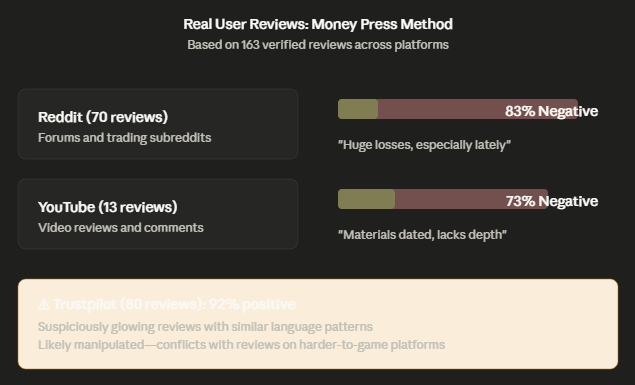
Reddit sentiment is brutal. Out of roughly 70 reviews and comments I found across various trading subreddits, about 83% were negative. Users describe the strategy as "oversimplified," say it "leaves out incredibly important details," and warn that it's "not just collecting income" like Preston claims. Multiple Redditors report significant losses, especially during volatile market periods.
One user specifically warned: "Selling a weekly option is not just 'collecting money.' It is the opening of a short option position (as part of a calendar spread), which will have a profit or loss on the day of expiration." They gave an example of losing $280 per contract in just one week when a stock dropped 3-5%. The book makes it sound like passive income. The reality is you can lose a lot very quickly.
Another Redditor who subscribed to the W.O.W. alerts wrote: "Current subscriber, have been doing this since June 2024 with huge losses, especially lately." This was posted in late 2025 or early 2026, meaning they stuck with it for months and kept losing money.
On the positive side, one Reddit user said: "I'm a subscriber. Yes, it's a simple principle and scratches me where I itch in the options space." But that's about the only positive comment I found, and it doesn't mention actually making money.
YouTube reviews are also mostly negative. Out of 13 video reviews and comments I analyzed, about 73% were critical. Common complaints include outdated materials ("The materials are from 2021, so some of it may feel a little dated"), lack of depth, and the DVD format being archaic for 2026.
One positive comment stood out: "What I found with your seminar and with your programs is they're absolutely unique." But again, no mention of actual profitability. Just that it's "unique."
The Better Business Bureau shows Traders Edge Network is not BBB accredited but has an A+ business rating. However, there's only 1 customer review posted (5 stars), which makes BBB less useful for assessing real customer experiences compared to platforms with more reviews like Reddit and YouTube.
When David complained, Traders Edge Network responded defensively, claiming his review "contradicts his earlier comments in their members' area" and restating that "any strategy that has a potential return brings a potential risk." That's a pretty weak response when someone just lost 30% of their money following your system.
Lynn Rosenberg left another scathing review saying she lost "a ton of money" and described Preston's live video trainings as "the worst." According to Lynn, Preston struggles with staying on topic and often rambles about different topics "that do not matter when you are losing money." Ouch.
Trustpilot shows 80 reviews with 92% positive ratings, but this looks manipulated. The reviews are suspiciously glowing, using similar language patterns, and most don't mention specific results. One review even says "I am truly grateful to be a part of this movement. It is life-changing." That's cult-like language, not a realistic trading review.
Compare that to the negative reviews on platforms that are harder to manipulate (Reddit, BBB), and you get a very different picture.
Amazon shows the book has 3.7 stars out of 22 ratings. Some buyers say it's "the best $7 I ever spent" and that Preston "explains everything so well." But others warn "the depth of material isn't great, and it leaves the user with lots of questions." One 2-star reviewer flat-out said to "save your money and look elsewhere."
I think the most telling data point is this: Preston claims to have shipped over 50,000 copies of the book, but he only says "hundreds of students FINALLY find success in trading options." He doesn't give an exact number, but let's be generous and say 500 students found success. That's a 1% success rate. And even that might be optimistic.
For a system that claims to work "under any set of market conditions," having 99% of your students not succeed is pretty damning evidence.
Is Money Press Method a Scam?
Money Press Method is not a scam. It teaches a legitimate options trading strategy (diagonal spreads) that real traders use. The problem isn't that it's fake—it's that it's oversimplified, outdated, and presented with misleading income claims.
The diagonal spread strategy itself is real and can be found in any comprehensive options trading textbook. Preston didn't invent it. He just repackaged it with a catchy name and marketed it as "consistent income" that works "no matter what the market does."
Here's where it gets sketchy: The company's own Terms of Use directly contradicts the marketing claims. According to their legal disclaimers, there are "no assurances or guarantees" that students will receive "profitable returns or have favorable performance." They also state that "income statements and income examples are merely estimates of what we think you could earn" and that "testimonials are not representative" of average earnings.
So Preston can run ads showing account screenshots of $54,000 growing to $174,000 in 9 months, but the fine print says those results aren't typical and there's no guarantee you'll make any money at all.
That's not illegal, but it's definitely misleading. The marketing sells dreams of consistent weekly income. The Terms of Use admits it's all just estimates and guesses.
I feel like if your system actually worked consistently, you wouldn't need disclaimers saying the testimonials aren't representative. You'd just show real, verified track records. Which Preston doesn't provide.
The <a href="https://www.bbb.org/us/ut/sandy/profile/online-trading-school/traders-edge-network-llc-1166-22225126" target="_blank" rel="noopener">Better Business Bureau listing for Traders Edge Network</a> shows a 2-star rating, which doesn't inspire confidence. And the fact that multiple users report losing significant money following Preston's system tells me this isn't a scam, but it's definitely not the "sleep-at-night protection" he promises.
The book costs $7, so you're not losing much there. But if you get upsold into the $129/month program and start trading with $10,000+ of your own money based on Preston's alerts? You could lose a lot more than $7.
What Are the Pros of Money Press Method?
There are a few legitimate positives about Money Press Method, even though I'm generally critical of the program.
The entry cost is extremely low. You only pay $7 for shipping to get the physical book, digital PDF, two DVDs, and the "How To Get Started On $10,000 or Less" guide. Compared to options trading courses that cost $997+ upfront, this is cheap access to learn the basics of diagonal spreads.
The strategy itself is legitimate. Diagonal spreads are a real options strategy used by professional traders. Preston didn't make this up. If you're interested in learning about calendar spreads and how to generate income from options premium, the book provides a basic introduction.
It's beginner-friendly in terms of explanation. Preston writes in a conversational style without overwhelming technical jargon. If you're completely new to options trading and want a simplified overview, the book makes the concepts accessible. He explains things step-by-step rather than assuming you already understand options Greeks and volatility.
The "market-neutral" structure does reduce directional risk compared to just buying calls or puts. Because you're selling premium and holding protection, you're not purely betting on the stock going up or down. In theory, this gives you more ways to profit or at least limit losses.
Some users do report success. While the majority of reviews are negative, there are testimonials from people who claim the system worked for them. On the Traders Edge Network website, Jeff S. from Asheville, NC says "I never thought I'd see the day, but last Thursday my account was up $150K in a single day!" Whether that's verified or cherry-picked, it shows some people have had positive experiences.
The refund policy exists. If you're unsatisfied with the $7 book, you can request a refund and still keep the materials. That's a fair deal for a $7 purchase.
That said, these pros don't outweigh the significant cons and risks I'll cover next. The low entry cost is designed to get you hooked so you upgrade to the $129/month program where the real money (for Preston) is made.
What Are the Cons of Money Press Method?
The cons of Money Press Method significantly outweigh the pros. Let me walk through the major problems with this program.
The materials are outdated. The book was published in July 2021. While some trading principles are timeless, the examples, market conditions, and specific strategies are now nearly five years old. Markets have changed dramatically since 2021, and the book doesn't reflect current volatility patterns or post-2022 interest rate environments.
DVDs are an archaic delivery format for 2026. Who has a DVD player anymore? This tells me Preston hasn't bothered updating the program's delivery method in years. If the format is outdated, what else is?
The information is extremely basic. The 121-page book spends 20+ pages on Preston's background, then covers the strategy in fairly general terms. Advanced traders will find nothing useful here. Even intermediate traders will be disappointed by the lack of depth on position management, rolling strategies, and what to do when trades go bad.
There's no community or coaching. You get the book and DVDs, then you're on your own. The only way to access support is by upgrading to the $129/month W.O.W. program. Compare that to other options trading courses that include Discord communities, weekly coaching calls, or at least a Facebook group for members.
The "market-neutral" claim doesn't hold up under scrutiny. Multiple users report massive losses during volatile market periods, which directly contradicts Preston's claim that the system "works under any set of market conditions, including NOW." A truly market-neutral strategy shouldn't blow up your account when the market drops.
There's zero verified performance data. This is my biggest issue. Preston shows historical trades going back to 2011 on the W.O.W. members' area dashboard, but none include profit/loss information. Just tickers, dates, and strikes. If you had 13+ years of profitable trading data, wouldn't you show win rates, yearly returns, and actual proof the system works?
The Terms of Use disclaims everything the marketing promises. While Preston's ads and sales pages promise "consistent income" and "sleep-at-night protection," the legal fine print says income examples are just "estimates" and testimonials are "not representative." That's a massive red flag.
Assignment risk is glossed over. The book doesn't adequately explain what happens if your short put gets assigned and you're suddenly holding 100 shares of stock you didn't plan to own. This can tie up thousands of dollars in capital and create margin issues in smaller accounts.
Time decay works against your long put. While you're collecting premium from the short puts, your protective long put is losing value every day from theta decay. Preston presents this as pure income generation, but you're also watching your insurance policy evaporate in real-time. The net effect can be negative even when you "win" the weekly trade.
You need at least $10,000 to implement this properly. The book mentions starting with less, but that's irresponsible advice. Options trading requires diversification and proper position sizing. Starting with less than $10K means you're putting too much capital into single positions, which amplifies risk.
The upsell structure is aggressive. The $7 book is designed to funnel you into the $129/month program. That's $1,548 per year, plus you're risking your own trading capital. And based on user reviews, many people lose money following Preston's alerts.
I think the biggest con is the misleading marketing. If Preston marketed this as "an introduction to diagonal spreads that might work in stable markets but comes with significant risk," I'd have less of an issue. But claiming it generates "consistent income" that works "no matter what the market does" while simultaneously disclaiming all results in the Terms of Use? That's deceptive.
What Does Weekly Options Windfall Actually Cost?
Weekly Options Windfall costs $129 per month or $997 per year. That's the premium alerts service Preston wants you to upgrade to after reading the $7 book.
But the subscription fee is only part of the real cost. Let me break down what you're actually paying:
$129/month or $997/year for the alerts service. This gets you trade recommendations via email, access to Friday live trading sessions, the members' area with educational videos, and the forum where you can ask questions.
$10,000 minimum in trading capital. Preston recommends starting with at least this much to properly diversify and size your positions. Less than that and you're taking on way too much risk.
Brokerage fees and commissions. Every time you enter or exit a trade, you're paying commissions. If you're trading weekly, those fees add up fast. Figure $1-$2 per contract per side, times multiple trades per week.
Options data subscriptions. Real-time options data from your broker often costs $5-$20 per month extra, depending on the platform.
Level 2 or 3 options approval required. Most brokers won't let you trade diagonal spreads without elevated options permissions, which typically requires proving you have sufficient trading experience and capital.
Losses from trades that don't work. Based on user reviews, many subscribers lose money following Preston's alerts. One user reported losing 30% of their account ($3,000+ if they started with $10,000) in a year. Another lost $6,000 in two months.
Your time. You're not passively collecting income. You need to monitor positions daily, manage adjustments, handle early assignments, and deal with the stress of watching your account balance fluctuate.
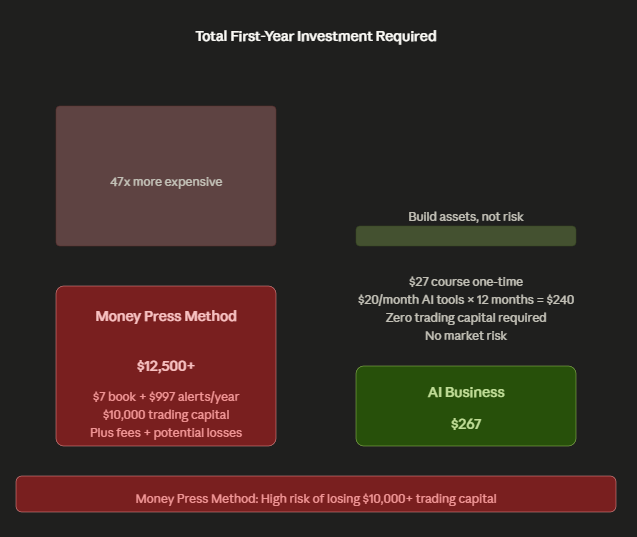
So the real total cost for year one? $997 (if you pay annually) + $10,000 trading capital + brokerage fees + potential losses + your time = easily $12,000-$15,000+ at risk.
And according to Preston's own Terms of Use, there's "no assurance or guarantee" you'll make any of that back.
Compare that to starting an online business where you control the variables and don't risk losing your entire capital in a single bad market day. I know which one I'd choose.
What Are Preston James' Main Claims?
Preston James makes several bold claims about Money Press Method that are worth examining closely.
Claim #1: The "market-neutral" strategy works regardless of market conditions. Preston repeatedly states the system works "under any set of market conditions, including NOW." The sales page emphasizes you can make money whether stocks go up, down, or sideways. This positions the strategy as low-risk and consistent.
Claim #2: You can generate "consistent income" using weekly options. The subtitle of the book literally promises "How To Generate Consistent Income Using Weekly Options No Matter What the Market Does." Preston frames this as a reliable income stream, similar to collecting rent from a rental property.
Claim #3: The system provides "sleep-at-night protection." Preston claims students don't have to "nervously check their accounts day and night" because the protective put limits downside risk. This implies low stress and hands-off management.
Claim #4: His account grew from $54,000 to $174,000 in less than 9 months. This specific example appears on the sales page as proof the system works. That's a 222% return, which sounds incredible and is designed to make you think you can achieve similar results.
Claim #5: Anyone can succeed in trading options using this system. Preston states the system works "IN SPITE of you, your moods, emotions and hunches." This suggests even beginners with no trading experience can follow the system and make money.
Claim #6: Four weekly option premiums lead to double the earnings compared with a one-month premium. Preston claims selling weekly options is more profitable than monthly options because you collect premium four times instead of once.
Claim #7: Over 50,000 books shipped and "hundreds" of students found success. This appears on the sales page as social proof. Preston uses the large number of books shipped to imply the system is popular and proven.
These claims sound great in marketing materials. But do they hold up when you look at the actual evidence? Let's find out.
Do Preston James' Claims Hold Up?
Preston James' claims do not hold up when you examine the actual evidence and fine print.
The "market-neutral" claim falls apart during volatility. Multiple users on Reddit and BBB report massive losses during volatile market periods, especially in 2024-2026. One user specifically said they had "huge losses, especially lately" despite following the system since June 2024. If the strategy truly worked "under any set of market conditions," subscribers wouldn't be losing 30% of their accounts in a year.
"Consistent income" is contradicted by the Terms of Use. While Preston markets the system as reliable weekly income, the company's legal disclaimers state there are "no assurances or guarantees" students will receive "profitable returns or have favorable performance." They explicitly say income examples are "estimates of what we think you could earn" and that "testimonials are not representative" of average earnings.
Translation: Preston can claim consistent income in marketing, but the fine print admits it's just a guess.
"Sleep-at-night protection" is a joke. Users report exactly the opposite experience. Lynn Rosenberg complained about Preston's training being "the worst" and said topics "do not matter when you are losing money." Another user on Ripoff Report said they lost $6,000 in two months with "no phone support" and alerts that "completely disregard all the negative impact being done to your account."
That doesn't sound like sleeping peacefully to me.
The $54K to $174K example is cherry-picked and unverified. Preston presents this as proof the system works, but there's zero verification of this claim. No brokerage statements, no third-party audit, nothing. And even if it's true, it's likely the best-case scenario from one successful period. The Terms of Use specifically says testimonials aren't representative, which means you shouldn't expect similar results.
Not everyone succeeds—in fact, almost nobody does. Preston admits he's shipped over 50,000 books but only "hundreds of students FINALLY find success in trading options." Let's do the math: Even if 500 students found success (which "hundreds" implies), that's a 1% success rate. That means 99% of people who bought the book didn't achieve success with the system.
For a strategy that supposedly works "IN SPITE of you, your moods, emotions and hunches," a 1% success rate is absolutely terrible. If the system truly worked regardless of the trader's skill, you'd expect much higher success rates.
The weekly vs monthly premium claim is misleading. Yes, you collect premium four times with weekly options versus once with monthly options. But you're also exposing yourself to assignment risk four times as often, paying four times the commissions, and dealing with four times the management headaches. The math isn't as simple as Preston makes it sound.
I think Preston's claims are classic marketing exaggeration. He takes a legitimate strategy (diagonal spreads), packages it with cherry-picked success stories, and uses careful legal disclaimers to avoid liability when students lose money. The system probably works for experienced options traders who already understand volatility, position sizing, and risk management. But for beginners following the book's simplified approach? The evidence suggests most people lose money.
What Are the Biggest Risks of Options Trading?
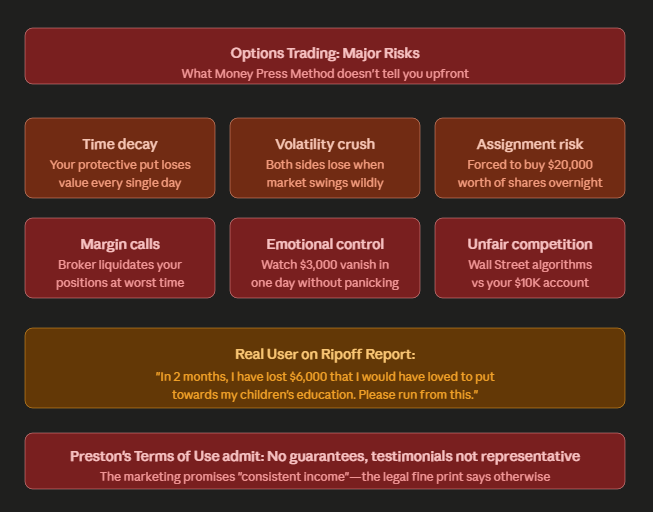
Options trading comes with massive risks that Money Press Method doesn't adequately explain. Let me walk you through the real dangers you're facing.
Time decay destroys your long put's value every day. While you're collecting premium from selling weekly puts, your protective long put is losing value from theta decay. Options lose value as they approach expiration, which means your "insurance policy" is constantly getting cheaper and less effective. In stable markets, the premium you collect might outpace the decay. In volatile markets, you're hemorrhaging money on both sides.
Implied volatility can crush your positions. When volatility spikes (which happens frequently), the options you sold become much more expensive to buy back, while your protective put might not gain enough value to offset the loss. This is called a volatility crush, and it can wipe out weeks or months of premium collection in a single day.
Assignment risk can tie up massive capital overnight. If your short put ends up in the money at expiration, you can get assigned 100 shares of stock per contract. If you sold puts on a $200 stock, you're suddenly forced to buy $20,000 worth of shares. Most people trading with $10,000 accounts can't handle that capital requirement. Your broker will either liquidate positions or hit you with margin calls.
After-hours assignment risk is often ignored. Even if your short put expires out of the money at 4pm market close, the stock can move after hours and your option can still get exercised. You wake up the next morning to find you're holding shares you never intended to own, often at a loss.
Margin requirements can explode during market stress. When markets get volatile, brokers increase margin requirements for options positions. You might have sufficient buying power one day, then get hit with a margin call the next day even though you didn't open new positions. If you can't meet the margin call, your broker liquidates your positions at the worst possible time.
Small mistakes cascade into big losses. Entering the wrong strike, selling the wrong expiration, or forgetting to close a position before expiration can cost you thousands. Options trading requires precision, and one typo or oversight can erase months of gains.
You're competing against professional traders and algorithms. Wall Street firms have entire teams of PhDs, billions in capital, and high-speed trading algorithms. They're making markets and exploiting tiny inefficiencies. As a retail trader with $10,000, you're bringing a knife to a gunfight.
Emotional control is harder than it sounds. Preston claims the system works "in spite of your moods and emotions," but that's nonsense. When you watch your account drop $3,000 in a single day, you're going to panic. Most people either close positions too early (locking in losses) or hold too long (hoping for a reversal that never comes).
The strategy requires constant monitoring. This isn't passive income. You need to check your positions daily, watch for early assignment, manage adjustments when stocks move, and be ready to act when alerts come through. Miss an important email from Preston and you could lose thousands.
I think the biggest risk is treating options trading like a business when it's actually speculation. With an online business, you create value, attract customers, and generate revenue. With options trading, you're betting on price movements you can't control. One is entrepreneurship. The other is gambling with fancy terminology.
How Much Money Do You Need for Money Press Method?
You need at least $10,000 to implement Money Press Method properly, though Preston claims you can start with less. Let me break down why $10K is the realistic minimum and what happens if you start with less.
Preston's official recommendation is $10,000 or more. The book includes a guide titled "How To Get Started On $10,000 or Less," but that's misleading marketing. The guide essentially says you can start with less, but it doesn't mean you should. Starting undercapitalized is one of the fastest ways to blow up your account.
Why $10,000 is the minimum: Proper risk management requires diversifying across multiple positions. If you're selling puts on 3-4 different stocks simultaneously (which Preston recommends), each position requires $2,000-$4,000 in buying power depending on the stock price and strikes. That math doesn't work with a $5,000 account.
What happens if you start with less: You're forced to concentrate your capital in 1-2 positions, which means a single bad trade can wipe out 30-50% of your account. You also can't properly manage adjustments because you don't have enough buying power to roll positions or add protection when needed.
Don't forget these additional costs:
Brokerage fees: $1-$2 per contract per side, times multiple trades per week adds up fast. Options data subscriptions: $5-$20/month for real-time data. The $7 book and potentially $129/month for W.O.W. alerts. Potential losses while you learn the system (most beginners lose money initially).
Based on user reports, many people lose significant chunks of their capital. One BBB reviewer lost 30% of their account in a year. Another Ripoff Report user lost $6,000 in two months. If you started with only $5,000, a 30% loss means you're down to $3,500—barely enough to continue trading.
I feel like Preston's "start with $10K or less" marketing is designed to lower the barrier to entry and get more people to try the system. But realistically, if you don't have $10,000+ that you can afford to lose, you shouldn't be trading options at all. And even if you do have $10K, that money would be better invested in learning proven affiliate marketing strategies where you're building assets instead of speculating on price movements.
Zero Startup Capital Comparison: My 2026 AI Business Blueprint costs $27 one-time and teaches you how to start an AI freelance business with zero capital beyond the course fee. You're selling services (copywriting, design, consulting) where clients pay you upfront. No $10,000 trading capital required, no risk of losing everything in a bad market day.
What's a Better Alternative to Options Trading?
A better alternative to options trading is building an AI-powered freelance or content business where you control the variables and don't risk losing capital to market movements you can't predict.
Here's why I think this is a smarter path in 2026:
You're creating value instead of speculating. With options trading, you're betting on price movements you don't control. One algorithm-driven sell-off and your account gets crushed. With an AI business, you're creating content, designs, copy, or consulting services that clients pay for upfront. You get paid before you do the work in many cases.
Zero trading capital required. Preston's system needs $10,000+ to implement properly. An AI freelance business needs less than $100 to start—just the cost of AI tool subscriptions like ChatGPT Plus ($20/month) or Claude Pro ($20/month). You're not risking thousands of dollars on diagonal spreads.
AI compresses execution time in 2026. Tasks that used to take hours now take minutes. Writing blog posts, designing graphics, creating video scripts, building email sequences—AI handles the grunt work while you focus on client relationships and strategy.
Your income scales with effort, not market conditions. When you trade options, you can work hard, follow the system perfectly, and still lose money if the market moves against you. With freelance services, the more clients you land and the more projects you complete, the more money you make. Simple cause and effect.
No margin calls or assignment risk. You'll never wake up to a margin call because volatility spiked overnight. You'll never get assigned 100 shares of stock you can't afford. Your biggest risk is a client disputing work quality, which is solvable through communication.
Builds long-term assets instead of short-term positions. Every article you write, every design you create, every client relationship you build adds to your portfolio and reputation. Options trades close out and disappear. A content portfolio compounds over time.
The AI Approach: Building Income Without Trading Capital ($27)
Instead of risking $10,000+ on options trading, you can build an AI-powered business for $27 that generates income without market risk.
My 2026 AI Business Blueprint teaches five complete business models where AI does the heavy lifting:
Module 1: AI Affiliate Marketing - Use AI to create review content, comparison articles, and SEO-optimized pages that generate affiliate commissions 24/7. No paid ads required.
Module 2: Faceless YouTube with AI - Create, script, voice, and edit YouTube videos entirely with AI. Build channels in niches like finance, health, or tech without showing your face or recording audio.
Module 3: AI E-Commerce - Use AI for product research, store design, ad copy, email sequences, and customer service. Launch dropshipping stores in days instead of months.
Module 4: AI Freelance Services - Sell copywriting, design, social media management, or consulting services where AI handles 80% of the execution. You manage client relationships and deliver quality work.
Module 5: Digital Products with AI - Create and sell ebooks, templates, courses, or tools using AI to handle content creation, design, and marketing.
What makes this different from Money Press Method:
No trading capital required. Just $27 for the course plus ~$20/month for AI tools. Zero market risk. You're not losing money when stocks drop. You're building assets (content, websites, client relationships) that compound over time. Copy-paste AI prompts included for every module. No guessing what to ask AI. Results depend on effort, not market conditions. You control the variables.
The course took me four months to create and includes real workflows I use in my own business. Every module has "If You Get Stuck, Watch It First" sections with YouTube search prompts for visual learners.
Want to Build a $10K/Month AI Business Without a Team or Paid Ads? Grab the free AI Side Hustle Starter Kit first to see if this approach fits your goals.

Which Should You Choose: Money Press Method or AI Business?
Choose an AI business over Money Press Method if you want predictable income that doesn't depend on market conditions you can't control.
Choose Money Press Method if:
You have $10,000+ in risk capital you can afford to lose. You enjoy analyzing markets and managing options positions daily. You're experienced with options trading and understand Greeks, volatility, and position management. You have emotional control to handle large account swings. You want to learn diagonal spreads for educational purposes.
Choose an AI business if:
You want to start with less than $100 instead of $10,000+. You prefer building assets that compound over time. You want income that scales with effort, not market luck. You don't want to risk waking up to margin calls. You're willing to do the work but want AI to handle the grunt tasks.
I think most people reading this review fall into the second category. Very few beginners have $10,000 they can afford to lose on learning options trading. Even fewer have the emotional control to handle watching that account drop 30% in a year while Preston sends emails saying "wow, what a crazy day - see ya manana."
My honest take? If you're drawn to options trading because you want consistent income, you're looking for the wrong thing in the right place. Options can generate income, but "consistent" is a stretch. Markets are volatile, and volatility kills diagonal spreads.
If you want actual consistent income, build something you control. Create content, land clients, sell products, grow an audience. Those are businesses. Options trading is speculation dressed up with risk management terminology.
And before someone comments "but Drew, you're biased because you're promoting your own course"—yes, I am. But I'm also not asking you to risk $10,000 of trading capital. I'm charging $27 for education, and you decide whether to implement it. That's a meaningful difference.
Check out my full breakdown of AI business models if you want to see the comparison in more detail.
Final Thoughts: Is Money Press Method Worth It?
Money Press Method is not worth it for most people. The $7 book provides a basic introduction to diagonal spreads, but the materials are outdated (2021), the strategy is oversimplified, and the marketing claims don't match reality.
The real problems:
Preston claims "consistent income" but his Terms of Use disclaims all income promises and says testimonials aren't representative. The "market-neutral" strategy blows up accounts during volatile markets despite claims it works under "any set of market conditions." There's zero verified performance data despite 13+ years of historical trades available. Most users report losses, especially those who upgraded to the $129/month W.O.W. alerts service. You need $10,000+ in risk capital to implement properly, plus brokerage fees and subscription costs.
Who should buy this:
If you're already interested in learning diagonal spreads and want a cheap introductory overview, the $7 book is fine for educational purposes. Just don't expect to implement it successfully or make the "consistent income" Preston promises.
If you have significant options trading experience and want to see how Preston structures his positions, it might be worth $7 of curiosity. But experienced traders will find the content too basic to be useful.
Who should avoid this:
Beginners with limited capital should absolutely avoid this. The marketing is designed to make options trading sound easy and low-risk. It's neither. If you have less than $10,000 you can afford to lose, don't risk it on learning diagonal spreads from a 2021 book.
Anyone looking for "consistent income" or "passive income" should look elsewhere. Options trading requires daily monitoring, emotional control, and accepting that you can do everything right and still lose money. That's not passive.
My recommendation: If you're drawn to Money Press Method because you want a reliable way to make money online, start with proven business models instead. Build content that ranks on Google, create YouTube videos, start a freelance service, sell digital products—anything where you control the outcome instead of betting on market movements.
And if you want to see what actually works in 2026, grab my free AI Side Hustle Starter Kit to see how AI compresses the work required to build a real online business.
I spent weeks researching this review because I know how tempting it is to believe in "weekly paychecks" from options trading. But the evidence is clear: most people lose money, the system isn't as market-neutral as claimed, and Preston's own disclaimers contradict his marketing promises.
Save your $7, keep your $10,000, and build something you actually control.
Frequently Asked Questions
How Much Does Money Press Method Cost?
Money Press Method costs $7 for shipping to receive the physical book, digital PDF, two DVDs, and bonus guide. However, the program is designed to upsell you to the Weekly Options Windfall alerts service, which costs $129 per month or $997 per year. You'll also need at least $10,000 in trading capital to implement the strategy properly, plus brokerage fees and options data subscriptions.
Is Preston James' Money Press Method Legit?
Money Press Method is technically legitimate because it teaches a real options trading strategy called diagonal spreads. However, the marketing claims are misleading. Preston promises "consistent income" that works "under any set of market conditions," but the company's Terms of Use disclaims all income guarantees and states testimonials aren't representative of typical results. Multiple users report significant losses, and there's no verified performance data to back up Preston's success claims.
What Is a Diagonal Spread?
A diagonal spread is an options strategy that combines elements of vertical spreads and calendar spreads. You buy a longer-dated option at one strike price and sell a shorter-dated option at a different strike price. In Money Press Method's version, you buy a put option 3-6 months out at a lower strike (protection) and sell weekly put options at or near the current stock price (to collect premium). The strategy is also called Poor Man's Covered Call when using call options instead of puts.
Can You Really Make Money with Money Press Method?
Most people do not make money with Money Press Method based on user reviews. While Preston claims over 50,000 books have been shipped, he only mentions "hundreds" of students finding success—suggesting a success rate around 1%. Multiple users on Reddit and BBB report losing 30%+ of their accounts following the system, especially during volatile markets. The strategy can work for experienced options traders in stable market conditions, but beginners typically lose money.
What's the Success Rate of Money Press Method?
The success rate of Money Press Method appears to be around 1% or less based on Preston's own admission that "hundreds" of students found success out of 50,000+ books shipped. Multiple review platforms show predominantly negative feedback, with 83% negative sentiment on Reddit and 73% negative on YouTube. Preston's Terms of Use explicitly states that testimonials are "not representative" of average earnings, which confirms most users don't achieve the marketed results.
How Risky Is the Money Press Strategy?
The Money Press strategy is high-risk despite marketing claims of "sleep-at-night protection." The main risks include: time decay eroding your protective put's value, implied volatility crushing both sides of your spread simultaneously, assignment risk forcing you to buy shares you can't afford, after-hours movements causing unexpected losses, and margin calls during volatile markets. One user reported losing 30% of their account in a year, another lost $6,000 in two months. The "market-neutral" claim doesn't hold up when real volatility hits.
What's Included in the $7 Money Press Book?
The $7 shipping fee gets you a 121-page physical book, instant digital PDF download, two instructional DVDs (archaic format for 2026), and a bonus guide called "How To Get Started On $10,000 or Less." The book covers Preston's background (first 20+ pages), the basic Money Press diagonal spread strategy with examples, and ends with a pitch for the $129/month Weekly Options Windfall program. There's no community access, no coaching, and no refund policy clearly stated upfront.
Is Weekly Options Windfall Worth $129 Per Month?
Weekly Options Windfall is not worth $129 per month based on user reviews. While you get trade alerts via email, Friday live sessions, and access to educational materials, multiple subscribers report losing money following Preston's recommendations. One BBB reviewer lost 30% of their account, another Ripoff Report user lost $6,000 in two months. The historical trade data on the members' dashboard shows no profit/loss information—just tickers and dates—which means there's no verified proof the alerts are profitable. The marketing promises "consistent income" but the reality is most subscribers lose money.
Ready to build a real online business instead of gambling on options trades? Check out The 2026 AI Business Blueprint ($27) for a proven path to consistent income without risking $10,000+ in trading capital.

- Top West Coast Fulfillment Companies for Ecommerce Brands in 2026 - October 19, 2026
- Digital Entrepreneurs Are Discovering That Physical Operational Infrastructure Accelerates Digital Scale - October 18, 2026
- Fast-growing E-commerce Sellers Are Overhauling Fulfillment Hubs To Keep Up With Orders - October 16, 2026