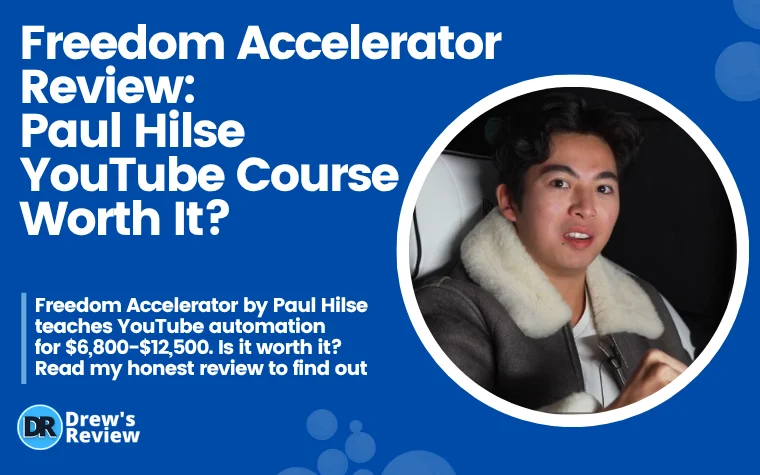
Hey, Drew here. I spent 15+ hours researching Freedom Accelerator by Paul Hilse – reading every Reddit complaint, watching YouTube reviews from actual students, analyzing testimonials, and even sitting through one of their high-pressure sales calls. Spoiler alert: they wanted $6,800 for six months of access.
I'm not a member because after running my own YouTube automation experiments, I think there are smarter ways to make money online in 2026. But I can give you the full picture of what you're actually buying if you join Paul Hilse's program.
Look, if you choose the wrong YouTube course, you could burn through $10,000+ in six months with nothing to show for it. You might pick oversaturated niches, hire terrible freelancers on Fiverr, and watch your channel get demonetized for copyright strikes. I've seen it happen to people who thought "faceless cash cow channels" were easy passive income.
But don't worry. I'm going to break down exactly what Freedom Accelerator teaches, what it actually costs (way more than the sticker price), and whether it's worth your money in 2026.
💡 Freedom Accelerator Teaches YouTube Automation the Manual Way. Here's the AI Shortcut.
Freedom Accelerator is comprehensive YouTube automation training – 40+ hours covering niche selection, team building, content outsourcing, and monetization. But it was built for 2020-2022 workflows where you manually hire scriptwriters on Upwork, vet voiceover artists for hours, and spend $400-800/month managing a remote team.
In 2026, AI compresses those workflows. Module 2 of my 2026 AI Business Blueprint shows you how to use AI for scriptwriting (minutes instead of hours), voiceover generation (ElevenLabs instead of freelancers), and video editing (CapCut AI instead of $100/video editors). The focus is on problem-solving content that ranks in YouTube search, not compilation videos that risk copyright strikes. $47 one-time vs $6,800+ for Freedom Accelerator.
Want to see the AI approach first? Grab the free starter kit here. Or keep reading to see what Paul Hilse actually teaches.
⭐ Freedom Accelerator Rating: 3.1/5
I give Freedom Accelerator a 3.1 out of 5. The training itself is solid and comprehensive, but the price is absurdly high for what you get, access ends after six months (you get kicked from the community), and the success rate appears to be around 10-20% based on student feedback. The "passive income" marketing is misleading – this requires daily management and significant capital.
What Will Be Discussed in This Freedom Accelerator Review
This isn't a surface-level review. I'm giving you the real details:
- What Freedom Accelerator actually teaches (and what it doesn't)
- The full cost breakdown (hint: it's way more than $6,800)
- Who Paul Hilse is and why his lack of public channels is a red flag
- Real student experiences from Reddit and YouTube (75% negative)
- Whether YouTube automation still works in 2026
- Alternatives that don't cost $10,000+ to get started
- My honest assessment after researching for weeks
What Is Freedom Accelerator?
Freedom Accelerator is Paul Hilse's YouTube automation coaching program that teaches you how to build faceless "cash cow" channels by outsourcing all content creation to freelancers. The model is simple: you pick a niche, hire a team (scriptwriters, voiceover artists, video editors, thumbnail designers), publish consistently, and collect YouTube ad revenue plus affiliate commissions.
The program includes 40+ hours of video training, weekly coaching calls for six months, a private Skool community with 1,000+ members, hiring templates, and niche selection tools. Paul claims his system helped him build channels earning $100K-$250K per month without ever appearing on camera.
Here's what they don't tell you upfront: you need at least $10,000-$15,000 saved before starting. That includes the course fee ($6,800-$12,500), monthly freelancer costs ($400-800), software tools ($60-180/month), and at least six months of runway because you won't make money immediately.
I think the model can work, but I feel like they oversell how "passive" it is. You're not sitting on a beach while money rolls in. You're managing a small content production company, reviewing analytics daily, giving feedback to editors, and constantly optimizing thumbnails and titles. That's not passive – that's project management.
Who Is Paul Hilse and Is He Legit?
Paul Hilse is a YouTube automation expert from New York who claims to make $100K-$250K per month from his faceless channels. He founded Freedom Accelerator in 2022 after allegedly building multiple successful channels and a management company that runs YouTube channels for clients.

His backstory is compelling: immigrant family, father died when he was young, mother fell for real estate scams and they lost everything, Paul had to help pay off debt while still in high school. He failed at dropshipping first, then discovered YouTube automation from an ad and went all-in. He claims one of his channels made $1.2 million profit in six months.
But here's where it gets suspicious: Paul has 550K+ followers on Instagram but only 2,000 subscribers on YouTube. For someone teaching YouTube success, that's backwards. He also doesn't publicly show any of his successful channels. In his training videos, he uses examples like "Bright Side" (42 million subscribers) but explicitly says "this is not my channel, but this is a prime example of what we create."
I find that concerning. If I was teaching YouTube and had channels making $250K/month, I'd be showing them off constantly. The fact that he only shows earnings screenshots from 2020-2022 (the COVID boom era when everyone was watching YouTube) and nothing recent raises red flags for me.
He does have YouTube Silver and Gold Play Buttons, so he has built something. But the lack of transparency about which channels are actually his makes me skeptical of the claims.
How Much Does Freedom Accelerator Actually Cost?
Freedom Accelerator costs $6,800 for six months or $10,000-$12,500 for one year. There's no public pricing on the website – you have to book a "discovery call" with their sales team first. That's usually a red flag because it means high-pressure sales tactics.
The sales call is typically 30-45 minutes where they'll qualify you (make sure you have money to invest) and pitch the program. They offer payment plans up to 36 months with financing, which sounds helpful until you realize you'll be paying interest on a course that might not even work for you.
But the course fee is just the beginning. Here's what you'll actually spend in the first six months:
Course access: $6,800-$7,500 (6-month option)
Monthly freelancer costs:
- Scriptwriters: $10-20 per video
- Voiceover artists: $15-30 per video
- Video editors: $50-100 per video
- Thumbnail designers: $10-20 per thumbnail
- Total per video: $85-170
- Weekly uploads (4 videos/month): $340-680/month
Software and tools:
- VidIQ or TubeBuddy: $20-50/month
- Stock footage (Artgrid, Storyblocks): $30-100/month
- Canva Pro or thumbnail tools: $10-30/month
- Total: $60-180/month
First six months total investment: $9,200-$12,300 minimum before you make a single dollar.
One thing to keep in mind before buying: you need significant capital upfront. Most students I've seen in Reddit threads report spending $12,000-$15,000 in their first year before becoming profitable. Going in underfunded is why 80-90% of people quit early.
What Do You Actually Get Inside Freedom Accelerator?
When you pay $6,800, here's what you're buying:
YouTube Accelerator Core Curriculum: 40+ hours of video training covering niche selection, channel setup, team building, content strategy, optimization, and monetization. The training is organized by modules and includes worksheets.
Private Skool Community: Access to a group with 1,000+ members where you can ask questions, share wins, and network. This is valuable for some people, but you get kicked out after six months when your access expires.
Weekly Coaching Calls: Four live group calls per week for six months. These are led by Paul's coaching team (not Paul himself), and you can get feedback on your analytics, thumbnails, and strategy. The calls are helpful according to some students, but others complain the coaches are spread too thin with 1,000+ students.
Niche Selection System: Templates and cheat sheets showing high-CPM niches, search volume data, and competition analysis. Paul focuses on finding "untapped markets" with demand but low competition.
Hiring Templates: Job posting templates for Upwork and Fiverr, vetting processes for freelancers, pay rate guidelines, and onboarding documents. This saves time but you still have to manage the hiring process yourself.
Channel Setup Templates: Optimized channel keywords, description templates, branding guidelines, and initial video ideas to help you launch quickly.
Viral Content Formula: Training on YouTube's algorithm, title/thumbnail optimization, retention tactics, and analytics interpretation. Paul emphasizes that titles and thumbnails matter more than video quality.
Bonuses: Guest speaker sessions, additional training modules, and updates. The value of these varies.
What you DON'T get: Direct access to Paul Hilse. You're coached by his team, not him. And after six months, you lose access to the coaching calls and community entirely. You keep the course materials but you're on your own.
How Does Paul Hilse's YouTube Automation System Work?
The Freedom Accelerator system follows this workflow:
Step 1: Niche Selection. Paul teaches you to use Google Trends, YouTube automation strategies, and keyword tools to find niches with search demand but low competition. He emphasizes choosing niches based on CPM (cost per thousand views) and advertiser demand, not personal interest. High-CPM niches include finance, business, technology, and health.
Step 2: Channel Setup. You create a YouTube channel with optimized branding, keywords in the channel name and description, and initial video ideas mapped out. Paul provides templates that speed this up.
Step 3: Team Building. This is where it gets expensive. You hire freelancers from countries like the Philippines, India, and Eastern Europe to keep costs down. You need a scriptwriter ($10-20/video), voiceover artist ($15-30/video), video editor ($50-100/video), and thumbnail designer ($10-20/thumbnail). Finding reliable freelancers takes trial and error – expect to fire people and restart the process.
Step 4: Content Production Workflow. You establish a weekly publishing schedule (minimum one video per week). The scriptwriter researches and writes, the voiceover artist records, the editor assembles everything with b-roll and music, and the thumbnail designer creates clickable images. You review everything and give feedback.
Step 5: Title and Thumbnail Optimization. Paul compares this to how MrBeast allegedly spends $10,000 per thumbnail. Your title and thumbnail determine if anyone clicks, so you test multiple options. The training covers psychological triggers, curiosity gaps, and pattern interrupts.
Step 6: Publishing and Analytics. You upload consistently and watch YouTube Studio analytics obsessively. Click-through rate (CTR) and average view duration (AVD) are the key metrics. If a video underperforms, you analyze why and adjust future content.
Step 7: Monetization. Once you hit 1,000 subscribers and 4,000 watch hours, you apply for the YouTube Partner Program. Then you earn from ads, plus affiliate commissions if you include product links.
Step 8: Scaling. Once one channel works, you replicate the system with new channels in different niches. Paul claims he scaled to multiple channels this way.
The system is solid in theory. It's basically building a small media company. But I feel like they downplay how much daily work this requires. You're not creating videos yourself, but you're managing people who are – which can be just as time-consuming when freelancers miss deadlines or deliver poor work.
What I Like About Freedom Accelerator (The Pros)
Comprehensive training. The 40+ hours cover everything from absolute beginner to advanced optimization. You're not left guessing what to do next.
Weekly coaching calls. Having access to coaches four times per week is valuable, especially when you're stuck on analytics or hiring issues. Some students said this was the most helpful part.
Active community. The Skool group has 1,000+ members actively sharing wins and asking questions. Networking with others doing the same thing reduces the feeling of working in isolation.
Hiring templates save time. Rather than figuring out job postings and vetting from scratch, you get proven templates that attract quality freelancers faster.
No need to show your face. If you're camera-shy or just don't want to be on YouTube personally, the faceless model lets you build channels without that barrier.
Proven niche selection methodology. Paul's approach to finding profitable niches with lower competition is based on data, not guessing.
Real system that has worked for some students. Despite the negative reviews, there are people making $2,000-$10,000/month with this system. It's possible if you execute well.
What I Don't Like About Freedom Accelerator (The Cons)
Absurdly expensive. $6,800-$12,500 is steep for a course, especially when you need another $3,000-$6,000 for freelancers and tools in the first six months. Most people can't afford that runway.
Access ends after six months. You get kicked from the community and coaching calls after six months, right when you're probably still figuring things out. For $6,800, I'd expect lifetime access.
No refunds, only extended coaching. Their "monetization guarantee" means if you don't get monetized in six months, they extend your coaching access. But getting monetized (1,000 subs + 4,000 watch hours) doesn't mean you're profitable. Many students hit monetization but are still thousands of dollars in the hole.
You're coached by a team, not Paul. For $6,800, I'd want direct access to the person whose name is on the program. Instead, you get coaches who reportedly manage 1,000+ students and are spread thin.
Not passive income despite the marketing. This requires daily management, constant optimization, and freelancer oversight. It's less passive than running a traditional YouTube channel where you do everything yourself and don't have to coordinate a team.
Very time-intensive. Between hiring, managing freelancers, reviewing content, optimizing thumbnails, and analyzing data, expect 10-20 hours per week minimum. That's a part-time job.
Oversaturated market in 2026. YouTube automation exploded in 2020-2022. Now there are thousands of faceless channels competing for views. Standing out requires higher production quality and unique angles.
Algorithm changes constantly. YouTube tweaks recommendations frequently. What works today might not work in three months. You're building on rented land with no control.
Risk of demonetization with AI content. YouTube is cracking down on AI-generated videos and reused content. Many faceless channels are getting demonetized or struggling to get approved for monetization.
No guarantee of results. The disclaimer on Paul's site admits "most people will not achieve the outcomes in the examples given." That's honest, but it means your odds are low.

Does Freedom Accelerator Have a Refund Policy?
No, Freedom Accelerator does not offer cash refunds. Instead, they have a "monetization guarantee" that extends your coaching access if you don't get monetized in six months.
Here's the problem with that guarantee: monetization is not the same as profitability. You can hit 1,000 subscribers and 4,000 watch hours (the YouTube Partner Program requirements) and still be $9,000 in the hole from course fees and freelancer costs.
The guarantee means if you follow their system and don't get monetized, they'll keep coaching you until you do. But "following their system" is subjective, and based on Reddit feedback, students report that after six months they get moved to a different Skool group with only course access – no community, no coaching calls.
I think this guarantee sounds better than it actually is. What you really need is a profitability guarantee, not a monetization guarantee. But no course can promise that because success depends on too many factors.
One more thing: there's financing available up to 36 months, but that just means you're paying interest on a course that might not work. I'd rather see you save up and pay cash if you're going to do this.
What Do Real Students Say About Freedom Accelerator?
I spent hours digging through Reddit threads, YouTube comments, and review sites. Here's what I found:
Reddit Reviews (75% Negative):
The most common complaints:
"Do not buy his course! Such a scam! The 'mentor' they assign to you is Zero help and when you call them out on it they try to make excuses like 'well I have over a thousand students.' Once they got my $7,500 I was basically on my own! The actual course/lesson plan is worth maybe $200, not a penny more."
"After 6 months they move you out of that group and the mentor calls don't exist anymore. waste of money."
"I spent $12,835 in my first year. $7,500 on the course, $4,585 on my team. After 12 months: 33 videos published, 643 subscribers, 2,732 watch hours (need 4,000 for monetization). Am I $12,835 in the negative? Yes, but I'm grinding it out staying consistent."
The positive minority:
"100% worth it, took it myself and tbh I was skeptical at first but everything was better than I expected. The mentorship calls are spot on and there was always an answer to my questions."
YouTube Reviews (88% Negative):
"DO NOT WASTE YOUR MONEY!! I was one of the suckers who paid for this program! NOT WORTH IT."
"The $1,497 course isn't enough – you need to buy more." (Note: This person seems to have paid a different price, suggesting pricing varies based on the sales call.)
Some positive outliers:
"Started 6 months ago, now I'm making $2,000/month."
"My channel went from zero to $15,000/mo within months. Couldn't have done it without Paul's systems."
My Analysis:
The success stories are real, but they're exceptions. Based on the feedback I've seen, the success rate appears to be 10-20% – meaning 80-90% of students either don't get monetized or don't become profitable.
The main complaints are consistent: coaching is inadequate for the price, access ends too soon, and the upfront costs are higher than expected. The people who succeed seem to be those who already have business experience, significant capital, and high tolerance for frustration.
I feel like Freedom Accelerator delivers on the training itself, but oversells the ease and timeline. If you go in thinking you'll be profitable in six months, you're setting yourself up for disappointment.
Is Freedom Accelerator Worth It for Beginners?
No, I don't think Freedom Accelerator is worth it for most beginners. Here's why:
The $10,000-$15,000 total investment in the first six months is too high for someone just starting out. If you've never built an online business before, you're better off learning with cheaper or free resources first.
Beginners struggle with:
Managing remote freelancers. If you've never hired anyone, coordinating scriptwriters, editors, and voiceover artists across different time zones is overwhelming. When someone misses a deadline or delivers bad work, you don't have experience to know how to handle it.
Understanding YouTube analytics. CTR, AVD, impressions, retention graphs – this is a new language. Beginners spend weeks just figuring out what the metrics mean before they can optimize.
Picking profitable niches. Even with Paul's templates, beginners often choose oversaturated niches or niches they're personally interested in (which don't pay well). This wastes months of effort.
Expensive mistakes. Hiring the wrong freelancer costs $500+ before you realize they're unreliable. Picking the wrong niche means rebuilding from scratch. Beginners make these mistakes more frequently.
Freedom Accelerator is better suited for people who already have $15,000+ saved, some business experience, and comfort managing remote teams. If you're brand new to online business, this is like learning to drive in a Ferrari – expensive crashes.
For beginners, I'd recommend starting with free YouTube resources to learn the basics, building a small test channel yourself, and only investing in expensive courses once you've validated that YouTube is something you can commit to long-term.
Is Freedom Accelerator Worth It for Experienced Creators?
Maybe, but probably not. If you're an experienced creator who already understands YouTube analytics, content production, and managing freelancers, Freedom Accelerator might offer value through:
Niche selection shortcuts. Paul's research on high-CPM untapped niches could save you weeks of testing.
Proven templates. Job postings, vetting processes, and channel setup templates compress your timeline.
Community connections. Networking with 1,000+ other automation channel owners could lead to joint ventures or freelancer referrals.
But here are the problems:
Only six months of access for $6,800+. If you're experienced, you'll probably extract the value in 2-3 months. Paying $6,800 for what amounts to shortcuts feels expensive.
You could learn this independently. Most of what Paul teaches is available through free YouTube videos, blog posts, and experimentation. An experienced creator can figure out hiring and niches without spending $6,800.
Better alternatives exist. For much less, you could buy AI video tools like InVideo AI or Pictory AI that eliminate the need for freelancers entirely. Or invest in growing your own branded channel where you control everything.
I feel like experienced creators would be better off using that $6,800 to hire their own team, buy premium tools, and test multiple niches independently. The only reason to join Freedom Accelerator as an experienced person is if you value the community connections and don't want to figure out the hiring process from scratch.
What Are Paul Hilse's Claims About YouTube Automation?
Paul makes several bold claims. Let me break down what's realistic:
Claim 1: "Earn $35K-$40K per video."
Reality: This requires millions of views in high-CPM niches. A finance video with 2 million views and a $20 CPM might earn $40,000. But most channels never get 2 million views on a single video. Even successful channels average 50,000-200,000 views per video, which translates to $500-$4,000 depending on niche.
Claim 2: "Channels can sell for millions."
Reality: Channel sales typically range from $1,000-$50,000 based on subscriber count and revenue according to data from Flippa and ChannelX. High-performing channels occasionally sell for $100,000-$500,000. Selling for millions is extremely rare and requires established media companies with diversified revenue. Paul's claim is technically possible but misleading about what's typical.
Claim 3: "It's passive income."
Reality: This is the biggest misrepresentation. YouTube automation requires daily management, team oversight, content review, analytics monitoring, and constant optimization. You're not creating videos yourself, but you're managing people who are. That's active income with some leverage, not passive income.
Claim 4: "Anyone can do this."
Reality: The barrier to entry is high. You need $10,000-$15,000 saved, 10-20 hours per week for 6-12 months, comfort with managing remote workers, and resilience when things go wrong. "Anyone" with those resources and skills can do this. But that's not actually "anyone."
I think Paul's claims are technically possible but misleading about what's typical. The examples he shows (like channels making $100K/month) are outliers. Most channels make $500-$3,000/month if they succeed at all.
How Long Does It Take to Make Money With Freedom Accelerator?
Most successful students report 6-12 months to hit monetization (1,000 subs + 4,000 watch hours) and 12-18 months to become profitable (covering all their costs and making net income).
Here's a realistic timeline:
Months 1-2: Learning the course, choosing niche, setting up channel, hiring and vetting freelancers. No revenue.
Months 3-6: Publishing 4-8 videos per month, building subscribers slowly, testing thumbnails and titles. Maybe hitting 200-500 subscribers by month 6. No revenue.
Months 7-12: If you picked a good niche and your content is resonating, you might hit 1,000 subscribers and 4,000 watch hours. You apply for monetization. First ad revenue might be $50-200/month.
Months 13-18: Growing to 5,000-10,000 subscribers if things are working. Ad revenue grows to $500-$2,000/month. Finally covering your ongoing freelancer costs.
Months 19-24: If you're in the successful minority, you might be making $2,000-$5,000/month and recovering your initial $10,000+ investment.
The reality: 80-90% of people quit before month 12 because they run out of money or patience. The ones who succeed are either well-funded, have business experience, or get lucky with a viral video that accelerates growth.
I feel like if you need money soon, this isn't the path. If you have a year of runway and can treat this like a long-term business investment, it might work.
What Are the Biggest Risks With Freedom Accelerator?
Financial risk: Losing $10,000-$15,000 with no return is the biggest risk. If your channel doesn't take off, you've spent a year's worth of savings with nothing to show.
Time risk: Six to twelve months minimum before knowing if it works. That's time you could have spent learning other skills or building different income streams.
YouTube policy changes: The platform can change its monetization requirements, algorithm priorities, or copyright policies at any time. What works today might not work tomorrow.
Copyright strikes: Compilation-style content is vulnerable to copyright claims even with voiceovers and transformative edits. One strike can demonetize your channel.
AI demonetization: YouTube is increasingly cracking down on AI-generated content and faceless channels. You might spend months building only to get rejected for monetization.
Team reliability: Freelancers disappear, deliver poor work, or miss deadlines. Finding replacements takes time and money.
Market saturation: YouTube automation exploded in popularity. Standing out requires higher production quality and unique angles that most beginners can't deliver.
Platform dependency: You're building entirely on YouTube's platform. If your channel gets shut down or demonetized, you lose everything with no recourse.
These risks don't mean you shouldn't try YouTube automation. But you should go in with eyes open, knowing that success is not guaranteed and most people don't make their money back.
What Are the Best Alternatives to Freedom Accelerator?
If you're interested in building online income but Freedom Accelerator seems too expensive or risky, here are alternatives:
1. Free YouTube Resources
YouTube is full of free tutorials on automation, niche selection, and scaling. Channels like Ali Abdaal, Think Media, and smaller creators teaching YouTube growth post comprehensive guides. You'll have to piece together information yourself, but it costs nothing.
2. Lower-Cost YouTube Courses
There are YouTube courses in the $50-$500 range. Check out options in my best YouTube courses roundup. They cover similar material without the $6,800 price tag.
3. AI-Powered YouTube Creation
Rather than hiring freelancers, use AI tools to create content faster and cheaper. Tools like InVideo AI and Pictory AI can turn scripts into videos automatically. You still need to understand strategy, but production costs drop from $400/month to $50/month.
4. Build Your Own Branded Channel First
Before spending $10,000 on automation, start a channel yourself. Film talking-head videos, screen recordings, or tutorials in a niche you know. Learn YouTube SEO, thumbnails, and analytics with your own content. Once you validate the model, then consider automating.
5. Different Business Models Entirely
YouTube automation isn't the only way to make money online. Consider:
- Affiliate marketing: Promote products through blogs or social media and earn commissions. Lower startup costs and no team required. Check out my best affiliate marketing courses if interested.
- Service-based freelancing: Offer video editing, scriptwriting, or thumbnail design yourself and earn $2,000-$5,000/month without platform risk.
- AI content creation: Use AI to build blogs, newsletters, or courses faster. Less expensive and more diversified than YouTube-only.
6. The AI Approach: Module 2 of The 2026 AI Business Blueprint ($27)
This is what I'd do if I was starting YouTube automation today. Rather than spending $6,800 on Freedom Accelerator and $400-800/month on freelancers, use AI to compress the entire workflow.
Module 2 of my course teaches faceless YouTube creation with AI doing the heavy lifting:
- AI scriptwriting: Claude or ChatGPT writes video scripts in minutes instead of hiring writers at $10-20/script
- AI voiceovers: ElevenLabs generates natural voiceovers for $1/video instead of $15-30 per freelancer
- AI video editing: CapCut's AI features handle cuts, captions, and b-roll automatically instead of paying editors $50-100/video
- Problem-solving content model: Focus on ranking in YouTube search with "how-to" and solution-based videos instead of compilation content that risks copyright
The strategy is the same as Freedom Accelerator (choose niche, create content, monetize), but execution is faster and cheaper. Total monthly cost: $50-100 vs $400-800 for freelancers. First-year investment: $500-1,000 vs $10,000-15,000.
The 2026 AI Business Blueprint covers five business models including YouTube, so you're not locked into one platform. And it's $47 one-time instead of $6,800 for six months.
Grab the course here or get the free starter kit to see if the AI approach fits your goals.
My Verdict: Should You Join Freedom Accelerator?
Freedom Accelerator is a comprehensive YouTube automation course with solid training, but it's overpriced for what you get, and the success rate is too low to justify the $10,000-$15,000 investment for most people.
The training itself is good. The niche selection methodology is data-driven, the hiring templates save time, and the weekly coaching calls provide accountability. Some students do succeed and make $2,000-$10,000/month.
But here's my problem: 80-90% of students don't succeed, access ends after six months right when you need it most, there are no refunds, and the "passive income" marketing is misleading. For $6,800, I'd expect lifetime access, direct coaching from Paul (not his team), and realistic expectations about timelines and success rates.
Who Freedom Accelerator is FOR:
- People with $15,000+ saved who can afford to lose it
- Business owners with experience managing remote teams
- Those who can commit 10-20 hours per week for 12-18 months
- People comfortable with high-risk, long-timeline investments
- Experienced creators who want niche selection shortcuts
Who Freedom Accelerator is NOT FOR:
- Beginners with no online business experience
- People with full-time jobs who can only commit 5 hours per week
- Anyone on a tight budget or needing money soon
- People expecting passive income or quick results
- Those uncomfortable with platform dependency
I think Freedom Accelerator delivers on training but oversells the ease, timeline, and income potential. If you've got the capital and experience, it might work. But for most people reading this, you're better off starting with free resources, testing YouTube yourself, or exploring lower-cost alternatives.
The AI approach I teach in The 2026 AI Business Blueprint gives you the same outcome (faceless YouTube channel earning passive income) at a fraction of the cost and time investment. You learn five business models instead of one, and you're not locked into YouTube if the platform changes its policies.
If you want to explore YouTube automation but aren't ready to drop $10,000, start with the free AI starter kit and see if the model resonates with you first.
Frequently Asked Questions
How Much Does Freedom Accelerator Really Cost?
Freedom Accelerator costs $6,800-$7,500 for six months or $10,000-$12,500 for one year of access. However, the total investment is much higher. You'll need to budget $400-800 per month for freelancers (scriptwriters, voiceover artists, editors, thumbnail designers) plus $60-180/month for software tools. Expect to spend $10,000-$15,000 total in your first six months before making any money.
Does Freedom Accelerator Have a Money-Back Guarantee?
No. Freedom Accelerator does not offer cash refunds. They have a "monetization guarantee" that extends your coaching access if you don't reach 1,000 subscribers and 4,000 watch hours in six months. But this doesn't guarantee profitability – many students hit monetization and are still thousands of dollars in debt.
How Long Does It Take to Make Money With Freedom Accelerator?
Most successful students report 6-12 months to reach YouTube monetization eligibility and 12-18 months to become profitable (covering all costs and making net income). The timeline varies based on niche selection, content quality, and consistency. About 80-90% of students quit before month 12.
Is Paul Hilse Legit?
Paul Hilse appears to have built successful YouTube channels based on his Play Button awards, but he doesn't publicly show which channels are his. He has 550K+ Instagram followers but only 2,000 YouTube subscribers, which is suspicious for someone teaching YouTube success. His earnings screenshots are from 2020-2022 only. I think he's built something real, but the lack of transparency about his current channels is concerning.
Can Beginners Succeed With YouTube Automation?
Yes, but it's harder and more expensive than marketed. Beginners need significant capital ($10,000-$15,000), 10-20 hours per week for at least 12 months, and resilience through multiple failures. Success rate appears to be 10-20%. Most beginners would be better off starting with free resources or lower-cost alternatives.
What Happens After 6 Months With Freedom Accelerator?
Your access to coaching calls and the main Skool community ends after six months. You get moved to a different group that only has course materials – no live support, no community interaction. For $6,800, this is a major limitation since most people are still figuring things out at month six.
Is YouTube Automation Still Profitable in 2026?
Yes, but it's much more competitive than 2020-2022. YouTube is favoring personal brands over faceless channels, cracking down on AI-generated content, and enforcing copyright more strictly. Success requires higher production quality, unique angles, and longer timelines than what was needed during the COVID boom. Many niches are oversaturated.
Do I Need to Show My Face for YouTube Automation?
No, that's the appeal of the model. All content is created by freelancers or AI – you never appear on camera. However, YouTube is increasingly favoring channels with personal brands and authentic human connection, making faceless channels harder to grow in 2026.
Can I Use AI Instead of Hiring Freelancers?
Yes. Tools like ElevenLabs (AI voiceovers), CapCut (AI editing), and Claude or ChatGPT (scriptwriting) can replace most freelancer roles at a fraction of the cost. Module 2 of The 2026 AI Business Blueprint teaches this approach. AI reduces monthly costs from $400-800 to $50-100 while compressing production timelines.
Are There Better Alternatives to Freedom Accelerator?
Yes. Free YouTube resources cover the basics. Lower-cost courses ($50-$500) teach similar material. AI tools eliminate the need for expensive freelancers. Building your own branded channel first lets you learn YouTube without the team management overhead. And different business models like affiliate marketing or freelancing have lower startup costs and faster ROI. Check my best YouTube courses guide for other options.
That's my complete Freedom Accelerator review. I spent weeks researching student experiences, analyzing the program structure, and calculating real costs. The training is solid, but the price is too high and the success rate is too low for most people.
If you're serious about YouTube, consider starting with the AI approach. It's faster, cheaper, and gives you five business models instead of locking you into one platform. Grab The 2026 AI Business Blueprint here or download the free starter kit to explore the strategy first.
Good luck with whatever path you choose!

- Top West Coast Fulfillment Companies for Ecommerce Brands in 2026 - October 19, 2026
- Digital Entrepreneurs Are Discovering That Physical Operational Infrastructure Accelerates Digital Scale - October 18, 2026
- Fast-growing E-commerce Sellers Are Overhauling Fulfillment Hubs To Keep Up With Orders - October 16, 2026