Hey, Drew here, and welcome to my Brook Hiddink review.
Brook Hiddink's high-ticket ecommerce program is real training with real students, but it's built for people with serious capital, and the ad budget costs more than the course.
Reported prices run from about $6,000 for the entry tier to around $20,000 for one-on-one coaching. Neither number includes the Google ad spend, which is where most students actually get stuck.
A lot has changed since I first published this review. Brook's company is now HighTicket.io, the program lineup has grown past the two tiers everyone talks about, and it now includes an AI tool suite that didn't exist when the "One Order Away" pitch first went viral.
📌 The Short Version
Brook Hiddink teaches high-ticket dropshipping: selling luxury products priced at $3,000 or more on Shopify, using Google Shopping ads to find buyers. His company, HighTicket.io, sells several tiers. Third-party reports put Accelerator around $6,000 and Incubator around $20,000, with Incubator Plus and Reactor above them. Prices aren't published anywhere public, and neither are refund terms. The real cost is the ad budget, since students report spending thousands a month on Google ads before their first sale. Trustpilot shows more than 2,700 reviews at a high score, and the company replies to all of its negative reviews.
🔄 What's Changed at HighTicket.io in 2026
If you're comparing older reviews of Brook Hiddink, know that most of them describe a program that doesn't exist in that form anymore. High-Ticket Ecom is now HighTicket.io, and three things are different.
The lineup grew. What used to be described as two tiers now has more. Accelerator is the entry program, and the company's own replies to reviewers describe Incubator and Reactor as advanced options with one-on-one coaching, custom store builds, and automated supplier outreach. Students also mention an Incubator Plus tier.
AI is now part of the pitch. The Accelerator includes what the company calls a proprietary AI tool suite, alongside roughly 30 hours of training and daily group coaching calls. Reviewers mention using it for niche research.
The support operation is bigger. The company replies to all of its negative Trustpilot reviews, usually within a week. That's a real change from the older reviews describing silence.
None of that changes the core math, which is what the rest of this review is about: the price isn't published, the ad budget dwarfs the course fee, and getting suppliers to say yes is harder than the marketing suggests.
⭐My High-Ticket Incubator Rating: 2.8 out of 5
I give HighTicket.io a 2.8 out of 5. The training is thorough, the coaching is frequent, and thousands of students have left positive reviews. The problem is everything you can't see before you pay.
Prices aren't published anywhere. You get them on a sales call, and third-party reports put the range at roughly $6,000 to $20,000 depending on the tier. Refund terms aren't published either. The company says its policies are explained before enrollment, but you can't read them beforehand the way you can with most programs at this price.
The bigger issue is the capital nobody advertises. Students report spending thousands a month on Google ads before their first sale, and several describe running out of money while still trying to find a product that converts. Add supplier acquisition, where reviewers describe contacting dozens of suppliers from the database and getting almost no replies, and you have a business model that demands far more than the course fee.
The Cold Reality of High-Ticket Logistics: Roses & Heavy Freight
Before we look at the course modules, we have to talk about the structural economics of selling expensive luxury items online. Gurus make high-ticket dropshipping sound easier because you need fewer sales to make money. The reality, however, is exceptionally fragile.
1. The "Premium Dating App" Cash Drain
Operating a high-ticket store is like paying for premium exposure on a dating app where every single message costs you another rose. Because you are targeting buyers looking for $4,000 items, your Google PPC (Pay-Per-Click) keywords are highly competitive. You are paying $8 to $15+ per click.
Furthermore, luxury purchase decision cycles are incredibly long. Users will click your expensive ads, browse, and leave. You will watch your ad budget drain day after day, praying a customer finally pulls the trigger before your credit card limits are maxed out.
2. The "UPS Freight" Profit Destroyer
With cheap dropshipping, if a customer wants a refund on a $20 phone case, you tell them to keep it and you send another. You cannot do that when you sell a $4,000 marble dining table or a 200 lb cold plunge tub.
Managing a return on freight shipping is an absolute nightmare. A single return requires coordinating commercial freight carriers, paying for residential lift-gate pickup appointments, and dealing with repacking. The moment a luxury item comes back even slightly damaged, the freight costs and restocking fees will instantly wipe out your entire week's or month's profit margins.
What Is HighTicket.io?
HighTicket.io is Brook Hiddink's ecommerce training company, which teaches you to sell luxury products priced at $3,000 or more on your own Shopify store without holding inventory. He founded it in 2022, one year after starting his own first store, and the company is based in Dubai.
The model is built on four steps. You pick a niche of expensive products, like furniture, cold plunge tubs, home gyms, or high-end office setups. You apply to become an authorized retailer for brands that already make those products in the US. You list them on your store at a markup. Then you run Google Shopping ads to reach people already searching for that kind of product.
Brook calls this the "One Order Away Method," because a single $4,000 sale can clear $1,000 in profit. Compare that with low-ticket dropshipping, where you'd need hundreds of $20 orders to make the same money, along with all the customer service that comes with them.
The program itself is delivered as video training, group coaching calls, a private community, and access to Supplier HQ, Brook's database of suppliers who work with dropshippers. The higher tiers add one-on-one coaching and hands-on help with supplier outreach.
What the marketing doesn't lead with: you need real money to run this. Not for inventory, since suppliers ship for you, but for Google ads. That's the part the next sections dig into.
Why High-Ticket Products Are Harder Than They Look
Selling expensive products solves the volume problem and creates two new ones: your ads cost more, and your mistakes cost more.
Clicks are expensive because your competition has money. When you bid on searches for $4,000 products, you're bidding against manufacturers, established retailers, and other dropshippers with real budgets. Luxury buyers also take their time. They click, compare, read reviews, leave, and come back days later. You pay for every one of those clicks whether they buy or not.
Returns hit differently at this price. With cheap dropshipping, a customer complains about a $20 phone case and you send another one. You can't do that with a 200-pound cold plunge tub or a marble dining table. Freight returns mean coordinating a commercial carrier, paying for a residential lift-gate pickup, and hoping the item arrives back undamaged. One bad return can wipe out the profit from several good sales.
You're the face of the transaction, not the brand. When a $4,000 table shows up scratched, the customer calls you, not the manufacturer. You handle the claim, the replacement, and the waiting. High-ticket buyers expect a level of service that matches what they paid.
None of this makes the model impossible. It does mean the "fewer sales, bigger profits" pitch is only half the story. The other half is that every single thing that goes wrong is more expensive.
Who is Brook Hiddink?
Brook Hiddink is a Canadian ecommerce entrepreneur based in Dubai who says he built a multimillion-dollar high-ticket store in his first year, then started teaching the model in 2022. He's the founder of HighTicket.io and Supplier HQ, and a co-founder of GuruPay, a payments and landing page tool for other course sellers.

His origin story, as told on his own site, starts in law school. While in his second year at Queen's University, he realized he didn't want a legal career. He was facing $170,000 in law school debt and a job offer he didn't want to take, so he went looking for another path and landed on ecommerce.
Here's the detail most reviews skip: his first 13 stores failed. They were low-ticket stores, the kind that sell $20 products. Only after those failures did he switch to selling premium products priced at $3,000 and up. By his own account, his second month in high-ticket brought $170,000 in revenue, his third brought $300,000, and his first year passed $4.6 million.
I like that he publishes the 13 failures. It's the most honest thing on his site, and it undercuts the ads that make this look fast.
The timeline is still worth noticing. Brook started his first store in 2021 and launched his first course in 2022. That's about a year between being a beginner and teaching beginners. He's since built a real company around it, with a team and thousands of students, but the teaching began early.
Are Brook Hiddink's Numbers Believable?
His revenue figures are plausible for the time period, but they come from his own screenshots, and the era he built in isn't the era you'd be buying into.
The number he's known for is roughly $4.7 million in revenue over about 15.5 months, at a stated 25% profit margin, which would put his profit near $1.17 million. There's no independent verification of any of it: no accountant's letter, no tax documents, just screenshots. That's normal for this industry, and it's also why you shouldn't treat those numbers as a forecast of your own.
Two things about the timing matter more than the numbers themselves. He built during 2021 and 2022, when ecommerce demand was unusually high and Google ad costs were lower than they are now. And he was selling into a market where far fewer stores were running this exact playbook. Since then, thousands of his students have been trained to chase the same suppliers and bid on the same keywords.
The profit margin is the claim I'd look at hardest. A 25% net margin on dropshipped goods, after ad spend, payment processing, returns, and freight problems, would be excellent. It's not impossible, especially with B2B orders, but it's well above what most sellers report. If you're building a plan around this model, don't budget at 25%.
What about his net worth? You'll see figures thrown around online, all of them guesses. What's verifiable: he runs a training company with thousands of paying students, a supplier database business, and a stake in a software company. That's a real operation. Any specific dollar figure you read, including on this page, would be a guess.
What is the One Order Away Method?
The One Order Away Method is Brook's name for selling products priced at $3,000 or more, so that a single sale clears around $1,000 in profit. The pitch is in the name: you're always one order away from a good month.
The method runs on four moving parts.
You sell branded products, not generic ones. Instead of sourcing unbranded goods from overseas marketplaces, you become an authorized retailer for US brands customers can look up. Think furniture makers, fitness equipment companies, and home decor labels. The brand does the manufacturing, the warranty, and the shipping.
You buy traffic from Google, not social media. Brook's argument here is sound. Someone typing "heated outdoor sauna for sale" into Google is shopping. Someone scrolling Instagram is not. Google Shopping ads put your product in front of people already looking to buy, which matters enormously when the price tag is four figures.
You find suppliers through Supplier HQ. This is Brook's own database of suppliers who work with dropshippers. Higher tiers include help with the outreach itself, which exists because the outreach is the hard part. More on that later.
You look like a real business, because you have to be one. An LLC, an EIN, a resale certificate, a professional store, and usually liability insurance. Premium brands check. This is genuinely different from low-ticket dropshipping, where anyone with a Shopify trial can start.
Where the pitch oversimplifies: "one order away" describes the upside of a single sale, not the cost of getting there. If clicks run several dollars each and a small percentage of visitors buy, that one order can take hundreds of clicks and weeks of spending to arrive. The math works, but only after you've funded the search.
How Much Does HighTicket.io Cost?
HighTicket.io doesn't publish its prices. Third-party reports and student posts put the Accelerator around $6,000 and the Incubator around $20,000, with Incubator Plus and Reactor sitting above them. You get the real number on a sales call, after an application.
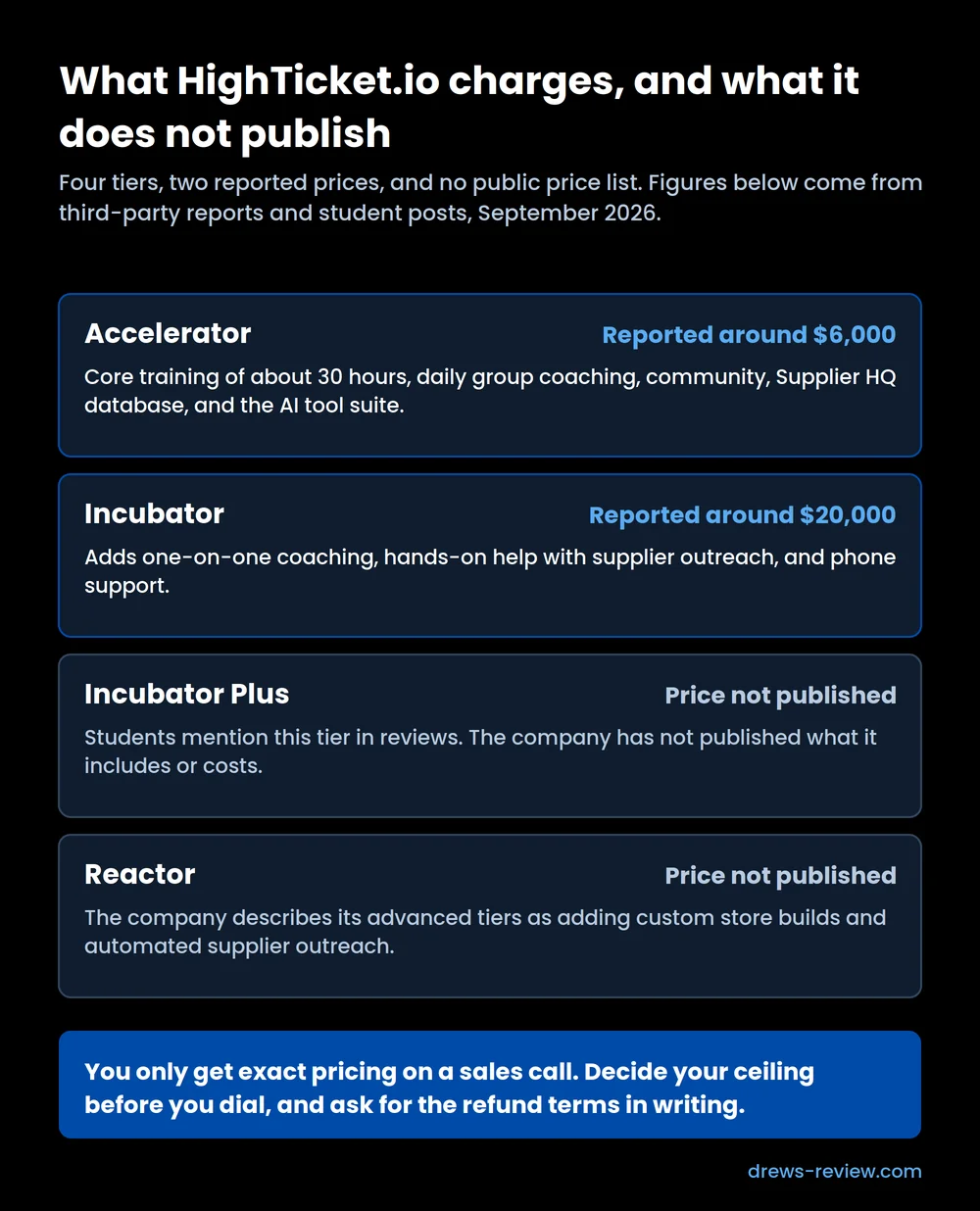
Here's what each tier appears to include, based on the company's public statements and student reviews.
Accelerator is the foundation: roughly 30 hours of training, daily group coaching calls, community access, the Supplier HQ database, and the company's AI tool suite.
Incubator adds one-on-one coaching, hands-on help with supplier outreach, and phone support.
Incubator Plus and Reactor are the advanced tiers. The company describes them as adding focused one-on-one coaching, custom store builds, and automated supplier outreach.
The unpublished price is itself worth knowing. Any program that requires a call before telling you the number is using the call to sell you. That's not unique to Brook, but go in expecting a pitch, and decide your ceiling before you dial.
Refund terms aren't published either. Older reviews, including my earlier version of this one, described a flat no-refund policy. What I can actually verify is narrower: the company says its refund policies are explained before enrollment, and its public replies to unhappy reviewers reference those policies. One reply apologizes for a delay in confirming a refund, which suggests refunds do happen in some circumstances. Get the terms in writing before you pay, and read them twice.
What Do You Actually Get With HighTicket.io?
Every tier gives you the core training, coaching calls, community access, the Supplier HQ database, and the company's AI tool suite. The higher tiers add one-on-one coaching and hands-on supplier outreach. Here's what that means in practice.
The training walks through the whole build: registering your LLC, getting your EIN and resale certificate, opening a business bank account, building the Shopify store, picking a niche, applying to brands as an authorized retailer, setting up Google Merchant Center, writing product and policy pages, and scaling ads once something converts. The company describes the Accelerator as roughly 30 hours of material.
The coaching is the part students praise most. The company runs daily group calls, and reviewers consistently mention getting specific answers rather than generic pep talks. Higher tiers add one-on-one sessions with coaches who have run stores themselves. [Verify: earlier materials described 6 months of one-on-one calls and coaches with $100K+ monthly stores. Confirm both against the current offer.]
The AI tool suite is the newest piece. The company includes it with the Accelerator, and students mention using it for niche research. I haven't used it, so I can't tell you how it compares to running the same research yourself in ChatGPT.
Supplier HQ is Brook's database of suppliers who work with dropshippers. This is the piece the whole model depends on, and it's the piece students complain about most.
The community runs on Skool, where students ask questions and post what's working. [Verify it's still on Skool.]
Bonuses in earlier materials included a tax advisory call, mastermind recordings, a product idea list with 1,500+ niches, an outsourcing masterclass, and a profit calculator. [Verify which of these are still included.]
Why Supplier HQ Is the Real Bottleneck
Getting approved by premium brands is the hardest part of this business, and a database doesn't solve it. The whole model collapses if suppliers say no, which is why the higher tiers sell help with outreach.
The problem is saturation. Thousands of students work from the same database using similar outreach templates, so the suppliers on that list get the same email over and over. Brands learn to filter them out, because new stores create support headaches and often fold within months.
Multiple reviewers describe the result. One said she contacted more than 60 suppliers from the database and got almost nothing back, with the single approval coming from a supplier that appears to accept nearly everyone. She described the list as feeling heavily recycled across members.
What premium brands actually want before they authorize you is a real business: a finished store with original copy and complete policy pages, an LLC, an EIN, a resale certificate, and usually liability insurance naming them as an additional insured party. Some want a minimum opening order, which means holding stock and giving up the main advantage of dropshipping.
This is why the program pushes B2B. Selling office furniture to a company outfitting a new floor, or equipment to a gym, gets you around consumer ad costs. But it's a different job: cold calling, custom quotes, and net-30 payment terms. Several of the success stories the company highlights are B2B deals, which is worth knowing if you signed up picturing a storefront that sells while you sleep.
One more trap worth knowing about. A reviewer described getting her Google Merchant Center account suspended because her store policies and compliance pages weren't finalized before she set it up. Get those pages done first. A suspension can stall you for weeks, and it's avoidable.
What Are Students Saying About HighTicket.io?
Reviews split along a clear line: people early in the program praise the training and coaching, while people further in describe supplier rejections and ad costs they didn't expect. Both groups are telling the truth about different stages.
Trustpilot
HighTicket.io has over 2,700 reviews on Trustpilot with a high score. [Pull the current count and rating on the day you publish, since it climbs weekly.]
Read them with two things in mind. Most of the positive reviews come from students in their first weeks, praising the module structure, the coaching calls, and the AI tools. Those reviews tell you the onboarding is good. They don't tell you whether anyone made money.
The second thing works in the company's favor: it replies to every negative review, usually within a week. Those replies are worth reading, because that's where the company states its own position on refunds, tiers, and what the Accelerator includes. A company that argues with critics in public is at least engaging with them.
Reddit is where the sharpest criticism lives, and the threads run harsher than Trustpilot. One widely shared post is from someone who says they spent $6,000 on the mentorship and regretted it. Others question whether the paid material is different enough from Brook's free YouTube content to justify the price.
Reddit skews negative for every paid program, since happy customers rarely post. But the specific complaints repeat, and repetition is the signal worth paying attention to.
The Success Stories
The wins the company promotes are real people with real numbers: students landing their first sale within months, one pair scaling to six figures monthly, another hitting $30,000 a month by month three.
Look closely at what kind of sales they are. Several are B2B deals, meaning selling to businesses rather than consumers. A single corporate furniture order can be worth more than a month of consumer sales, and landing one takes negotiation skills, not better Google ads. If the marketing sold you a storefront and your coach steers you toward cold-calling offices, that's a different business than the one you bought.
The Complaints That Repeat
Supplier rejection comes up most, with students contacting dozens of suppliers and getting few replies.
Ad costs nobody warned them about comes second. One reviewer reported being told she'd need $25,000 a month in ad spend to reach $100,000 in sales, and said she only learned that after joining. Another described watching monthly costs for ads, apps, phone numbers, and setup fees pass her sales.
Refund friction comes up too. One student finished the course, built her store, secured five suppliers, and asked for her money back as costs mounted. The company's public position is that its refund terms are explained before enrollment, and its replies to unhappy reviewers point back to those terms.
Getting a human on the phone appears in older reviews, with one student describing weeks of unanswered messages. The company's current Trustpilot reply rate suggests support has improved since then, so date any complaint you read.
What Does It Really Cost to Run a High-Ticket Store?
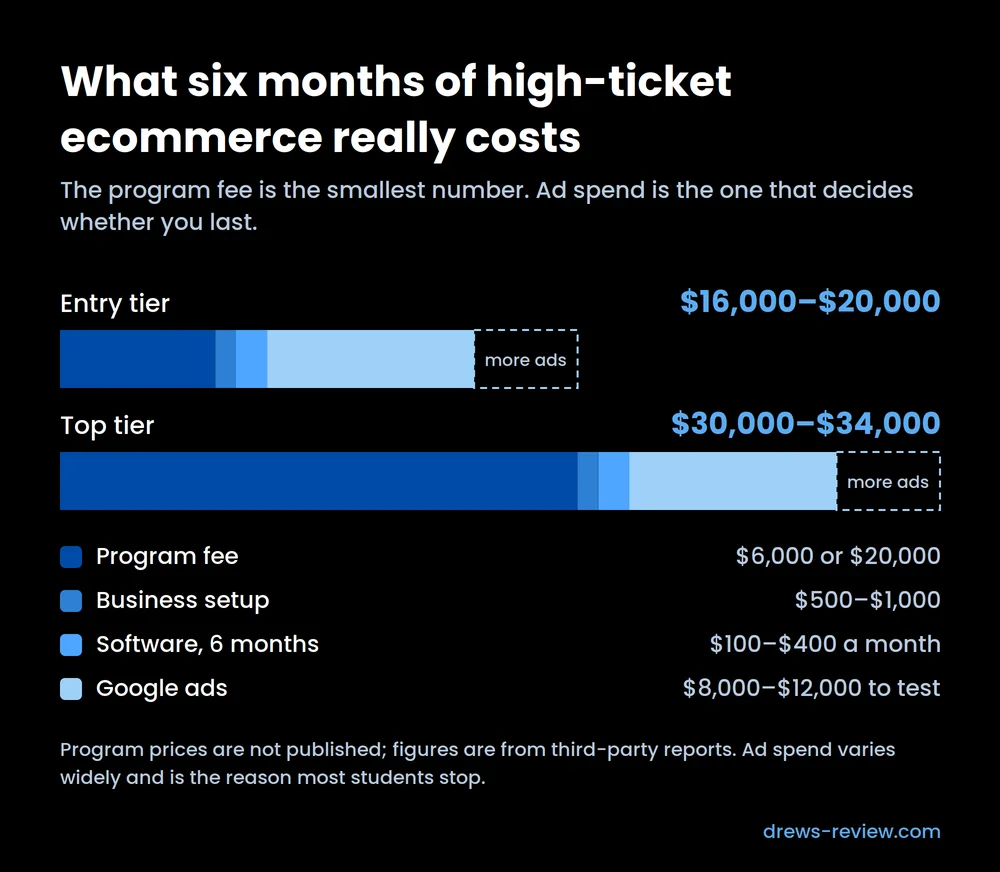
The course fee is the smallest number in this business. Between ads, software, and business setup, plan on $10,000 to $20,000 in working capital on top of whatever tier you buy, before the model pays for itself.
Here's where the money goes.
The program. Reported at roughly $6,000 for Accelerator and around $20,000 for Incubator, with the advanced tiers costing more. One payment, no published refund terms.
Business setup: $500 to $1,000. LLC registration varies by state. An EIN is free from the IRS, though plenty of services charge to file it for you. Resale certificates are usually free. Liability insurance runs a few hundred a year, and many premium suppliers require it before they'll approve you.
Software: roughly $100 to $400 a month. Shopify's entry plan, a page builder, email marketing, review apps, and a business phone line. Individually small, and they add up every month whether you sell anything or not.
Google ads: this is the real cost. Clicks on searches for expensive products are among the most competitive in retail, and luxury buyers take days or weeks to decide. You pay for every click in between. Students describe spending thousands before their first sale, and one reported being told she'd need $25,000 a month in ad spend to reach $100,000 in monthly sales.
Returns: budget for at least one bad one. A freight return on a large item means a commercial carrier, a lift-gate pickup, and a repacking bill. One damaged return can erase the profit from several good sales.
A Realistic First Six Months
If you buy the entry tier and run lean, you're looking at roughly $16,000 to $20,000 for your first six months. That's about $6,000 for the program, $800 for setup, $1,200 for software, and $8,000 to $12,000 in ad spend while you test products and find one that converts.
Buy the $20,000 tier and the same six months runs closer to $30,000 to $35,000.
The number that matters isn't the total, it's the runway. Most students who fail don't fail because the training was bad. They run out of money during the testing phase, before they've found a product that converts, and have to stop right when the data is getting useful. If your budget covers the course but only a month or two of ads, you're buying training you won't be able to act on.
One honest note on the ad math. You'll see people frame ad spend as a simple ratio, like spending $25,000 to make $100,000. Early on, your ratio will be much worse, because you're paying for clicks on products that turn out not to sell. The ratio improves only after you've spent enough to know what works. Budget for the learning, not the steady state.
I Don't Just Review These Programs - I Build Active Digital Assets
When you see the actual capital requirements of high-ticket dropshipping, it becomes clear that the model is built for people who already have massive corporate budgets. For the everyday entrepreneur, spending $35,000 just to test a business model is highly inefficient.
In my own business, I practice what I preach. I focus entirely on building low-overhead digital assets that generate consistent, automated cash flow without the constant headache of shipping logistics, inventory sync tools, or expensive PPC ad campaigns.
To show you what is possible when you build highly optimized organic assets instead of chasing expensive physical freight, here is a look behind the scenes of my active pipelines:
1. Faceless YouTube with AI
Inside my own training, I show students exactly how I build automated, highly targeted traffic engines. By leveraging organic traffic rather than burning thousands on Google Ads, I scaled one of my niche channels to over $7,600 in direct ad revenue alone (crossing $10,000 in total revenue when factoring in backend product sales).
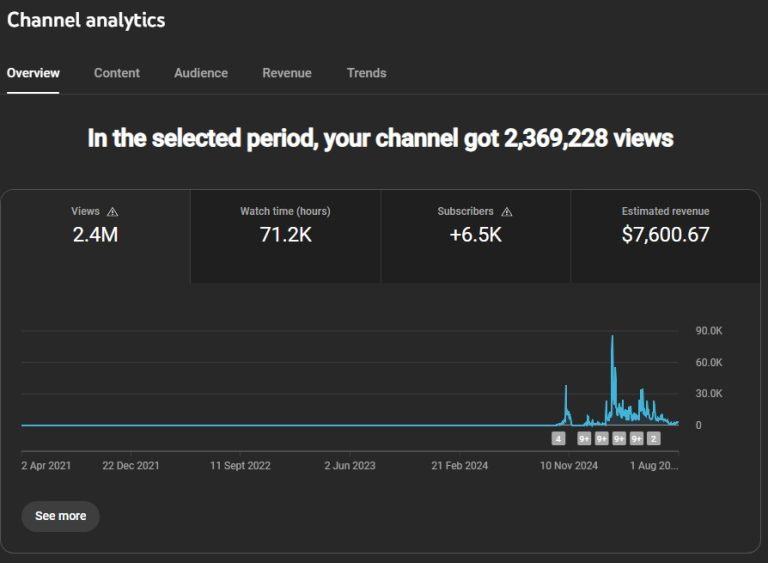
Figure 1: Real-time traffic analytics from one of my niche YouTube channels—generating over $7,600 in direct ad revenue without spending a dollar on ads.
2. Digital Products with AI
Because I sell digital assets rather than physical products, I don't deal with suppliers, shipping damage, or freight carriers. By utilizing clean checkout systems, my storefront consistently processes automated, direct-to-consumer digital sales daily.
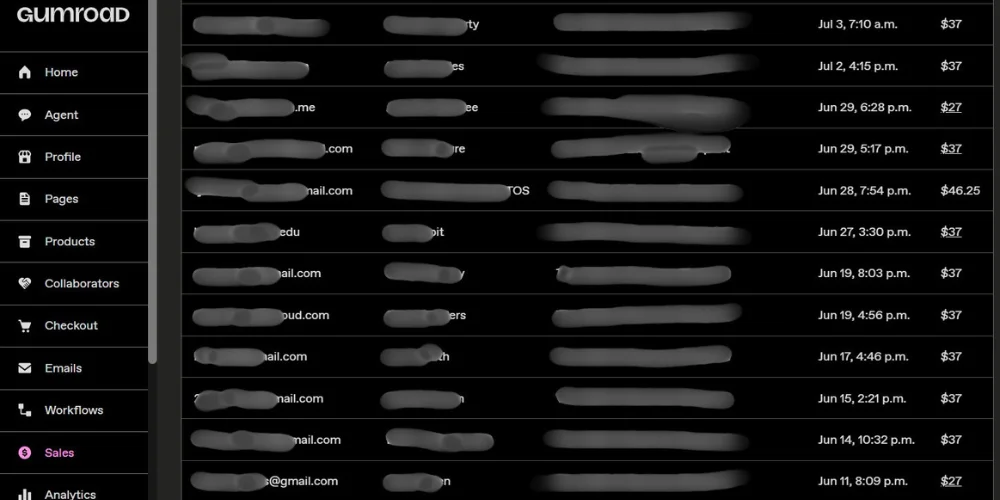
Figure 2: Consistent, automated digital product sales flowing directly into my Gumroad storefront—no client management, no high-ticket retainers, and zero sales calls.
This is the model I teach. Instead of locking up $30,000+ of your hard-earned capital in high-risk physical inventory and ad campaigns, I focus on building high-margin digital real estate that belongs entirely to you.
Not yet ready to commit to a course? Download my free guide to learn what AI businesses are making money right now.
Why Supplier HQ Falls Short in Execution
The concept behind Hiddink’s proprietary database, Supplier HQ, sounds incredibly simple: log in, pick a luxury US supplier, use a template to email them, and get approved to list their products.
In reality, supplier saturation is a major roadblock. When thousands of students are all using the exact same database and email templates, premium suppliers get bombarded. They’ve learned to instantly filter out or auto-reject these templated emails because new, unestablished stores often fail within months and create customer service headaches.
Premium US brands will not partner with you unless you can prove your business is legitimate. Before they approve you as an authorized retailer, they typically require:
- A Fully Built, Professional Store: Not a generic Shopify template. They want to see high-quality branding, unique copywriting, and complete compliance pages.
- Legal Business Infrastructure: Registered LLC documents, an EIN, and a resale certificate from your state.
- General Liability Insurance: Most luxury suppliers require you to carry business insurance, often naming them as an additional insured party ($300 to $500 annually).
- Minimum Purchase Orders: Some suppliers require you to stock $5,000 to $10,000 in physical inventory upfront, defeating the entire concept of dropshipping.
Because direct-to-consumer supplier acquisition has become so difficult, the program has increasingly pivoted students toward B2B (Business-to-Business) sales. While B2B contracts (like selling office furniture to a corporate office) can be highly lucrative, they require an entirely different skill set: cold calling, custom pricing negotiations, and managing net-30 payment terms. This is a far cry from the passive Shopify storefront shown in the marketing.
Does High-Ticket Dropshipping Still Work in 2026?
Yes, high-ticket dropshipping still works, but the barrier to entry has skyrocketed. The landscape in 2026 is vastly different from when Brook Hiddink started his first store in 2021:
- Skyrocketing Ad Costs: Keywords that cost $3 to $5 per click in 2021 now run $8 to $15+ per click on Google Shopping due to intense competition.
- Sophisticated Buyers: Modern consumers are highly skeptical of middlemen. They will cross-reference your Shopify prices, check if you are a verified authorized dealer, and buy directly from the manufacturer if they spot a dropship markup.
- The 90% Failure Rate: According to Forbes, the vast majority of dropshipping stores fail. In high-ticket e-commerce, that failure is much more expensive because you run out of testing capital before finding a winning product.
Top Alternatives to High-Ticket Incubator
If you want to build an online business without risking $20,000 on a single course, there are much more balanced alternatives:
| Business Program / Model | Upfront Cost | Refund Policy | Primary Focus | Best For |
| eCom Elites (Franklin Hatchett) | $197 – $297 | 30-Day Money-Back | Comprehensive Shopify dropshipping (all budget levels) | Beginners who want to learn the mechanics of e-commerce safely. |
| High-Ticket Masterclass (Joe Verschoor) | $3,000 – $5,000 | Case-by-case | High-ticket dropshipping with custom supplier support | Those set on high-ticket but unwilling to pay $20K. |
| Affiliate Marketing Assets | $500 – $1,500 | N/A | Reviewing products, SEO, and earning commissions | Those who want to avoid suppliers, inventory, and customer service. |
| The 2026 AI Business Blueprint | $47 | Risk-Free | Automated AI workflows across 5 business models | Entrepreneurs wanting to launch low-overhead businesses fast. |
The AI Approach: Cutting Out the Manual Grunt Work
Programs like High-Ticket Incubator teach manual, time-consuming workflows developed years ago: spending days scrolling through databases, writing dozens of product descriptions by hand, and managing complex ad campaigns manually.
In 2026, AI compresses these timelines to practically zero:
Product Research: Rather than scrolling through databases for hours, you can use advanced AI prompts to analyze trending products, target demographics, and competitor weaknesses in minutes.
Store Design & Copywriting: AI tools can generate compelling product descriptions, shipping policies, and high-converting landing page copy in seconds, saving you thousands in freelance copywriter fees.
Automated Customer Support: Integrating AI chatbots into your Shopify store allows you to automate up to 80% of routine customer inquiries (tracking info, returns, specifications), leaving you to only step in for complex issues.
By utilizing AI, you drastically lower your operational costs. If a niche doesn't work, you can pivot to another one immediately without losing thousands of dollars in setup fees.
Final Verdict: Is High-Ticket Incubator Worth $20,000?
For most people reading this, no, and the reason is money rather than quality. The training is thorough, the coaching is frequent, and students say good things about both. But the program asks for thousands up front and then thousands more in ad spend before you know whether your niche works.
Be clear about what you're buying. At the entry tier, you're paying roughly $6,000 for training, coaching, and a supplier database, then funding your own experiment on top of it. At the higher tiers, you're paying for one-on-one time and help with supplier outreach, which exists because that outreach is the hardest part of the model.
What I'd want to know before paying: the exact price of the tier you're considering, the refund terms in writing, and what the coach you'll be assigned has actually built. Those are fair questions on a sales call, and the answers tell you a lot.
My concern hasn't changed since I first wrote this review. Teaching beginners to replicate 2021 and 2022 results in 2026, without being upfront about the capital required and how often this doesn't work, is the part I can't get past. Brook's own story includes 13 failed stores before the one that worked. That's the honest version of this business, and it deserves more airtime than it gets in the ads.
Consider this program only if all three apply:
- You have $15,000 or more you can lose without it changing your life.
- You already understand paid ads, or you're prepared to lose money learning them.
- You're ready to handle freight, damaged deliveries, and customer service on expensive items.
If that's not you, learn ecommerce on a smaller budget first, or build something where your main investment is your time instead of your ad account.
Frequently Asked Questions
How much does HighTicket.io cost?
HighTicket.io doesn't publish its prices. Third-party reports put the Accelerator around $6,000 and the Incubator around $20,000, with Incubator Plus and Reactor costing more. You get exact pricing on a sales call, and none of it includes the ad budget you'll need.
Does HighTicket.io offer refunds?
The refund terms aren't published publicly. The company says its policies are explained before enrollment, and its replies to unhappy reviewers point back to those terms. Ask for them in writing before you pay.
Who is Brook Hiddink?
Brook Hiddink is a Canadian ecommerce entrepreneur based in Dubai who founded HighTicket.io in 2022, a year after starting his own store. He also founded Supplier HQ and co-founded GuruPay. He says his first 13 low-ticket stores failed before he switched to high-ticket.
What is the One Order Away Method?
It's Brook's name for selling products priced at $3,000 or more, so a single sale clears around $1,000 in profit. You become an authorized retailer for US brands and use Google Shopping ads to reach buyers who are already searching.
Is Brook Hiddink legit?
Yes, he runs a real company with thousands of paying students and a support team that answers publicly. The criticism isn't that the business is fake. It's that the price is high, the total cost isn't disclosed up front, and the model needs far more capital than the marketing suggests.
How much money do you need to start high-ticket dropshipping?
Plan on $10,000 to $20,000 beyond the course. That covers business setup, software, and enough ad spend to test products long enough to find one that converts. Running out of money mid-test is the most common way students fail.
Does high-ticket dropshipping still work in 2026?
Yes, but it's harder and more expensive than when Brook started in 2021. Ad costs are higher, buyers check whether you're an authorized dealer, and thousands of students are approaching the same suppliers from the same database.
Is Supplier HQ worth it?
It's the weakest part of the offer, according to reviewers. Students describe contacting dozens of suppliers and hearing back from almost none, since brands receive the same templated outreach constantly. The higher tiers sell help with this, which tells you how big the problem is.
What is Brook Hiddink's net worth?
Nobody outside his business knows, and any figure you see online is a guess. What's verifiable is that he runs a training company with thousands of students, a supplier database, and a stake in a software company.
Got questions about High-Ticket Incubator or Brook Hiddink? Drop a comment below and I'll respond.

- Top West Coast Fulfillment Companies for Ecommerce Brands in 2026 - October 19, 2026
- Digital Entrepreneurs Are Discovering That Physical Operational Infrastructure Accelerates Digital Scale - October 18, 2026
- Fast-growing E-commerce Sellers Are Overhauling Fulfillment Hubs To Keep Up With Orders - October 16, 2026