Hey, Drew here. If you've been researching ways to make money online with local lead generation, you've probably come across Cory Long and his Digital Storefronts course. And you probably have the same question everyone else does — is it worth dropping $5,000 on?
I spent a lot of time digging into this one. I went through independent reviews, scraped Reddit threads, read BBB complaints, watched YouTube breakdowns, and cross-referenced what Cory claims with what his students actually say. I've been in the affiliate marketing and online business space since 2010, so I know what a solid course looks like and what a red flag looks like.
My short answer: Digital Storefronts is not a scam, and the rank-and-rent business model it teaches is legitimate. But there are real concerns — the high price, a murky refund policy, a controversial backstory involving Cory getting kicked out of the program he learned everything from, and a noticeable lack of recent student success stories. For $5,000, I'd expect a lot more transparency and a lot more proof.
💡 Digital Storefronts Costs $5,000 and Teaches One Business Model. Here's What $47 Gets You.
Digital Storefronts teaches local lead generation — building small websites, ranking them on Google, and renting leads to businesses. It's a proven model. But $5,000 is a steep entry point, especially when you can't even see the price until you sit through a sales call. If you don't have that kind of money to invest in a course — or you want to test the waters making money online before locking into a high-ticket program — my 2026 AI Business Blueprint covers 5 proven business models (including local lead gen) for $47 one-time. No sales call, no upsells, no financing needed.
Jump to the AI alternative or keep reading to see what Digital Storefronts actually offers first.
⭐ Digital Storefronts Rating: 2.5/5
I give Digital Storefronts a 2.5 out of 5. The rank-and-rent business model it teaches is legitimate and has real income potential — that's what keeps it from scoring lower. But at $5,000+, I expect a lot more than what you're getting here. The SEO training hasn't kept up with how Google works in 2026, the refund policy is murky at best (with students reporting they were denied refunds outright), the student success stories are few and recycled from years ago, and the DFY upsells inflate your real cost well beyond the initial price tag.
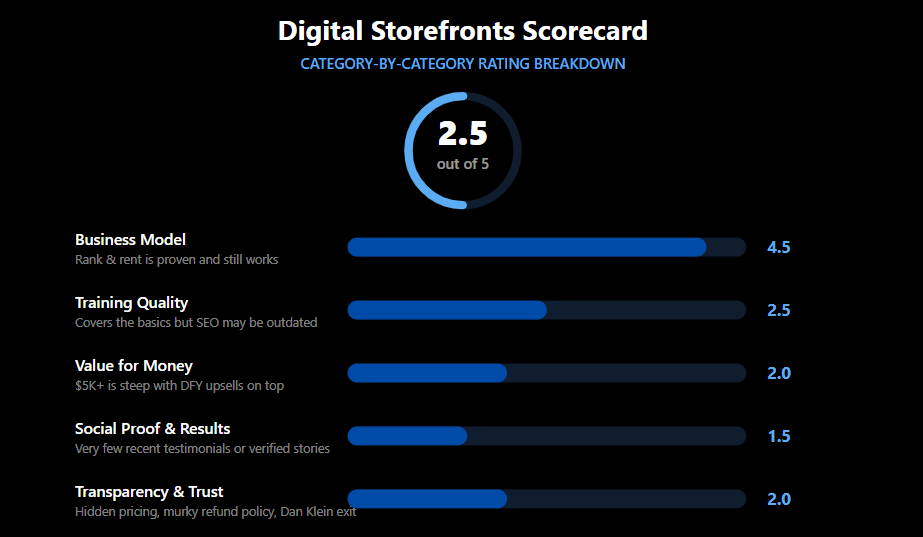
The Dan Klein backstory also raises trust concerns that are hard to ignore. If this course were priced at $500–$1,000 with a clear money-back guarantee, I'd score it higher. But when you're charging premium prices, you need premium proof — and Digital Storefronts doesn't deliver that.
What Is Digital Storefronts?
Digital Storefronts is a 7-module video course that teaches you the rank-and-rent local lead generation business model. You learn how to build simple websites for local services (think plumbing, tree care, roofing), rank them on Google using SEO, and then rent those leads to local business owners for a monthly fee.
The concept is similar to owning digital real estate. You build a small website targeting long-tail local keywords like "tree removal service in Topeka" and get it ranking in Google's organic results and the local map pack. Once the site starts generating phone calls and inquiries, you forward those leads to a local business using a call tracking number that you control. The business owner pays you a recurring monthly fee — typically $500 to $2,000 per property — because those leads bring them paying customers.
The course also includes access to a private Facebook group, coaching calls, and optional Done-For-You services like website builds. It's sold exclusively through a strategy call with Cory's sales team via growdigitalstorefronts.com, so there's no public checkout page or listed price.
If you're familiar with the Digital Rental Method or other rank-and-rent programs, Digital Storefronts follows the same playbook. The main differentiator Cory emphasizes is the faith-based community angle — more on that below.
Who Is Cory Long?
Cory Long is an entrepreneur, digital marketer, minister, and the founder of Yroc Consulting LLC based in Sherman, Texas. He graduated from Texas Tech University with a degree in Electrical and Electronics Engineering and spent 17 years working in full-time ministry — youth ministry, college ministry, and serving as CEO of Carpenter Place in Wichita, Kansas.
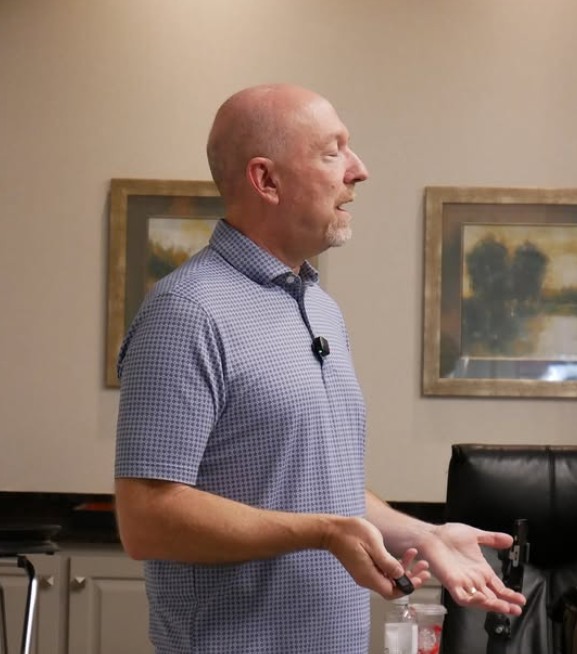
In 2014, he started North Texas Safety Supply, providing safety equipment to construction businesses. That company became overwhelming, so he pivoted to online consulting and founded Yroc Consulting, which helps small businesses grow through digital marketing and SEO. It was around this same time that Cory discovered the local lead generation business model through a coaching program created by Dan Klein.
After finding success with lead gen himself, Cory launched Digital Storefronts in 2019 to teach others how to do the same thing. The program was initially called "Digital Tentmaking" before being rebranded. He positions it specifically toward Christians, pastors, missionaries, and ministry-minded people who want to fund their calling while building an online income.
Cory claims to have served over 800 clients through Yroc Consulting and says his businesses have generated over $42 million in revenue. He's also received ClickFunnels' Two Comma Club award. On the side, he runs Kingdom Co-Lab (a Christian business community), Faith Epoxy of Texas, and more recently launched The Entrepreneurial Forge (E-Forge) Accelerator — a weekly coaching program for established business owners looking to scale.
His Yroc Consulting LLC is listed on the Better Business Bureau with a B- rating. The business is not BBB Accredited and has one unanswered complaint on file. Worth noting — several competing review sites claim Cory has no BBB listing at all. That's wrong. The listing exists under Yroc Consulting at 1800 Teague Dr Suite 416, Sherman, TX 75090.
The Dan Klein Backstory (This Is Important)
This is the single most-discussed controversy around Cory Long, and it comes up in virtually every independent review of Digital Storefronts. If you're thinking about buying this course, you need to know this story.
In 2014, Cory joined a local lead generation coaching program created by Dan Klein, an 8-figure entrepreneur who has been in the lead gen space for over 15 years. The program was originally called "Job Killing." Cory was a standout student — he closed his first deal within three weeks of joining and eventually spoke at their live events in Las Vegas.
After a couple of years, Cory and Dan tried to become business partners. Dan even helped Cory start putting together his own program. But the partnership fell apart. According to multiple sources — including Dan's own team, former students, and the one Reddit thread that actually discusses this — Cory was kicked out of the program for selling his own services and course to other students inside Dan's private group. That was explicitly against the group's rules.
After his exit, Cory launched Digital Storefronts in 2019. Multiple reviewers describe the course as a derivative of Dan Klein's original curriculum. The module structure, the strategies taught, and the overall framework follow the same playbook. One reviewer from ippei.com (who was the main coach in Dan's program) put it bluntly — the course is essentially a repackaged version of what Dan teaches, but without the same depth or ongoing updates.
Interestingly, another lead gen instructor named Chad Kimball claims to have taught Dan Klein the business model in the first place. Kimball calls himself Cory's "Internet Marketing Grandpa." So there's a whole lineage here.
Does this make Digital Storefronts a bad course? Not necessarily. Cory did learn the model, he did have success with it, and he does teach it. But the way he went about starting his own program — soliciting students from the group that trained him, after agreeing not to — is a legitimate trust concern. Especially for someone who leads with his identity as a minister.
How Much Does Digital Storefronts Cost?
The base price for Digital Storefronts sits around $5,000, but the actual amount varies depending on what you negotiate on the sales call. I've seen reports ranging from $4,000 all the way up to $7,500.
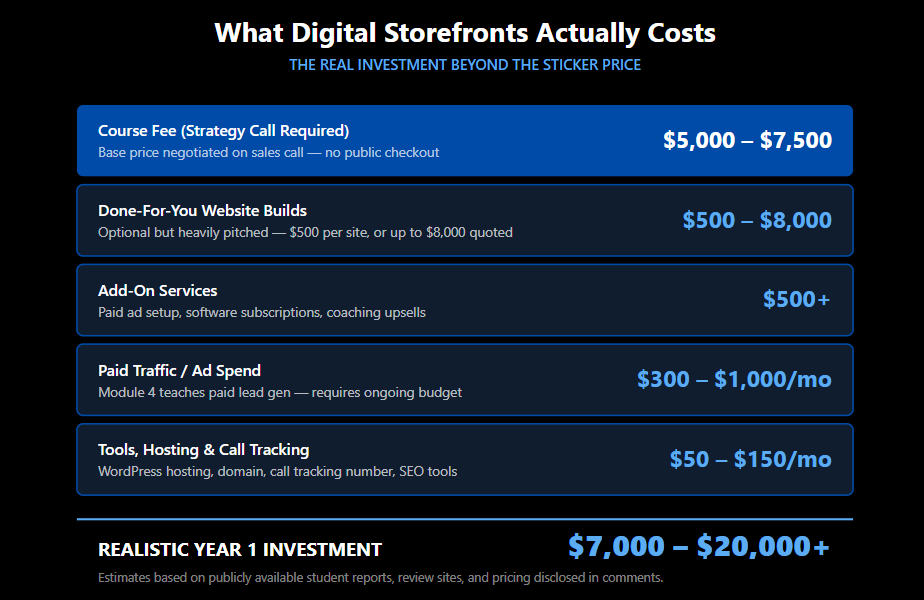
There is no publicly listed price. You can't go to a website and click "buy." Instead, you book a strategy call through Cory's funnel pages, fill out an application, and then get on the phone with a sales rep who walks you through the program and presents pricing based on your situation. This is a standard high-ticket sales process — common in the coaching industry, though it rubs some people the wrong way because of the pressure-cooker environment.
One commenter on ScamRisk described being quoted $7,500 with a $1,000 discount if they signed within 48 hours. They were offered PayPal Credit as a financing option — six months interest-free, but if you don't pay it off in time, interest gets retroactively applied from day one. Another commenter on the same thread signed up for a precursor program called "Freedom to Serve" at $1,997 before even getting access to the full Digital Storefronts training.
The $5,000 is just the starting point. On top of the core course fee, Cory's team offers additional Done-For-You services. Website builds run around $500 each, and there are add-ons for paid advertising setup, software subscriptions, and other services. These can add up quickly. One source noted that a single DFY storefront was quoted at $8,000.
For context, there are other rank-and-rent and local lead gen courses on the market at a fraction of this price. The Local Marketing Vault and Google Maps Gold both teach similar concepts and are worth comparing if you're shopping around.
What's Inside the Course? (Module Breakdown)
Digital Storefronts is structured as a 7-module video training program with an introductory section. After you pay and get your login, you access an online portal where each module contains several training videos. Here's what's covered.
Introduction and Success Road Map
Cory opens with a welcome section laying out the business model, setting expectations, and providing a success roadmap. Standard stuff — most online courses start this way. He gives you a high-level view of how rank and rent works and where you'll be by the time you finish the training.
Module 1: Finding the Perfect Locations
This module focuses on choosing where to build your lead generation sites. Cory teaches you how to evaluate markets based on niche demand, market size, competition level on Google, and competition in the local market itself. He encourages you to target high-ticket service businesses — contractors, dentists, financial consultants, roofers — that don't have strong digital presences already.
Location selection is one of the most important decisions in rank and rent because picking the wrong market means months of work with nothing to show for it. This module covers the basics well from what I've seen in the breakdowns.
Module 2: Creating Digital Storefronts
Here Cory walks you through building your actual lead generation websites and setting up Google Business Profiles. The site-building training uses WordPress as the platform, and he covers how to get a GBP approved (which can be tricky since Google has cracked down on verification methods in recent years).
One criticism I've seen from multiple reviewers is that WordPress is not ideal for simple lead gen sites. It's designed more for blogs and content-heavy sites with all its plugins and extensions. Some competing programs use purpose-built site builders that are faster to deploy and easier to optimize for local rankings.
Module 3: Getting Ranked
The SEO module. Cory teaches how to get your digital properties ranking on Google through backlinks, citations, keyword optimization, and content strategy. He also covers ranking in multiple locations with a single property.
This is where some reviewers raise concerns about the training being outdated. Multiple sources — including one reviewer who has been doing rank and rent for 11 years — say that Cory's SEO strategies lean heavily on older techniques that were more effective a few years ago. Google's algorithm has evolved significantly, and the local SEO landscape in 2026 is different from what it was when Digital Storefronts launched in 2019.
Module 4: Quick Lead Methods
This module introduces paid traffic as a way to generate leads faster while waiting for organic rankings to kick in. Cory covers Facebook Ads and social media strategies for driving leads to your storefronts.
The caveat here is that paid traffic can burn through cash quickly if you don't have a solid strategy. Several reviewers noted that Cory's paid traffic teachings can get expensive without delivering results, especially for beginners who don't have experience managing ad spend.
Module 5: Finding and Closing Deals
Once your sites are generating leads, you need to actually find business owners who will pay for them. Cory teaches prospecting strategies — looking at Google Maps for businesses with weak online presences, reaching out directly, and explaining the value of the leads you can provide.
The ScamRisk review pointed out that this module could be deeper. Sales and client acquisition are often the hardest parts of running a lead gen business, and several lead gen programs on the market dedicate significantly more training time to this step.
Module 6: Tenant Attraction System
A continuation of the client acquisition module. Cory calls the business owners who rent your digital storefronts "tenants" (similar to how a landlord rents property to a tenant). This module covers how to market your services and attract business owners who want to work with you long-term.
Module 7: Bonus Module
Additional training materials and resources. Details on exactly what's included here are sparse in public reviews.
Does the Rank and Rent Business Model Still Work in 2026?
Yes. Local lead generation through rank and rent is still a viable business model in 2026. The fundamentals haven't changed — local businesses need customers, and most of them are terrible at digital marketing.
According to BrightLocal's annual consumer survey, the vast majority of consumers still use Google to find local businesses on a regular basis. Research from other industry sources puts the number of small businesses without any website at all around 27%. Nearly half of all Google searches have local intent. That's a massive gap between what business owners need and what they're actually doing online.
The model works because you're building assets you own. Unlike running a marketing agency where you're constantly chasing clients and managing their campaigns, a ranked lead gen site generates calls on autopilot once it's positioned well. The business owner pays you a monthly fee because those calls turn into revenue for them. It's a win-win arrangement as long as the leads keep flowing.
That said, the landscape has gotten more competitive since 2019 when Digital Storefronts launched. Google has tightened its policies around Google Business Profile verification (making it harder to set up listings without a real physical address), and AI-powered search is starting to change how people discover local services. The model still works, but the execution needs to be more precise than it was five years ago. That's why up-to-date training matters.
What Do Real Students Say About Digital Storefronts?
This is where things get complicated. Finding genuine, independent student reviews of Digital Storefronts is surprisingly difficult for a program that's been around since 2019.
Reddit Reviews
There is essentially one Reddit thread about Digital Storefronts, and it contains the full spectrum of opinions.
On the positive side, one user (DueOperation7952) shared that they joined the program, learned what they needed, and used it to start their own lead gen agency. They said they still respect Cory and have met him at live events. Another user was trying to resell their unused access at half price and called it a "good program, just wrong time in life."
On the negative side, the most recent comment (from just a few weeks ago, by user Distinct-Poet5810) is a detailed complaint. They paid $5,500 for the course and an additional $1,500 for DFY website builds that were never delivered. They said the training videos were already outdated by the time they bought in and that the internet was already saturated with lead gen sites. When they requested a refund, they received a personal email from Cory explaining that success was never guaranteed and warning that if they attempted a chargeback, his team would fight it.
An older comment mentioned people looking into suing to recover a $10,000 investment, though I couldn't verify whether any legal action was actually taken.
One thing multiple Reddit users pointed out — and this is important — is that most of the "review" sites ranking on Google for "Digital Storefronts review" are affiliate sites for competing lead gen courses. Sites like ScamRisk push Digital Leasing. Ippei.com pushes Dan Klein's program. One Reddit user specifically called out ScamRisk as "nothing more than an affiliate marketing site to push Josh Osborne's lead gen course." They're not wrong. Almost every review I read follows the same formula: acknowledge the business model works, criticize Cory, then funnel you to their preferred alternative. Take those reviews with a heavy grain of salt.
Independent Review Feedback
Across all the review sites I analyzed, the sentiment breaks down roughly like this: positive reviews tend to come from Cory's own platforms (his YouTube testimonials playlist, his SoTellUs page with 124 reviews). Negative reviews tend to come from Reddit, blog comment sections, and the BBB. The independent review sites themselves are almost all competitor-affiliated, so they skew negative by design.
The biggest issue isn't that reviews are bad — it's that there just aren't many independent ones at all. For a program claiming anywhere from 2,000 to 7,000 students (depending on which source you believe), the absence of organic, unsolicited success stories is conspicuous. Cory's own YouTube channel has videos with thousands of views but comments are either turned off or barely existent. The few testimonials that do appear on his sales pages are the same three or four stories recycled over and over — Kelly, Brad, and an insurance agent. These are real people, but they appear to be from several years ago.
There is no Trustpilot page for Digital Storefronts or Cory Long.
What Are the Pros of Digital Storefronts?
The business model itself is solid. Rank and rent local lead generation has been working for over a decade and there's a real demand for it. Local businesses need leads, and most of them are not going to figure out SEO on their own. If you can build and rank a site, you have a genuinely valuable asset.
Cory does have real experience. Whatever you think of how he got started, the fact remains that he learned the model, made money with it, and has been teaching it for several years. His Yroc Consulting agency has real clients and real results.
The course covers the full process from start to finish. You're not left guessing what comes next. The 7 modules walk you through location selection, site building, ranking, lead generation, and client acquisition in a logical sequence.
The training platform is easy to navigate. Multiple reviewers noted that the portal is clean and straightforward. One video per page, progress tracking, and simple navigation. Nothing fancy, but it works.
There is a community component. The private Facebook group gives you access to other students and to Cory's team for questions and support. Whether the group is active enough to justify the price is another question, but the support structure does exist.
The faith-based angle resonates with a specific audience. If you're a Christian entrepreneur, pastor, or ministry worker looking for an online income that aligns with your values, this positioning may genuinely appeal to you. It's a real differentiator from the typical "make money online" crowd.
What Are the Cons of Digital Storefronts?
The price is steep for what you get. At $5,000+ for a 7-module video course, Digital Storefronts is one of the more expensive rank-and-rent programs on the market. Other courses teaching the same business model are available at a fraction of the cost. The Agency Vault and Modern Millionaires are both worth looking at if you want to compare.
The DFY upsells add up fast. After paying $5,000 for the course, you'll be pitched additional services — website builds at $500 each, paid ad setup, software subscriptions. These aren't optional extras for most beginners; they're things you'll feel pressured to buy because the course positions them as shortcuts to results.
There's very little recent social proof. The same handful of student testimonials have been circulating for years. A program claiming thousands of students should have a steady stream of fresh success stories. The absence raises legitimate questions about how many students are actually getting results.
The SEO training may be outdated. Multiple knowledgeable reviewers have flagged that Cory's ranking strategies lean on older techniques. Google's algorithm updates, the rise of AI search, and tighter GBP verification policies have all changed the local SEO landscape since 2019. If the training hasn't kept pace, students are learning methods that may not work as well today.
The sales process is high-pressure. The strategy call model means you don't know the price until you're on the phone with a salesperson. Quotes vary wildly — from $4,000 to $7,500 — and limited-time discount offers create urgency. This is a standard high-ticket tactic, but it doesn't build trust.
The Facebook group is small. Depending on the source, the private group has somewhere between 500 and 1,000 members. For a program that claims thousands of graduates, that's a low retention number. Some reviewers also noted that engagement in the group is minimal.
The originality question lingers. Whether or not it bothers you, the fact that Digital Storefronts is widely viewed as a repackaged version of Dan Klein's program is a legitimate concern. You're paying premium pricing for content that was originally developed by someone else.
Can You Get a Refund?
This is one of the most confusing aspects of Digital Storefronts, and it's a red flag. The refund policy is inconsistent depending on where you look.
Some sources reference a 90-day refund policy. The exact wording from the Terms and Conditions reportedly reads: "We will return contracts within 90 days of the original contract purchase." That sounds like a money-back guarantee, but it's vague enough to leave room for interpretation.
However, ippei.com's review (updated April 2026) states flatly that Digital Storefronts does not issue refunds after the initial payment. One review site quoted Cory's policy as explicitly stating there are no refunds.
And then there are the student experiences. On ScamRisk, a commenter named Diana said she was in the program for less than three weeks, requested a refund of her $4,000 payment, and was refused. She called it "one of the biggest mistakes in our life." On Reddit, the most recent commenter described trying to get a refund and receiving a personal email from Cory explaining that he never guaranteed success — and warning that if they pursued a chargeback, his team would contest it.
The refund policy is not mentioned in the FAQ section of the sales page. You have to dig through the Terms and Conditions to find it, which is never a great sign. If I'm spending $5,000, I want crystal-clear refund terms in writing before I hand over my credit card — not buried in legal language.
My advice: if you're seriously considering buying, get the refund policy in writing on the sales call before you commit. Record it if your state allows single-party consent. Don't assume you'll get your money back if it doesn't work out.
Is Digital Storefronts a Scam?
No, Digital Storefronts is not a scam. Cory Long is a real person running a real business. The rank-and-rent model he teaches is legitimate and has generated real income for people who have applied it. You get actual training content, access to a community, and support from his team.
That said, "not a scam" and "worth $5,000" are two very different things.
There are enough yellow flags — the Dan Klein exit, the murky refund policy, the recycled testimonials, the expensive DFY upsells, and the high-pressure sales process — to warrant serious caution. The business model is sound. Whether this specific course is the best way to learn it at this price point is the real question.
I'd put it this way: if you're a Christian entrepreneur who specifically values a faith-based community and you have $5,000 to invest without financial stress, Digital Storefronts might work for you. But if you're evaluating strictly on value for money and quality of training, there are stronger options available at lower price points.
How Does Digital Storefronts Compare to Other Lead Gen Courses?
Digital Storefronts sits in a crowded market. There are several other programs teaching the same rank-and-rent business model, often with more content, more social proof, and lower prices. Here's how it stacks up against some of the alternatives I've reviewed.
Local Marketing Vault by James Bonadies focuses on lead generation with a heavier emphasis on paid ads (Google Ads and Facebook Ads) rather than organic SEO. It has a larger community and more documented student results. If you want a lead gen course that doesn't rely exclusively on ranking sites organically, LMV is worth a look.
Google Maps Gold focuses specifically on ranking Google Business Profiles in the local map pack. Since that's a core component of what Digital Storefronts teaches, this is a solid specialized alternative at a fraction of the cost.
Agency Vault by Connor Cahill teaches you how to build a full digital marketing agency, which is what many rank-and-rent practitioners end up doing as they scale. If you think you might want to offer additional services beyond just lead gen, this could be a better fit.
The Digital Rental Method follows a very similar rank-and-rent framework to Digital Storefronts but with different pricing and a different community structure. Worth comparing if you're set on this exact business model.
And then there's Dan Klein's original program that Cory learned from. If you want the source material rather than the derivative, that's an option too — though it's also high-ticket.
Don't Have $5,000? Here's What I'd Do Instead
If you're interested in making money online but $5,000 for a single course feels like too big a bet, I get it. That's a lot of money to put down — especially when you can't see the price upfront, the refund policy is questionable, and you're being asked to commit on a high-pressure sales call.
Here's what I'd recommend instead.
My 2026 AI Business Blueprint costs $47 one-time and covers 5 proven online business models, including local lead generation. It won't replace a dedicated rank-and-rent coaching program, but it will show you how AI tools can compress the execution timeline on every model — from building sites to generating leads to creating content. No sales call, no upsells, no financing needed.

If you're not even sure this space is for you, start with my free guide: Want to Build a $10K/Month AI Business Without a Team or Paid Ads? It walks you through the basics of what's working right now and whether an AI-powered online business makes sense for your situation.
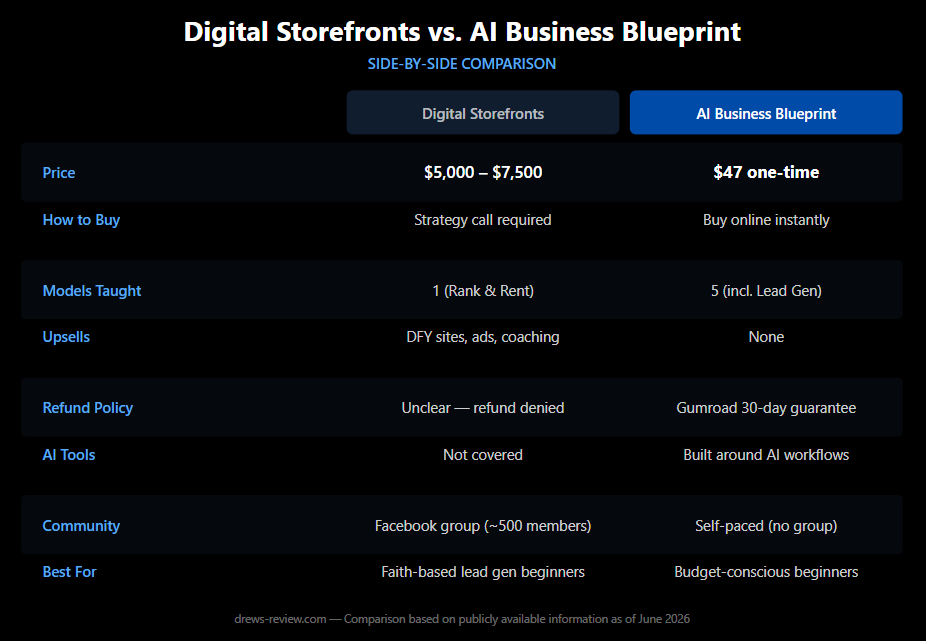
And if you want a deeper look at how people are actually making money online with AI in 2026, I break down the 5 models that are producing real results right now — with specific tools, workflows, and income examples.
The point is this: you don't need to drop $5,000 to get started. Test the concept, see if you like it, and then invest more once you know the business model is right for you.

Who Should Buy Digital Storefronts?
Digital Storefronts makes the most sense for a specific type of buyer. If the following describes you, it could be a fit.
You're a Christian entrepreneur or ministry worker who specifically values a faith-based business community. This is Cory's strongest differentiator and the reason some students choose his program over cheaper alternatives. If having a coach and community that share your values matters more to you than getting the absolute lowest price, that's a legitimate reason to lean toward Digital Storefronts.
You have $5,000+ to invest without putting yourself in financial stress. This is not a course you should buy on credit if money is tight. The additional costs (DFY services, ad spend, software) will add up, and it may take months before your sites start generating revenue. You need a financial cushion.
You want a complete, structured program rather than piecing things together from free content. Digital Storefronts does walk you through the entire process from start to finish. If you're the type who learns best from a step-by-step system with coaching support, the structure has value.
You're comfortable with the Dan Klein backstory and the limitations of the training. If you've read everything above and you still feel good about Cory as a coach, then the controversy shouldn't stop you. Just go in with realistic expectations.
Who Should NOT Buy Digital Storefronts?
You're on a tight budget. Spending $5,000+ on a course when you don't have money set aside for the additional costs (ad spend, tools, DFY services) is a recipe for stress and failure. You'll be underfunded before you even start.
You expect quick results. Ranking websites organically takes time — often 3 to 6 months or more. If you need income next month, this model won't deliver that. The paid traffic module can speed things up, but that requires additional ad spend with no guarantee of ROI.
You care a lot about social proof and verified student results. If seeing a track record of recent, documented success stories is important to your buying decision, Digital Storefronts will leave you wanting. The available testimonials are few, old, and largely limited to Cory's own platforms.
You've already been through other lead gen training. If you have experience with rank and rent from another program, you're unlikely to learn anything new in Digital Storefronts. The content is foundational, not advanced.
You're uncomfortable with the high-pressure sales process. If the idea of a discovery call where pricing is revealed and financing is offered on the spot doesn't sit well with you, trust that instinct. There are plenty of programs in this space where you can see the price and buy on your own terms.
Final Thoughts
Digital Storefronts is a functional course that teaches a legitimate business model, but it's hard to recommend at its current price point. The rank-and-rent model works — that part isn't in question. Local businesses need leads, they're willing to pay for them, and this model lets you own the assets that generate those leads.
But for $5,000, I expect more. I expect a clear refund policy. I expect a thriving, active community. I expect a steady stream of recent student success stories. I expect training that reflects the current SEO landscape, not strategies from 2019. And I expect transparency on pricing — not a sales call with a pressure-close and financing options.
The Dan Klein backstory won't bother everyone, and that's fine. But the pattern it reveals — learning from one program, getting removed for breaking the rules, and launching a near-identical program of your own — is worth factoring into your trust calculation.
If you have the budget and the faith-based community aspect appeals to you, Digital Storefronts could work. But if you're evaluating purely on value, training quality, and track record, I'd look at the alternatives first.
And if $5,000 is more than you can comfortably spend right now, don't force it. Start smaller. My 2026 AI Business Blueprint covers multiple proven business models — including lead gen — for $47. No sales call required.
Frequently Asked Questions
Is Digital Storefronts Worth $5,000?
It depends on what you're comparing it to. The rank-and-rent business model is legitimate and can generate real passive income once your sites are ranked. But $5,000 is on the high end for what you're getting — a 7-module video course, a small Facebook group, and optional paid add-ons. Other programs teach the same model with more depth, more community support, and more social proof at a lower price point. If the faith-based community angle is important to you and you have the budget, it could be worth it. For everyone else, I'd shop around.
Does Digital Storefronts Have a Refund Policy?
This is unclear. Some sources reference a 90-day refund window buried in the Terms and Conditions, but at least two students have publicly reported being denied refunds — one after less than three weeks. Another source states the policy is no refunds after purchase. My advice: get the refund terms in writing before you pay, and confirm exactly what conditions apply.
How Many Students Has Digital Storefronts Had?
The numbers vary wildly depending on the source. Cory's own about.me page says "over 2,000 students worldwide." Chad Kimball's review says "more than 6,000." One review site claims 7,000+. The private Facebook group has only 500 to 1,000 members, which is small relative to any of those numbers. There's no way to independently verify the actual student count.
What Happened Between Cory Long and Dan Klein?
Cory joined Dan Klein's lead generation coaching program (called "Job Killing") in 2014 and became a successful student. After a few years, they attempted a business partnership, but it fell apart when Cory was caught selling his own services and program to other students inside Dan's group — a direct violation of the group's rules. Cory was removed from the program and launched Digital Storefronts in 2019. Multiple reviewers describe Digital Storefronts as a repackaged version of Dan's curriculum.
Is the Rank and Rent Business Model Still Viable?
Yes. Local lead generation through ranked websites and Google Business Profiles is still a viable business model in 2026. The majority of consumers use Google to find local services, and a large percentage of small businesses still have weak or nonexistent online presences. The model works, but execution matters more than ever. Google's algorithm updates, stricter GBP verification, and the rise of AI search mean you need current strategies to compete — not techniques from five years ago.
Is There a Cheaper Way to Learn Local Lead Generation?
Yes. If you want to learn how to make money online without committing $5,000 upfront, my 2026 AI Business Blueprint covers local lead gen alongside four other proven business models for $47 one-time. You can also grab my free AI starter guide to see if the approach is right for you before spending anything at all.
What Is the E-Forge Accelerator?
The Entrepreneurial Forge (E-Forge) Accelerator is Cory Long's newer coaching program aimed at established business owners who want to scale. It's separate from Digital Storefronts — think of it as the next level up. E-Forge includes weekly coaching sessions, business systems training, and a community for entrepreneurs doing mid-six to seven figures. It has its own podcast on Spotify and Apple Podcasts. Digital Storefronts remains Cory's foundational course for beginners.
Was Digital Storefronts Previously Called Something Else?
Yes. The program was originally called "Digital Tentmaking" before being rebranded to Digital Storefronts. The name change appears to have happened sometime around 2019-2020 based on older reviews that reference the original name.

- Fast-growing E-commerce Sellers Are Overhauling Fulfillment Hubs To Keep Up With Orders - October 16, 2026
- Ad Network Marketing Myths That Can Lead to Poor Campaign Decisions - October 13, 2026
- Dropship Breakthru Review: Price, Guarantees, Fine Print - October 11, 2026