Did you know? The old 18th century robbery threat — “Your money or your life” — expressed by Wild West highwaymen (robbers on horseback) has been borrowed by modern marketers who use the YMYL abbreviation to describe healthcare content quality.
Today, however, the meaning of this expression has shifted from threat to responsibility, highlighting how inaccurate information can directly affect a person’s health, safety, or well-being. Crazy times back then and creative approaches today.
That’s a bit of a detour and the necessary preamble to today’s topic of applying Google’s E-E-A-T — the strictest quality framework — to the healthcare SEO practices. Upon reading this guide, you’ll understand what search engines expect from healthcare websites and how to best align your SEO efforts with those expectations.
Why E-E-A-T Underpins Healthcare SEO Success
From the content perspective, the healthcare industry is special — it represents a high-stakes information environment where content plays a life-changing role. Simply put, it can influence diagnoses, treatment decisions, and patient response to those decisions, including acceptance or refusal to take the prescribed medicine or follow a standard hospital treatment line.
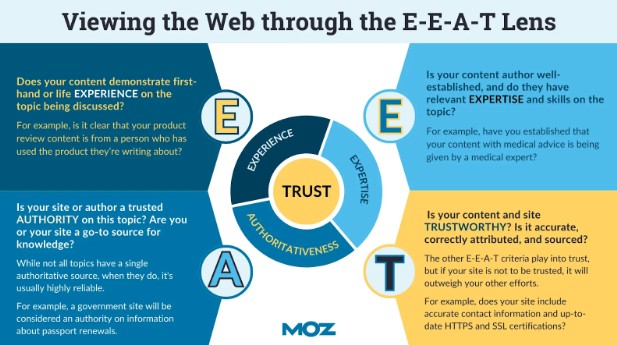
That’s exactly why in the healthcare sector, Google imposes its strictest marketing content quality principles, the E-E-A-T, which stands for:
- Experience — indicates that a given healthcare services provider has a prior, documented real-world medical involvement (not a newcomer).
- Expertise — signals deep knowledge within a chosen medical field, something that a reader/patient can trust and rely on.
- Authoritativeness — shows that this medical services provider has an established name/reputation in the healthcare sector.
- Trustworthiness — signals to potential patients that a provider is safe to use and that they can entrust them with their health, reducing misinformation and post-treatment complications risks.
On and off-site SEO still works for the healthcare sector, but they are not the only players in town. Technical tweaks and optimizations can only get you so far in this highly competitive and regulated niche, but the true competitive advantages lie in the ability to excel in the patient trust department, where Google’s E-E-A-T plays a pivotal role.
Source: Moz
Building Healthcare Authority With Credentials and Trust Signals
Building authority is a Holy Grail of SEO and, more recently, the AEO (Answer Engine Optimization), but in the healthcare sector, this task becomes significantly more complex because authority must be demonstrated and verified.
It essentially becomes a matter of credibility, compliance, and patient safety — all perfectly aligned with the E-E-A-T in SEO framework.
You can claim you have authority, but it won’t work in the healthcare SEO strategy. Here, you need to prove it. How? Via honest and well-deserved credentials, and using every opportunity to build strong external trust signals.
Take these recommendations as a general guideline, and feel free to adapt them to your particular practice:
- Ensure your pages contain clearly displayed medical credentials and qualifications.
- Your compliance section/screen must include verified professional affiliations and licensing details.
- Every blog post, every article should include author bios outlining clinical experience and specialization.
- Involve certified healthcare professionals to review and proofread all content you publish on your site and externally.
- Implement transparent editorial policies.
Remember, authority begins at the source — with the people and institutions behind the content. If you don’t respect yourself, every piece of content you publish and every claim you make, no one else is going to fill in this gap for you.
One practical way to reinforce authority is by contributing expert content to health blogs accepting guest posts, and if you need a vetted starting point, you can get it from here. Make sure your content includes:
- Mentions or backlinks from reputable healthcare resources.
- Citations from peer-reviewed medical publications.
- Positive patient feedback that you collect and nurture earlier (e.g., on your site, or on patient review sites).
Showing Real Medical Experience in Healthcare Content
Potential patients who visit a healthcare website are not the same as ordinary website visitors. They come better prepared, with prior knowledge and a burning need to solve their healthcare problem(s). They might have read tons of other medical materials and already know what their ideal healthcare provider looks like.
What’s more important, prospective patients won’t be convinced by the generic content, empty promises, theories, and claims that are not supported by practice. People sense absence or absence of experience from a mile away.
For that reason, forget about using AI chatbots to write medical content. At this stage of their development, they are designed to produce generic stuff; they cannot show off original data, insights, or tell real success stories.
ChatGPT, Gemini, and Claude may write fast and convincingly, but content volume and persuasion skill (eloquence) are not enough to impress a prepared reader.
Alternatively, this is how you can demonstrate experience in your healthcare content by using human expert-written content:
- Include physician or specialist commentary within blogs and articles.
- Explain procedures step by step as they occur in practice.
- Place citations by doctors and real medical practitioners who have a strong positive reputation.
- Address common patient misconceptions encountered in clinics.
- Always conclude with FAQs that address nascent patient concerns.
Demonstrating experience in medical content reduces stress and uncertainty, lowers bounce rates, and enhances engagement. What’s more important, it improves the perceived importance of medical advice, making even generic recommendations look trustworthy and convincing.
On-Page and Technical SEO That Supports E-E-A-T
Technical and on-page SEO work as a translation layer between the signals sent by credentials and real-world experience and search engines. The latter perceives website value through things like technical schema markup and internal linking — all perfectly within the competence of a technical and medical website SEO.
The following on-page practices help reinforce your E-E-A-T signals and make them heard by Google and other search engines:
- Clear author bios with highlighted experience and visible credentials.
- Dedicated customer review/testimonials/feedback sections.
- Structured headings that reflect what search engines and AI value (e.g., crispness, trending keywords, matching user queries).
- Proper citation formatting for medical references.
- Transparent publication and last-updated dates.
From a technical SEO perspective, search engines assess the overall domain quality of a guest posting site before passing value through its links.
The same happens when a search engine’s crawler visits your healthcare website: it meticulously evaluates whether your technical SEO for healthcare setup aligns with the quality standards characteristic of the healthcare industry:
- Medical schema markup (e.g., MedicalWebPage for condition pages, or MedicalOrganization for healthcare providers).
- Compliance & privacy infrastructure (e.g., GDPR-compliant cookie and consent systems, secure HTTPS, and HIPAA security standards).
- Logical internal linking and relevant, not overly descriptive anchor text between related medical pages.
The rise of AI and structured data has expanded the role of structured markup from simple SERP enhancements to interpretation by answer engines. Today, unless your website is actively sending these critical trust signals, your healthcare business remains poorly visible for chatbots like ChatGPT and Purplexity.
Earning Patient Trust Through UX SEO
In a healthcare SEO strategy, visibility without trust is a waste of resources. Just think of it, your SEO specialists do whatever it takes to attract visitors to your pages, but if the content and navigation they find there provides poor user experience (UX), they’ll not stay. They’ll bounce like a ball from the wall.
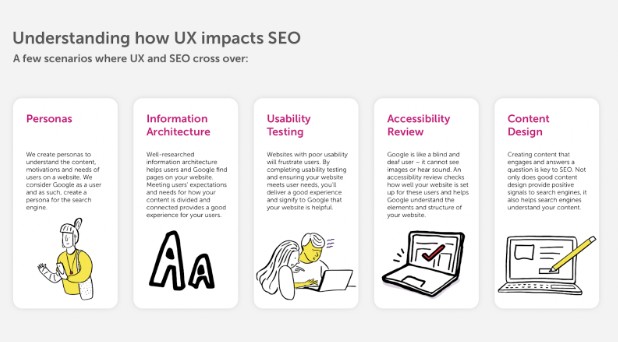
UX bridges technical optimization and human perception, and it plays a big role in Google’s E-E-A-T.
Source: Thisisgain
Not only Google, but all modern search engines interpret user experience as a proxy for trust. Signals like dwell time, bounce rate, scroll depth, engagement, and others tell it a lot about user satisfaction. And in the highly sensitive healthcare environment, user comfort and satisfaction are synonyms for conversions.
That said, the following UX elements can help you strengthen E-E-A-T:
- Carefully structured, clean layouts for medical posts.
- Simple hierarchy of headings, following diagnostic logic.
- Articulated author credentials, including achievements and past experiences.
- Strict protection of patient privacy and a transparent mechanism to ensure it is in place.
- Visible physical clinic addresses with contact details with several channels.
On top of that, UX-oriented clinics and practices strive to ensure mobile-friendly pages that load fast and work with all devices, operating systems, and varied cellular connection speeds.
The Bottom Line
Healthcare SEO optimization is not a one-time action, no matter how successful your first moves could be. It’s a continuous process, where you maintain a steady pace and make progress from each one of your incremental adjustments aimed at reinforcing trust, clarity, and long-term visibility.
The above approach is the only viable one when the implementation of the E-E-A-T framework is a priority. Patients and Google will appreciate your achievements, but should you make a single SEO mistake or in any other way damage your reputation as a healthcare provider, both patient confidence and search visibility can decline rapidly.
So, start focusing on Google’s E-E-A-T in your healthcare provider journey as early as possible, building trust and nurturing genuine authority with on-site and off-site SEO. As the proverb says, “Slow and steady wins the race.”

- All About Optimizing Healthcare SEO with E-E-A-T - February 12, 2026
- How Technology Is Empowering AI-Driven Enterprises Today - February 5, 2026
- Best Digital Advertising & Marketing Agencies in Calgary - February 2, 2026