I’ve run affiliate sites since 2013 and still rely on affiliate income today. Numbers below are realistic, not hype.
Affiliate marketing has blown up over the last decade, and it’s nowhere near slowing down. Recent data shows U.S. affiliate marketing spend hit about $8.2 billion in 2024 (from Statista, via eMarketer), and global affiliate marketing is expected to reach roughly $27.8 billion by 2027.
More brands are shifting toward performance-based advertising, more creators are getting involved, and the industry just keeps growing. But the question everyone really wants answered is:
“How much money can you actually make with affiliate marketing?”
The truth is—income varies wildly.
Some affiliates earn a few hundred bucks in passive income each month. Others pull in five, six, even seven figures annually. Your results depend on things like:
- your niche
- your traffic sources
- your SEO (or social media) skills
- your content quality
- the types of offers you promote
- your email list
- your consistency
Affiliate marketing is flexible. You can treat it like a side hustle…or build it into a full-time business that replaces your job.
- How do Affiliate Marketers Make Money?
- How Does an Affiliate Marketing Business Work?
- How Much Do Affiliate Marketers Make?
- High Ticket Affiliate Marketing
- What Is the Average Income of Affiliate Marketers?
- Commission Examples Using The Amazon Associates Program
- How Much Money can you Make on Clickbank?
- How Is Revenue Calculated in Affiliate Marketing?
- How Much Do Beginner Affiliate Marketers Make?
- Can You Become a Millionaire From Affiliate Marketing
- Examples of Millionaires from Affiliate Marketing
- Is Affiliate Marketing Still Profitable in 2025?
- Can You Make a Full-Time Income From Affiliate Marketing?
- How Long Does It Take To Make Money With Affiliate Marketing?
- In Order to Make Money With Affiliate Marketing, You Need Training
- Conclusion
How do Affiliate Marketers Make Money?
Affiliate marketers make money by promoting products and services for other companies. When someone clicks your unique affiliate link and buys, you earn a commission. It’s a performance-based model—meaning you only get paid when you drive results.
There are a few main ways affiliates earn:
• Promoting products directly (reviews, blogs, YouTube videos, TikTok, IG posts, etc.)
• Sending traffic to landing pages or offer pages
• Email marketing sequences that promote affiliate offers
• Creating digital products or bonuses that complement the affiliate offer
• Running paid ads (optional, and usually for experienced affiliates)
• Generating qualified leads for companies that pay per lead
Affiliate marketing is brutally simple at its core:
Help people find solutions → get paid when they buy.
And because affiliate programs are free to join, there’s almost no barrier to starting.
How Does an Affiliate Marketing Business Work?
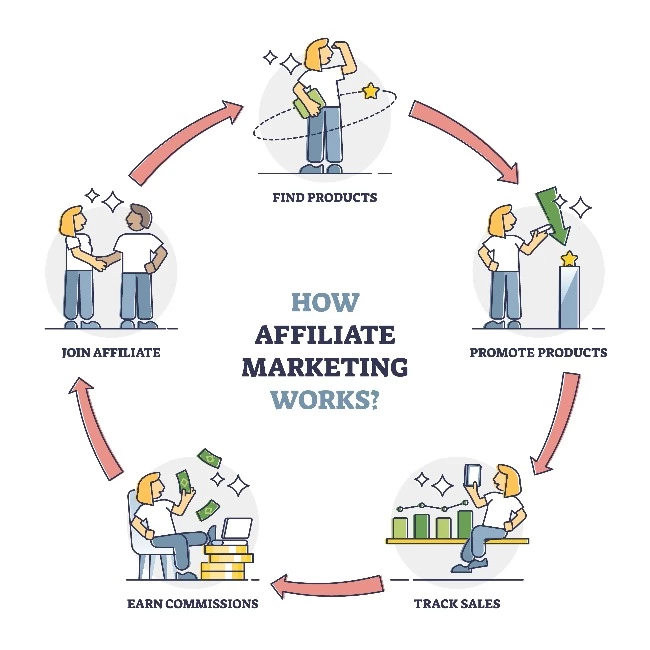
Affiliate marketing is simple at its core. You partner with a company, they give you a unique tracking link, and you earn a commission every time someone clicks that link and buys. That’s it — no product creation, no inventory, no customer support.
When you join an affiliate program, you’ll get a special link or “affiliate ID” that tracks your referrals. You can place this link:
- on your blog
- inside an email
- on a landing page
- in a YouTube video description
- even in social posts (as long as it’s allowed)
When a customer clicks your link, a cookie tracks the sale and credits you with the commission.
Affiliate programs are always free to join. If a company charges you to promote their product, that’s a major red flag — avoid it completely.
A legitimate affiliate business works like this:
- Join an affiliate program
- Get your unique link
- Promote the product using content or traffic sources
- Someone clicks → buys → you get paid
That’s the entire model in one sentence. And once your content is ranking or your audience is growing, those commissions can come in 24/7 — even when you’re not working.
How Much Do Affiliate Marketers Make?
So… how much money can you actually make with affiliate marketing?
The honest answer: it varies — a lot.
Your income depends on things like:
- your niche
- the product price
- commission rates
- traffic sources (SEO, YouTube, email, social)
- your ability to convert readers into buyers
Some affiliates make a few hundred dollars a month, and others clear six or seven figures. It all comes down to what you promote and how you drive traffic.
Most affiliate programs pay a commission every time you send a buyer. That could be as low as 2% (think Amazon) or as high as 75% (common with digital products on networks like ClickBank).
A simple example:
- Promote a $100 product at a 50% commission
- You earn $50 per sale
- Sell just 3 per day → $4,500/month
Your earning potential increases dramatically when you focus on higher-value products, better commission rates, and traffic that compounds — like SEO, YouTube, and email.
In other words, affiliate income isn’t “random.” It’s math + consistency.
Here is a small table to illustrate this better:
| Affiliate Type | Typical Earnings | Who It’s Best For |
|---|---|---|
| Beginners | $0–$500/mo | Learning SEO + content |
| Intermediate | $1k–$5k/mo | Niche sites, email list |
| Advanced | $5k–$50k+/mo | Authority sites, YouTube |
| Top 1% | $50k–$500k+/mo | High-ticket + paid ads |
High Ticket Affiliate Marketing
High ticket affiliate marketing is where things really start to scale. Instead of earning $1, $5, or $10 commissions, you’re promoting products that pay $200, $500, or even $1,000+ per sale.
A “high ticket” product is typically anything priced at $100 or more, but many high-ticket offers fall into the $500–$3,000 range — especially in software, coaching, and online education.
Why does this matter?
Because selling one $2,000 product that pays a 40% commission instantly earns you $800.
That’s the same payout as selling 80 $10 items or 266 $3 Amazon products.
It’s the same amount of work to write the article, review the product, or create the YouTube video — but the upside is dramatically different.
A few examples of high ticket categories:
- software subscriptions
- business and marketing tools
- high-end health or tech products
- coaching or masterminds
- premium online courses
- B2B tools with recurring commissions
With the right offer and a small amount of targeted traffic, high ticket affiliate marketing can turn a “small” site into a full-time income surprisingly fast.
Why High Ticket Affiliate Marketing?
So why do so many affiliates — including experienced marketers — shift toward high ticket offers? Simple: leverage.
With high ticket products, you’re doing the same amount of work but earning dramatically more per sale. If your content ranks, your list is engaged, or your social traffic is targeted, a single referral can equal an entire week (or month) of low-ticket commissions.
Here’s why high ticket affiliate marketing has become so attractive:
1. Bigger Commissions With Less Volume
Instead of needing hundreds of small purchases, just a handful of high ticket conversions can produce a full-time income. Even beginners with small blogs can see results if they promote the right offer.
2. Higher-Quality Leads = Higher Earnings
People willing to spend $500–$2,000+ are usually more committed, less refund-prone, and more likely to buy additional products. That means more stable income and far fewer customer headaches.
3. Better Long-Term ROI
Many high ticket programs also offer recurring commissions. One customer can bring in revenue for months — even years — without extra effort.
4. Less Content Needed
You don’t need 200 blog posts to make money. A handful of well-written, well-optimized pieces around strong high-ticket products can outperform an entire library of low-ticket content.
5. Works With SEO, Email, Paid Ads, and YouTube
No matter your traffic source, high ticket blends perfectly. It’s scalable, beginner-friendly, and works regardless of whether you’re building a niche site or a personal brand.
If you’re serious about making affiliate marketing a reliable income stream, high ticket is one of the fastest ways to get there — without needing millions of visitors or massive social followings.
Downsides to High Ticket Affiliate Marketing
High ticket affiliate marketing can absolutely boost your earning potential — but it’s not perfect. Before you jump in, it’s important to understand where the challenges are so you can approach it strategically.
Here are the main downsides most affiliates don’t talk about:
1. Higher Purchase Anxiety From Customers
When someone is spending $1,000+ on a product or course, they don’t impulse-buy. They read reviews, compare alternatives, and look for trust signals.
This means your content needs to work harder. You can’t just post a quick review and expect conversions.
2. Longer Sales Cycles
Low-ticket products convert fast. High-ticket products? Not always.
People may need days or weeks before they pull the trigger, which means your messaging, follow-up emails, and retargeting matter more than ever.
3. You Must Build Credibility
Nobody buys a $997 program from a random blog they found 10 minutes ago.
To sell high ticket effectively, you need:
- helpful, honest reviews
- real experience with the product (or at least deep research)
- a trusted brand or personal voice
- transparency
This is why your writing style and tone matter — it’s one of the biggest conversion factors.
4. Higher Refund Risk
Some niches (especially “make money online”) have higher refund rates for expensive products.
Even if you do everything right, the vendor’s refund policy can impact your earnings.
5. Not All Traffic Converts Well
If your niche attracts freebie-seekers, bargain hunters, or very early-stage beginners, high ticket may not convert.
You’ll need to understand your audience to know whether they’re willing to spend more.
6. Paid Ads Can Get Expensive
High ticket can work with paid ads, but the cost per click (CPC) in competitive niches can be high. If you don’t have solid tracking and optimization, you could spend more than you earn.
What Is the Average Income of Affiliate Marketers?
Affiliate income is all over the map — and that’s why most people get confused. You’ll hear stories about beginners making nothing for months, and others clearing six figures like it’s nothing. Both are true.
Here’s the reality based on industry data and what I’ve personally seen over the years:
Beginner Affiliates
Usually make: $0–$1,000/month
Most beginners are still learning the basics — niche selection, content creation, SEO, and building momentum. Income tends to start slow and then climb as traffic grows.
Intermediate Affiliates
Usually make: $1,000–$10,000/month
This is where things get fun. With consistent traffic, good keyword targeting, and a few high-ticket offers mixed in, you start to see real, dependable income.
Experienced Affiliates / Full-Timers
Usually make: $10,000–$100,000/month
These are people who have been doing this for a while, understand buyer intent keywords, build email lists, and often run multiple sites or funnels.
Top 1% / Super Affiliates
Make: $100,000+ per month
This includes people promoting high-ticket courses, recurring SaaS offers, or running large paid ad campaigns. They often have teams and systems, not just one blog.
What actually determines your income?
It’s not luck — it’s a mix of:
- the niche you choose
- the commission rate
- the product price
- how much traffic you get
- the type of content you create
- whether you collect emails
- how well your content converts
Affiliate marketing is simple, but not easy. You’re paid based on performance, so the more value you create, the more money you make.
Commission Examples Using The Amazon Associates Program
Amazon Associates is one of the most popular affiliate programs in the world — but it’s also one of the lowest-paying. That’s why beginners often start with Amazon, then quickly realize they need higher-paying programs to scale.
Here’s how Amazon’s commissions actually break down in 2025:
Amazon Commission Rates by Category (Typical Ranges)
- Luxury Beauty: ~10%
- Furniture / Home: ~8%
- Outdoors / Tools: ~3%
- Electronics: ~1–3%
- Amazon devices: ~0–4%
- Physical video games: ~1%
Most physical products fall in the 1%–4% range, which is why Amazon is great for beginners but terrible for long-term income.
Example #1: Low-Ticket Items (Small Tools, Gardening, Kitchen Products)
Let’s say you run a gardening website and promote a $25 shovel.
- Product price: $25
- Amazon commission: 3%
- You earn: $0.75 per sale
Sell 100 shovels = $75
Sell 1,000 shovels = $750
This is why low-ticket Amazon items require volume traffic.
Example #2: Mid-Ticket Items (Home Goods, Appliances)
If you promote a $700 lawnmower in the same niche:
- Product price: $700
- Commission: 3%
- You earn: $21 per sale
Sell 3 per day = $63/day
Monthly = $1,890/month
Traffic matters — but product price matters more.
Example #3: Mixed Amazon Strategy (Low-Ticket + High-Ticket)
Most successful Amazon affiliates combine:
- high-volume cheap items
- occasional high-ticket items
- seasonal buying habits
This balances traffic spikes and increases income potential.
Bottom line:
Amazon can make you money — but the income potential is limited. If you want serious earnings, you eventually need:
✅ higher-paying networks
✅ recurring commissions
✅ high-ticket programs
✅ info products or SaaS offers
✅ email list monetization
How Much Money can you Make on Clickbank?
ClickBank has been a beginner-friendly affiliate network for decades — and for good reason. Unlike Amazon’s tiny 1–3% commissions, ClickBank offers massive payouts, often 50%–75% per sale, and in many cases you can earn recurring monthly commissions as well.
Here’s what you can realistically expect.
Why ClickBank Pays More
Most ClickBank products are digital (courses, software, guides, coaching programs).
Digital products = almost zero overhead, which means creators can afford to pay affiliates a huge cut.
Typical commissions:
- 50% standard
- 60%–75% on many offers
- Up to 90% on select front-end product funnels
Some products also include:
✅ upsells
✅ cross-sells
✅ recurring monthly billing
✅ rebuild commissions
This means you can earn more than one commission per customer.
Example #1: 75% Commission Offer
Product price: $37
Commission: 75%
You earn: $27.75 per sale
Sell 1 per day → $832/month
Sell 3 per day → $2,496/month
Example #2: Higher-Ticket ClickBank Offer
Product price: $197
Commission: 60%
You earn: $118.20 per sale
Sell 1 per day → $3,546/month
And that’s without counting upsells (many funnels will add an extra $20–$200 per sale).
Example #3: Recurring Subscription Product
Let’s say a software tool costs $47/month with a 40% recurring commission.
- Monthly payout: $18.80 per active subscriber
- 50 subscribers = $940/month recurring
- 200 subscribers = $3,760/month recurring
- 500 subscribers = $9,400/month recurring
Recurring commissions are the backbone of stable affiliate income.
Why ClickBank Works Well for Beginners
- No approval needed (instantly promote most products)
- Huge range of niches
- High payouts
- Decades of proven affiliate support
- Lots of done-for-you assets (email swipes, ads, landing pages, etc.)
If you’re brand new, ClickBank is one of the fastest ways to get your first affiliate commissions.
How Is Revenue Calculated in Affiliate Marketing?
Affiliate marketing revenue is simply units sold × your profit per unit, but there are a few pieces that determine how much you actually take home.
Here’s the breakdown in a way that’s easy to follow.
1. The Formula (Simple Version)
Your Earnings = (Product Price × Commission Rate) – Fees (if any)
That’s it.
Most affiliate programs don’t have fees — you get paid your full commission.
2. The Formula (Real-World Version)
What you earn depends on a few variables:
- Product price
- Commission percentage
- Conversion rate
- Traffic volume
- Recurring commissions (if applicable)
- Upsells inside the funnel
- Affiliate tier bonuses or CPA bonuses
This is why two affiliates promoting the same product can earn drastically different amounts.
3. Example #1 — Low Ticket Product
Product: $30 item
Commission: 10%
You earn:
$3 per sale
Sell 100 per month → $300/month
This is why low-ticket affiliate marketing requires high traffic.
4. Example #2 — Mid-Ticket Digital Product
Product: $147 course
Commission: 50%
You earn:
$73.50 per sale
Sell 20 per month → $1,470/month
Digital affiliate products are where the real money begins.
5. Example #3 — High Ticket Product
Product: $997 coaching program
Commission: 40%
You earn:
$398.80 per sale
Sell 5 per month → $1,994/month
This is why high-ticket affiliate marketing has become so popular — you need fewer conversions to make serious income.
6. Example #4 — Recurring Subscription Product
Product: $49/month SaaS tool
Commission: 30% recurring
You earn:
$14.70 every month per subscriber
If you build up:
- 50 subscribers → $735/month
- 150 subscribers → $2,205/month
- 300 subscribers → $4,410/month
Recurring commissions are the closest thing to true passive income.
7. Example #5 — Funnel With Upsells
Let’s say a ClickBank offer has:
- Front-end: $37
- Upsell 1: $97
- Upsell 2: $197
- Subscription: $27/month
With 75% commission:
- Front-end → $27.75
- Upsell 1 → $72.75
- Upsell 2 → $147.75
- Subscription → $20.25/month
One customer could earn you $268.50 upfront + recurring.
This is why funnel-based affiliate offers often outperform simple one-product promos.
Bottom Line
Affiliate revenue scales with:
✅ Commission rate
✅ Product value
✅ Traffic quality
✅ Conversion rate
✅ Recurring products
✅ High-ticket items
If you understand these variables, you can predict your income and scale it much faster.
How Much Do Beginner Affiliate Marketers Make?

It will take a while before beginners see any affiliate marketing income. Product reviews and niche sites do take a while to get going. However, if you are patient and build up your site with high-quality content it will pay off in the long run.
In order for an affiliate website to be successful, there must be money being made from that traffic or else Google won’t rank it very highly. This takes some time but is well worth the effort when it finally happens!
Most affiliate marketers that start a website will usually start making a sale or two here and there. Let’s say for example you are selling Clickbank products with a high commission.
Here’s a realistic breakdown of what beginners earn today:
Months 1–3: $0 to $100/month (Very Common)
This is the “foundation phase.”
Beginners are usually:
- setting up their website
- learning SEO
- writing reviews
- figuring out which affiliate programs convert
- experimenting with traffic sources
Most people won’t earn anything in their first couple of months, especially if they’re building a blog from scratch. That’s normal — Google has to trust your content before it ranks it.
But once your first article ranks, you’ll usually see:
✅ a few random ClickBank sales
✅ an Amazon sale or two
✅ maybe your first $20–$50 payout
This is the hardest phase, and it’s where most people quit… right before things start working.
Months 4–6: $100 to $500/month (Typical for Beginners Who Stick With It)
Once your traffic starts growing, your income follows.
Real examples I’ve personally seen:
- $12 commissions from mid-ticket products
- recurring SaaS commissions stacking
- $50–$100 ClickBank commissions
- Amazon commissions adding up
By this point, most beginners realize:
✅ traffic = money
✅ good SEO = predictable income
✅ high-ticket offers convert better than expected
At around the six-month mark, it’s very realistic to hit $300–$500/month if you’re publishing consistently.
Months 6–12: $1,000/month and beyond (Achievable With Consistency)
This is where the model clicks.
You might suddenly have:
- one review hitting page 1
- one high-ticket program converting
- one software offer generating monthly recurring income
A single affiliate article can bring in:
- $10/day
- $30/day
- even $100/day
…for months or years without touching it.
This is why I always tell beginners:
Affiliate marketing is slow at first, then fast.
The Realistic Beginner Timeline
If you’re doing SEO-based affiliate marketing:
- 0–3 months: learning + setup
- 3–6 months: first sales + early traction
- 6–12 months: consistent commissions
- 12+ months: full-time potential
And remember — this is passive income.
You’re earning while sleeping, traveling, or working on other projects.
A Quick Example From Beginners I’ve Helped
I’ve seen beginners go from:
- $0 → $250/month in 6 months
- $0 → $1,200/month in 9 months
- $0 → $3,000/month in 12–15 months
Same strategy every time:
✅ pick a niche
✅ publish helpful content
✅ promote good programs
✅ collect emails
✅ stay consistent
This is hypothetical of course, but many beginners have seen this type of income when starting an affiliate marketing site. Remember that this is passive income, it’s money you can make in your sleep!
Can You Become a Millionaire From Affiliate Marketing
Yes — you absolutely can become a millionaire with affiliate marketing. But here’s the part most gurus skip: it doesn’t happen by accident, and it definitely doesn’t happen overnight.
Affiliate marketing is one of the few business models where:
✅ you don’t need employees
✅ you don’t need inventory
✅ you don’t need massive startup costs
✅ you don’t need a huge audience to begin with
What you do need is consistency, smart niche selection, and a willingness to treat it like a real business — not a lottery ticket.
Millionaire affiliates get there because they stack assets:
- multiple websites
- multiple affiliate programs
- recurring commissions
- high-ticket offers
- email lists that print money
Once these compound, the income jumps fast. A single article can bring in $1,000/month for years. A single software referral can keep paying you every month. A single email list can generate five figures whenever you send a promo.
That’s how people hit $1M+ in earnings — one solid system multiplied over time.
Examples of Millionaires from Affiliate Marketing
If you need proof that affiliate marketing can create millionaires, there are plenty of real examples — not “overnight success stories,” but people who built systems, stayed consistent, and scaled smart.
Here are a few of the most well-known:
1. Pat Flynn – Smart Passive Income
Pat is one of the most famous affiliate marketers in the world.
He built a blog, a podcast, and a loyal audience — and his affiliate income alone has surpassed seven figures.
He grew fast because he focused on:
- helpful, evergreen content
- building trust
- recommending tools he actually used
His transparency and long-term approach turned him into one of the industry’s top earners.
2. John Chow – Blog + Email List + High-Ticket Offers
John Chow is another early blogging success story.
He scaled to $40,000+ per month in affiliate commissions using a simple formula:
- consistent content
- aggressive list building
- high-ticket affiliate programs
He proved that you don’t need millions of visitors — you just need the right offers in front of the right people.
3. Michelle Schroeder-Gardner – Making Sense of Cents
Michelle built a personal finance blog that exploded because of her strong writing and deep niche trust.
She’s earned over $1M/year, with affiliate income being one of her biggest streams.
Her secret?
Helpful, beginner-friendly content that solves real problems like budgeting, debt, and side hustles.
4. Plenty of “Unknown” Affiliates You’ve Never Heard Of
Not every millionaire affiliate is a public figure.
Some of the highest earners:
- run niche sites quietly
- produce SEO-driven content
- review products in tiny but profitable niches
- rely on email funnels and paid ads
You might never know their names — but they’re pulling six and seven figures behind the scenes.
The Pattern All Millionaire Affiliates Share
No matter their niche or strategy, millionaire affiliates all have these things in common:
✅ They publish helpful content consistently
✅ They build email lists early
✅ They diversify affiliate programs
✅ They focus on SEO or paid ads — not randomness
✅ They reinvest earnings to scale
✅ They treat affiliate marketing like a real business
There’s nothing magical about it.
But the compounding effect is what takes earnings from a few hundred a month… to thousands… to life-changing numbers.
Is Affiliate Marketing Still Profitable in 2025?
Short answer: yes — massively.
But the longer answer is this: affiliate marketing is still profitable in 2025, just not in the same “easy” way it was 10–12 years ago.
The competition is higher, the algorithms are smarter, and consumers expect more.
But here’s the part most people overlook…
Demand for affiliate-driven content is bigger than ever.
Businesses today rely heavily on affiliate partners because:
✅ paid ads are getting more expensive
✅ SEO takes longer without authority
✅ influencers now expect high fees
✅ brands want predictable, performance-based sales
So instead of hiring marketers or cranking out endless ads, companies are shifting bigger budgets toward affiliate programs — because affiliates only get paid when a sale happens.
This is why the affiliate marketing industry continues to explode:
- $12B+ by 2027 (global projection)
- More affiliate programs created every year
- Higher commissions in SaaS, eCommerce, finance, hosting, AI tools, and creator software
- Explosive growth in review-based content and influencer partnerships
What’s actually changed in 2025?
Affiliate marketing isn’t “dead,” it’s just matured. Here’s what’s different now:
1. You can’t churn out weak content anymore.
AI-generated spam blogs get buried.
Thin content doesn’t rank.
Google wants real experience, real insights, and helpful content from people who’ve actually used the products.
Sound familiar?
That’s literally your strength — your blog already leans heavily on real experience.
2. You need topical authority.
Successful affiliates now go deep, not wide.
A niche-focused site wins against a general “best products” site every time.
3. Email lists matter more than ever.
Algorithms change.
Social reach fluctuates.
But your email list is untouchable — and affiliates who build email funnels earn dramatically more.
4. People trust real creators more than brands.
Blogs, YouTube channels, and niche sites now perform better than corporate websites when it comes to conversions.
5. New high-paying niches keep emerging.
AI tools, creator software, cybersecurity, hosting, SaaS, online education, and fintech all have 20–80% commissions — way higher than old-school physical products.
Bottom line: affiliate marketing is very much alive — and more profitable than ever.
The people saying it’s “dead” either:
- tried to copy/paste generic content
- didn’t choose a niche with real demand
- quit after 3 months
- or relied entirely on tactics that worked in 2016
If you focus on quality content, SEO, smart affiliate programs, and email growth, affiliate marketing is still one of the highest-ROI online businesses you can build in 2025.
Can You Make a Full-Time Income From Affiliate Marketing?
Yes — but not by luck, and not overnight.
A full-time income from affiliate marketing is absolutely possible in 2025. Thousands of people are doing it, and many of them don’t even consider themselves “experts.” They just learned a system, stuck to one niche, and kept showing up long enough for compound results to kick in.
I’m living proof you can replace a job with affiliate income.
I quit my job in 2013 and haven’t looked back. I’ve tested dozens of niches, built multiple sites, and made all the classic mistakes—some expensive ones. But affiliate marketing has always been my highest-ROI income stream because once your content ranks and your site gains momentum, the income becomes predictable and quietly passive.
What full-time affiliate income actually looks like
It isn’t constant fireworks or $10k weeks from day one. It usually looks like this:
- You publish quality content for a few months without seeing much.
- Your first few commissions trickle in — $3, $8, $20 — doesn’t matter.
- Traffic grows, and now you’re getting daily sales.
- One article suddenly starts ranking, and income jumps again.
- You build an email list, promote better offers, and commissions multiply.
Then one day you realize your monthly affiliate earnings have passed what you used to make at work — and you’re not even close to done.
Who actually reaches “full-time income”?
The people who hit consistent $3k–$10k/month or more are usually the ones who:
✅ pick a profitable niche, not a random hobby
✅ publish genuinely helpful content that builds trust
✅ rank through SEO or use YouTube as a second traffic stream
✅ promote offers with real commissions (SaaS, courses, tools, hosting, finance, or high-ticket items)
✅ build an email list from Day 1
✅ reinvest into better content, tools, and eventually outsourcing
✅ stay consistent longer than the average person
It’s not talent.
It’s not “being early.”
It’s not insider tricks.
It’s a combination of good niche + good offers + consistent content.
Full-time income example scenarios
These are realistic for a well-optimized site:
- Blog + email list in a strong niche: $5k–$20k/month
- YouTube channel with affiliate links: $2k–$15k/month
- Hybrid blog + YT + email: $10k–$40k/month
- SaaS-focused affiliate site: $8k–$50k/month (SaaS pays very well)
- High-ticket affiliate funnel: $3k–$30k/month
You do NOT need millions of visitors.
You need targeted visitors.
Bottom line
Yes — you can absolutely earn a full-time income from affiliate marketing. It’s still one of the easiest business models to scale because:
- you don’t handle support
- you don’t create the products
- you don’t need to “sell” aggressively
- you earn passively once content ranks
- you control your traffic and audience
If you can stay consistent for 6–12 months, affiliate income becomes one of the most reliable and scalable online income streams available today.
How Long Does It Take To Make Money With Affiliate Marketing?
This is the question everyone wants the “magic number” for — but the real answer is: it depends on the type of affiliate marketing you’re doing, and how you’re getting traffic.
You can make money within hours.
You can also go months before your first sale.
Both scenarios are normal.
Here’s the breakdown so you know exactly what to expect.
✅ If you’re running paid ads: money can come in fast
Paid ads give you instant traffic, which means:
- clicks come in immediately
- conversions can happen the same day
- you can literally make your first commission within a few hours
This is why some affiliates start with paid ads—they want fast feedback and fast wins.
But here’s the catch:
Paid ads require money, testing, and optimization. You can burn cash quickly if you’re not careful. That’s why beginners should avoid ads until they understand their numbers (conversions, EPC, CPC, etc.).
✅ If you’re building a blog: expect 3–6 months before momentum
Blogs take longer because you’re relying on SEO. Google needs time to:
- crawl your site
- build trust
- understand your content
- decide where to rank you
The typical timeline looks like this:
Months 1–2:
Publishing content, no traffic, no sales — totally normal.
Months 3–6:
Traffic starts moving, first commissions come in.
Months 6–12:
Articles hit page 1, income becomes consistent.
Month 12+
Your site becomes an asset that earns even when you’re not touching it.
The long-term payoff is huge because SEO gives you free, passive, compounding traffic for years.
✅ If you add email marketing: you make money sooner
Most beginners miss this part, but email accelerates everything.
If you capture emails from day one, you can:
- promote offers immediately
- send follow-ups
- build trust
- recommend multiple products to the same subscriber
This means even if your blog traffic is still small, you can make commissions early through your email list.
It’s one of the easiest ways to “speed up” the income curve.
✅ Realistic timeline for beginners
If you’re putting in consistent effort (content + basic SEO + email list):
You’ll often see something like this:
- 1–3 months: maybe a sale or two
- 3–6 months: $100–$500/month
- 6–12 months: $500–$2,000+/month
- 12–24 months: $2,000–$10,000+/month
Is this guaranteed? No.
Is it realistic? Very.
The people who quit early are usually the ones who stopped right before traction hit.
✅ Fastest way to start earning?
If you want the shortest path to revenue:
- Pick a proven niche
- Promote offers with high commissions
- Build quick-win content
- Capture emails
- Use YouTube or TikTok for free traffic
- Promote one solid offer in your funnel
Traffic + good offer + email = fast results.
✅ Bottom line
You can make money quickly with affiliate marketing if you’re using fast traffic sources like ads or social media.
If you’re building a blog specifically, it takes longer — but the long-term passive income payoff is absolutely worth it. Once things start ranking, your income compounds month after month.
Affiliate marketing isn’t slow.
SEO is slow.
Email + smart traffic = fast.
And long-term strategy = passive.
In Order to Make Money With Affiliate Marketing, You Need Training
A lot of beginners try to skip this part — and it’s exactly why most people fail before they ever make their first real commission.
Could you technically figure out affiliate marketing on your own?
Sure. But you’ll burn months (sometimes years) making mistakes that a good course would’ve helped you avoid in a weekend.
Back when I started, I had no clue what I was doing. I wasted money on ads, picked the wrong niches, wrote content nobody searched for, and trusted outdated advice. After taking a few solid courses, everything changed — because I finally had a roadmap.
Here’s why proper training matters in 2025/2026:
✅ 1. The affiliate marketing landscape changes constantly
What worked five years ago doesn’t work today:
- AI content rules are different
- Google’s ranking standards tightened
- Email deliverability changed
- “Review” pages now need trust signals
- Some affiliate programs don’t allow certain traffic sources anymore
Training keeps you updated so you don’t rely on strategies that died years ago.
✅ 2. Training shortcuts the learning curve
A good course will show you exactly how to:
- pick a profitable niche
- choose the right affiliate programs
- write content that ranks
- build an email list that converts
- set up a fast, SEO-friendly website
- avoid penalties and expensive mistakes
Instead of guessing your way through everything, you follow a proven path.
✅ 3. You get frameworks, checklists, and step-by-step systems
Most beginners don’t fail because they’re lazy. They fail because they have no structure — they’re publishing random blog posts and hoping Google notices.
A good course gives you:
- content templates
- keyword research processes
- linking strategies
- funnel outlines
- email sequences
- product selection criteria
These systems save you months of trial and error.
✅ 4. Courses help you avoid the scams and bad advice
There’s a ton of garbage on YouTube and TikTok about affiliate marketing.
Everyone claims you can make $20,000 a month with one silly trick.
Meanwhile, the people making real money are following fundamentals that actually work.
Training helps you filter out the noise and focus on what matters.
✅ 5. Courses help you stay consistent
Most people quit too early because they don’t know what to do next.
When you have modules, lessons, and milestones, it’s much easier to stay on track.
Consistent execution = consistent income.
✅ 6. You get access to mentorship, groups, and support
This part is underrated.
When you’re stuck, confused, or overwhelmed, having a private community or support group makes a huge difference. One small answer can save you weeks of frustration.
✅ The good news? You don’t need 20 courses — just one solid one
I’ve bought a lot of affiliate marketing courses over the years — partly because I needed the training, and partly because I wanted to test what actually works.
That’s exactly why I created my list of the best affiliate marketing courses.
I recommend the ones that are proven, updated, and beginner-friendly — not the overpriced “guru” stuff.
And my #1 recommended course is shockingly affordable compared to most programs out there.
✅ Do you absolutely need a course to succeed?
Not technically. But…
If you want to avoid wasting money, avoid wasting time, and actually start earning sooner rather than later, then yes — training is essential in today’s affiliate marketing environment.
It simply gives you a massive advantage.
Conclusion
By now, you’ve got a clear picture of how much money you can make with affiliate marketing — and the honest truth is this:
Your income depends entirely on your niche, your strategy, and the effort you’re willing to put in.
Some people make a few hundred bucks a month.
Some make a full-time income.
And some hit six or seven figures.
The opportunity is there — it’s just a matter of whether you treat affiliate marketing like a real business or a side hobby.
Here’s the part most people miss:
✅ Affiliate marketing is not a get-rich-quick scheme.
It takes time to build trust, grow traffic, and rank your content.
✅ But once it starts working, it becomes one of the most scalable, passive online income streams you’ll ever find.
You can literally earn commissions while you sleep, travel, or take a day off — because your content continues working for you 24/7.
✅ And yes, it’s absolutely possible to make life-changing money.
I left my job in 2013 because affiliate marketing gave me the freedom to do it — and I’ve never looked back.
If you’re serious about starting, here’s what I recommend:
- pick a niche you understand
- get proper training (this matters more in 2025/26 than ever)
- write helpful, honest content
- build trust
- focus on long-term traffic and email list growth
- stick with it
The people who stay consistent always win.
Are you ready to start building a real affiliate income?
If you have questions, drop them in the comments — happy to help.
Liked this article? Consider sharing!

- AIVille Review: Everything You Get, Pros, Cons, and My Honest Verdict - January 22, 2026
- Innovative Methods for Personal and Professional Choices - January 19, 2026
- Boosting Business Growth Through Consistent Call Management - January 18, 2026