Hey there! Welcome to my updated best affiliate marketing courses roundup for 2026.
A lot has changed since I first published this review. Two of the most respected courses in the space — Affiliate Lab by Matt Diggity and The Authority Site System by Authority Hacker — both closed to new students in 2024 and early 2025.
They cited Google's algorithm updates making the traditional content-site model harder to teach with confidence. That's a significant shift, and it means a lot of the "best of" lists you'll find ranking right now are recommending courses that literally don't exist anymore.
The courses that made this list are the ones still standing after the Google updates, still accepting students, and still teaching strategies that work in 2026. Some focus on SEO and content. Others bypass Google entirely through email marketing or paid ads. A few are built for specific niches. I've ranked them based on content quality, instructor credibility, student results, support, and value for money.
You don't need to spend a fortune to get solid training. But you do need to pick the right course for the way you actually want to build your business. Let's get into it.
Full disclosure before we get into the list: I recently launched my own course called The 2026 AI Business Blueprint. It covers affiliate marketing alongside four other AI-powered business models.
I'm including it on this page because I genuinely think it fills a gap in the market — specifically for people who want an AI-first approach at a fraction of the cost of traditional courses. Take that recommendation with appropriate skepticism since it's mine, but I've tried to position it honestly against the other options.
Top 6 Affiliate Marketing Courses
Here's the full lineup with a quick snapshot of what each course offers:
1. Savage Affiliates - Best for beginners who want to learn multiple traffic methods including SEO, email marketing, and sales funnels. Comprehensive training at a one-time price of $197-$297.
2. Scale Your Travel Blog - Best for travel bloggers at any level. Includes personalized keyword research, site audits, and coaching. Two options: course-only at $797 or full coaching program at $2,997.
3. E-Farming System - Best for email marketing without needing a website. Teaches you how to build and monetize an email list using solo ads. One-time payment of $197.
4. Commission Hero - Best for affiliate marketing with paid ads on Facebook. Teaches you how to promote Clickbank offers with ad campaigns. $997 one-time or two payments of $597.
5. Making Sense of Affiliate Marketing - Best for bloggers who already have a site with some traffic and want to add affiliate income. Text-based course at $197.
6. Wealthy Affiliate - A subscription-based platform with a large community. Outdated training and heavy recruitment focus make it hard to recommend despite being legit. $49-$99 per month.
Quick Comparison Table
| Course | Price | Best For | Traffic Method | Difficulty |
|---|---|---|---|---|
| Savage Affiliates | $197-$297 (one-time) | Beginners wanting multiple strategies | SEO, email, paid ads, funnels | Beginner |
| Scale Your Travel Blog | $797-$2,997 (one-time) | Travel bloggers at any level | SEO, Pinterest, email | Beginner to Intermediate |
| E-Farming System | $197 (one-time) | Anyone who doesn't want a website | Email marketing, solo ads | Beginner |
| Commission Hero | $997 (one-time) | People with ad budget for paid traffic | Facebook ads | Intermediate |
| Making Sense of Affiliate Marketing | $197 (one-time) | Existing bloggers with traffic | Depends on your existing site | Intermediate |
| Wealthy Affiliate | $49-$99/month (recurring) | Not recommended | SEO (poorly taught) | Beginner |
👉 Want the AI approach instead? I created The 2026 AI Business Blueprint as a $27 alternative that teaches 5 complete AI-powered business models—not just affiliate marketing. Jump to that section below if you're curious.
1. Savage Affiliates
Best for Beginners, Includes Email, Funnel Marketing and Site Building
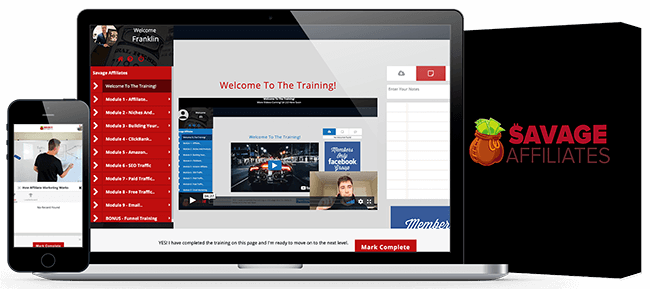
Savage Affiliates was created by internet marketer Franklin Hatchett. It's great for beginners and those that not only want to do affiliate marketing with a website but with email and funnel marketing as well.
It's a very diverse program with a lot of different ways to make money with affiliate marketing.

Franklin is an expert when it comes to funnels.
He's won a couple of the prestigious "2 Comma Club" awards from Clickfunnels for generating over $2 Million in sales.
If funnel marketing interests you, he's one of the best in the business.
What Will You Learn in Savage Affiliates?
If you have never built a website or blog before, no worries! You'll learn how to build one from scratch using WordPress.
Franklin is going to teach you how to turn a passion of yours into money by monetizing your website with affiliate links that produce passive income - even in your sleep.
While other courses only focus on either paid or SEO traffic, Savage Affiliates teaches you how to get traffic through SEO, free traffic methods, and paid traffic methods.
What’s Included in the Course?
Here are some highlights of just some of the things you'll learn:
- How to do niche & keyword research
- How to set up your website in WordPress from scratch
- In-depth training on email marketing including all of Franklin's email hacks
- How to setup funnels (and get free funnels in Savage Affiliates Super)
- Clickbank & Amazon affiliate training
- How to do SEO
- How to get free traffic
- A full module on Paid traffic (FB & Google ads)
It's suitable for beginners but covers many strategies to grow your business how you want.
Pros and Cons
Pros:
Cons:
Savage Affiliates Pricing
- The standard version ($197) includes niche research, website creation training, email marketing, funnel training, SEO, paid and free traffic training, and more.
- The Super version ($297) includes everything above and the Clickfunnels Affiliate Academy, done-for-you marketing funnels, blueprints on Launch Jacking & Web hosting.
With this low-cost, diverse training from a reputable coach with lots of success stories, you can't go wrong with Savage Affiliates.
Who Is Savage Affiliates For?
Savage Affiliates works for beginners who want a complete overview of affiliate marketing without committing to just one traffic method. It's also good for people who want to learn email marketing and sales funnels alongside traditional SEO strategies.
If you don't have a big budget for paid ads or expensive tools, Savage Affiliates teaches you plenty of free and low-cost strategies to get started. I think the $197-$297 price point is fair for what you're getting, especially compared to courses that cost $997 or more.
You can read my full Savage Affiliates review if you want more details, or click below to check out the course directly.
You can read my Savage Affiliates Review if you'd like to learn more or click below to jump to the main site.
2. Scale Your Travel Blog
Best for Travel Bloggers

Want to combine your passion for travel with blogging? Scale Your Travel Blog by Mike and Laura Peters is the best course for travel bloggers out there. Mike and Laura run multiple blogs in the travel space, and their main travel blog makes them over $30,000 a month.
I went through the entire course and was genuinely impressed. What makes this course different is how interactive it is. You don't just watch videos and hope for the best. You actually get things done for you if you choose the full coaching program.
For example, you submit your niche and their team gives you 25 targeted keywords you should go after. You send them your site URL and you get back a personalized video audit showing exactly what needs to be fixed. That level of hands-on support is rare in this space.
What Will You Learn in Scale Your Travel Blog?
The course covers 12 modules of training including how to pick the perfect niche, how to write blog posts that rank, how to set up WordPress from scratch, how to use SEO for valuable free traffic, what affiliate programs you need to promote, and how to set up email campaigns.
You also get access to an active Facebook group and bonus webinars. When you buy this course you're not just getting training. You're joining a community of people who want to see you succeed.
The course now includes a Pinterest traffic module which is a smart addition. Google traffic is harder than it used to be, so having a secondary traffic source baked into the strategy makes sense.
Scale Your Travel Blog Pricing
There are two options. The full coaching program includes the course itself, community access, in-person mastermind meetups, a personalized site audit, done-for-you keywords, done-for-you blog post outlines, blog post reviews, group coaching calls, traffic and income growth strategy calls, and more. This costs $2,997, or you can split it into 6 monthly payments of $500 or 12 payments of $257.
The second option is the course-only version. You get access to the same 12 modules, bonus lessons, templates, and the Facebook community, but without the personalized services and coaching calls. This costs $797, or 3 payments of $280.
If you don't need a lot of hand-holding, the course-only version at $797 gives you the same training for much less. But if you're starting from scratch and want to move fast, the done-for-you keyword research alone in the full program saves you weeks of guessing.
Pros and Cons
Pros:
- Personalized keyword research and site audits (full program only)
- Solid SEO training that's current for 2026
- Laura is an excellent teacher with real experience
- Active and supportive Facebook community
- Pinterest module adds valuable secondary traffic strategy
- 14-day money-back guarantee on both options
- Over 85 students have gotten into Mediavine (50K sessions minimum)
Cons:
- Expensive compared to most courses, especially the full program
- Examples and affiliate programs are travel-specific
- Some tool costs not mentioned upfront on sales page
Who Is Scale Your Travel Blog For?
This course is for anyone serious about building a travel blog that makes real money. It works for complete beginners who haven't started yet, intermediate bloggers with some traffic but no consistent income, and even advanced bloggers earning $5,000+ per month who want to scale further.
Despite the name, the strategies here apply to pretty much any niche. The SEO, affiliate marketing, and email marketing methods work for food blogs, lifestyle blogs, personal finance blogs and more. That said, you'll get the most out of it if travel is your actual niche since all the examples and recommended programs are travel-focused.
Check out my full Scale Your Travel Blog review for more details, or click below to see which option fits your situation.
3. E-Farming System
Best Affiliate Marketing Course for Email Marketing

The E-Farming System is an affiliate marketing course where you don't need a website, you don't need to worry about SEO or ranking in Google, and you don't have to spend money on Facebook or Google ads. For people looking to make money using affiliate marketing without creating a website, e-Farming might be the perfect fit.
Igor Kheifets built his entire affiliate business using email marketing, and he teaches the exact system he uses. E-Farming is essentially permission-based email marketing with a fresh name. You're building a list of subscribers who opted in to hear from you, then promoting affiliate products they're genuinely interested in.
How Does E-Farming Work?
The process is straightforward. You choose an offer in a niche you like. You create a landing page using a tool like Leadpages. You write an email sequence following Igor's training, and he provides scripts so you're not starting from scratch. You buy a solo ad to drive traffic to your landing page. Then you repeat the process for other offers.
Solo ads are where you pay someone who already has a large email list to send an email on your behalf pointing their subscribers to your landing page. The traffic is fast. You can have subscribers on your list within days of launching. The downside is that solo ad quality varies a lot between vendors, and you need to keep buying traffic to keep growing your list.
E-Farming System Pricing
The e-Farming System costs $197 as a one-time payment. You get a 30-day money-back guarantee. If you haven't built a list of at least 1,000 subscribers and haven't made your first commission within 30 days, you can request a full refund with no questions asked.
Beyond the course, you'll need an autoresponder like GetResponse which starts at around $15.58 per month. You'll also need budget for solo ads. Expect to spend at least a few hundred dollars on traffic for your first meaningful test before you see results.
Pros and Cons
Pros:
- No technical knowledge needed to get started
- No need to build a website or wait for Google rankings
- Money-back guarantee with clear success threshold
- Possible to get commissions the same day you launch your campaign
- Taught by Igor Kheifets, a well-known super affiliate
- Email copy scripts provided so you don't need to be a copywriter
- Responsive support from Igor's team
Cons:
- You need to keep buying solo ads to maintain and grow your list
- Solo ad quality is inconsistent and can burn through budget fast
- No free traffic component means ongoing ad spend is required
- Most money comes from follow-up sequences, not immediate sales
Who Is E-Farming For?
E-Farming is a strong fit for complete beginners who want to get into affiliate marketing without building a website or waiting months for organic traffic. If you have some budget to invest in paid traffic and want a structured system, this is a solid starting point.
It's also a good option for people who don't want to create content or put themselves on camera. Solo ads let you build an email business entirely behind the scenes.
E-Farming is not a great fit if you're expecting passive income with minimal upfront spend. You'll need to invest consistently in traffic, and results aren't fast or guaranteed. If you want a free traffic model, you'd be better served by an SEO-based course like Savage Affiliates.
Check out my full E-Farming review for more details, or visit the link below.
4. Commission Hero
Best Course for Affiliate Marketing Using Pay-Per-Click Ads

Commission Hero was created by Robby Blanchard, the #1 ranked affiliate on Clickbank. The course teaches you how to make money using Facebook ads with affiliate offers. If you don't want to build a website and wait for it to rank in Google, this course is for you.
Robby's approach is completely different from the courses above. With Commission Hero, you learn how to become an expert in Facebook ads. You drive targeted traffic to high-paying affiliate offers using paid advertising. You source products from Clickbank, create a compelling landing page, and run Facebook ads to that page to generate commissions.
No one else teaches this method better than Robby Blanchard. He became the #1 Clickbank affiliate by actually doing what he teaches, at a scale most people in this industry have never matched.
How Does Commission Hero Work?
The method comes down to four steps. First, you find a high-converting affiliate offer on Clickbank. These are digital products that pay commissions of 50% or higher per sale. Robby teaches you exactly what to look for when evaluating offers.
Second, you build a landing page using templates Robby provides. This page warms up visitors before they hit the actual offer. Third, you run paid ads on Facebook to drive traffic to that landing page. Fourth, when someone clicks through and buys, you earn a commission directly from Clickbank.
The key thing to understand is that not every campaign works right away. You'll need to test multiple ads and audiences before you find a winner. That testing phase costs money, and it's the part that catches most beginners off guard.
Commission Hero Pricing
The original Commission Hero course costs $997 as a one-time payment, or two payments of $597. If you take the payment plan, that works out to $197 more than paying upfront.
Robby now runs multiple offers beyond the original course. There's Hero+, an AI-powered upgrade with higher-ticket pricing revealed only inside webinar funnels. There's also a 1-on-1 coaching program sold by phone after you complete a questionnaire. And the Inner Circle at $297 per month gives you done-for-you offers, custom audiences, landing pages, and weekly coaching calls.
The course fee is just the beginning. You also need ClickFunnels 2.0 at $97 per month, a click tracking tool at around $27 per month, an autoresponder at around $29 per month, and a real budget for Facebook ad spend. Budget at least $2,500-$3,500 total to give this system a proper shot.
Pros and Cons
Pros:
- Taught by the #1 Clickbank affiliate with proven results
- Thorough training delivered in clear video format
- Done-for-you landing page templates and ad copy swipe files
- Active Facebook community with Robby participating personally
- Impressive documented student success stories
- No pressure to promote Commission Hero itself
Cons:
- Pricing for Hero+ and coaching is hidden behind webinar funnels
- Refund policy unclear since moving off Clickbank marketplace
- Facebook ad costs have increased significantly since 2019
- You're entirely dependent on one ad platform
- No organic traffic component means income stops when ads stop
- Upsell ecosystem can get expensive quickly
Who Is Commission Hero For?
Commission Hero is for people who want to build an affiliate business without writing blog posts, waiting for Google rankings, or building an audience from scratch. If you're comfortable with paid advertising and have a real budget for it, this course gives you a proven framework.
It's a good fit if you want speed. With a blog you might wait six to twelve months before you see your first meaningful commission. With Commission Hero you could have your first sale within days of launching a campaign, assuming you follow the training and set things up correctly.
Commission Hero is not for you if you're on a tight budget. The $997 course fee plus tools and ad spend adds up fast. It's also not for you if you want to build long-term brand equity. You're not building a website or creating content that compounds over time. The moment you stop running ads, the income stops.
Check out my full Commission Hero review for more details, or click below to watch Robby's free training webinar.
5. Making Sense of Affiliate Marketing
Best for Existing Bloggers with Traffic
Making Sense of Affiliate Marketing is a course created by Michelle Schroeder-Gardner, the blogger behind Making Sense of Cents. Michelle has earned over $5 million blogging in total, with more than $2 million of that coming directly from affiliate marketing. If you want a benchmark for what's possible with a blog, Michelle is a legitimate one.
This course teaches you how to make money through affiliate marketing with your blog. The key phrase here is "with your blog." This course assumes you already have a functioning blog set up with at least one post published. It does not teach you how to set up WordPress, pick a domain name, or choose a niche. That work needs to be done before you join.
What Will You Learn in Making Sense of Affiliate Marketing?
The course walks you through how to find affiliate programs to join, how to choose the right products for your niche, how to add affiliate links strategically without overdoing it, and how to drive conversions without feeling pushy or salesy.
Michelle also covers what not to do, which is valuable for beginners. She talks about mistakes like only writing positive reviews, making unrealistic income promises, and cluttering your site with too many calls to action. These are practical issues that a lot of new affiliate marketers get wrong.
The course includes worksheets, bonuses, a list of 80+ affiliate programs covering bloggers across all niches, and access to a private Facebook group. One module I appreciated is the section on legal compliance. Michelle walks you through FTC disclosure requirements, no-follow links, and what to do if you live in a Nexus state. This only applies to the United States, so if you're from another country you'll need to look into your own laws.
Making Sense of Affiliate Marketing Pricing
The course costs $197 as a one-time payment, or two payments of $105 per month. The payment plan only costs $13 more total, which is reasonable compared to most course creators who inflate payment plans significantly.
There is a 30-day refund guarantee, but you need to prove you went through the material and took action. I'm not sure how you prove that, but if you're requesting a refund I imagine you can come up with something.
Pros and Cons
Pros:
- Active and supportive Facebook community with 6,200+ members
- Step-by-step breakdown of affiliate marketing basics
- Teaches you to work smarter by focusing on high-traffic pages
- White-hat strategies only, no black-hat tactics
- Free lifetime updates included
- Pinterest bonus module with solid strategies
- Michelle is credible with real documented success
Cons:
- Very basic training that you could find free on YouTube
- Almost entirely text-based with hardly any video instruction
- Zero SEO training included, on-page or off-page
- Not suitable for complete beginners who don't have a blog yet
- Lacks detail on key topics like email list building
- Some hidden costs like Tailwind and Facebook ads not disclosed upfront
Who Is Making Sense of Affiliate Marketing For?
This course is for beginner to intermediate bloggers who already have a functioning blog with some traffic. If you're getting visitors but haven't figured out how to monetize them with affiliate marketing, this course can help.
It's not for aspiring bloggers who don't have a site set up yet. The course does not teach you how to build a blog, and it assumes you already have pages that are generating traffic. If you're starting from scratch, you'll need a more complete course first.
It's also not for people who want to make money with affiliate marketing through methods other than blogging. If you want to do paid advertising, email marketing, or YouTube, this course won't help you.
Check out my full Making Sense of Affiliate Marketing review for more details.
6. Wealthy Affiliate
Subscription-Based Platform (Including but not recommending)
Wealthy Affiliate is an affiliate marketing platform that teaches you how to make money online with a website. It focuses on building a site that ranks naturally in search engines, with some paid traffic strategies included as well. The course is likely the most popular affiliate marketing platform in the world, boasting 2.5-3 million members.
Wealthy Affiliate is also an affiliate program itself, and members are told quite frequently to promote the course as an affiliate. That recruitment push is one of the main issues with the platform.
The course was founded in 2005 by Kyle Loudoun and Carson Lim. When they started, it was simply a keyword list site for a monthly fee. It has since evolved into a full training platform with hosting, tools, and a large community.
What's Inside Wealthy Affiliate?
The platform includes five core training modules. The Online Entrepreneur Certification teaches you how to create an affiliate website in a niche that doesn't have to do with making money online. The Affiliate Bootcamp is a 7-phase, 70-lesson module dedicated entirely to helping you promote Wealthy Affiliate itself.
There are also live weekly webinars, a large community forum where members help each other, and tools including Site Rubix for building and hosting websites and Jaaxy for keyword research.
The Affiliate Bootcamp is the reason you see so many positive reviews of Wealthy Affiliate online. Members are heavily encouraged to promote the platform, which creates a self-serving cycle of biased reviews.
Wealthy Affiliate Pricing
At first glance, $49 per month for Premium doesn't sound terrible. But the Premium Plus+ plan now runs $99 per month or $995 per year. That went up significantly from what it used to cost.
Over two years of Premium, you're spending over $1,100. Over two years of Premium Plus+, you're spending nearly $2,000. And you're still paying. The subscription never stops as long as you're a member.
Compare that to courses like Savage Affiliates at $197-$297 one-time with lifetime updates. Wealthy Affiliate's subscription model makes it one of the more expensive options over time, despite appearing cheap on the surface.
Pros and Cons
Pros:
- Active community with millions of members
- Hosting and tools included in the subscription
- Live weekly webinars with up-to-date information
- Easy to get support when you have questions
Cons:
- Badly outdated training with content from 2013 still in modules
- SEO advice is dangerous (believes you can rank without backlinks)
- Heavy MLM-style push to recruit other members
- Subscription model costs more than one-time courses over time
- No refunds offered, only cancellation
- Course structure is disorganized and contradictory in places
- Misleading claims on sales page (promises you won't fail, etc.)
- If you cancel, you lose your hosting and your website
Why Wealthy Affiliate Is Still Around While Better Courses Closed
Affiliate Lab by Matt Diggity and The Authority Site System by Authority Hacker both closed to new students in 2024-2025. They cited Google's Helpful Content Update making the content-site model increasingly difficult to teach with confidence.
So why is Wealthy Affiliate still here? I think it's because WA was never really an SEO course. It was always a subscription platform with a community attached. Its revenue model doesn't depend on students ranking sites. It depends on students staying subscribed and recruiting other subscribers.
The irony is real. The courses that took SEO seriously enough to shut down when the landscape changed are gone. Wealthy Affiliate, which taught you to ignore backlinks and focus on writing articles, is still here charging you every month.
Who Is Wealthy Affiliate For?
Wealthy Affiliate could work for complete beginners who have no idea what affiliate marketing is and want to gain some basic knowledge. It's clearly built for beginners only. If you're an intermediate or experienced affiliate marketer, you'll learn nothing new here.
That said, I don't recommend Wealthy Affiliate even for beginners. The outdated content, poor SEO advice, and subscription trap model make it a bad investment in 2026. You're better off with a one-time course that teaches current strategies.
Check out my full Wealthy Affiliate review for a detailed breakdown of everything wrong with this platform.
The AI Alternative: A New Approach for 2026
Every course above was created between 2015 and 2020, before AI tools existed. They teach affiliate marketing assuming you're doing everything manually — writing content yourself, researching keywords by hand, building everything from scratch.
If you want a course built specifically for 2026 where AI handles the grunt work, I created The 2026 AI Business Blueprint to fill that gap.
Full transparency: This is my course. I'm positioning it separately rather than ranking it against the established courses above. Take this recommendation with appropriate skepticism since it's mine, but I've tried to be honest about what it covers and who it's for.
What Is The 2026 AI Business Blueprint?
The 2026 AI Business Blueprint is a text-based course teaching five AI-powered business models, with affiliate marketing as Module 1. It shows you how to use AI tools to compress the timeline between starting and earning your first dollar.
Module 1 covers AI-assisted affiliate marketing across three paths: building an affiliate blog, running a faceless YouTube channel, or promoting through TikTok Shop. Each path includes the exact AI tools to use, 50+ copy-paste prompts, and realistic timelines for when you can expect income.
The course is text-based, not video. I made that choice after spending $20,000+ on video courses and constantly scrubbing through timestamps. With text, you search, you find it, you're done.
What's Inside The Course?
Seven chapters covering why affiliate marketing works better in 2026, how to choose your path (blog/YouTube/TikTok Shop), niche and product research with AI, the blog path with WordPress and SEO, the YouTube path with faceless options, the TikTok Shop path with product validation, and email marketing plus traffic scaling.
You also get four other business models (Faceless YouTube, AI E-Commerce, AI Freelancing, Digital Products) and three bonuses: Faceless Social Media Starter Pack, AI Tools Stack Guide, and Anti-AI Detector Framework.
The 2026 AI Business Blueprint Pricing
$27 as a one-time payment. No upsells, no subscription. Instant access to all five modules and three bonuses.
Compare that to Savage Affiliates at $197-$297, Commission Hero at $997, or Scale Your Travel Blog at $797-$2,997. Budget is the main differentiator here.
Pros and Cons
Pros:
- AI-first approach with 50+ copy-paste prompts
- Text-based format (easy to search and reference)
- Covers 5 business models, not just affiliate marketing
- $27 one-time vs. $997+ for most courses
- No recurring fees or subscription
- Built by someone running an active affiliate site
Cons:
- No video training if you prefer watching
- No live coaching or community (coming in the future)
- Newer course with fewer student testimonials
- Not as deep on advanced SEO as Affiliate Lab was
- Self-directed only, no hand-holding (email support is provided)
Who Is The 2026 AI Business Blueprint For?
This course works for complete beginners who want to learn affiliate marketing with AI doing the grunt work. If you don't have $997 for Commission Hero or $797+ for Scale Your Travel Blog, this is a legitimate budget alternative.
It's also good for people who prefer reading to watching videos. Everything is searchable. You can copy-paste prompts directly without rewinding anything.
It's NOT for people who want live coaching, community support, or hand-holding. This is a self-directed course. It's also not for advanced affiliates already earning $5,000+ per month. The training is built for beginners and intermediate marketers.
Not sure? Download my free cheat sheet to preview all 5 models first.

Which Affiliate Marketing Course Is Right for You?
Picking the right course comes down to how you want to build your business and what situation you're starting from. The good news is that each course on this list serves a different approach, so matching yourself to the right one isn't complicated.
If You're a Complete Beginner and Want the Most Complete Training
Go with Savage Affiliates. It teaches you everything from scratch including how to build a WordPress site, how to do keyword research, how to get traffic through SEO and paid ads, and how to set up email marketing and sales funnels.
You're not locked into one method, which gives you flexibility to figure out what works best for your situation. At $197-$297 one-time, it's also one of the most affordable complete courses available.
If You're Building a Travel Blog Specifically
Go with Scale Your Travel Blog. The training is built for travel bloggers, the recommended affiliate programs are travel-focused, and the community is full of people in the same niche.
If you choose the full coaching program at $2,997, you get personalized keyword research, a custom site audit, and direct access to Laura for coaching calls. That level of support is rare. If you're more self-directed, the course-only option at $797 gives you the same training without the hands-on services.
If You Don't Want to Build a Website at All
Go with E-Farming. Igor teaches you how to build and monetize an email list using solo ads. No website required, no SEO to learn, no waiting months for Google to rank your content.
You'll need a budget for solo ads and an autoresponder, but if the idea of writing endless blog posts sounds exhausting, this is the cleanest alternative. The course costs $197 one-time and comes with a clear refund policy tied to hitting specific milestones.
If You Want to Focus on Paid Ads and Have the Budget for It
Go with Commission Hero. Robby Blanchard is the #1 Clickbank affiliate and he teaches you his exact Facebook ads system. This is not a beginner-friendly budget option. You need money for the course, tools, and a real ad testing budget on top of that.
But if you have the capital and want speed over waiting for organic traffic, this is the best paid ads course in the space. Just know that the total cost to get started properly is closer to $2,500-$3,500 when you factor everything in.
If You Already Have a Blog with Traffic
Go with Making Sense of Affiliate Marketing. Michelle's course is built for bloggers who already have a site up and running but haven't figured out how to monetize it with affiliate marketing. At $197, it's one of the cheaper options on this list.
The training is basic and mostly text-based, but if you just need a roadmap for adding affiliate income to an existing blog, it gets the job done.
If You're on a Tight Budget and Want AI to Do the Heavy Lifting
Go with The 2026 AI Business Blueprint. Full disclosure: this is my course, so take this recommendation with appropriate skepticism.
At $27, it's 1/4 the price of Savage Affiliates and 1/20 the price of Commission Hero. You get affiliate marketing training plus four other business models, 50+ copy-paste AI prompts, and three bonus packs.
The course assumes AI tools exist in 2026 and teaches you how to use them properly from day one. Research that used to take a full day now takes 30 minutes with the right prompts. Content that required hiring writers can be drafted in an hour. You're learning the AI-native approach, not trying to retrofit AI into a pre-2020 system.
The trade-off is there's no coaching, no community, and no video training. It's text-based and self-directed. If you need hand-holding or weekly check-ins, spend more and get Scale Your Travel Blog's coaching program. But if you're comfortable reading, executing independently, and using AI to remove most of the manual work, this is the most affordable path forward.
If Someone Recommends Wealthy Affiliate to You
Don't join. I gave it 2.5 out of 5 stars for a reason. The training is outdated, the SEO advice is borderline dangerous, and the subscription model means you'll pay more over two years than you would for lifetime access to Savage Affiliates.
The constant push to recruit other members gives it an MLM feel that's hard to ignore. There are better options at every price point on this list.
Final Thoughts: Pick One and Stick With It
I've been running drews-review.com since 2017 and I've been doing affiliate marketing since 2010. I've bought dozens of courses over the years, and the ones that made this list are the ones I genuinely believe will help you build a real business if you put the work in.
The landscape has changed. Google's algorithm updates forced some of the most respected courses in the space to shut down. The courses still standing are the ones that either adapted to the new reality or never relied entirely on traditional SEO in the first place.
Savage Affiliates and Scale Your Travel Blog teach current SEO strategies that still work. E-Farming and Commission Hero bypass Google entirely through email and paid ads. Making Sense is for people who already have traffic and just need to monetize it better.
Here's what I want you to understand. No course is going to make you rich overnight. Affiliate marketing is a real business model that can generate serious income, but it requires work. If you're not willing to put in at least 5-10 hours a week consistently for the first six months, don't buy any of these courses. You'll just waste your money.
But if you show up, follow the training, and stay consistent even when results are slow at first, affiliate marketing can genuinely change your financial situation. I've seen it happen for students in every one of these courses. The difference between people who succeed and people who quit almost always comes down to persistence, not intelligence or luck.
Pick the course that matches how you want to build your business. Get in, go through the training, and start applying what you learn immediately. Don't get stuck in endless learning mode. The money comes from execution, not from buying another course.
If you have questions about any of these courses or want help deciding which one fits your situation, leave a comment below. I read and respond to everyone.
Frequently Asked Questions
What is Affiliate Marketing?
Affiliate marketing is a way to make money online by promoting other people's products. You collect a commission when someone buys through your unique affiliate link. The steps are simple: select a niche you're familiar with or interested in, find a product in that niche with an affiliate program and get your affiliate link, promote your affiliate link on your blog, through email, Facebook, Google ads, or other channels, and when someone clicks your link and makes a purchase you get a commission.
Which affiliate marketing course is best for complete beginners?
Savage Affiliates is the best option for complete beginners. It teaches you everything from scratch including how to build a WordPress site, how to do keyword research, how to get traffic through multiple methods, and how to set up email marketing and funnels. At $197-$297 one-time, it's affordable and gives you the most complete training without locking you into a single strategy.
If budget is your main constraint, The 2026 AI Business Blueprint at $27 is the most affordable complete course on this list. Full disclosure: it's my course. It teaches affiliate marketing with AI handling most of the grunt work, but it's self-directed with no coaching or community. If you can afford Savage Affiliates at $197-$297, that's a more complete system with better support. But if $27 is what you have to work with, it's a legitimate starting point.
Do I need a website for affiliate marketing?
No, you don't need a website. E-Farming teaches you how to build an email list and promote affiliate offers without ever creating a blog. Commission Hero uses landing pages and Facebook ads instead of a full website. That said, most successful affiliate marketers eventually build a website because it gives you an asset that compounds over time with free organic traffic.
How long does it take to make money with affiliate marketing?
It depends on the method you choose. With paid ads like Commission Hero, you could make your first commission within days of launching a campaign if you have the budget to test properly. With SEO-based methods like Savage Affiliates or Scale Your Travel Blog, expect little to no income for the first three to six months while your content ranks in Google. Email marketing through E-Farming sits somewhere in the middle. Realistically, plan for six to twelve months before you see consistent meaningful income regardless of which method you pick.
Can you really make money with affiliate marketing?
Yes, affiliate marketing is a legitimate business model. Many affiliate marketers make five or six figures per month. Michelle Schroeder-Gardner has made over $5 million blogging with affiliate marketing as a major income source. Mike and Laura from Scale Your Travel Blog make over $30,000 per month. Robby Blanchard became the #1 Clickbank affiliate earning over $1 million per month. These are real results, but they're also outliers. Most people who succeed with affiliate marketing build up to a few thousand dollars per month over time, which is still life-changing income.
Is affiliate marketing easy?
No, affiliate marketing is not easy. If it was, everyone would be doing it. You need the right training, the right strategy, consistent effort, and patience when results are slow. That's why picking a quality course matters. The courses on this list give you proven frameworks to follow, which significantly increases your odds of success compared to figuring everything out on your own.
Why did Affiliate Lab and The Authority Site System close?
Both courses closed to new students in 2024-2025 after Google's algorithm updates made the traditional content-site model harder to teach with confidence. Matt Diggity and Authority Hacker both felt they could no longer guarantee the strategies they were teaching would produce consistent results in the current SEO landscape. That's why the courses that made this list are either adapted to the new reality or bypass Google entirely through email marketing and paid ads.
What's the difference between SEO courses and paid traffic courses?
SEO courses like Savage Affiliates and Scale Your Travel Blog teach you how to get free organic traffic from Google by ranking content in search results. This takes longer to see results but builds an asset that compounds over time. Paid traffic courses like Commission Hero teach you how to buy traffic through Facebook ads to generate immediate results. Paid traffic is faster but requires ongoing ad spend, and the income stops when you stop running ads. Email marketing courses like E-Farming use paid solo ads to build a list, then monetize that list over time.
Is Wealthy Affiliate worth it in 2026?
No, I don't recommend Wealthy Affiliate. I gave it 2.5 out of 5 stars. The training is outdated with content from 2013 still in the modules, the SEO advice is poor, and the subscription model costs more over time than one-time courses like Savage Affiliates. The heavy push to recruit other members gives it an MLM feel. You're better off with any of the top five courses on this list.
How much should I budget for affiliate marketing?
It depends on the course and method. For SEO-based courses like Savage Affiliates or Scale Your Travel Blog, budget $500-$1,500 for the course, hosting, domain, and tools to get started properly. For email marketing with E-Farming, budget $1,000-$1,500 including the course and several months of solo ads and autoresponder costs. For paid ads with Commission Hero, budget $2,500-$3,500 minimum including the course, tools, and ad testing budget. The investment varies significantly based on the strategy you choose.
For the most budget-conscious option, The 2026 AI Business Blueprint costs $27 total with no additional tools required to get started beyond free AI tools like ChatGPT. You can add hosting and a domain later if you choose the blog path, but the course itself plus free AI tools is enough to begin. Full disclosure: this is my course.
Can I do affiliate marketing part-time?
Yes, affiliate marketing works well as a part-time business. Most people start while working a full-time job and transition to affiliate marketing once the income is consistent enough to replace their salary. You'll need at least 5-10 hours per week to make meaningful progress, but you can work whenever your schedule allows. The flexibility is one of the main appeals of this business model.
What are the best affiliate networks to join?
The best network depends on your niche. For digital products and online courses, ClickBank and JVZoo are solid options. For physical products, Amazon Associates is the most common but has low commission rates. For travel bloggers, programs like Booking.com, Skyscanner, and travel insurance companies convert well. The courses on this list teach you which networks make sense for your specific situation and how to get accepted into programs.

- Dropship Breakthru Review: Price, Guarantees, Fine Print - October 11, 2026
- Best Outdoor Equipment Fulfillment Companies for DTC Brands - October 8, 2026
- Why Your Site Needs an Automated Price Calculator - October 7, 2026

Hi Drew,
If you had to pick between TASS or Affiliate Lab without looking at the price which one would you go to? Which one do you feel is the best without the price variable?
For myself, I’d go with Affiliate Lab only because I don’t need the website building walkthrough that TASS does. You can’t go wrong with either, it just comes down to preference.
Hey Drew,
Thank you for the thorough article!
I would love to hear your insights on Wealthy Affiliates if you have any…
thanks!
Hi Eranit, I am not a fan of Wealthy Affiliate which is why it’s not on this list. You can check out my Wealthy Affiliate review to see why.
Hello Drew,
Is the SEO taught in these courses only for Google or do they teach for other search engines like Bing?
Considering the threat from ChatGPT, do you think affiliate marketing through Google has bright prospects in future?
Hi Stanley, good question. SEO is SEO so if you get it right you’ll rank in Google and other search engines. ChatGPT is just another tool affiliate marketers can use. It still needs user interaction to get it right, so I don’t ever see it being a threat.
Hi Drew,
I am a complete beginner with nil SEO or blogging knowlege. After going through the reviews of the best affiliate marketing courses I find that each course has its limitations. For instance, Affiliate Lab focuses less on content creation, TASS does not cover grey hat SEO etc.,
Which begs the question:
Is one course enough for a beginner or should a beginner take two or three courses so that all concepts are covered?
Hi Xavier, great question. Definitely one course is all you need. This changes if you want to do affiliate marketing in a different way. For example, TASS & Affiliate Lab focus on building websites that get free organic traffic, 301K focuses on Solo ads and email lists, Commission Hero focuses on Facebook ads. Whichever type of affiliate marketing you want to get into, any one of these courses will cover everything. I think buying both TASS and Affiliate Lab would be overkill because even though they have subtle differences, both are going to prepare you very well to get an authority site up and running. Hope that helps!
Hi Drew,
Thanks for this review and advise. All very helpfull for me. I would like to know if the courses you recommend for people intereste in making money in affiliate marketing also apply to people living outside US lile me in Portugal (EU Country). Will the courses be usefull to my location reality and the niches here? For example amazon here as a site for every country….so to link to them is a not just link amazon.com..
Thanks for your insights.
Artur
Hi Artur,
Yes, it doesn’t matter where you are in the world, you can take any of these courses to learn affiliate marketing. If your site is in English, you’ll be targeting all English speaking countries and also those that search for products and services in English where English is not the official language. Niches are universal for the most part so they work everywhere. If you are going to use Amazon links, you can set up what is called an Amazon International link. You can get more info about this on the Amazon Associates page. Hope that helps!
Hi Drew,
Which mode is good for a newbie ? Affiliate marketing through website OR email marketing? Which of these can make more money? Can a newbie learn both the courses ie., TASS & 301K challenge and adopt both modes?
Hi Joseph, newbies can do either one. It’s more of a preference really. I prefer setting up a website because when it ranks it’s much more passive than email marketing strategy in 301K which you constantly have to tweak and throw money at solo ads. Keep in mind with a website you can also do email marketing using the inbound traffic which you don’t have to pay for. If you’re interested in both, you’ll only need TASS.
Hi Drew,
May i check Igor Kheifets 301K Challenge & his 30-Day E-Farming Challenge same course? Both are price $197.
Read the pointers for both courses in Igor’s page. Saw some overlaps. Hence puzzled which to purchase as a beginner. Advise please, thank you
Hi Sinah, The 301k and the E-farming challenge are basically the same courses but with different framing, both are for beginners to help them start their affiliate business and make their first sale.