Hey, Drew here. One of the most common questions I get from people just getting into dropshipping is some version of "how do I know what to sell?" It's the right question to obsess over — pick the wrong product and no amount of marketing saves you. Pick the right one at the right time and even a scrappy store with mediocre ads can turn a profit.
I've been doing ecommerce product research since 2010, and the core skill hasn't changed: you're looking for momentum before it peaks. What has changed is where you look, which tools actually work in 2026, and which product categories are generating real sales right now. I'll cover both — the hottest categories you can start testing today, and the methods I'd use to find the next wave before everyone else does.
Key Takeaways
- The best trending product categories in 2026 are health and wellness, pet supplies, home fitness, smart home, eco-friendly products, phone accessories, beauty tools, and home organization
- A trending product isn't just popular — it's gaining momentum fast enough that you can still get in ahead of peak saturation
- Google Trends, TikTok Creative Center, Exploding Topics, and Amazon Movers & Shakers are the free tools that give you the earliest signals
- Tools like Sell The Trend automate most of the research and cut your discovery time down dramatically
- Always validate across multiple platforms before committing ad spend — a spike in one place can be a fluke; a spike in three places is a signal
What Makes a Product Worth Selling in 2026?
A trending product isn't just something that's popular today — it's a product gaining momentum fast enough that real profit is still available to you.
Think of it like catching a wave. You don't want to paddle out after it's already crashing — you want to catch it while it's still building. The surfers who made money on fidget spinners got in during early 2017, not six months later when every dollar store in the country was selling them.
Here's what a wave worth catching looks like: search volume is rising consistently on Google or TikTok, people are talking about it organically on Reddit and in Facebook groups, influencers are promoting it or using it in content without being paid to, competitors haven't saturated it yet, and most importantly — it solves a real problem. Convenience, comfort, health, or a genuine pain point people experience regularly. Products that check all five of those boxes before the mainstream notices them are where the real profit sits.
One more thing I want to get out of the way before we get into the categories. Just because you like a product doesn't mean it will sell. I don't care how convinced you are. If your target audience doesn't want it, it won't move no matter how much ad spend you throw at it. Product research is about what other people want to buy — not what you find interesting.
Trending Product Categories for 2026
Health, Wellness, and Recovery
This is the single strongest category in dropshipping right now, and it's been building for several years with no sign of slowing down.
The shift started during the pandemic when people began prioritizing their health more seriously, and it's evolved into a full lifestyle movement. What makes this category exceptional for dropshippers is the combination of high perceived value, strong margins (typically 3x–5x on cost), and the fact that many products in this space are consumables or lead to repeat purchases.
The specific products winning right now include massage guns and percussion therapy devices, red light therapy panels, posture correctors, acupressure mats, sleep aid accessories like weighted eye masks and white noise machines, and blue-light blocking glasses. Recovery-focused products are especially strong — foam rollers, resistance bands, and mobility tools are all seeing sustained demand growth rather than viral spikes, which means they're safer bets for building a store around rather than chasing a fad.
The key to this niche is positioning. You're not selling a massage gun — you're selling faster recovery after a workout, better sleep, less desk pain. Lead with the outcome in your ad copy and you'll convert far better than competitors leading with product specs.
Pet Supplies
Pet owners are some of the most loyal and emotionally driven buyers in ecommerce, and the "pet humanization" trend — treating pets like family members — has pushed this category into sustained high-growth territory.
The global pet care market has surpassed $147 billion and accessories are growing faster than food. What makes pet products particularly good for dropshipping is the combination of repeat purchases, strong TikTok and Instagram performance (pet content goes viral constantly), and the fact that buyers aren't particularly price-sensitive when they believe they're improving their pet's life.
The specific products performing best right now are cat water fountains with filtration systems (the replacement filters create built-in recurring revenue), dog cooling mats, lick mats and slow feeders, paw cleaners, GPS tracking collars, self-grooming brushes, and adjustable harnesses. Smart pet tech is an emerging sub-niche worth watching — pet cameras, health-monitoring litter, and activity trackers for dogs are all gaining traction and have strong demo potential on video platforms.
Dog products dominate volume, but cat products are worth paying attention to specifically because cat owners are underserved by most dropshipping stores, which means lower competition and cleaner positioning.
Home Fitness Equipment
Home workouts are not a pandemic trend that faded — they've become a permanent fixture of how people approach exercise, and the product demand has followed.
The reason home fitness products keep selling is practical: gym commutes take time, memberships are expensive, and people want flexibility. That shift in behavior has created a durable market for compact, space-efficient equipment that fits real homes rather than commercial gym floors.
The strongest products in this category right now are resistance bands (high margin, low shipping cost, enormous variety of use cases), pull-up bars, adjustable dumbbells, ab rollers, jump ropes, and yoga accessories. Biohacking and recovery products specifically — cold plunge accessories, infrared sauna blankets, breathwork tools — are a faster-growing sub-niche with less competition than mainstream fitness gear.
Lightweight products are your best friend here from a logistics standpoint. A resistance band set costs almost nothing to ship and carries a 4x–5x markup with ease. Compare that to something like a squat rack and the operational simplicity difference is obvious.
Smart Home Devices
Smart home adoption has crossed from early adopter territory into mainstream consumer behavior, and the product range that falls under this category gives dropshippers a lot to work with at multiple price points.
Smart bulbs, plugs, and switches are high-volume, low-cost entry points — people buy multiple units and the purchase is easy to justify. Smart security cameras, video doorbells, and motion sensors sit in a higher-ticket range with strong conversion potential because security is an emotionally driven purchase. Voice assistant accessories, smart displays, and energy monitoring devices round out a category that's being replenished constantly by new tech releases creating new accessory sub-niches.
The angle that's working particularly well for ads in this space is the energy-saving positioning. With utility costs up, a smart plug that reduces phantom power draw is an easy sell — the ROI practically writes the ad copy itself.
Eco-Friendly and Sustainable Products
Conscious consumerism has moved well past trend status — buyers are actively seeking out sustainable alternatives and willing to pay a meaningful premium for them.
What makes this category interesting for dropshippers is the margin structure. Customers purchasing eco-friendly products typically have higher disposable income and view purchases as value-aligned decisions rather than pure price comparisons. Markups of 3.5x–5x are realistic on the right products, with average order values running $45–$70.
The best-performing specific products right now include bamboo kitchen utensil sets, reusable silicone food storage bags, compostable cleaning sponges, beeswax food wraps, stainless steel safety razors, and natural fiber dish brushes. The consumable products in this list — the sponges, wraps, and bags — create repeat purchase behavior, which is where your real lifetime customer value comes from.
Phone Accessories
Phone accessories are one of the fastest-moving dropshipping categories in 2026, and the introduction of MagSafe technology and foldable phones has opened up new sub-niches with minimal established competition.
The strength of this category is the constant product refresh cycle. Every new phone generation creates new accessory demand, and the window before major brands flood the market is where dropshippers can move fast. MagSafe-compatible cases and wallets, magnetic car mounts, foldable phone screen protectors, card-style portable chargers, and Type-C hubs are all strong performers right now.
Phone accessories ship cheaply, photograph well, and perform naturally on short-form video. They're also impulse buys at the right price point — a $15–$30 MagSafe wallet is an easy add-to-cart for someone who just got a new iPhone.
Beauty and Skincare Tools
Beauty tools — as opposed to consumable skincare products, which carry regulatory complexity — are an excellent dropshipping category because they combine high perceived value with strong video demo potential.
The products winning right now are facial rollers and gua sha tools, LED face masks, microcurrent devices, silicone facial cleansing brushes, and at-home microneedling accessories. The "spa experience at home" positioning is the through-line for this category — buyers are replacing expensive treatments with tools they can use daily, and the emotional hook in video ads is very easy to demonstrate visually.
Margins in beauty tools run high, typically 60–70% gross on the right products. The main thing to manage is supplier quality — beauty tools that malfunction or cause skin irritation generate returns and negative reviews fast, so ordering samples before you scale is non-negotiable here.
Home Organization and Storage
This is the quintessential "TikTok made me buy it" category — products that look satisfying in video, solve a real daily annoyance, and are cheap enough that the purchase decision is nearly frictionless.
Closet organizers, under-sink storage solutions, cable management systems, fridge organizers, drawer dividers, and wall-mounted storage racks are all consistent performers. The category has no seasonal dependency and no real trend risk — clutter is a permanent problem for a permanent market.
What makes home organization products particularly good for newer dropshippers is that they're forgiving on margins, easy to find through standard supplier channels, and have a simple content playbook: show the before, show the after, let the product sell itself. TikTok and Instagram Reels are the natural channels here.
How to Find Trending Products Yourself: 16 Methods
What to Understand Before You Start
Before we get into the tools, one thing needs to be clear. Finding a product you personally think is cool is not product research. Real product research is about finding products that have demonstrated demand signals from real buyers — not your gut feeling. If a product checks out on data but doesn't excite you personally, that's still worth testing.
Method 1: Google Trends
Google Trends is the best free tool for validating whether a product's interest is growing, peaking, or dying — but it works best when you already have a product in mind.
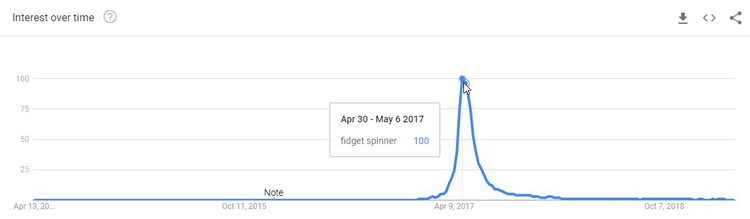
Go to trends.google.com and enter the product name. What you want to see is a chart moving steadily upward over the past 6–12 months. A sharp vertical spike followed by a drop is a fad that's already over.
A smooth consistent climb is a trend with room left to run. The fidget spinner example is textbook — peak interest in April 2017, dead six months later. If you'd seen that chart climbing in early 2017 you could have made real money. If you found it in July 2017, you were already late.
You can also use the "trending searches" feature to discover products you weren't already looking for. Browse through what's gaining traction by category and see if anything jumps out.
Method 2: Exploding Topics
Exploding Topics is one of the most underrated free tools available, and unlike Google Trends it brings topics to you rather than requiring you to already know what to search.
Go to explodingtopics.com, browse by category, and filter by growth rate. You're specifically looking for products with consistent upward growth over 6–12 months rather than sudden spikes. The sweet spot is finding something in the "regular" or "peaked" early phase — before it hits mainstream search volume but after it's demonstrated real traction. The Pro version at $39/month unlocks earlier trend alerts and more detailed data, which is worth it if product research is a core part of your business.
Method 3: Sell The Trend
Sell The Trend is the tool I'd point anyone to who wants to cut their product research time down by 80% — I'm a real member and it's the most comprehensive product research platform I've used.
It tracks what's trending simultaneously across AliExpress, Amazon, and Shopify stores, which gives you a cross-platform demand signal that's far more reliable than any single source. The NEXUS explorer shows you products gaining momentum before they saturate, the store explorer lets you spy on what top-performing Shopify stores are selling, and you get notifications when new products are added to competitor stores. There's a free 7-day trial so you can test it before paying. I've written a full Sell The Trend review if you want to see inside the members area before signing up.
Method 4: Amazon Movers & Shakers
Amazon Movers & Shakers is completely free, updates every hour, and almost nobody in the dropshipping space talks about it — which makes it valuable.
Navigate to amazon.com/gp/movers-and-shakers and browse by the product category relevant to your niche. You're looking for products that have jumped dramatically in sales rank within a 24-hour window — 500% or more is a strong signal that something is driving momentum, whether it's a viral TikTok video, a news mention, or genuine word of mouth. Cross-reference anything interesting with Google Trends and TikTok to confirm the momentum is real before acting on it. Make it a habit to check this a few times a week and you'll start spotting patterns your competitors miss.
Method 5: TikTok Creative Center
TikTok isn't just where trends go to get discovered — it's where they're born, and the Creative Center gives you direct access to what's gaining traction in real time.
Go to TikTok Creative Center, click on Trends, and look at which products and hashtags are accelerating. If you see one product generating multiple viral videos from different creators independently — especially unpaid UGC content — that's a genuine consumer excitement signal. The window between TikTok virality and AliExpress saturation can be as short as two to three weeks, so speed matters here. Use this tool for early signals and validate elsewhere before spending on ads.
Method 6: Reddit
Reddit surfaces products weeks or months before they hit mainstream platforms, and because the recommendations are organic — people sharing things they're genuinely excited about — the demand signals are unusually reliable.
The subreddits worth bookmarking are r/shutupandtakemymoney for impulse-buy products, r/BuyItForLife for durable evergreen items, and whatever niche-specific subreddits align with your store category. Sort by "Hot" or "Top" within the last month and look for product posts with high upvotes and engaged comments. The strongest buying signal on Reddit is comments asking "where can I get this?" — that's unsatisfied demand you can step into immediately.
Method 7: AliExpress Best Sellers
AliExpress is the most accessible starting point for most dropshippers, and the best sellers list does a lot of the initial research for you.
Browse the best sellers by category to see what's actually moving volume. A product selling thousands of units on AliExpress already has proven demand — your job is to present it better than the competition, find a domestic supplier for faster shipping, or target a more specific audience than the generic listings do. Keep in mind that heavy AliExpress best-seller status can also mean the product is already in a lot of Shopify stores, so validate competition before committing.
Method 8: SaleHoo Directory
SaleHoo pulls real sales data from eBay, Amazon, and AliExpress to surface top-selling products and pairs each one with a vetted supplier list — which is a genuinely useful combination for beginners.
At $67 for a full year of access it's the most affordable paid research tool on this list. The fact that it combines product discovery with supplier vetting in one place saves you a step that most other tools leave to you. Worth the investment if you're just starting out and want a structured way to find both products and reliable suppliers simultaneously.
Method 9: Influencer Monitoring
When multiple influencers in the same niche start posting the same product independently, that's one of the strongest early-trend signals available — and you don't need a paid tool to spot it.
Focus on mid-tier influencers in the 20,000–100,000 follower range rather than the mega-names. These creators are more likely to be posting about products they genuinely use rather than running paid campaigns, which makes the signal more authentic. Search relevant hashtags on Instagram and TikTok, follow ten to fifteen niche creators, and watch for product overlap. When you see the same item appear across three or four accounts in a short period, that's worth investigating.
Method 10: Trend Research Blogs and Publications
Sites like Trend Watching, Springwise, and Cool Material publish ongoing research into emerging consumer behavior that gives you a macro view of where markets are heading.
These aren't product lists — they're consumer insight reports. You won't find "sell this specific item" guidance here. What you will find are signals about emerging behaviors and lifestyle shifts that you can then translate into specific products through your own research. Think of this as strategic intelligence rather than tactical product discovery.
Method 11: Pinterest and Instagram
Visual social platforms are product discovery engines, and the engagement signals they surface are some of the most direct buying intent indicators you can find for free.
On Instagram, look at the likes and comments on product-related posts in your niche. High engagement on a product post — especially comments asking where to buy — is a strong commercial signal. Pinterest is particularly good for home, beauty, fashion, and lifestyle categories where discovery is visually driven. Save anything with strong engagement and cross-reference across other platforms before testing it.
Method 12: BuzzSumo
BuzzSumo shows you what content is performing best across social platforms, which gives you an indirect but useful window into what products and topics are generating genuine consumer interest.
At $79/month it's the most expensive free-standing tool on this list and is better suited to serious marketers who want deep niche research rather than occasional product discovery. The free trial gives you enough searches to evaluate whether the data is useful for your specific niche before committing. The influencer discovery feature is a genuine bonus — you can find niche creators to reach out to within the same tool.
Method 13: Dropship.io and Commerce Inspector
These two tools let you spy directly on what other Shopify stores are selling and how well it's working — which removes a lot of the guesswork from product research.
Commerce Inspector has a free browser plugin that shows you a store's top products, traffic sources, and apps. The paid version adds revenue data and weekly bestseller lists. Dropship.io is the more modern option, built specifically for competitive store research with estimated revenue data, recent product additions, and traffic analysis. At $29/month for Dropship.io it's worth running alongside a tool like Sell The Trend for maximum coverage. The old MYIP.MS trick for finding Shopify stores no longer works — Shopify moved to distributed hosting and that IP lookup method is dead.
Method 14: Consumer Marketplaces
Amazon, eBay, Etsy, and AliExpress all have trending or best-seller pages that give you direct data on what consumers are actually buying right now.
Each platform has a different buyer demographic, which makes browsing all four more useful than sticking to one. Amazon skews toward higher-intent buyers. Etsy surfaces craft and lifestyle products with strong repeat purchase behavior. eBay's WatchCount.com tool shows real-time popularity based on how many people have added an item to their watch list — a genuine demand signal that most people overlook. Scan all four regularly and note what appears across multiple platforms simultaneously.
Method 15: Review Blogs and Gear Sites
Sites like Wirecutter, Gear Patrol, and Top Ten Reviews do extensive product testing in specific niches — what they're featuring and reviewing is a proxy for what consumers are actively searching for.
Find the review blogs that cover your specific niche rather than relying on general sites. A photography niche blogger covering a specific type of camera accessory is more useful signal than a generic top-ten list. These sites invest in finding and testing new products, so they often surface items before they hit mass-market awareness.
Method 16: Trend Publications
Springwise, Trend Watching, and Cool Material publish research on emerging consumer trends that gives you directional intelligence you can't get from product-level research tools.
Use these alongside the product discovery tools rather than instead of them. They help you understand why a category is growing, not just that it is — and that context makes your product positioning, ad copy, and targeting dramatically better.
How to Tell If a Trend Is Worth Chasing
Not every trending product is worth your time — some go viral and die before you can even launch an ad campaign.
The first check is Google Trends or Exploding Topics. You want a chart showing steady upward momentum over six to twelve months, not a vertical spike and crash. A smooth climb means the trend has room left to run. A spike-and-drop means the wave already crashed. This one filter alone will save you from most bad product decisions.
The second check is competition. Search AliExpress, Amazon, and TikTok Shop and count how many sellers are offering the same product. If you find hundreds of identical listings, you're late unless you have a differentiated angle — better materials, a unique bundle, a more specific target audience. Use Dropship.io or Commerce Inspector to see how many Shopify stores are already selling it.
The third check is margin. Add up your product cost, shipping, platform fees, and realistic ad spend. If you can't clear at least 30–40% net margin after all of that, the product isn't worth building a campaign around regardless of how good the trend looks. A viral product with bad margins will keep you busy while losing money.
The fourth check is social proof. Search the product on TikTok and Instagram and look at what real buyers are saying in comments. "I need this" and "where can I buy it?" are buying signals. "This broke after a week" and "complete waste of money" are reasons to keep looking. Genuine consumer excitement in comments is one of the most reliable indicators of a product worth testing.
If it passes all four checks, start small. Run $50–$100 in ads and watch your CPM, CTR, and add-to-cart rate before scaling. The goal at this stage is signal, not revenue. If the signal is good, scale. If it isn't, move on without having lost much.
You Might Also Find This Useful
- Sell The Trend Review — my full inside look at the product research tool I use myself
- Best Dropshipping Courses — the training that will teach you how to actually build a store around the products you find
- Is Dropshipping Dead? — a straight answer on whether the model still works in 2026
Want to Skip the Dropshipping Learning Curve Entirely?
If finding trending products sounds like the right model but you want a faster path to income that doesn't depend on ad spend and supplier relationships, my 2026 AI Business Blueprint covers five AI-powered income models — including an AI-assisted ecommerce approach that compresses product research, store setup, and marketing into a fraction of the traditional timeline. It's $47 one-time. You can grab the free starter guide here if you want a preview first.

Frequently Asked Questions
What are the best products to dropship in 2026?
The strongest categories right now are health and wellness tools, pet supplies, home fitness equipment, smart home devices, eco-friendly products, phone accessories, beauty tools, and home organization products. Within each category, the best specific products solve a real problem, ship cheaply, and have strong visual appeal for social media advertising.
How do I know if a trending product is a fad or a long-term winner?
Check Google Trends over a 12-month window. A steady upward climb indicates a sustainable trend. A sharp spike and drop indicates a fad. Also look at whether the product solves a recurring problem — products that address ongoing pain points outlast novelty items every time.
What is the best free tool for finding trending products?
Google Trends, TikTok Creative Center, Amazon Movers & Shakers, and Reddit are all free and genuinely useful. Google Trends validates products you've already identified. TikTok Creative Center surfaces new trends early. Amazon Movers & Shakers shows real-time sales momentum. Reddit surfaces organic consumer excitement before it hits mainstream platforms.
Are trending products too competitive to dropship?
Not always — the key is catching the trend early enough that saturation hasn't set in yet. Tools like Exploding Topics and Sell The Trend help you find products in the momentum-building phase before they're in every second Shopify store. If you do find a product that's already competitive, a differentiated angle — better targeting, unique bundles, faster shipping — can still make it viable.
How many products should I test before finding a winner?
There's no fixed number, but most experienced dropshippers test five to fifteen products before finding a consistent winner. The key is testing efficiently — small ad budgets, clear success metrics, and a willingness to cut products that don't show early signals quickly. The goal is to find a winner and scale it, not to fall in love with any single product.
Do I need paid tools for product research?
No — Google Trends, TikTok Creative Center, Amazon Movers & Shakers, and Reddit are all free and provide real signal. That said, paid tools like Sell The Trend and Exploding Topics Pro compress the research process significantly and surface opportunities earlier. If product research is central to your business, the investment pays for itself quickly.
What profit margin should I aim for in dropshipping?
Aim for at least 30–40% net margin after all costs — product, shipping, platform fees, and ad spend. Gross margins need to be higher than this to account for returns, chargebacks, and ad testing losses that most beginners underestimate. Products with 50%+ gross margins give you the most room to run profitable campaigns.
Related Posts

- Top West Coast Fulfillment Companies for Ecommerce Brands in 2026 - October 19, 2026
- Digital Entrepreneurs Are Discovering That Physical Operational Infrastructure Accelerates Digital Scale - October 18, 2026
- Fast-growing E-commerce Sellers Are Overhauling Fulfillment Hubs To Keep Up With Orders - October 16, 2026

Great article to blow up my mind, currently I enrolled in an online course though that was not recommended by you, haha, but anyway a good start point for me to accelerate my study. thanks again and appreciate your detailed shared knowledge.
No problem Yi, main thing is that you apply the training (whatever it is and hopefully legit) and never give up!
Great article, I really learned something new and useful from this!
Thanks Drew!
Glad you got something out of it Mihai!
Thanks a lot, Drew! This is very insightful.
One question – if I find what I think is a great product (using any of these strategies, but say, looking up on top selling products of other stores, or likable product pictures on Instagram, etc., and discover that this product is not on AliExpress. Then what? I don’t mean the products that other stores clearly produce themselves, but just general products. Are most of them on AliExpress, or arethere any other ways to find the realiable suppliers for them?
Thank you,
Anzh (or I also signed as “An” here before by mistake)
Pretty much anything that is selling I am sure its on Aliexpress already. If it’s not, it probably will be very soon. I never really had trouble finding anything. You could use a tool like Salehoo to find other products or suppliers so that is an option but it’s a paid tool so keep that in mind but you can always get a $1 trial to check it out. Learn more about it here – https://drews-review.com/salehoo/
Hope that helps!
Wonderful. Thank you very much.
Have a great day Drew!
You’re welcome!
Great resources Drew! Thanks again for the useful content you provide
Thanks Julie!
I’d been thinking about the drop shipping business for the past 3 weeks. I saw several youtube videos that got my interest but it was not until I found your Drew’s Review webpage and found your Cheat Sheet that I decided to take the leap. Thank you for all the valuable info and the step by step explanations. I’m now headed to read your reviews of the Marketing Courses.
Awesome stuff! I’m glad I’m able to help out. Feel free to ask any questions if something isn’t clear. All the best!
Like always very great and useful content, thanks so much <3
You’re welcome Audrey glad you got something out of it 🙂
Many thanks drew for all the very useful information.
This makes me a focused beginner with a goal to win
You are a motivator and have made me purpose to do whatever it takes to get to the next level
I am encouraged that if others have done it, i can also do it
I do not have a website yet and hope to get you again to teach me how that can be done.
You’re welcome Irene and thank you as well for the positive comments! What I suggest is to grab my ecom cheat sheet, it’s a free download. It will help you get started with eCom and prepare you for what’s ahead. If you just answer the questions on the bot assistant on the site, (bottom right hand corner) you’ll be directed to it – just choose Ecommmerce/dropshipping.